
June 18, 2026
Permian natural gas prices negative: what the market is really signalling
Extreme commodity prices often look like a verdict on supply and demand. In reality, they can be a verdict on infrastructure. When readers see headlines that Permian natural gas prices negative, the instinct is to assume gas has somehow lost its value. That is not what is happening. A negative cash price in West Texas is better understood as a congestion signal inside a physically constrained network.
In this case, the problem is highly regional. The Permian Basin produces so much gas alongside oil that pipelines cannot always move every molecule to Gulf Coast demand centres, LNG export terminals, industrial facilities, or power markets. When transport options fill up, the local clearing price can collapse below zero even while US benchmark gas remains positive and overseas gas prices stay far higher.
Negative Waha gas prices do not mean natural gas is worthless everywhere. They mean supply is trapped in a specific producing region, and sellers may have to pay counterparties to remove gas when takeaway capacity is insufficient.
That distinction matters for investors, industrial users, policymakers, and households. Furthermore, the same dislocation that hurts some producers can lower feedstock costs for chemicals, support US manufacturing competitiveness, and soften inflation pressure in parts of the economy.
When big ASX news breaks, our subscribers know first
What negative Waha gas prices actually mean
Waha is the main pricing hub for Permian gas. It is a regional physical market marker, not the national reference price for all US natural gas. The US benchmark remains Henry Hub, which reflects conditions in a much broader Gulf Coast-linked market.
When Permian natural gas prices negative at Waha, the mechanism usually works like this:
- Oil-focused drilling keeps producing associated gas
- Pipeline space out of the basin becomes scarce
- Local sellers compete to move excess gas
- Buyers with available transport or consumption capacity gain leverage
- The cash price falls below zero because disposal is cheaper than shutting in oil production or violating operational constraints
For many Permian operators, gas is not the main revenue driver. It is produced with crude, so the decision to keep wells flowing is often tied more closely to oil economics than gas realisations. That is why subzero gas pricing can coexist with continued production.
Recent market reporting from Natural Gas Intelligence also highlighted how quickly local prices can rebound from extreme lows when conditions briefly improve. However, temporary recoveries do not remove the structural bottleneck.
Why Permian gas can crash while global gas rises
The puzzle is simple on the surface: how can West Texas gas go negative while Europe and Asia face expensive fuel? The answer is that regional oversupply and global scarcity can exist at the same time.
The Permian is dominated by associated gas. When oil drilling remains attractive, gas volumes keep coming regardless of whether local gas prices are healthy. Unlike a dry gas basin, producers cannot always reduce gas output without also cutting oil production.
At the same time, international gas markets are shaped by LNG shipping, import terminal capacity, geopolitics, storage levels, and competition among buyers. Those markets are not instantly connected to West Texas cash pricing. In addition, the US may have ample supply, but if export and pipeline channels are full, that surplus cannot fully arbitrage away global shortages.
This disconnect becomes clearer when viewed alongside LNG supply implications, because export capacity and shipping constraints play a major role in whether cheap inland gas can reach stronger overseas markets.
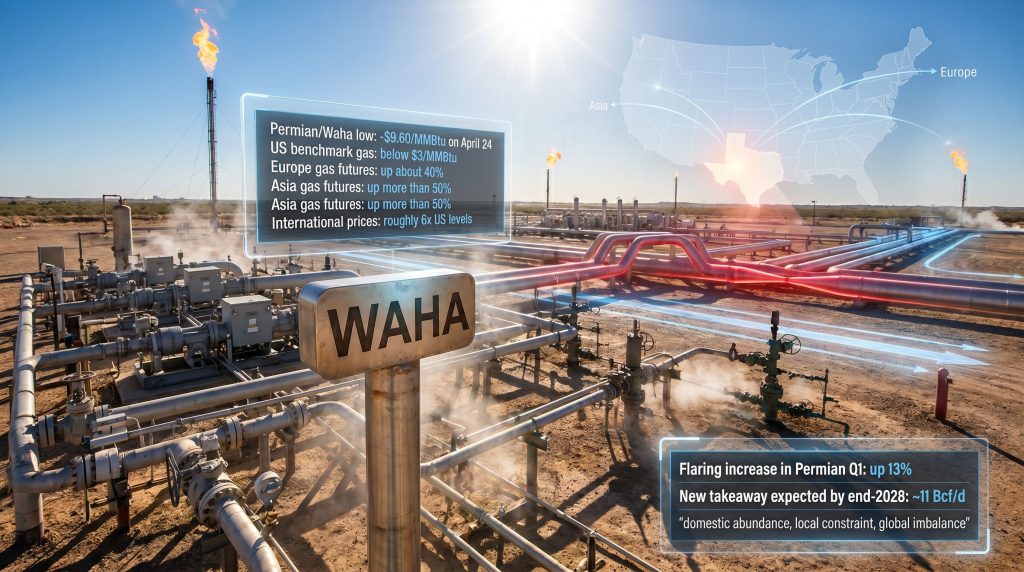
According to the supplied market data:
- Waha cash gas fell to about -$9.60/MMBtu on April 24
- US benchmark gas traded below $3/MMBtu
- US benchmark prices were about 10% lower since the conflict began
- European gas futures rose roughly 40%
- Asian gas futures climbed more than 50%
- International prices were around 6 times US levels
That spread is not a contradiction. Rather, it is evidence of a segmented market.
The hard numbers behind the current dislocation
A quick comparison shows how distorted the market has become.
| Metric | Permian Waha | US Benchmark | Europe | Asia |
|---|---|---|---|---|
| Recent price reference | -$9.60/MMBtu | Below $3/MMBtu | Much higher | Much higher |
| Direction since conflict began | Severe local collapse | Down about 10% | Up about 40% | Up more than 50% |
| Relative positioning | Distressed spot market | National benchmark | Around 6x US | Around 6x US |
Other important indicators help explain why negative pricing has become more severe:
| Signal | Reported figure | Why it matters |
|---|---|---|
| Utility gas prices in March CPI | Down 0.9% | Lower gas can cushion parts of consumer inflation |
| Permian flaring in Q1 | Up 13% | Shows transport stress and wasted supply |
| New takeaway expected by end-2028 | ~11 Bcf/d | Major relief if built on schedule |
| Capacity addition as share of US output | ~10% | Large enough to matter nationally |
| Producer curtailment example | 2% quarterly cut | Weak gas economics affect production decisions even outside Permian |
| Trader loss example | More than $300,000 in one week | Basis blowouts can be lucrative or destructive |
| Gas revenue share for an oil-focused producer | ~5% in a good year, potentially toward 10% | Gas matters more to earnings than some investors assume |
| Public forecast reference | US gas expected well below $4 through 2027 | Suggests the broader US discount may persist |
For broader context, US natural gas prices forecast also points to a softer national pricing backdrop, which helps explain why local stress in West Texas is unfolding within an already subdued domestic market.
How infrastructure and market design helped create this outcome
Negative pricing in the Permian has appeared intermittently since 2019, which points to a structural issue rather than a one-off event. Production grew faster than takeaway infrastructure. That matters more than headline output alone.
The underlying chain looks like this:
- More oil drilling creates more associated gas
- Pipeline buildout lags basin growth
- Regional gas gets stranded
- Basis differentials widen against Henry Hub
- Spot prices can collapse into negative territory
This is also where regulation starts to matter. Texas and New Mexico handle flaring differently. Texas has historically allowed broad exceptions to limits intended to restrain flaring, while New Mexico has generally taken a tighter approach. Consequently, those differences shape producer behaviour during periods of severe gas distress.
Importantly, broad political rhetoric about energy abundance does not prevent local basis collapses. A basin can sit on huge resources and still suffer negative local pricing when pipes, compression, processing, and downstream demand are not aligned.
Additional industry coverage from East Daley has shown that even new infrastructure starts do not always resolve recurring negative prices straight away, especially if production growth quickly absorbs the added capacity.
Winners from ultra-cheap US gas
Low domestic gas prices are not universally bad. In fact, they create clear advantages for several sectors.
Manufacturing and industrial feedstocks
Chemicals, ammonia, fertiliser, and petrochemicals are among the biggest beneficiaries because gas is both an energy source and a feedstock. Dow has indicated that constrained feedstock availability in Europe and Asia is improving competitive positioning for production in the Americas.
Electricity users and inflation-sensitive sectors
Cheap gas can help restrain electricity costs, even if power bills are still under pressure from grid investment and rising demand. March CPI data showed utility gas prices down 0.9%, underscoring that weak gas prices can soften part of the inflation basket.
Data centres and AI-linked power demand
Gas is increasingly important in the debate over how to supply round-the-clock electricity for data centres. Reliable thermal generation remains valuable where intermittent renewables alone cannot meet always-on loads. That is one reason low gas prices are being discussed as a competitive factor for AI infrastructure in the US.
RBC Capital Markets has argued that US gas has remained not only cheaper than global benchmarks, but also less exposed to the volatility seen in Europe and Asia. That relative insulation supports domestic industries that depend on gas for heat, feedstock, and power reliability.
The next major ASX story will hit our subscribers first
Who loses when Permian natural gas prices negative
The winners are visible, but so are the casualties.
Upstream producers
Producers exposed to Waha can suffer very poor realised prices. Even oil-heavy operators are paying more attention because gas can account for roughly 5% of revenue in a good year, with some expecting that share to trend toward 10%.
Gas producers outside the Permian
A weak US benchmark can affect operators far beyond West Texas. One notable example cited in the research was a 2% quarterly production cut by a major US gas producer due to low prices and elevated storage.
This pressure links closely to how commodity prices affect mining companies, as volatile energy and feedstock prices can alter margins, capital allocation, and investor sentiment across extractive industries.
Traders and midstream participants
Basis blowouts create opportunity, but only for those with secure transport. A trader with long-term pipeline rights may capture exceptional margins when Waha collapses versus other hubs. Yet operational disruptions can reverse the trade quickly. One market participant reportedly lost more than $300,000 in a single week after pipeline maintenance stranded gas and forced replacement purchases elsewhere.
The environment
When takeaway economics break down, flaring tends to rise. Research cited in the source material showed Permian flaring up 13% in the first quarter, the largest increase for that period in data back to 2019. That means more carbon dioxide emissions, more wasted resource, and often more scrutiny from regulators and local communities.
Environmental advocates have described the situation as a market failure because gas needed elsewhere is being burned off locally instead of reaching productive use.
Why local oversupply still matters globally
It would be a mistake to dismiss this as a purely regional curiosity. The disconnect has international consequences.
High gas prices abroad can reduce fertiliser output, raise heating and power costs, and squeeze industrial margins. The research supplied for this article noted:
- Slovakia-based Duslo AS curbed ammonia output after gas prices surged
- Indian producers including Indian Farmers Fertiliser Cooperative Ltd. cut urea production after LNG supply disruption
- Vitol LNG leadership warned that energy stress can spill into food systems through fertiliser markets
This matters because ammonia and urea are tied to agricultural productivity. When gas shocks disrupt fertiliser production, the effects can travel into food prices and broader inflation.
| Global consequence of high gas prices outside the US | Likely effect |
|---|---|
| Fertiliser output risk | Potential pressure on crop input costs |
| Higher electricity and heating costs | Consumer stress and political fallout |
| Manufacturing margin pressure | Reduced competitiveness and output |
| Inflation spillovers | Wider macroeconomic drag |
Furthermore, trade policy can intensify these distortions. For instance, both the US-China trade war and oil prices and the broader trade war impact on oil markets show how geopolitics can reshape commodity flows well beyond the producing basin.
Can new pipelines fix the problem?
The market appears to expect improvement, though not perfection. Intercontinental Exchange forward pricing referenced in the research showed Waha moving back into positive territory around October 2026, roughly when the Blackcomb Pipeline is expected to enter service.
Beyond that, five new Permian projects are projected to add about 11 Bcf/d of capacity by the end of 2028, equivalent to roughly 10% of total US gas production. That is a meaningful number.
Still, investors should avoid simplistic conclusions. New pipes can ease the most extreme distress, but they may not eliminate the broader US discount to global gas. If shale supply keeps rising and LNG export capacity remains a hard ceiling, the US market can stay structurally cheaper than Europe and Asia even after Waha normalises.
Scenario outlook for the next 12 to 36 months
| Scenario | Trigger | Impact on Waha basis | Likely response | Main winners |
|---|---|---|---|---|
| Bull case | Pipeline relief arrives on time | Basis tightens sharply | Better producer realisations | Permian producers, constrained traders |
| Base case | Capacity improves but supply also grows | Extreme distress fades, discount remains | More stable marketing strategies | Midstream, industrial users |
| Bear case | Production outpaces infrastructure again | Basis widens anew | Curtailments, more flaring pressure | Buyers with firm transport |
| Regulatory shift case | Tighter flaring enforcement | Could force behaviour change rapidly | More shut-ins or infrastructure urgency | Environmental outcomes, some pipeline owners |
One independent market analyst cited in the source material expects Permian gas prices to be materially stronger once additional infrastructure enters service. That view is plausible, but it remains a forecast rather than a certainty.
How to interpret Permian natural gas prices negative without oversimplifying
The clearest takeaway is that Permian natural gas prices negative is a local transport signal, not a universal statement about the commodity’s value.
Keep these points in mind:
- It does not mean natural gas has no value everywhere
- It does mean West Texas can become temporarily oversupplied relative to pipeline capacity
- It can help consumers and manufacturers while hurting producers and some traders
- It may lower some inflation inputs while worsening environmental waste through flaring
- It says as much about market design, logistics, and regulation as it does about geology
FAQ: Permian natural gas prices negative
Why are Permian natural gas prices negative?
Because local gas supply can exceed available pipeline takeaway, forcing sellers to accept subzero prices to move gas out of the basin.
What is Waha pricing?
Waha is the main regional gas pricing point for the Permian Basin. It reflects local physical market conditions and often trades at a discount or premium to Henry Hub depending on constraints.
How low did Permian gas prices fall?
The supplied market data indicates Waha fell to -$9.60/MMBtu on April 24.
Are negative prices likely to continue?
They may persist intermittently until enough new capacity enters service. Forward markets have pointed to improvement later in 2026, but timing and execution risk remain.
Do negative gas prices lower electricity bills?
They can help reduce fuel costs for power generation, but retail electricity bills also depend on transmission, distribution, regulation, hedging, and local utility structures.
Why does flaring increase when gas prices collapse?
Because selling gas becomes uneconomic or physically difficult when takeaway is constrained, making flaring a fallback in some operating situations.
Which industries benefit most from cheap US natural gas?
Chemicals, fertiliser, ammonia, petrochemicals, industrial heat users, and power-intensive sectors such as data centres.
Will new pipelines fix the problem permanently?
Probably not permanently. They can reduce extreme local distress, but long-term results will still depend on production growth, LNG exports, storage, and regulation.
Final perspective: warning sign, competitive edge, or both?
Permian natural gas prices negative should be read as both a warning and an advantage. It is a warning that infrastructure, regulation, and production growth are out of sync in one of the world’s most important hydrocarbon regions. However, it is also a competitive edge for parts of the US economy that benefit from cheap energy and feedstocks while other regions struggle with scarcity and price shocks.
The deeper lesson is that this story is less about resource shortage than transport capacity, export limits, and system design. If new pipelines arrive on schedule, the worst local dislocations may ease. If production keeps outpacing infrastructure, the cycle could return. Either way, the Permian remains a reminder that abundance alone does not determine price. Location, logistics, and rules do.
Disclaimer: This article is for informational purposes only and should not be treated as investment, trading, legal, or regulatory advice. Market prices, forward curves, and infrastructure timelines can change quickly. Forecasts and scenario analysis are inherently uncertain.
Could the Next Major ASX Discovery Move Faster Than the Market?
Powered by Discovery Alert’s proprietary Discovery IQ model, Discovery Alert delivers real-time alerts on significant ASX mineral discoveries so investors can act on actionable opportunities before the broader market catches up. See how historic discoveries have delivered exceptional returns on the Discovery Alert discoveries page and start a 14-day free trial today.