
August 26, 2026
Why Ore Reserve Growth Is the Most Underrated Metric in Gold Mining
In gold mining, production numbers grab headlines. Quarterly output, all-in sustaining costs, and realised gold prices dominate investor briefings and analyst coverage. Yet one metric consistently does more work over a longer time horizon than any of these short-cycle figures: the size and quality of a producer's ore reserve base. Reserve growth is the geological foundation upon which every other financial metric ultimately rests, and for mid-tier producers, it is often the single most reliable leading indicator of long-term valuation re-rating.
Understanding why requires a clear distinction between two terms that are frequently conflated by retail investors but treated with surgical precision by institutional capital.
The Difference Between Mineral Resources and Ore Reserves Explained
A mineral resource represents a concentration of mineralised material with reasonable prospects for eventual economic extraction. It is divided into three confidence categories: Measured, Indicated, and Inferred, with the latter carrying the greatest geological uncertainty. Resources are a geological statement of what exists in the ground.
An ore reserve, by contrast, is a financial and technical statement of what can be profitably mined. Only Measured and Indicated resources can be converted into Proved and Probable reserves respectively, and only after detailed mine planning, modelling of cut-off grades, metallurgical assessment, and economic analysis under defined price assumptions have all been completed. Understanding mineral deposit tiers helps contextualise how these classifications sit within the broader geological hierarchy.
This distinction is critical:
- Resources tell you what is there
- Reserves tell you what can be extracted at a profit under current or assumed market conditions
- Only reserves directly underpin mine scheduling, production guidance, and project financing
- Reserve growth extends mine life, supports debt facilities, and often precedes production guidance upgrades
- A material reserve increase is, in effect, a balance sheet event disguised as a geological announcement
How Annual Reserve Statements Drive Valuation Cycles in the Gold Sector
Gold producers typically update their reserve and resource statements annually, aligned with the close of their financial year. These updates feed directly into net asset value models used by institutional analysts to assign price targets. When a producer delivers a reserve increase that materially exceeds depletion from mining activity, the forward mine life extends and the discount rate applied to future cash flows often compresses, both of which drive NAV higher.
A reserve increase of 40% in a single reporting period is not a routine update. By institutional standards, it is a material event. It signals not just geological success but a fundamental shift in the scale and longevity of the underlying business. For context, most well-managed producers target a reserve replacement ratio of between 100% and 120% of annual mined depletion simply to keep their reserve base flat. Exceeding that by a factor of three or more in a single year is genuinely rare.
When big ASX news breaks, our subscribers know first
What the Perseus Mining Proved and Probable Reserves Increase Actually Means
Perseus Mining's (ASX: PRU) annual mineral resource and ore reserve update, reported as at 30 June 2026, delivered a result that sits well outside the normal range of annual reserve statements from ASX-listed gold producers.
Breaking Down the Numbers
| Metric | 30 June 2025 | 30 June 2026 | Change |
|---|---|---|---|
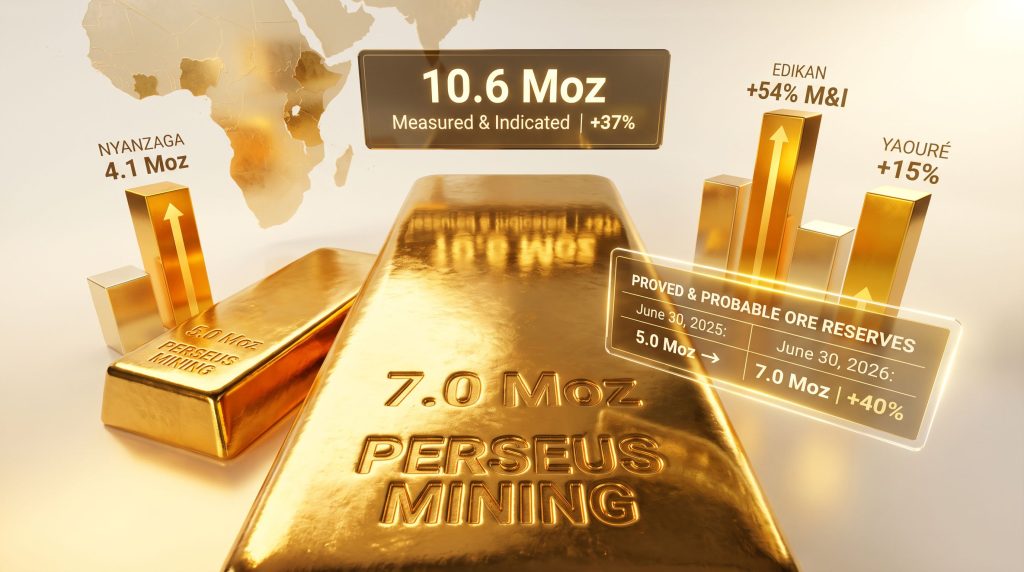
| Proved & Probable Ore Reserves | 5.0 Moz | 7.0 Moz | +2.0 Moz (+40%) |
| Measured & Indicated Resources | 7.8 Moz | 10.6 Moz | +2.9 Moz (+37%) |
| M&I Resource Tonnage | 185.9 Mt | 270.3 Mt | +84.4 Mt (+45%) |
| M&I Resource Grade | 1.30 g/t Au | 1.22 g/t Au | -0.08 g/t |
| Inferred Resources | 1.9 Moz | 2.5 Moz | +0.6 Moz (+32%) |
| Inferred Resource Grade | 1.5 g/t Au | 1.4 g/t Au | -0.1 g/t |
The group's total M&I mineral resources are now estimated at 270.3 million tonnes grading 1.22 g/t gold, containing 10.6 Moz. Inferred resources stand at 57.5 Mt grading 1.4 g/t for 2.5 Moz. The Mineral Resource Statement accounts for mining depletion of in-situ resources and is reported inclusive of ore reserves.
Understanding the Grade Versus Tonnage Trade-Off
The modest decline in average grade across both M&I and Inferred categories deserves specific attention because it is frequently misread by less experienced market participants as a negative signal. It is not.
When gold prices rise sustainably, the cut-off grade economics shift such that material previously classified as waste or sub-economic resource is reclassified into the reserve envelope. This mechanically dilutes the average grade while simultaneously growing contained ounces and total tonnage. The critical number to track is not the grade in isolation but the total contained ounces and the economics of extraction at the prevailing price.
A shift from 1.30 g/t to 1.22 g/t across a resource base that simultaneously grew by 84.4 million tonnes is entirely consistent with a healthy, price-driven expansion of the ore envelope. It reflects disciplined geological modelling, not deteriorating deposit quality.
Industry practitioners often describe this dynamic as the reserve responding to the price signal. At sustained gold prices above US$3,000 per ounce, the economic case for including lower-grade material strengthens considerably, and reserve statements reflect that new economic reality.
Which Assets Are Driving the Reserve Growth?
The composition of any reserve increase matters as much as its magnitude. A reserve addition concentrated at a single development asset carries different implications than one spread across multiple operating mines, and the specific characteristics of each contributor shape the investment thesis in distinct ways.
Nyanzaga: A Cornerstone Asset Reshaping the Portfolio
The most structurally significant element of the Perseus Mining proved and probable reserves increase is the contribution from Nyanzaga, which accounts for approximately 4.1 million ounces of ore reserves, or roughly 59% of the group's total 7.0 Moz reserve base.
This single figure fundamentally redefines Perseus's scale. Prior to Nyanzaga's inclusion at this magnitude, the company operated as a multi-mine producer with a reserve base sized to support existing production. The Nyanzaga reserve alone now exceeds the entire group reserve position of recent prior years.
Perseus's management has described the project as firmly established as a cornerstone of the portfolio, with the reserve base underpinning the next phase of the company's production growth as the project advances toward first gold. Development-stage projects of this scale typically require substantial capital investment in infrastructure, processing facilities, and mine construction before sustained production commences.
Located in Tanzania, Nyanzaga adds a new jurisdiction to the Perseus operating footprint, which currently spans Côte d'Ivoire and Ghana. Multi-jurisdiction portfolios introduce both diversification benefits and country-specific risk considerations that investors should assess independently.
Yaouré: Pit Optimisation Unlocking Incremental Value
At the flagship Yaouré operation in Côte d'Ivoire, ore reserves increased by 15% over the reporting period. This net addition was driven specifically by optimisation work on the Yaouré open pit rather than by new discoveries, which is an important distinction.
Pit optimisation at an operating mine involves re-running Whittle pit optimisation software or equivalent tools against updated cost structures, commodity price assumptions, and refined geological models. When gold prices rise, the economically optimal pit shell expands outward and downward, capturing additional mineralised material at the margins of the previous design. This can generate meaningful reserve additions without requiring a single new exploration drill hole.
The 15% net addition at Yaouré is therefore a technical and economic achievement rather than a purely geological one, and it demonstrates active value extraction from existing assets.
Edikan: Exploration Success at an Operating Mine
The Edikan gold mine in Ghana delivered the strongest percentage resource gain across the group, with Measured and Indicated mineral resources increasing by 54%. For an operating mine, this level of resource growth is particularly significant.
Near-mine exploration at producing assets is often underweighted in capital allocation discussions, yet it consistently delivers some of the highest-return exploration outcomes in the sector. Interpreting gold drill results from near-mine programmes benefits from existing infrastructure, established geological models, and nearby assay turnaround. The cost per discovery ounce is typically far lower than greenfield exploration.
A 54% M&I resource increase at Edikan signals strong near-mine exploration success and substantially expands the pipeline available for future reserve conversion. Combined with ongoing depletion replacement at the site, the operational life trajectory at Edikan appears meaningfully extended.
Sissingué: Depletion Replacement as a Strategic Discipline
Sissingué in Côte d'Ivoire continues to replace mining depletion without delivering material net growth in the reserve base. While this outcome generates less attention than a large percentage increase, it is strategically important.
Depletion replacement at operating mines is a form of reserve maintenance that prevents the gradual erosion of the asset base during active production. A producer that fails to replace depletion faces a steadily shrinking reserve life, deteriorating mine economics, and eventually asset retirement without a replacement production base. Sissingué's steady-state replacement performance reflects a disciplined approach to reserve management at a smaller-scale operation.
How This Compares to Mid-Tier Gold Sector Benchmarks
Reserve Scale and Production Capacity
Among ASX-listed gold producers, reserve scale is a primary determinant of institutional interest and market capitalisation. Producers with reserves in the 5 to 10 Moz range are generally considered well-positioned to sustain annual production of 400,000 to 600,000 ounces, placing them firmly in the mid-tier category by global standards.
Perseus's movement from 5.0 Moz to 7.0 Moz in a single reporting year positions the company toward the upper end of this bracket. Furthermore, at a hypothetical steady-state production rate of approximately 500,000 ounces per annum, the current reserve base implies a theoretical mine life of around 14 years. This is a simplified projection and does not account for future reserve additions, grade variability, or production rate changes, but it illustrates the structural de-risking that a reserve base of this scale provides.
Extended theoretical mine life matters in valuation models because:
- It reduces the risk premium applied in discounted cash flow analysis
- It lengthens the period over which capital costs can be amortised
- It strengthens the company's position when approaching lenders for project finance on development assets
- It increases the confidence interval around long-term production guidance
Organic Growth Versus Acquisition-Driven Growth
A critical element of Perseus's reserve growth story is its organic character. The reserve and resource expansion has been driven by exploration drilling and technical optimisation rather than corporate acquisitions. This distinction carries meaningful valuation implications. Consequently, the gold price impact on miners who grow organically is often more pronounced, as expanding margins flow directly through to reserve economics without the dilution risk that typically accompanies acquisition-driven strategies.
| Growth Pathway | Capital Intensity | Execution Risk | Market Perception |
|---|---|---|---|
| Organic Exploration Drilling | Low to Medium | Low | Highly positive |
| Near-Mine Resource Conversion | Low | Very Low | Positive |
| Brownfield Development | Medium | Medium | Neutral to Positive |
| Acquisition-Driven Growth | High | High | Cautious |
Organic reserve growth avoids the integration risks, goodwill impairments, and equity dilution that frequently accompany acquisition strategies. It also tends to generate resource ounces at a lower discovery cost, preserving capital efficiency across the portfolio.
Portfolio Optimisation Strategy: What It Signals to the Market
Moving Beyond Fixed Asset Investment Targets
Perseus's annual planning cycle incorporates a portfolio-level optimisation framework rather than allocating fixed capital targets to each individual asset. This approach allows capital to flow dynamically toward the highest-return opportunities across the group, whether that means accelerating drilling at Edikan, advancing construction at Nyanzaga, or conducting pit redesign at Yaouré.
This kind of capital flexibility is a hallmark of well-managed mid-tier producers. Companies that ring-fence capital by asset regardless of relative returns often find themselves underinvesting in their best opportunities while overinvesting in assets with diminishing returns. A portfolio optimisation approach can materially improve capital efficiency over a multi-year planning horizon.
The planned expansion of the FY27 drilling programme signals management's confidence that further organic resource growth is achievable across the portfolio. With 2.5 Moz of Inferred resources already identified as at 30 June 2026, the pipeline available for conversion to the higher-confidence Measured and Indicated categories is substantial. In addition, as Nyanzaga advances toward a definitive feasibility study phase, the technical and economic parameters underpinning its reserve base will be refined further, potentially unlocking additional value across the development timeline.
Frequently Asked Questions: Perseus Mining Reserve Update
What are Proved and Probable Ore Reserves?
Proved and Probable Ore Reserves are the highest-confidence classifications of economically mineable gold within a mining company's portfolio. Proved reserves are derived from Measured resources and carry the greatest geological certainty. Probable reserves are based on Indicated resources that have been assessed as economically viable under defined assumptions. Both categories form the foundation for mine scheduling, production planning, and external financing.
How much did Perseus Mining's reserves increase?
As at 30 June 2026, Perseus Mining reported Proved and Probable Ore Reserves of 7.0 million ounces, an increase of 2.0 million ounces or 40% compared to the 5.0 million ounces reported at 30 June 2025. This represents the Perseus Mining proved and probable reserves increase as a standout result in the ASX gold producer universe for the reporting period.
Which asset contributes the most to Perseus Mining's reserve base?
Nyanzaga is the largest contributor, holding approximately 4.1 million ounces of ore reserves, representing around 59% of the group's total Proved and Probable position as at 30 June 2026.
Why did average grades decrease despite the reserve increase?
The slight reduction in average grade reflects the inclusion of lower-grade material that becomes economically mineable at elevated gold prices. This is a standard outcome of reserve expansion in a rising price environment and indicates an expanding ore envelope rather than deteriorating deposit quality.
What does the 54% resource increase at Edikan mean for investors?
A 54% increase in M&I mineral resources at an operating mine is a strong indicator of near-mine exploration success. It significantly expands the pipeline available for future reserve conversion and suggests the operational life at Edikan may extend materially beyond current reserve boundaries.
The next major ASX story will hit our subscribers first
Key Takeaways
- Perseus Mining's Proved and Probable Ore Reserves reached 7.0 Moz as at 30 June 2026, a 40% increase on the prior year
- Measured and Indicated mineral resources grew to 10.6 Moz, up 37%, with total resource tonnage rising from 185.9 Mt to 270.3 Mt
- Nyanzaga dominates the reserve base at 4.1 Moz, establishing it as the portfolio's primary development and production growth asset
- Yaouré delivered a 15% net reserve increase through pit optimisation, demonstrating technical value extraction at an operating mine
- Edikan achieved a 54% M&I resource increase, the strongest percentage gain across the group and a signal of significant near-mine exploration success
- Inferred resources grew 32% to 2.5 Moz, providing a substantial pipeline for future conversion into higher-confidence categories
- An expanded FY27 drilling programme is planned, signalling continued commitment to organic reserve growth
- The portfolio-level optimisation strategy prioritises capital efficiency over fixed per-asset targets
This article is for informational purposes only and does not constitute financial advice. Past reserve growth does not guarantee future production outcomes or investment returns. Readers should conduct their own research and consult a qualified financial adviser before making any investment decisions. Forward-looking statements and projections, including mine life estimates, are hypothetical illustrations only and are subject to material uncertainty.
Want to Spot the Next Major ASX Gold Discovery Before the Market Does?
While reserve growth metrics like Perseus Mining's 40% increase signal long-term value, the most significant returns in the gold sector often come from identifying transformative discoveries at the moment they are announced — exactly what Discovery Alert's proprietary Discovery IQ model is built to deliver, scanning ASX announcements in real time and converting complex mineral data into actionable insights. Explore historic discovery returns that illustrate just how substantial early-mover positioning can be, and begin a 14-day free trial to ensure the next major ASX mineral discovery doesn't pass unnoticed.