July 10, 2026
The Strait of Hormuz Has Become a Geopolitical Instrument, Not Just a Shipping Lane
Maritime chokepoints have always carried outsized strategic importance relative to their physical dimensions. The Strait of Malacca, the Suez Canal, the Bab-el-Mandeb — each has shaped the architecture of global trade during periods of geopolitical stress. However, none of them has ever been transformed, within a matter of weeks, from a commercially neutral passage governed by international maritime law into what analysts are now describing as a politically stratified toll road.
That transformation is precisely what is underway in the Strait of Hormuz, and the implications for Persian Gulf oil tanker traffic recovery extend far beyond the immediate conflict. Furthermore, the broader oil price shock reverberating through global markets is amplifying every dimension of this disruption.
The deeper question is not whether tanker volumes will eventually climb back toward prior levels. It is whether the conditions that made pre-conflict throughput possible — predictable access, commercially neutral passage rights, multilateral maritime governance — can ever be reconstructed once a state actor has demonstrated the capacity and willingness to use a critical waterway as a geopolitical instrument.
When big ASX news breaks, our subscribers know first
Understanding the Strait of Hormuz: Why This Waterway Defines Global Energy Security
The Scale of What Is at Stake
To understand the magnitude of the current disruption, it helps to grasp exactly what the Strait of Hormuz represented before the conflict began. According to the EIA's analysis of critical chokepoints, the waterway's navigable shipping channel spans approximately 3.2 kilometres in each direction — a physical constraint that concentrates an extraordinary volume of global energy trade through a corridor barely wider than a mid-sized harbour.
At pre-conflict operational levels, the strait facilitated the movement of crude oil, liquefied natural gas, and refined petroleum products originating from Saudi Arabia, the UAE, Kuwait, Iraq, and Qatar. The destinations spanned three continents, with the dominant flow directed toward energy-hungry Asian importers including China, Japan, South Korea, and India.
| Metric | Pre-Conflict Baseline |
|---|---|
| Daily oil volume transiting Hormuz | ~17–20 million barrels per day |
| Share of global oil trade | ~20–21% |
| Share of global LNG trade | ~25–30% |
| Key destination markets | China, Japan, South Korea, India, Europe |
| Primary vessel types | VLCCs, LNG carriers, product tankers |
No single maritime chokepoint comes close to matching this concentration of energy trade. Consequently, the closure or partial restriction of the strait does not merely inconvenience shipping companies — it restructures the physical supply architecture of the global oil market.
How the Disruption Unfolded: A Timeline of Deterioration
The sequence of events that has brought Persian Gulf oil tanker traffic recovery into serious question unfolded rapidly:
-
Late February: Conflict escalation triggers a near-total cessation of commercial transit, with tanker activity falling an estimated 40–50% and approximately 240 vessels clustering at the strait's entry points, unable or unwilling to proceed.
-
Mid-April: Iran signals a conditional reopening. Dozens of vessels surge toward the passage, and at least 13 tankers complete transit — though a significant proportion subsequently reversed course or remained anchored within the Persian Gulf, reflecting persistent uncertainty about safe passage.
-
Early May onward: Daily transits remain materially below pre-conflict baselines. Commercial shipping analysts characterise the situation as having largely failed to recover in any meaningful operational sense.
-
Present: A partial, politically mediated transit regime has emerged. Vessels are operating under Iranian-imposed conditions that include designated routing requirements, pre-approval protocols, and proximity constraints relative to Iranian territorial waters.
What Does Partial Recovery Actually Mean? Deconstructing the 60–70% Scenario
The Structural Ceiling on Traffic Normalisation
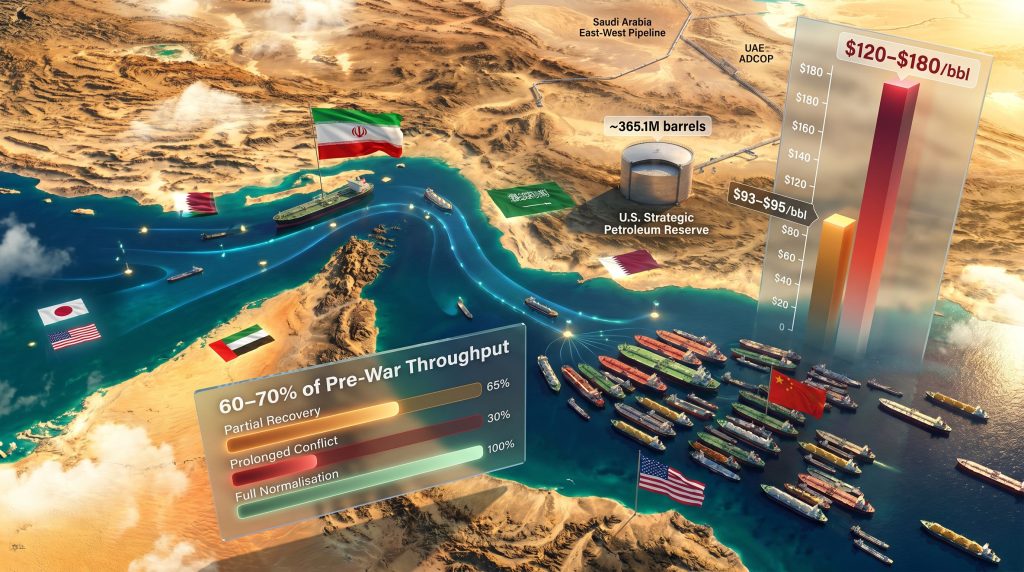
The most widely cited near-term recovery projection places Persian Gulf oil tanker traffic stabilisation at somewhere between 60% and 70% of pre-war volumes. This figure, referenced by senior analysts in the maritime intelligence sector, does not represent a temporary bottleneck that will naturally resolve as conflict subsides. It reflects a structurally reconfigured access regime in which the physical act of transiting the strait is no longer governed by freedom of navigation principles but by political calculus.
Analysts have described this outcome as producing something more insidious than an outright closure — a permanently bifurcated strait where access is determined by political alignment rather than internationally recognised maritime rights. This framing, widely cited in financial and energy market commentary, suggests the damage to the pre-war transit model may be irreversible in the near to medium term.
Even within this partial recovery ceiling, vessel treatment is expected to be asymmetric. The emerging picture is one of a two-tier transit system in which the flag state and trading relationships of each vessel determine the conditions under which passage is granted or denied.
The Bifurcation Model: A New Geopolitical Toll Road
| Vessel Category | Expected Treatment | Market Implication |
|---|---|---|
| Chinese-flagged or China-affiliated tankers | Preferential passage | Reinforces China's structural energy security advantage |
| Western-flagged commercial tankers | Conditional access, potential passage fees | Elevated freight costs, insurance premiums |
| U.S. Navy-escorted vessels | Limited, coordinated crossings | Not commercially scalable at volume |
| LNG carriers (Qatar, UAE) | Uncertain; subject to bilateral negotiations | European LNG diversification plans face compounding risk |
The logic underpinning China's likely preferential treatment is rooted in the depth of its economic relationship with Iran. China has historically absorbed a significant share of Iranian crude exports, providing Tehran with a critical revenue stream during periods of Western sanctions. This interdependence creates a structural incentive for Iranian authorities to facilitate Chinese vessel transit while applying stricter commercial and political conditions to Western-affiliated shipping.
How Are Alternative Routes Absorbing the Supply Gap?
Pipeline Diversions and Their Structural Limits
Two pipeline systems have absorbed a portion of the volume displaced by Hormuz disruption:
-
Saudi Arabia's East-West Pipeline (Petroline), which traverses the Arabian Peninsula to Red Sea export terminals at Yanbu.
-
The UAE's Abu Dhabi Crude Oil Pipeline (ADCOP), which connects Abu Dhabi's oil fields to the Fujairah terminal on the Gulf of Oman, bypassing the strait entirely.
Together, these systems have reportedly absorbed an estimated 50% of the volume that would otherwise have transited Hormuz. However, this is not a permanent solution at scale. Neither pipeline was designed or sized to replace Hormuz maritime throughput comprehensively, and the remaining ~50% of displaced volume continues to face delivery disruption, rerouting delays, or outright cancellation.
Rerouting Economics: The Hidden Cost of Hormuz Avoidance
For vessels that cannot use pipeline alternatives, the only maritime option is a significantly longer voyage around the Arabian Peninsula via the Cape of Good Hope. The economic consequences are substantial:
-
Voyage times for Asian-bound cargoes extend by 10 to 14 days, increasing fuel consumption, vessel utilisation costs, and crew expenses on a per-cargo basis.
-
Extended voyage distances compress effective fleet capacity, as the same number of vessels can deliver fewer cargoes per year when each voyage takes significantly longer.
-
Spot freight rates for Very Large Crude Carriers (VLCCs) on Middle East-to-Asia routes have experienced significant upward pressure as a direct consequence of rerouting demand and fleet concentration near the strait.
-
War risk insurance premiums for vessels transiting or approaching the Persian Gulf have risen sharply. Major marine underwriters including Lloyd's of London have implemented exclusion zones and elevated premium structures that are unlikely to normalise rapidly even under a ceasefire scenario.
What Are the Geopolitical Scenarios for Long-Term Hormuz Access?
Scenario Modelling: Three Structural Outcomes
The following scenarios are structured around the degree of Iranian operational control over the Strait of Hormuz and the nature of any diplomatic resolution. Each carries distinct implications for global oil supply, energy pricing, and maritime trade architecture. These are analytical projections, not forecasts, and should not be treated as investment advice.
In addition, the geopolitical trade shifts currently reshaping broader supply chains are compounding each of these scenarios with further structural uncertainty.
Scenario 1: Diplomatic Resolution with Iranian Oversight Retained
A ceasefire or limited agreement is reached, but Iran retains de facto operational control over the strait. Key characteristics of this outcome include:
- Traffic recovers to the 60–70% ceiling with a bifurcated access regime in place.
- Western energy markets face a structurally higher cost of Middle Eastern crude as insurance, routing, and passage premiums become embedded in supply chain economics.
- Oil prices stabilise in the $100–$120 per barrel range as markets price in permanent supply-side friction.
- This scenario is currently assessed as the most probable near-term outcome.
Scenario 2: Prolonged Conflict with Selective Iranian Enforcement
No deal is reached, and Iran selectively enforces passage rights based on political alignment:
- Traffic remains at 40–55% of pre-conflict levels for an extended period.
- Global oil inventories deteriorate toward critically low thresholds within weeks.
- Rystad Energy has modelled re-escalation scenarios in which oil prices reach $180 per barrel by August, representing the upper boundary of credible near-term price projections.
- This scenario carries moderate probability and represents the primary tail risk for energy markets.
Scenario 3: Full Normalisation Under International Maritime Framework
A comprehensive agreement restores freedom of navigation under international law:
- Traffic gradually recovers toward 85–95% of pre-conflict levels over 12–24 months.
- Considered the least likely near-term outcome given Iran's entrenched strategic position.
- Even under this scenario, structural changes to insurance markets, routing preferences, and supply chain diversification are unlikely to fully reverse.
Scenario Probability Summary
| Scenario | Estimated Probability | Oil Price Range | Traffic Recovery Level |
|---|---|---|---|
| Diplomatic resolution, Iranian control retained | High | $100–$120/bbl | 60–70% of pre-war |
| Prolonged conflict, selective enforcement | Moderate | $120–$180/bbl | 40–55% of pre-war |
| Full normalisation under international law | Low | $80–$100/bbl | 85–95% of pre-war |
What Is the Global Inventory Crisis Telling Us?
The Supply Buffer Is Eroding Faster Than Markets Have Priced In
Perhaps the most consequential dimension of the current disruption is not the shipping disruption itself but the accelerating depletion of global oil inventory buffers. The U.S. Strategic Petroleum Reserve (SPR) has declined from approximately 415.4 million barrels at the onset of hostilities to around 365.1 million barrels — a drawdown of more than 50 million barrels in a relatively short period.
Senior executives at major integrated oil companies have moved beyond cautious warnings into explicit alarm. Exxon's senior vice president Neil Chapman publicly stated at a New York industry event that global inventory levels are approaching territory that has no modern precedent, noting that the question is no longer whether critically low levels will be reached but whether that threshold arrives within two weeks or three weeks.
His remarks, reported by CNBC in late May 2026, signal that the major integrated producers now view a severe supply crunch as a near-certainty rather than a risk scenario. Furthermore, the crude oil price trends already emerging in 2025 had foreshadowed exactly this kind of inventory vulnerability.
Chevron's chief executive Mike Wirth reinforced this assessment, noting that the market's shock absorbers have been steadily drawn down and that the system's capacity to absorb further supply-demand imbalance is dramatically reduced compared to the start of the conflict. Wirth projected that the pressure building in physical crude markets would begin flowing directly into prices over the coming weeks, with June and July representing the period of maximum vulnerability.
| Indicator | Current Status | Risk Threshold |
|---|---|---|
| U.S. SPR levels | ~365 million barrels | Below 300 million barrels = critical |
| Global commercial crude stocks | Declining | Multi-decade lows projected by July 2026 |
| Brent crude price | ~$93–$95/bbl | $120+ if physical tightness materialises |
| WTI crude price | Below $90/bbl | Divergence from Brent signals market stress |
The Inventory-Price Lag: Why Markets Are Underpricing the Risk
A critical and under-appreciated dynamic in current crude oil markets is the lag between physical inventory deterioration and price discovery. Sentiment-driven trading — responding to diplomatic signals, ceasefire negotiations, and social media commentary from political leaders — has temporarily suppressed prices below levels that physical fundamentals would otherwise justify. This divergence between sentiment-driven pricing and fundamental supply scarcity cannot persist indefinitely. When the physical inventory constraint becomes undeniable in market data, the price adjustment is likely to be sharp and rapid rather than gradual.
Brent crude trading above $100 per barrel on conflict escalation before retreating to the $93–$95 per barrel range on diplomatic optimism illustrates this dynamic precisely. The moderation reflects hope rather than improved supply conditions. Multiple institutions have cited upside price scenarios of $120 to $160 per barrel once inventory drawdowns reach critical thresholds, with Rystad Energy's re-escalation model extending to $180 per barrel by August under adverse conditions.
The next major ASX story will hit our subscribers first
How Is the Conflict Reshaping Global Energy Trade Architecture?
The Emergence of a Politically Stratified Maritime Order
The Hormuz disruption is functioning as an accelerant for trends that were already reshaping global energy trade before the conflict began. Several structural shifts are now advancing at a pace that would have taken years under normal conditions:
-
Energy trade regionalisation and the growth of bilateral supply arrangements are replacing multilateral open-market mechanisms for Middle Eastern crude.
-
China's structural energy security advantage is being entrenched. Its likely preferential access to Hormuz transit deepens the eastward pivot of Gulf oil flows that has been building for over a decade, reinforcing Beijing's position as the dominant buyer of Middle Eastern crude.
-
European LNG diversification, already forced by the disruption of Russian pipeline gas, now faces a second simultaneous supply-side shock from Hormuz restrictions. The LNG supply outlook for Qatari and UAE flows has consequently deteriorated, with Canadian LNG increasingly framed as a long-term strategic diversification priority rather than an optional supplement.
What This Means for Asian Energy Importers
| Country | Hormuz Dependency | Immediate Impact | Strategic Response |
|---|---|---|---|
| China | Very High | Preferential access likely mitigates near-term impact | Deepening bilateral arrangements with Gulf states |
| Japan | Very High | Crude imports fell 66% in April | Emergency stock drawdowns, alternative supplier negotiations |
| India | High | Central bank flagging growth risks from oil shock | Exploring non-Gulf supply alternatives, LNG diversification |
| South Korea | High | Significant refinery throughput disruption | Strategic reserve deployment |
Japan's April crude import collapse of 66% is perhaps the starkest single data point in the current crisis. For an economy with virtually no domestic hydrocarbon production, a two-thirds reduction in crude import volumes within a single month represents an acute national energy emergency. The speed and severity of this impact underlines why Asian importers are now scrambling to construct alternative supply relationships that do not depend on unimpeded Hormuz access.
Is U.S. Naval Presence a Credible Solution for Tanker Traffic Recovery?
The Limits of Military Escort as a Commercial Shipping Mechanism
The U.S. Navy has been coordinating vessel crossings through the Strait of Hormuz, but these operations carry fundamental limitations as a commercial shipping solution:
-
Military escort is resource-intensive and logistically complex, consuming naval assets that have competing deployment priorities across a region in active conflict.
-
The scale of escort operations cannot approach the commercial throughput that pre-conflict transit represented. Hundreds of vessels previously transited the strait's narrow commercial lanes daily — a volume that naval coordination cannot replicate.
-
Perhaps most critically, military escort operations may complicate rather than support diplomatic efforts to reach a ceasefire. The visible presence of U.S. naval forces facilitating tanker transits provides Iran with both a political grievance and a bargaining chip in negotiations.
The Diplomatic Track: What a Deal Would and Would Not Resolve
Current negotiations between the United States and Iran are focused on extending a ceasefire rather than achieving comprehensive conflict resolution. Even senior U.S. national security officials with direct involvement in Gulf energy policy have publicly acknowledged that regardless of what any deal contains, Iran will retain operational control over the Strait of Hormuz for the foreseeable future.
This assessment, widely circulated in financial and policy circles following comments made to CNBC in late May 2026, fundamentally constrains the upside scenario for Persian Gulf oil tanker traffic recovery. The oil market impact of this retained Iranian control is, furthermore, likely to persist well beyond any formal ceasefire agreement.
The nuclear dimension adds further complexity. U.S. negotiating positions have included demands for guarantees against Iranian nuclear weapons development as a precondition for broader normalisation — a requirement that substantially raises the political cost of any comprehensive agreement.
The Long-Term Structural Verdict: A New Normal for Middle Eastern Energy Flows
Why Recovery Is the Wrong Framework for Investors and Planners
Framing the current situation as a recovery problem implies that a prior equilibrium exists to return to. However, the conditions that defined pre-conflict Hormuz transit — commercially neutral access, freedom of navigation principles, multilateral maritime governance — were not simply disrupted by the conflict. They were revealed to be contingent on Iranian restraint rather than grounded in durable legal or institutional foundations.
What is emerging in their place is a permanently restructured maritime trade architecture in which access to the Persian Gulf's energy flows is mediated by geopolitical alignment, bilateral commercial arrangements, and Iranian strategic interests. According to Wood Mackenzie's analysis of Gulf export recovery, this has cascading implications across multiple sectors:
-
Shipping finance institutions are reassessing vessel deployment strategies, with some operators redirecting fleet capacity away from Gulf routes entirely given the combination of elevated war risk premiums and unpredictable transit conditions.
-
Refinery operators in Asia and Europe are accelerating crude supply diversification programs that were previously treated as long-term strategic planning exercises rather than immediate operational necessities.
-
Energy price volatility is structurally elevated for an extended period, with the inventory-price lag dynamic suggesting that the most acute phase of price pressure has not yet fully manifested in market pricing.
Key Takeaways for Energy Market Participants
-
Supply chain diversification away from Hormuz-dependent routes has shifted from contingency planning to commercial imperative.
-
Insurance and freight cost structures for Middle Eastern crude are unlikely to normalise even under a ceasefire scenario, given the demonstrated vulnerability of the corridor.
-
Asian importers, particularly Japan, South Korea, and India, face the most acute near-term supply security challenges and are under structural pressure to accelerate bilateral supply arrangements outside the Gulf region.
-
China's strategic positioning as Iran's preferred trading partner gives Beijing a durable energy security advantage that Western nations cannot replicate without fundamental shifts in their relationship with Gulf producers.
-
Oil price volatility is likely to remain elevated well into the second half of 2026, with the $120 to $180 per barrel scenario range remaining credible under adverse diplomatic or conflict trajectories.
Disclaimer: This article contains forward-looking analysis, scenario projections, and references to price forecasts produced by third-party institutions including Rystad Energy, RBC Capital Markets, and major integrated oil companies. These projections are subject to significant uncertainty and should not be construed as investment advice. Readers should conduct their own due diligence before making any investment or commercial decisions based on the information contained herein.
Want to Capitalise on the Energy Market Disruption Reshaping Global Oil Flows?
Discovery Alert's proprietary Discovery IQ model delivers real-time alerts on significant ASX mineral discoveries — including those tied to energy commodities experiencing structural supply shocks — instantly empowering subscribers to identify actionable opportunities ahead of the broader market. Explore Discovery Alert's dedicated discoveries page to understand how historic discoveries have generated substantial returns, and begin your 14-day free trial today to position yourself ahead of the next major market move.