May 16, 2026
Global energy markets face unprecedented vulnerability as supply chains navigate an increasingly fragmented geopolitical landscape. The concentration of critical energy infrastructure in geographically constrained waterways creates systemic risks that extend far beyond regional conflicts. When maritime chokepoints become contested zones, the ripple effects cascade through international commerce, insurance markets, and energy security frameworks worldwide. Furthermore, the current Persian Gulf standoff exemplifies how regional tensions can trigger global energy market disruptions that affect everything from OPEC production impact to international trade relationships.
What Makes the Strait of Hormuz the World's Most Critical Energy Artery?
Global Energy Transit Dependencies
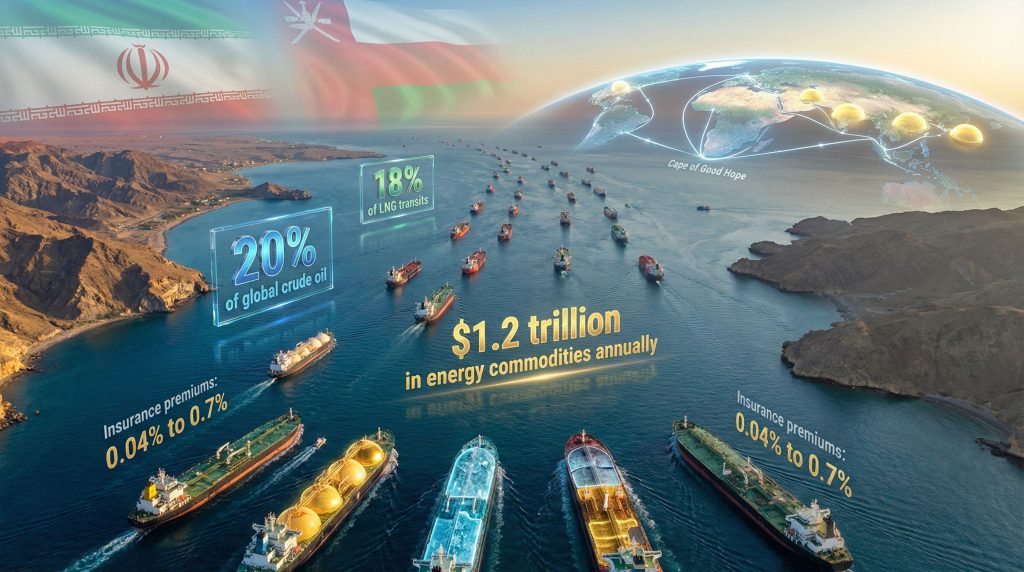
The Strait of Hormuz functions as the primary conduit for global energy commerce, facilitating the transit of approximately 21-22% of the world's crude oil and 18-20% of global liquefied natural gas. This translates to roughly 21-22 million barrels of crude oil passing through the waterway daily, representing a substantial portion of international energy trade flows.
The economic significance becomes evident when examining the scale of these operations. Energy commodities valued at hundreds of billions of dollars transit this narrow passage annually, making any disruption a matter of immediate global concern. The International Energy Agency officially designates the Strait as the world's most important oil chokepoint, given its centrality to global energy security frameworks.
Alternative routing options present significant cost penalties for energy transportation. Vessels circumnavigating through the Cape of Good Hope face an additional 3,500 nautical miles and 15-20 days of transit time, substantially increasing operational costs and delivery timelines. These extended routes also strain global shipping capacity, as vessels remain occupied for longer periods during each voyage cycle.
Chokepoint Vulnerability Assessment
The physical constraints of the Strait create natural bottlenecks that amplify vulnerability during periods of tension. At its narrowest point, the waterway spans only 21 miles, with shipping lanes further constrained to 2-mile-wide corridors in each direction. These limitations mean that any disruption affects the entire flow of maritime traffic through the region.
Daily vessel traffic patterns reveal the intensity of operations within these confined spaces. Approximately 2,000 vessels transit the Strait annually, with traffic concentrated through carefully managed shipping lanes that accommodate both laden tankers and ballast returns. The International Maritime Organization maintains strict navigation standards to ensure safe passage through these congested waters.
Infrastructure dependencies create additional layers of vulnerability for regional energy exporters. Major facilities such as Qatar's Ras Laffan LNG terminal and the UAE's strategic ports at Jebel Ali and Fujairah rely entirely on Strait access for export operations. Any prolonged closure would effectively strand production capacity and disrupt established supply contracts.
When big ASX news breaks, our subscribers know first
How Do Regional Conflicts Transform Into Global Energy Crises?
Escalation Economics: From Local Tensions to Supply Chain Disruption
The transformation of regional tensions into global energy crises occurs through sophisticated risk transmission mechanisms that operate independently of physical conflict. Insurance markets serve as the primary conduit for this transformation, with commercial maritime insurance premiums providing an early warning system for escalating geopolitical risks. Consequently, Iran strikes escalate Gulf standoff as maritime security concerns intensify throughout the region.
Recent developments demonstrate this mechanism in action. Commercial insurance premiums for energy cargo have increased from a baseline of 0.04% of insured cargo value to 0.7%, representing a 1,650% increase. This dramatic escalation reflects the insurance industry's assessment of elevated risk levels across the Persian Gulf region.
The geographic scope of risk assessment extends beyond immediate conflict zones. High-Risk Area (HRA) designations now encompass broader Persian Gulf waters, affecting vessels that may never approach actual conflict areas. This expansion creates a risk-buffer model where insurance underwriters protect against potential incident spillover effects.
Commercial shipping operators face binary decision matrices when confronted with elevated insurance costs:
• Accept higher per-unit costs and pass expenses to end consumers
• Route cargo through alternative, longer pathways
• Halt operations temporarily until risk premiums normalise
• Negotiate selective corridor arrangements through diplomatic channels
Each response introduces friction into global energy supply chains, creating delays and cost escalations that propagate throughout the system.
Energy Security Domino Effects
The cascading effects of chokepoint disruption extend through multiple layers of the global energy system. Asian markets, heavily dependent on Middle Eastern energy imports, implement emergency protocols including fuel rationing responses and strategic petroleum reserve activations when supply constraints emerge. Meanwhile, the chokepoint at the center of the US-Iran standoff continues to draw international attention as global powers assess strategic implications.
Price transmission mechanisms amplify regional disruptions into global market volatility. Futures markets react immediately to disruption announcements, with crude oil and natural gas contracts reflecting risk premiums that often exceed the actual supply impact. This financial market response creates self-reinforcing cycles where price volatility encourages further speculative activity.
Strategic petroleum reserve coordination between International Energy Agency members provides a counterbalancing mechanism, though these reserves have finite capacity and political constraints on deployment. Emergency release protocols require consensus-building among member nations, introducing delays that may not match the speed of market disruption.
What Are the Immediate Operational Impacts on Energy Transportation?
Vessel Displacement and Cargo Stranding Analysis
Current disruptions provide concrete examples of how geopolitical tensions translate into operational impacts across multiple energy sectors. The stranding of vessels carrying diverse energy products demonstrates the comprehensive nature of supply chain vulnerability.
| Vessel Category | Stranded Count | Cargo Volume | Estimated Value |
|---|---|---|---|
| LPG Carriers | 3 foreign-flagged | ~94,000 tonnes | $47-65 million |
| Crude Oil Tankers | 4 foreign-flagged | 2-3 million barrels | $150-200 million |
| LNG Vessels | 3 foreign-flagged | 200,000+ cubic metres | $80-120 million |
| Indian Fleet | 18 vessels | Mixed cargo | $300-500 million |
The composition of stranded vessels reveals multi-product supply chain disruption occurring simultaneously across LPG, crude oil, and natural gas segments. This broad impact pattern indicates that chokepoint disruptions affect entire energy portfolios rather than isolated commodity streams.
Detention costs compound the economic impact beyond commodity values. Modern energy vessels incur demurrage charges ranging from $30,000-100,000 per day depending on vessel type and size. Multi-day delays thus create $500,000-3+ million in additional operational costs beyond the value of carried commodities.
Successful passage examples demonstrate that selective corridor management can enable critical cargo movement during elevated tension periods. Two LPG carriers carrying approximately 94,000 tonnes of cooking gas successfully cleared the Strait and reached their destinations, indicating that diplomatic intervention can facilitate individual cargo passage.
Maritime Insurance Market Restructuring
The expansion of High-Risk Area designations triggers comprehensive restructuring of maritime insurance markets. War risk premium calculations incorporate multiple variables including geographic proximity to conflict zones, historical incident frequency, and current threat assessments derived from classified intelligence sources.
Lloyd's of London designations of "areas of conflict" create binding classifications that affect all vessels operating within designated zones. These classifications operate independently of actual incident occurrence, creating preemptive risk pricing that reflects potential rather than realised threats.
Alternative coverage mechanisms emerge during extended crisis periods, including:
• Government-backed insurance schemes for critical cargo
• Consortium arrangements among major shipping operators
• Self-insurance pools for state-owned energy companies
• Bilateral governmental insurance agreements for essential supplies
These mechanisms provide operational continuity while traditional commercial insurance markets adjust to elevated risk environments.
How Do Energy Chokepoint Closures Reshape Global Trade Flows?
Alternative Route Economics
Chokepoint closures force fundamental restructuring of global energy trade flows, with alternative routing options presenting significant economic and logistical challenges. The Cape of Good Hope diversion route adds substantial costs and time penalties that cascade through entire supply chain operations.
Extended routing impacts multiple operational parameters:
• Transit Time: Additional 15-20 days per voyage cycle
• Fuel Consumption: Increased by 40-60% due to extended distance
• Crew Costs: Extended voyage periods requiring additional provisions
• Cargo Degradation: Longer exposure periods for time-sensitive products
• Port Scheduling: Disrupted arrival patterns affecting loading/unloading schedules
Suez Canal capacity constraints create additional bottlenecks for redirected traffic. The canal's daily transit limitations mean that vessels diverted from the Persian Gulf cannot seamlessly transition to alternative Mediterranean routes without creating queuing delays and additional congestion.
Pipeline alternatives provide limited relief due to capacity constraints and geographic limitations. Existing pipeline networks through Turkey and Central Asia lack sufficient capacity to replace maritime transport volumes, particularly for LNG shipments that require specialised handling infrastructure.
Regional Energy Hub Vulnerability Assessment
Major energy export facilities face concentrated vulnerability due to their dependence on Strait access. Qatar's position as the world's largest LNG exporter creates particular systemic risk, as Ras Laffan terminal operations cannot be economically redirected through alternative routes.
The UAE's strategic positioning as a regional energy hub amplifies vulnerability across multiple dimensions. Fujairah's role as a major oil storage and bunkering centre means that disruptions affect not only UAE exports but also the broader regional energy logistics network.
Saudi Arabia's east-west pipeline system provides the only significant bypass mechanism for Gulf energy exports, though its capacity limitations prevent full replacement of maritime transport volumes. This infrastructure represents critical strategic resilience, though it cannot accommodate LNG shipments or the full scale of regional crude oil exports.
What Are the Macro-Economic Implications for Energy-Dependent Economies?
Asian Market Structural Dependencies
Asian economies face disproportionate vulnerability to Persian Gulf standoff scenarios due to structural dependencies on Middle Eastern energy imports. India's energy import profile exemplifies this vulnerability, with 85% of oil imports and 50% of LNG imports originating from Gulf region producers.
China's strategic petroleum reserve adequacy becomes critical during prolonged disruption scenarios. While China maintains substantial strategic reserves, the duration of potential chokepoint closures could exceed reserve capacity, particularly if coupled with disruptions to alternative supply sources from Russia or Africa.
Japan and South Korea's energy security contingency protocols reflect decades of chokepoint vulnerability planning. Both nations maintain diversified supplier relationships and enhanced strategic reserve capacity, though neither can achieve complete independence from Middle Eastern energy supplies without substantial economic cost.
Energy import dependency metrics reveal the scale of potential economic impact:
• India: 85% oil import dependency, 50% LNG import dependency
• China: 70% oil import dependency, 45% LNG import dependency
• Japan: 95% oil import dependency, 95% LNG import dependency
• South Korea: 98% oil import dependency, 98% LNG import dependency
These dependency levels indicate that sustained chokepoint disruption would require fundamental economic adjustments across Asia's largest economies.
Price Elasticity and Market Response Mechanisms
Energy price elasticity during chokepoint crises follows predictable patterns based on historical precedent and market structure analysis. Oil price volatility typically escalates immediately upon disruption announcements, with futures markets incorporating risk premiums that often exceed actual supply impact. However, recent patterns show that an oil price rally can be triggered by various geopolitical factors beyond regional conflicts.
Natural gas spot market dynamics reflect different patterns due to limited alternative supply options and regional market segmentation. LNG spot prices demonstrate higher volatility than oil markets due to infrastructure constraints that limit rapid supply substitution.
Refined product shortage cascading effects create secondary market disruptions that extend beyond crude oil price movements. Gasoline, diesel, and aviation fuel markets experience independent volatility patterns based on regional refining capacity and product storage availability.
Historical analysis indicates that insurance premium escalation often provides more accurate crisis duration predictions than geopolitical analysis. The commercial insurance industry's financial exposure creates incentives for sophisticated risk assessment that incorporates factors beyond political rhetoric.
How Do Geopolitical Standoffs Accelerate Energy Transition Policies?
Strategic Autonomy Through Diversification
Energy chokepoint crises create political momentum for accelerated renewable energy deployment as governments recognise the security implications of import dependency. Strategic autonomy objectives increasingly drive energy policy decisions that might otherwise face economic or technical obstacles.
Domestic production incentive restructuring follows crisis periods as governments prioritise energy security over pure economic efficiency. Enhanced support for domestic oil and gas production, renewable energy development, and energy storage deployment reflects long-term security planning triggered by immediate crisis experience. Furthermore, the recent US oil production decline has highlighted the importance of maintaining domestic energy capabilities.
Regional energy cooperation framework strengthening emerges as nations seek to reduce collective vulnerability through diversified supply arrangements and enhanced interconnection infrastructure. These cooperation mechanisms often survive beyond immediate crisis periods, creating lasting changes to energy trade patterns.
Supply Chain Resilience Building
Alternative supplier relationship development accelerates during crisis periods as energy importers recognise the risks of concentrated supply sources. Long-term contract negotiations incorporate security-of-supply provisions that may accept higher costs in exchange for diversified sourcing.
Critical mineral supply chain vulnerability assessment extends beyond energy products to encompass materials required for renewable energy infrastructure. Rare earth elements, lithium, and other minerals face similar chokepoint vulnerabilities that influence transition technology deployment strategies.
Energy storage infrastructure investment receives enhanced political and financial support as governments recognise its role in managing supply disruption impacts. Battery storage, pumped hydro, and other storage technologies provide strategic reserves that extend beyond traditional petroleum stockpiling approaches.
The next major ASX story will hit our subscribers first
What Emergency Response Mechanisms Activate During Energy Crises?
Government Intervention Protocols
Strategic reserve release coordination between International Energy Agency members follows established protocols designed to stabilise markets during supply disruptions. These releases require consensus-building among member nations and careful timing to maximise market impact while preserving reserve capacity for extended crises.
Emergency shipping lane protection measures represent the intersection of military and economic policy during energy crises. Naval escort services, enhanced surveillance, and diplomatic intervention create frameworks for maintaining essential energy flows during periods of elevated geopolitical risk.
Diplomatic intervention escalation procedures provide structured approaches to crisis management that balance immediate commercial needs with longer-term geopolitical considerations. Government-to-government negotiations can facilitate individual cargo passage while broader diplomatic solutions are pursued.
Commercial Sector Crisis Management
Energy company force majeure declaration thresholds reflect carefully calibrated risk management strategies that balance contractual obligations with operational realities. These declarations provide legal protection while maintaining commercial relationships for post-crisis operations.
Alternative sourcing activation timelines demonstrate the importance of pre-crisis relationship development and contract flexibility. Companies with diversified supplier networks and flexible delivery terms maintain operational continuity more effectively than those with concentrated sourcing strategies.
Customer priority allocation during shortage periods follows predetermined protocols that reflect regulatory requirements and commercial strategies. Essential services, long-term contract customers, and strategic relationships typically receive priority access to limited supplies.
How Do Energy Chokepoint Crises Reshape Long-Term Investment Strategies?
Infrastructure Resilience Investment
Alternative pipeline route development economics become more attractive during periods of chokepoint vulnerability, leading to enhanced investment in infrastructure projects that might otherwise lack commercial justification. These projects often receive governmental support as strategic infrastructure investments.
Floating storage and regasification unit deployment provides flexible response capacity that can be repositioned based on evolving crisis patterns. FSRU technology offers particular value for LNG importers seeking to reduce fixed infrastructure vulnerability while maintaining supply flexibility.
Regional refining capacity expansion receives enhanced investment consideration as companies and governments recognise the strategic value of domestic processing capability. Refined product imports face additional vulnerability during chokepoint crises, making domestic refining capacity a strategic asset.
Technology Acceleration Opportunities
Energy efficiency technology adoption accelerates as crisis periods demonstrate the economic value of reduced consumption during supply constraint periods. Industrial, commercial, and residential efficiency investments provide immediate economic returns while reducing strategic vulnerability.
Alternative fuel development investment surges during crisis periods as governments and companies recognise the long-term risks of conventional energy dependency. Biofuels, synthetic fuels, and hydrogen technologies receive enhanced support despite higher current costs.
Smart grid and demand response system prioritisation reflects recognition that supply-side vulnerability requires enhanced demand-side management capability. Advanced grid technologies provide tools for managing energy flows during disruption periods while optimising available supplies.
What Historical Precedents Inform Current Crisis Management?
Previous Strait of Hormuz Disruptions
The 1980s Tanker War provides the most comprehensive historical precedent for sustained Persian Gulf standoff situations. During that conflict, insurance premiums reached 6-12% of cargo value, far exceeding current levels of 0.7%, suggesting that present conditions remain below historical crisis peaks.
The 2019 vessel seizure incidents demonstrated how limited disruptions can create disproportionate market responses. Oil price spikes following individual vessel incidents exceeded the actual supply impact, indicating that market psychology amplifies crisis effects beyond physical disruption levels.
COVID-19 shipping disruption recovery patterns provide insights into supply chain resilience and adaptation capabilities. The rapid recovery of energy trade flows following pandemic-related disruptions suggests that commercial systems maintain significant adaptation capacity when underlying infrastructure remains intact.
Comparative Chokepoint Crisis Studies
The 2021 Suez Canal blockage created economic modelling frameworks applicable to other chokepoint disruptions. The Ever Given incident demonstrated how single-point failures in critical waterways can disrupt global trade flows, with economic impacts extending far beyond the immediate blockage duration.
Malacca Strait security concerns provide comparative analysis for narrow waterway vulnerability assessment. Piracy and terrorism risks in Southeast Asian waters create similar insurance market responses and alternative routing considerations, though at smaller scale than Persian Gulf operations.
Panama Canal capacity constraints illustrate how infrastructure limitations create bottlenecks even without geopolitical disruption. Water level constraints and vessel size limitations provide examples of how physical infrastructure capabilities define global trade flow patterns.
What Triggers Broader Trade War Implications?
Economic Weapon Deployment
The strategic use of energy chokepoints as economic leverage creates cascading effects beyond immediate supply disruption. When combined with broader trade tensions, these disruptions amplify trade war oil movements that reshape global energy partnerships and alliance structures.
Retaliatory measures often extend beyond energy sectors to encompass broader economic relationships. Sanctions, counter-sanctions, and trade restrictions create complex interdependencies that affect multiple commodity markets simultaneously.
International law complications arise when energy transportation becomes weaponised through legal restrictions, insurance denials, and port access limitations. These mechanisms operate within existing legal frameworks while creating de facto blockades that challenge traditional maritime law principles.
Market Volatility Amplification
Speculative trading activity increases dramatically during geopolitical tensions, with futures markets reflecting risk premiums that exceed fundamental supply and demand factors. This financial amplification creates feedback loops that intensify price volatility beyond physical market conditions.
Cross-commodity contagion effects spread from energy markets to agricultural products, metals, and manufactured goods as transport costs increase and supply chain relationships become strained. These broader market impacts create economy-wide inflationary pressures.
Long-term contract renegotiation accelerates as buyers and sellers reassess counterparty risk and delivery reliability. Force majeure clauses become central to commercial negotiations as parties seek protection against politically-driven supply disruptions.
Strategic Implications for Global Energy Architecture
Short-Term Stabilisation Requirements
Immediate diplomatic intervention priorities focus on maintaining essential energy flows while preventing crisis escalation. Government-to-government negotiations can facilitate individual cargo passage while broader diplomatic solutions address underlying geopolitical tensions.
Emergency energy supply coordination mechanisms require enhanced international cooperation frameworks that extend beyond existing International Energy Agency protocols. Regional cooperation agreements and bilateral strategic partnerships provide additional tools for crisis management and supply security.
Market volatility mitigation strategies must address both physical supply concerns and speculative trading activity that amplifies crisis impacts. Coordinated strategic reserve releases, enhanced market surveillance, and trading limit mechanisms can help stabilise energy prices during disruption periods. However, oil price stagnation remains a concern when multiple factors converge to create market uncertainty.
Long-Term Structural Adaptations
Energy security framework evolution must incorporate lessons learned from chokepoint vulnerability while balancing economic efficiency with strategic resilience. Enhanced supply diversification, infrastructure redundancy, and emergency response capabilities require substantial investment but provide essential crisis management tools.
Regional cooperation mechanism strengthening creates opportunities for collective energy security enhancement through shared infrastructure, coordinated purchasing, and mutual assistance agreements. These mechanisms can reduce individual nation vulnerability while enhancing regional stability.
Technology-driven resilience building through renewable energy deployment, energy storage development, and efficiency enhancement provides long-term solutions to chokepoint vulnerability. While these technologies require substantial investment and time for deployment, they offer fundamental alternatives to traditional energy security approaches that rely primarily on supply diversification and strategic reserves.
Investment decisions during periods of energy market volatility involve substantial risk, and readers should conduct thorough due diligence and consider professional advice before making investment commitments. Historical patterns of crisis response and market recovery do not guarantee similar outcomes in future scenarios.
Looking to Capitalise on Energy Market Volatility?
Discovery Alert's proprietary Discovery IQ model delivers real-time notifications on significant ASX mineral discoveries, transforming complex market data into actionable trading opportunities during periods of global uncertainty. With major energy and commodity disruptions creating unprecedented market conditions, investors can position themselves ahead of the curve by accessing historic examples of substantial discovery returns and beginning a 14-day free trial today.