June 15, 2026
The global shift towards critical minerals reserve development has exposed significant vulnerabilities in international supply chains, particularly for rare earth elements essential to advanced manufacturing. As governments worldwide reassess their strategic dependencies, established metallurgical institutions face unprecedented opportunities to diversify beyond traditional precious metals processing. Perth Mint rare earths processing represents a compelling strategic pivot that could leverage existing infrastructure, technical expertise, and government support to capture substantial value from Australia's mineral wealth. The concentration of rare earth processing capacity within single geographic regions has created critical supply chain weaknesses, prompting industrial policymakers to prioritise domestic value-adding capabilities.
Strategic Infrastructure Assets Enable Processing Diversification
The Perth Mint's existing metallurgical infrastructure presents compelling advantages for potential rare earths processing expansion. Current gold and silver refining operations utilise sophisticated hydrometallurgical systems, electrolytic purification processes, and precision quality control mechanisms that share fundamental similarities with rare earth element separation technologies.
Capacity utilisation analysis reveals significant expansion potential within existing facilities. Furthermore, the mint's current precious metals processing throughput operates well below theoretical maximum capacity, creating opportunities for parallel processing streams without major infrastructure overhaul. Advanced furnace systems, chemical handling protocols, and waste management frameworks already meet stringent environmental standards required for critical minerals processing.
Metallurgical Process Convergence Analysis
Comparative assessment of gold refining versus rare earths processing reveals substantial technological overlap in separation methodologies. Both processing streams require multi-stage purification, precise temperature control, and complex chemical separation techniques. In addition, the Miller chlorination process used for gold purification shares operational principles with solvent extraction methods employed in rare earth element isolation.
| Processing Parameter | Gold Refining | Rare Earths Processing |
|---|---|---|
| Primary separation method | Chlorination/electrolysis | Solvent extraction |
| Purity requirements | 99.99% | 99.9%+ individual REEs |
| Chemical handling protocols | Established | Transferable |
| Quality control systems | Advanced | Adaptable |
| Environmental compliance | Certified | Expandable framework |
Workforce Capability Assessment
Western Australia's mining sector has developed one of the world's most sophisticated metallurgical workforces through decades of complex ore processing operations. The Perth Mint employs specialists in analytical chemistry, process engineering, and quality assurance whose expertise translates directly to rare earth element processing requirements.
Skilled labour availability has increased following recent industry consolidations and facility closures across the state. However, Albemarle's decision to place its Kemerton lithium hydroxide processing plant into care and maintenance has displaced experienced chemical processing personnel, creating an accessible talent pool for new critical minerals initiatives.
When big ASX news breaks, our subscribers know first
Market Structure Gaps Create Commercial Opportunities
Australia's position as the world's largest producer of rare earth concentrates contrasts sharply with its minimal participation in downstream processing activities. Current market dynamics demonstrate a fundamental structural imbalance where raw materials are exported at commodity prices while processed products are imported at premium valuations.
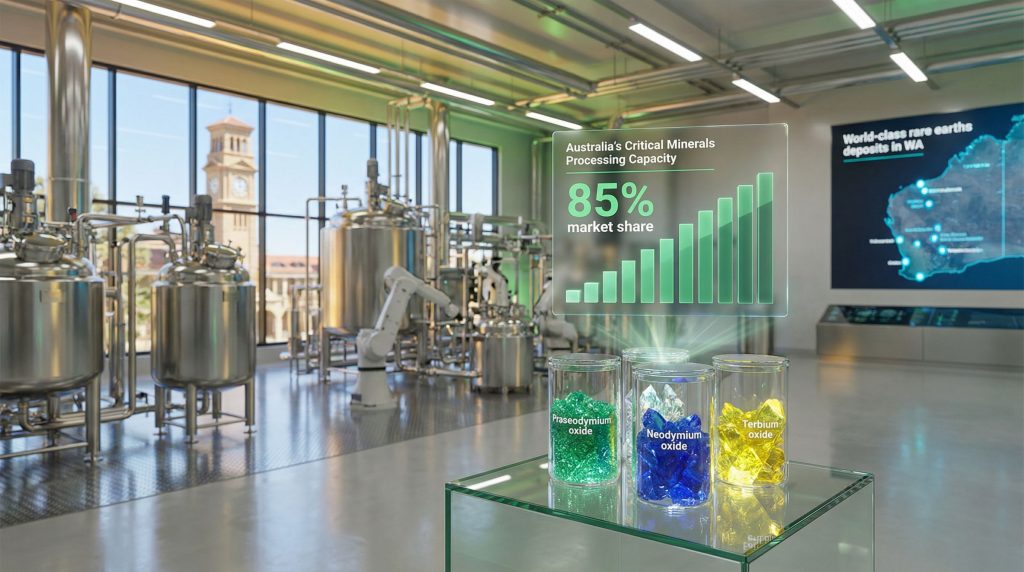
Global rare earth processing capacity remains heavily concentrated within Chinese facilities, representing approximately 85% of worldwide production capacity. Consequently, this geographical concentration creates significant supply chain vulnerabilities for Western manufacturers dependent on processed rare earth materials for advanced technology applications.
Critical Materials Processing Economics
Economic analysis reveals substantial value capture opportunities through domestic processing initiatives. Raw rare earth concentrates typically trade at $8-15 per kilogram, while processed rare earth oxides command prices ranging from $50-1,200 per kilogram depending on element specifications and purity levels.
High-Value Rare Earth Elements by Market Pricing:
- Terbium oxide: $800-1,200/kg (green phosphors, fluorescent lighting)
- Dysprosium oxide: $300-500/kg (permanent magnets, wind turbines)
- Europium oxide: $200-400/kg (LED phosphors, display technologies)
- Neodymium oxide: $50-80/kg (permanent magnets, electric vehicles)
- Praseodymium oxide: $60-90/kg (magnets, metal alloys)
Infrastructure Asset Availability
The recent closure of Albemarle's Kemerton facility has created unique asset acquisition opportunities within Western Australia's processing landscape. The facility's established infrastructure includes specialised chemical processing equipment, regulatory approvals for hazardous materials handling, and proximity to port facilities for international export capabilities.
Environmental permits and operational licences already secured for the Kemerton site could significantly reduce regulatory timeframes for new critical minerals processing ventures. Moreover, the facility's design specifications for lithium hydroxide production share engineering principles with rare earth element processing requirements.
Technology Transfer Opportunities in Metallurgical Processing
Hydrometallurgical expertise developed through precious metals refining provides a strong foundation for rare earth element processing technologies. Solvent extraction, ion exchange, and precipitation techniques utilised in gold purification can be adapted for individual rare earth element separation with appropriate process modifications.
The Perth Mint's processing capabilities for precious metals products exceed standards required for most rare earth applications. Existing analytical capabilities include X-ray fluorescence spectroscopy, inductively coupled plasma mass spectrometry, and fire assay techniques directly applicable to rare earth element analysis and certification.
Process Engineering Considerations
Critical differences between precious metals and Perth Mint rare earths processing primarily involve chemical reagent selection and separation sequence optimisation. Rare earth elements exhibit similar chemical properties requiring sophisticated separation techniques to achieve individual element isolation, contrasting with precious metals processing where target elements have distinct chemical behaviours.
Key Processing Technology Requirements:
- Multi-stage solvent extraction systems for element separation
- Ion exchange columns for final purification stages
- Precipitation and calcination equipment for oxide production
- Advanced analytical instrumentation for quality control
- Automated process control systems for consistent output
Environmental management protocols established for precious metals processing provide a regulatory compliance framework adaptable to rare earth operations. For instance, existing waste treatment systems, chemical storage facilities, and environmental monitoring programmes meet or exceed requirements for critical minerals processing activities.
Policy Framework Supporting Processing Development
Federal government initiatives have established substantial financial support mechanisms for domestic critical minerals processing development. The $2 billion Critical Minerals Facility provides loan guarantees, grants, and equity investments specifically targeted at downstream processing projects that enhance Australian supply chain capabilities.
Export Finance Australia has allocated dedicated funding streams for critical minerals infrastructure development, offering competitive financing terms for projects that demonstrate strategic value to national economic security. These programmes specifically prioritise projects that create domestic value-adding capabilities for Australian mineral resources, supporting the broader defence materials strategy.
State Government Strategic Positioning
Western Australian Premier Roger Cook has publicly indicated state government support for Perth Mint diversification into critical minerals processing. The Premier's endorsement reflects broader state policy objectives to capture additional value from the state's substantial mineral resource base through expanded processing capabilities.
State ownership of the Perth Mint through Gold Corporation enables strategic direction aligned with broader economic development objectives rather than short-term profit maximisation. This governance structure facilitates long-term investment planning and strategic partnerships that may not be feasible under private ownership models.
Government Support Mechanisms:
- Modern Manufacturing Initiative grants for processing infrastructure
- Research and development tax incentives for technology development
- Fast-track environmental approvals for strategic projects
- Co-investment opportunities through state investment vehicles
- Workforce development funding for specialised training programmes
Investment Structure Options for Market Entry
Joint venture partnerships with established rare earth miners offer reduced capital requirements and immediate access to feedstock materials. Lynas Rare Earths operates Australia's largest rare earth processing facility in Malaysia but has expressed interest in domestic processing capabilities to enhance supply chain security.
Technology licensing agreements with international processors could provide accelerated access to proven separation technologies whilst minimising research and development timelines. Several European and North American rare earth processors have developed proprietary separation techniques that could be adapted for Australian operations, similar to developments in the raw materials facility sector.
Phased Development Strategy
A staged approach to rare earth processing entry minimises initial capital commitments whilst demonstrating technical feasibility. Phase One operations could focus on pilot-scale processing to establish proof of concept and refine operational parameters before commercial-scale expansion.
Recommended Development Sequence:
- Pilot facility development (12-18 months, $5-10 million investment)
- Commercial demonstration plant (24-30 months, $50-100 million investment)
- Full-scale processing facility (36-48 months, $200-500 million investment)
- Integrated value chain development (60+ months, ongoing investment)
Risk mitigation strategies for each development phase include off-take agreements with end-users, government co-investment arrangements, and technology partnership agreements that share technical and commercial risks among multiple stakeholders.
Element-Specific Processing Opportunities
Heavy rare earth elements present the highest value capture opportunities due to their scarcity, critical applications, and limited global processing capacity. Dysprosium and terbium, essential for permanent magnet applications and green technology manufacturing, command premium pricing and exhibit strong demand growth projections.
Strategic element prioritisation should focus on materials with high supply risk, strong demand fundamentals, and substantial value-adding potential through domestic processing. Furthermore, defence and renewable energy applications provide stable, long-term demand profiles that support investment in specialised processing capabilities.
Market Entry Strategy Framework
| Element Category | Processing Complexity | Market Value | Strategic Priority |
|---|---|---|---|
| Heavy REEs | High | Very High | Primary focus |
| Light REE concentrates | Medium | Medium | Secondary development |
| Mixed REE products | Low | Low | Entry-level processing |
Building customer relationships in defence and aerospace applications provides access to premium pricing and long-term contractual arrangements. These sectors prioritise supply security and quality assurance over cost optimisation, creating opportunities for Australian processors to establish market position despite higher operational costs.
The next major ASX story will hit our subscribers first
Economic Impact Assessment for Processing Expansion
Capital investment requirements for rare earth processing capabilities range from $200-500 million for commercial-scale operations, depending on target production capacity and element specifications. These investments generate substantial economic multiplier effects through high-skilled employment creation and technology spillover benefits.
Revenue diversification benefits for Gold Corporation include reduced dependence on precious metals price volatility and access to growing critical minerals markets. Perth Mint rare earths processing operations could generate $100-300 million in annual revenue at full operational capacity.
Competitive Positioning Analysis
The Perth Mint's established brand recognition in precious metals markets provides credibility for expansion into critical minerals processing. International customers associate the Perth Mint brand with quality assurance, reliability, and technical expertise that translates to other metallurgical applications.
Geographic advantages include proximity to major Asia-Pacific manufacturing centres, established logistics infrastructure, and favourable time zone alignment with key export markets. In addition, Perth's port facilities provide efficient access to international shipping routes essential for global market participation.
Key Competitive Advantages:
- Brand recognition: Established reputation for quality and reliability
- Technical expertise: Decades of metallurgical processing experience
- Infrastructure: Existing processing facilities and logistics networks
- Regulatory position: Established compliance frameworks and permits
- Strategic location: Proximity to Asian markets and mineral deposits
Supply Chain Security and National Strategic Benefits
Domestic rare earth processing capability enhances Australia's strategic autonomy in critical technology supply chains. Current dependence on Chinese processing facilities creates vulnerabilities for defence contractors and technology manufacturers requiring assured access to high-purity rare earth materials.
National stockpiling capabilities could be established in conjunction with processing operations to provide strategic reserves for emergency situations or supply disruptions. The United States and European Union have identified critical minerals stockpiling as essential components of national security infrastructure.
Regional Development Outcomes
High-value manufacturing job creation in Western Australia would establish the state as a global centre for critical minerals processing expertise. Technology transfer and innovation spillovers from rare earth processing operations could catalyse additional downstream manufacturing investments, supporting broader mining industry innovation initiatives.
Enhanced investment attractiveness for international technology companies seeking secure rare earth supply sources could drive foreign direct investment in related manufacturing sectors. Companies producing permanent magnets, batteries, and advanced electronics increasingly prioritise supply chain security in location decisions.
Australia's participation in the AUKUS partnership and Quad strategic initiatives creates additional opportunities for rare earth processing collaboration with allied nations seeking supply chain diversification from Chinese sources.
Implementation Challenges and Risk Mitigation
Environmental approval processes for chemical processing operations require comprehensive environmental impact assessments and community consultation programmes. Rare earth processing generates radioactive waste streams that must be managed according to strict regulatory protocols.
Workforce development programmes must address the specialised technical skills required for rare earth element separation and purification processes. However, training partnerships with universities and technical institutions could provide ongoing capability development support.
Technical and Financial Risk Factors
Technology acquisition and intellectual property considerations may require licensing agreements or joint ventures with international rare earth processors. Proprietary separation technologies are closely guarded by existing market participants.
Primary Risk Categories:
- Technical risks: Process development and optimisation challenges
- Market risks: Rare earth price volatility and demand fluctuations
- Regulatory risks: Environmental approvals and compliance requirements
- Financial risks: Capital intensity and long payback periods
- Competitive risks: Established Asian processor advantages
Long-term off-take agreements with end-users provide revenue stability and financing support for capital investments. Defence contractors and renewable energy manufacturers increasingly seek supply agreements that ensure material availability and price predictability.
Success Metrics and Strategic Vision
Processing capacity targets of 5,000-10,000 tonnes per annum of rare earth oxides would establish Australia as a significant participant in global markets whilst remaining achievable given domestic resource availability and market demand projections.
Product quality specifications must meet or exceed international standards for individual rare earth oxides, with purity levels above 99.9% for most applications. Quality certification from recognised international bodies provides market access and premium pricing opportunities.
Long-Term Strategic Objectives
Integration with Australia's broader critical minerals value chain could establish the Perth Mint as a central processing hub for multiple rare earth producers across the continent. Shared infrastructure and technical expertise would reduce individual project risks and costs, aligning with the broader sustainable mining transformation agenda.
Technology leadership in selective rare earth processing could position Australia as a global centre of excellence for critical minerals separation technologies. Research and development collaborations with universities and international partners would maintain technological competitiveness.
Performance Indicators:
- Production capacity: 5,000+ tonnes REO per annum by 2030
- Product quality: >99.9% purity for target elements
- Market share: 5-10% of non-Chinese rare earth processing capacity
- Revenue contribution: $100-300 million annually at full capacity
- Employment creation: 200-400 high-skilled technical positions
The success of Perth Mint rare earths processing expansion could serve as a model for other government-owned entities considering diversification into critical minerals processing, demonstrating the viability of leveraging existing metallurgical expertise for strategic economic development objectives.
This analysis is based on publicly available information and industry research. Readers should conduct independent due diligence before making investment decisions. Market conditions and regulatory frameworks may change, affecting the viability of processing expansion opportunities.
Ready to Capitalise on Australia's Critical Minerals Boom?
Discovery Alert's proprietary Discovery IQ model delivers real-time notifications on significant ASX mineral discoveries, instantly empowering subscribers to identify actionable opportunities ahead of the broader market. Explore how major mineral discoveries can generate substantial returns by visiting Discovery Alert's dedicated discoveries page, then begin your 14-day free trial today to position yourself ahead of the market.