May 14, 2026
Understanding Peru's Geological Advantages in the Global Copper Market
The Andean copper belt stretches over 7,000 kilometers along South America's western coast, containing some of the richest copper deposits on Earth. Within this geological treasure trove, Peru stands as a mining powerhouse with extraordinary untapped potential that could reshape global supply dynamics. The nation's copper reserves exist within world-class porphyry systems, where large-scale, low-grade deposits have sustained mining operations for decades while offering expansion opportunities that remain largely unexploited.
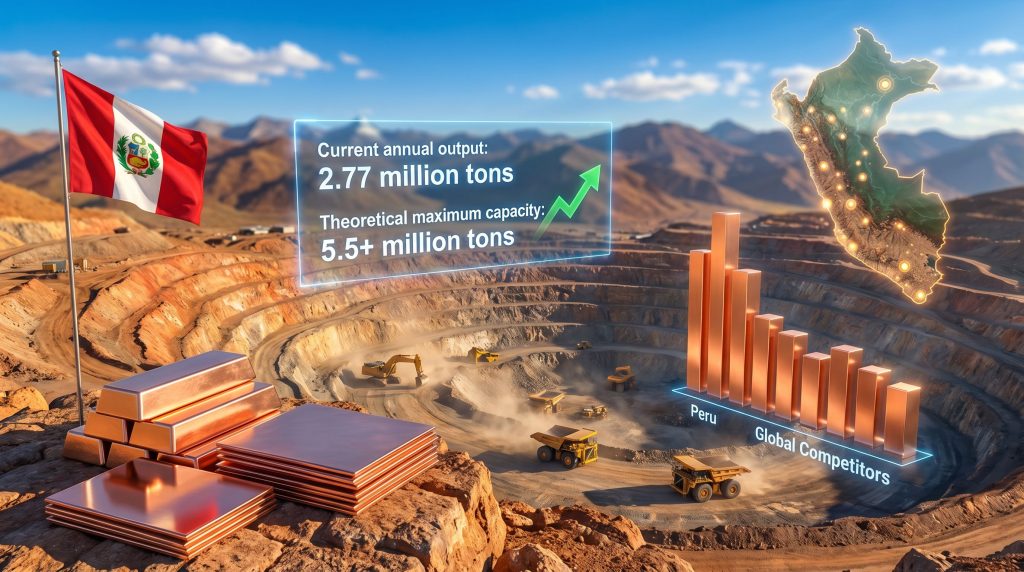
Peru's mining sector operates at approximately half of its theoretical geological capacity, suggesting that Peru could double copper production through systematic development of existing deposits and advancement of stalled projects. This capacity utilisation gap represents one of the most significant opportunities in global copper supply, particularly as the world transitions toward renewable energy systems requiring unprecedented amounts of the red metal.
Current Production Landscape:
- Annual copper output: 2.4 million tons (2024 estimates)
- Global market share: Approximately 10-12%
- Number of operating mines: 23 major copper operations
- Reserve grade average: 0.6-1.1% copper content
- Economic impact: $12-15 billion in annual export value
The geological advantages extend beyond simple tonnage. Peruvian copper deposits often contain valuable by-products including molybdenum, gold, and silver, creating additional revenue streams that improve project economics. These polymetallic characteristics make Peru particularly attractive for mining companies seeking to maximise returns from single operations.
When big ASX news breaks, our subscribers know first
Economic Drivers Behind Peru's Production Expansion Potential
The pathway to doubled copper production hinges on addressing fundamental infrastructure constraints that have historically limited Peru's mining sector growth. These bottlenecks span transportation networks, power generation, water management, and processing capabilities, each requiring substantial capital investment but offering clear pathways to increased output.
Transportation Infrastructure Challenges:
- Limited rail capacity connecting highland mines to coastal ports
- Port throughput constraints at Callao and regional terminals
- Mountain highway systems requiring significant upgrades
- Last-mile logistics from remote mining sites
Current estimates suggest that Peru could double copper production with investments totalling $20-35 billion across all infrastructure categories over the next decade. This figure represents both the scale of the opportunity and the commitment required from government and private sector stakeholders. Furthermore, understanding the global copper supply forecast helps contextualise Peru's potential contribution to worldwide availability.
Power Generation Requirements:
Mining operations consume approximately 3.5 GWh of electricity per ton of copper produced. Doubling production would require an additional 8-10 GW of installed capacity in mining regions, necessitating new generation projects and transmission infrastructure. The shift toward renewable energy sources adds complexity but aligns with global sustainability trends increasingly demanded by copper consumers.
Water Resource Management:
Peru's copper mining regions face significant water stress, with competing demands from agricultural communities, urban populations, and industrial users. Advanced water recycling technologies and desalination projects could unlock production potential while addressing environmental concerns. Some mining operations already achieve 85-90% water recycling rates, demonstrating the technical feasibility of water-efficient expansion.
Labour Market Dynamics:
The mining sector directly employs approximately 200,000 workers, with potential to create 350,000-400,000 additional jobs through production expansion. However, skills gaps exist in specialised areas including:
- Automated mining equipment operation
- Environmental compliance and monitoring
- Advanced metallurgical processing
- Digital mining technologies
- Community relations and social impact management
Regulatory Framework Analysis and Permitting Challenges
Peru's regulatory environment presents both opportunities and obstacles for mining expansion. Environmental impact assessments average 3-4 years for major projects, compared to 18-24 months in Chile, creating competitive disadvantages that directly impact the timeline for achieving doubled production capacity.
Permitting Process Comparison:
| Jurisdiction | Average EIA Timeline | Success Rate | Key Requirements |
|---|---|---|---|
| Peru | 3-4 years | 60-70% | Community consultation, biodiversity studies |
| Chile | 18-24 months | 75-80% | Water rights, indigenous consultation |
| Mexico | 2-3 years | 65-75% | Environmental bonds, restoration plans |
Community Engagement Complexities:
Social licence considerations have become increasingly sophisticated, with approximately 35-40% of mining conflicts related to water resource concerns and 30-35% involving land use disputes. Successful projects now require extensive community development programmes, environmental monitoring systems, and revenue-sharing agreements that extend far beyond traditional corporate social responsibility initiatives.
Key Regulatory Improvements Needed:
- Streamlined permitting for expansion of existing operations
- Standardised environmental monitoring protocols
- Enhanced dispute resolution mechanisms
- Clearer guidelines for community consultation requirements
- Accelerated approval processes for infrastructure projects supporting mining
The mining permitting process directly impacts whether Peru could double copper production within the next decade. Reform initiatives focusing on process efficiency whilst maintaining environmental standards could reduce project development timelines by 18-24 months.
Major Mining Companies' Investment Strategies in Peru
International mining corporations evaluate Peruvian opportunities through sophisticated risk-adjusted return frameworks that account for political stability, operational costs, infrastructure access, and resource quality. These assessments increasingly favour Peru due to its geological advantages and improving business environment.
Investment Decision Factors:
- Resource Quality: Ore grades averaging 0.7-1.0% copper content
- Political Risk Assessment: Moderate risk premium of 1-3% above developed markets
- Operational Cost Structures: Labour costs 25-35% below developed market equivalents
- Infrastructure Proximity: Access to existing transportation and power networks
- Expansion Potential: Ability to increase production from existing operations
Major Development Projects in Pipeline:
| Project | Operator | Investment Scale | Production Capacity | Development Stage |
|---|---|---|---|---|
| Quellaveco | Anglo American | $5.3 billion | 300,000 tons annually | Construction phase |
| Corani | Bear Creek Mining | $1.8 billion | 250,000 tons annually | Permitting stage |
| Los Chancas | Southern Copper | $2.6 billion | 150,000 tons annually | Feasibility study |
These projects alone could contribute 700,000 tons of additional annual copper production, representing approximately 30% of the increase needed for Peru to achieve doubled output. The remaining capacity would come from expansions at existing operations and development of smaller-scale projects. Consequently, companies are implementing copper growth strategy insights to maximise returns from these opportunities.
Technology Integration in Investment Planning:
Leading mining companies increasingly factor digital transformation potential into their Peruvian investment decisions. Advanced technologies offer significant value creation opportunities:
- Autonomous mining equipment: 10-15% reduction in operational costs
- Predictive maintenance systems: 90-95% equipment uptime achievement
- Real-time ore grade optimisation: 5-8% improvement in mill throughput
- Integrated mine planning software: 12-18% improvement in resource utilisation
Technology Innovation Opportunities in Peruvian Mining
The potential for Peru to double copper production increasingly depends on technology adoption that can unlock efficiency gains and enable exploitation of previously uneconomical deposits. Digital mining technologies represent a paradigm shift in how copper extraction operations can be optimised and scaled.
Automation and AI Implementation:
Advanced automation systems demonstrate measurable impact on production efficiency and safety performance. Peruvian mines implementing autonomous haulage systems report:
- Operating cost reductions of 8-12%
- Safety incident reductions of 60-70%
- Equipment utilisation improvements of 15-20%
- Fuel efficiency gains of 10-15%
Processing Technology Advances:
Next-generation metallurgical processes could enable economic extraction from lower-grade deposits that comprise significant portions of Peru's copper resources:
- Bioleaching applications: Suitable for oxide and sulfide ores below 0.4% grade
- Electrowinning improvements: 95%+ copper recovery from solution
- Concentrate optimisation: Higher-grade concentrates reducing shipping costs
- Tailings reprocessing: Recovery of copper from historical waste streams
Environmental Technology Integration:
Sustainable mining technologies address regulatory requirements whilst improving operational efficiency:
- Water recycling systems: Achieving 85-90% water reuse rates
- Dust suppression technologies: Reducing environmental impact in arid regions
- Renewable energy integration: Solar and wind power for remote operations
- Carbon footprint reduction: Process optimisation reducing energy consumption per ton
Moreover, the mineral exploration importance in identifying new deposits continues to drive technological innovation across the sector.
Global Market Impact of Doubled Peruvian Production
The scenario where Peru could double copper production would fundamentally alter global copper market dynamics, potentially adding 2.4 million tons of annual supply to world markets. This increase represents approximately 8-9% of current global copper mine production, sufficient to meaningfully impact price volatility and supply security.
Supply Chain Rebalancing Effects:
Doubled Peruvian production would reduce global supply concentration risk currently dominated by Chile (28% of global production) and Peru (12% of global production). The expanded output could:
- Moderate copper price volatility during demand surges
- Provide supply flexibility during geopolitical disruptions
- Support aggressive electrification and renewable energy deployment
- Reduce dependence on recycled copper during transition periods
Market Share Evolution Scenarios:
| Production Scenario | Peru Output | Global Market Share | Strategic Impact |
|---|---|---|---|
| Current Baseline | 2.4M tons | 10-12% | Regional player |
| Moderate Growth | 3.5M tons | 14-16% | Major supplier |
| Doubled Production | 4.8M tons | 18-20% | Market influencer |
Energy Transition Support:
Global copper demand for energy transition applications is projected to reach 8-12 million tons annually by 2035, driven by:
- Electric vehicle manufacturing requiring 180-200 kg copper per vehicle
- Solar power installations using 4-5 tons copper per MW of capacity
- Wind turbine construction requiring 3-4 tons copper per MW
- Grid infrastructure upgrades supporting renewable energy integration
Peru's expanded production capacity would directly support these applications whilst potentially moderating record high copper prices that could otherwise constrain energy transition progress.
The next major ASX story will hit our subscribers first
Investment Opportunities and Strategic Positioning
The pathway for Peru to double copper production creates multiple investment opportunities across the mining value chain, infrastructure development, and supporting services. These opportunities span different risk profiles and capital requirements, offering entry points for various investor types.
Direct Mining Investment Strategies:
- Large-cap mining companies: Established producers with Peruvian operations expansion plans
- Mid-cap exploration companies: Developers advancing projects through feasibility studies
- Royalty and streaming companies: Providing financing for development projects
- Private equity funds: Targeting operational improvements and expansion projects
Infrastructure Investment Categories:
- Transportation projects: Rail lines, port facilities, highway improvements ($8-12 billion total investment)
- Power generation: Renewable energy projects serving mining regions ($6-10 billion investment)
- Water infrastructure: Desalination plants, recycling systems ($3-5 billion investment)
- Processing facilities: Smelters, refineries, concentrate plants ($4-7 billion investment)
Risk Management Considerations:
Political and Regulatory Risks:
- Mining tax policy changes affecting project economics
- Environmental regulation evolution impacting permitting
- Community relations requiring ongoing social investment
- Currency fluctuation affecting USD-denominated revenues
Operational Risk Factors:
- Water availability during extended drought periods
- Skills shortage constraining expansion timelines
- Equipment supply chain disruptions
- Commodity price volatility affecting project viability
ESG Integration Requirements:
- Environmental monitoring and compliance systems
- Community development programme implementation
- Worker safety and health standard maintenance
- Climate change adaptation and mitigation measures
Future Outlook and Strategic Implications
The question of whether Peru could double copper production extends beyond technical feasibility to encompass coordination across government policy, private investment, infrastructure development, and social acceptance. The convergence of these factors over the next 8-10 years will determine whether Peru can realise its geological potential.
Critical Success Factors:
- Regulatory reform: Streamlined permitting reducing development timelines by 24-36 months
- Infrastructure investment: Coordinated public-private partnerships addressing capacity constraints
- Technology adoption: Industry-wide implementation of efficiency-enhancing systems
- Social licence maintenance: Sustainable community engagement and benefit-sharing models
- Environmental innovation: Advanced technologies minimising ecological impact
Timeline Considerations:
Realistic assessment suggests that significant production increases would begin materialising in the late 2020s, with full doubled-production potential achievable by the mid-2030s. This timeline reflects:
- 4-6 years for major project development and construction
- 2-3 years for infrastructure upgrades and expansion
- Ongoing technology implementation and optimisation phases
- Gradual scaling of operations to full capacity
Global Copper Market Integration:
Peru's expanded copper production would integrate into global markets during a period of unprecedented demand growth driven by electrification and renewable energy deployment. This timing alignment creates favourable conditions for:
- Sustained higher copper prices supporting project economics
- Strong demand absorption of increased supply
- Strategic importance recognition from consuming nations
- Technology transfer and knowledge sharing opportunities
The realisation of Peru's potential to double copper production represents one of the most significant opportunities in global copper supply development. Success would position Peru as a cornerstone supplier for the global energy transition whilst demonstrating how geological endowment, combined with strategic development and responsible mining practices, can create sustained economic value for producing nations and consuming markets alike. Furthermore, these developments align with Peru's comprehensive mining expansion strategy and industry reports highlighting the sector's growth potential.
This analysis is based on publicly available information and industry assessments. Mining investments carry significant risks, and actual results may differ from projections. Investors should conduct thorough due diligence and consider professional advice before making investment decisions.
Ready to Capitalise on Peru's Copper Production Potential?
Discovery Alert's proprietary Discovery IQ model delivers real-time alerts on significant ASX mineral discoveries, instantly empowering subscribers to identify actionable copper and mining opportunities ahead of the broader market. Understand why historic discoveries can generate substantial returns by visiting Discovery Alert's dedicated discoveries page and begin your 14-day free trial today to position yourself ahead of the market.