June 11, 2026
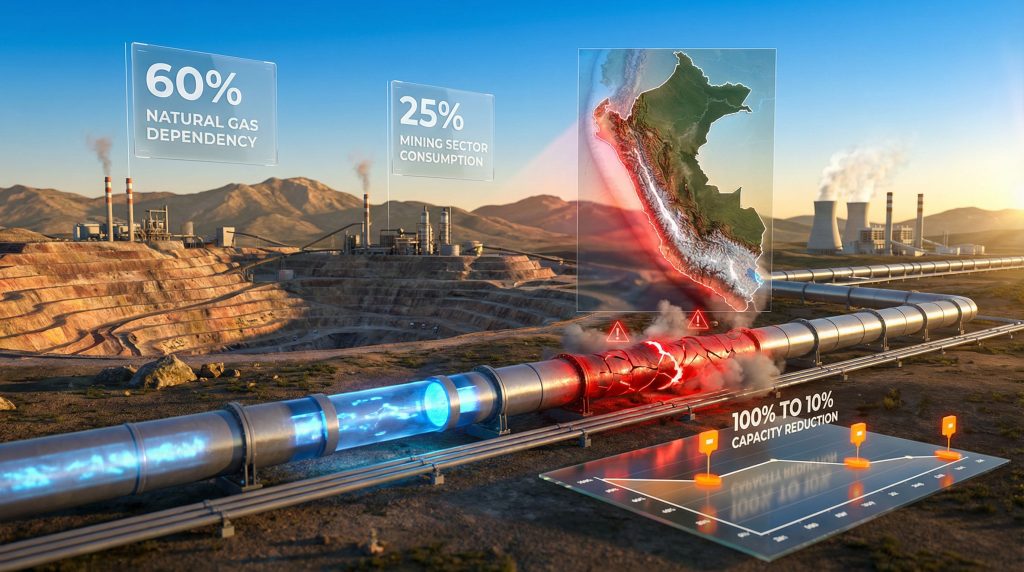
Peru's mining sector faces unprecedented vulnerability as a single pipeline rupture exposes critical weaknesses in South America's energy infrastructure. When Peru taps fuel reserves to combat energy crunch, the country's heavy reliance on natural gas for electricity generation creates cascading risks across industrial operations, particularly affecting copper production facilities that consume nearly one-quarter of national electricity demand. When energy distribution systems concentrate through limited pathways, operational disruptions can trigger nationwide economic consequences within hours.
Understanding Peru's Strategic Energy Dependencies
Peru's electricity generation framework relies predominantly on natural gas, which provides approximately 60% of total power generation capacity. This dependency creates what energy analysts term "single point of failure" vulnerability, where disruption to primary gas infrastructure can compromise nationwide industrial operations.
The country's mining sector represents a particularly energy-intensive consumer, demanding approximately 25-30% of national electricity supply. Major copper mining operations require continuous, high-quality electrical supply with reliability thresholds exceeding 99.5% uptime compared to 99% for residential consumers. Furthermore, these operations cannot easily reduce power consumption without triggering immediate production slowdowns.
Critical Infrastructure Specifications:
• Pipeline Network: Three primary systems serving different geographic regions
• Camisea Field Output: 1.1 billion cubic feet per day under normal operations
• Distribution Pressure: Operating at 1,000-1,200 PSI across 408-kilometre transmission corridors
• Industrial Allocation: Mining operations receive 30-35% of distributed supply during emergencies
The Transportadora de Gas del Perú (TGP) operates the primary distribution network connecting Peru's Amazon gas fields to coastal industrial centres. This infrastructure serves as the critical link between domestic energy production and the mining operations concentrated in highland regions.
Energy diversification remains limited, with renewable sources accounting for a smaller percentage of the overall generation mix. Hydroelectric capacity provides additional baseload power, however, seasonal variations and climate dependency create additional vulnerability layers during extended dry periods.
When big ASX news breaks, our subscribers know first
Analysing the March 2026 Infrastructure Crisis
On March 1, 2026, a pipeline rupture in the Megantoni district triggered the most severe energy shortage Peru had experienced in two decades. The incident reduced gas supply from full operational capacity to approximately 10% within 72 hours, creating immediate supply chain disruptions across multiple industrial sectors.
Crisis Timeline and Impact Magnitude:
- Day 1 (March 1): Initial pipeline rupture in Amazon transmission corridor
- Days 2-3: TGP implemented emergency isolation protocols
- Day 4 (March 5): Government suspended all natural gas exports
- Day 5 (March 6): Comprehensive emergency measures announced
The supply reduction represented a deficit of approximately 990 million cubic feet per day, forcing immediate prioritisation decisions across residential, commercial, and industrial consumers. Moreover, the US natural gas forecast shows similar infrastructure vulnerabilities affecting global markets. Energy and Mines Minister Angelo Alfaro's congressional testimony confirmed the severity exceeded initial projections, with delivery capacity falling to historic lows.
Technical Response Protocols:
Emergency response procedures involved isolating the affected pipeline section using remotely operated shut-off valves, followed by sequential depressurisation to prevent secondary failures. The geographic isolation of the rupture point in Amazonian terrain complicated repair operations and extended recovery timelines significantly.
TGP prioritised residential and essential services including hospitals and water treatment facilities over industrial allocation. This decision framework reflected regulatory requirements for emergency resource distribution, but created immediate operational constraints for mining companies dependent on continuous electrical supply.
The Pluspetrol Pisco fractionation plant suspension eliminated approximately 70% of Peru's domestic LPG production capacity, creating secondary energy shortages affecting residential heating, cooking, and additional industrial processes beyond electricity generation.
Copper Production Vulnerabilities During Energy Disruptions
As the world's second-largest copper producer, Peru's mining sector represents both economic significance and operational complexity during energy crises. Annual copper production of approximately 2.3 million metric tons requires continuous energy-intensive processing operations that cannot easily accommodate supply interruptions.
Energy Intensity Requirements:
Major copper mining facilities operate with substantial electrical demands that exceed typical industrial consumers. The largest operations maintain peak capacity requirements ranging from 400-800 MW, with combined consumption representing 60-70% of Peru's industrial electricity demand.
| Mining Operation | Peak Capacity (MW) | Annual Production (MT) | Energy Intensity |
|---|---|---|---|
| Antamina | 750-800 | 700,000-800,000 | 3.5-4.0 MWh/MT |
| Las Bambas | 500-600 | 600,000-700,000 | 3.8-4.2 MWh/MT |
| Cerro Verde | 400-500 | 450,000-550,000 | 3.2-3.7 MWh/MT |
During the March crisis, mining operations faced immediate operational adjustments as electricity allocation shifted toward residential consumers. Production typically reduces to 60-70% capacity within 24 hours of energy constraints, with some facilities experiencing 15-20% output reductions during extended supply disruptions. In addition, the broader copper production outlook indicates similar vulnerabilities across major producing regions.
Emergency Power Generation Challenges:
Mining companies maintain diesel-powered backup generators providing 20-40% of primary power capacity, but extended emergency generation increases operational costs by 30-50%. Emergency diesel generation costs approximately $0.15-0.20 per kWh compared to standard grid electricity at $0.08-0.12 per kWh.
The technical requirements for copper processing demand continuous voltage supply with minimal harmonic distortion. Voltage fluctuations can damage specialised processing equipment, making backup power systems complex and expensive to implement effectively across large-scale operations.
Government Emergency Response and Resource Allocation
Prime Minister Denisse Miralles announced comprehensive emergency measures on March 6, 2026, implementing remote work mandates for public and private sector employees while shifting educational systems to online learning protocols. These decisions reflected strategic resource conservation aimed at preserving residential energy access.
Immediate Operational Adjustments:
• Workforce Modifications: Remote work implementation affecting millions of employees
• Educational System: Online learning transition for 6+ million students
• Transportation Restrictions: Private vehicle fuel rationing in metropolitan areas
• Export Suspension: Natural gas exports halted to preserve domestic supply
The government's emergency allocation framework prioritised residential consumers at 40-45% of distributed supply, with industrial mining operations receiving secondary allocation at 30-35%. Commercial and other industrial sectors received tertiary allocation representing 15-20% of available capacity.
Strategic Reserve Deployment:
Peru accessed strategic petroleum reserves to supplement energy supply during the crisis, implementing fuel distribution protocols for critical sectors. The National Chamber of Mining, Oil and Energy (SNMPE) coordinated emergency LPG import arrangements to offset domestic production losses from the Pluspetrol plant suspension.
Emergency resource management during energy crises requires balancing essential services preservation with economic continuity across industrial sectors.
The 14-day emergency period provided legal authority for comprehensive resource reallocation, including export suspension procedures and domestic consumption prioritisation measures designed to maintain social stability while supporting critical economic activities. Consequently, when Peru taps fuel reserves to combat energy crunch, the strategic approach reflects lessons learned from energy transition security planning across resource-dependent economies.
Long-Term Infrastructure Resilience Assessment
The March 2026 crisis exposed fundamental vulnerabilities in Peru's energy infrastructure design, highlighting risks associated with concentrated distribution pathways and limited redundancy systems. Single pipeline dependency creates cascading failure potential where one technical incident can compromise nationwide industrial operations.
Critical Infrastructure Gaps:
• Geographic Concentration: Primary gas infrastructure serves coastal zones while mining operations concentrate in highland regions
• Alternative Distribution: Limited backup pipeline systems for emergency supply routing
• Renewable Integration: Insufficient diversification away from fossil fuel dependencies
• Storage Capacity: Strategic reserve levels inadequate for extended disruptions
Energy security analysts emphasise that Peru's infrastructure concentration mirrors patterns seen in other resource-dependent economies, where rapid industrial development outpaces diversified energy system planning. The Amazon-to-coast pipeline route represents both economic efficiency and systemic vulnerability.
Investment Priorities for Risk Mitigation:
- Redundant Pipeline Networks: Secondary distribution pathways for emergency routing
- Regional Energy Hubs: Distributed generation capacity reducing transmission dependencies
- Renewable Capacity Expansion: Solar, wind, and additional hydroelectric development
- Strategic Storage Expansion: Increased fuel reserve capacity for extended crisis periods
Mining companies increasingly evaluate energy security as a primary investment criterion, incorporating backup system requirements and infrastructure resilience assessments into project planning frameworks. The financial impact of extended energy disruptions can exceed operational cost increases, affecting long-term production commitments and contract fulfilment. Furthermore, evolving mining industry trends emphasise infrastructure resilience as a competitive advantage.
Global Mining Sector Implications and Market Responses
Energy infrastructure vulnerabilities in major mining jurisdictions create ripple effects across global commodity markets, particularly when production disruptions affect supply chain reliability. Peru's position as the world's second-largest copper producer means domestic energy crises can influence international pricing and inventory management strategies.
Market Psychology During Supply Disruptions:
Commodity traders monitor energy infrastructure incidents closely, as production uncertainty can trigger price volatility even when physical supply remains adequate. The March 2026 crisis occurred during a period when copper prices traded at $5.84 per pound, with market participants evaluating potential production losses against existing inventory levels.
Alternative Supplier Considerations:
Global mining companies maintain diversified production portfolios partly to mitigate jurisdictional risks including energy security concerns. When major producing regions experience infrastructure disruptions, alternative suppliers may accelerate production or delay maintenance schedules to capture market opportunities.
• Chile: Increased production scheduling from existing operations
• Australia: Expedited shipment schedules to capture price premiums
• Indonesia: Enhanced output from smaller-scale operations
• Democratic Republic of Congo: Accelerated export timelines where infrastructure permits
The interconnected nature of global mining operations means that energy crises in one jurisdiction can create economic opportunities in others, but also highlights the systemic risks associated with concentrated production in energy-vulnerable regions. However, copper market investments continue reflecting long-term demand fundamentals despite short-term supply disruptions.
The next major ASX story will hit our subscribers first
Investment Decision Framework for Energy-Dependent Operations
Mining companies increasingly incorporate energy security assessments into project evaluation criteria, recognising that infrastructure reliability affects long-term operational viability. The Peru crisis demonstrates how energy vulnerabilities can transform from theoretical risks into immediate operational challenges within days.
Risk Assessment Criteria:
• Infrastructure Redundancy: Multiple energy supply pathways and backup generation capacity
• Regulatory Framework: Government emergency response protocols and resource allocation priorities
• Geographic Diversification: Production exposure across multiple jurisdictions with different energy profiles
• Operational Flexibility: Ability to adjust production schedules during supply disruptions
Energy cost modelling now includes crisis scenario planning, where companies evaluate financial impacts of emergency diesel generation and reduced production capacity. These assessments influence capital allocation decisions and long-term strategic planning processes.
Technology Integration Opportunities:
Advanced mining operations explore energy storage systems, on-site renewable generation, and intelligent grid management technologies to reduce dependency on centralised energy infrastructure. These investments require substantial capital expenditure but provide operational continuity during regional energy crises.
Mining companies with diversified energy sourcing and robust backup systems demonstrate greater resilience during infrastructure disruptions, often maintaining higher production levels and capturing market share when competitors face operational constraints.
Emergency Management Protocols and Industry Best Practices
The Peru crisis highlights the importance of coordinated emergency response between government agencies, energy infrastructure operators, and industrial consumers. Effective crisis management requires pre-established communication protocols, clear priority frameworks, and flexible resource allocation mechanisms.
Multi-Sector Coordination Elements:
- Real-Time Information Sharing: Government-industry communication systems for rapid decision-making
- Priority Classification Systems: Clear criteria for essential vs. non-essential service designation
- Resource Pooling Arrangements: Industry collaboration for emergency fuel procurement
- Recovery Timeline Optimisation: Coordinated repair scheduling and alternative supply activation
The National Chamber of Mining, Oil and Energy (SNMPE) demonstrated industry coordination capabilities by organising emergency LPG import arrangements in record time, showcasing the effectiveness of pre-established supplier relationships and rapid procurement protocols. Additionally, Peru's energy security measures reflect coordinated policy responses to infrastructure vulnerabilities.
Lessons for Sector Resilience:
Mining companies benefit from developing comprehensive energy security plans that extend beyond immediate operational requirements. These plans should include supplier diversification strategies, emergency procurement protocols, and coordination frameworks with government agencies and industry associations.
The March 2026 crisis reinforces the strategic importance of energy infrastructure investment and diversification for maintaining stable mining operations in resource-dependent economies. Companies with robust emergency planning and flexible operational capabilities demonstrate superior resilience when facing unexpected infrastructure disruptions.
In conclusion, when Peru taps fuel reserves to combat energy crunch, the experience provides valuable insights for resource-dependent economies worldwide. The crisis demonstrates that infrastructure resilience requires continuous investment, diversified energy portfolios, and coordinated emergency response capabilities across government and industry stakeholders.
Disclaimer: This analysis is based on publicly available information and industry reports. Investment decisions should consider multiple factors beyond energy infrastructure considerations. Commodity markets involve significant risks, and past performance does not guarantee future results. Readers should consult qualified financial advisors before making investment decisions related to mining companies or commodity exposure.
Looking to Capitalise on Mining Infrastructure Vulnerabilities?
Discovery Alert's proprietary Discovery IQ model provides instant alerts on significant ASX mineral discoveries, helping investors identify actionable opportunities when infrastructure challenges affect global suppliers like Peru. Start your 14-day free trial today and position yourself ahead of market disruptions that create investment opportunities for prepared investors.