July 25, 2026
The Geological Frontier That Global Capital Is Finally Pricing In
The history of copper supply cycles reveals a consistent pattern: the world tends to underinvest in exploration during periods of price weakness, then scrambles to rebuild discovery pipelines once demand accelerates beyond what existing operations can satisfy. That dynamic is now playing out at scale across the Andes, and no jurisdiction sits more centrally within it than Peru mining exploration acceleration.
Understanding why Peru's exploration renaissance matters requires stepping back from individual project announcements and examining the structural mechanics of the global copper market. Electric vehicles require roughly two to four times more copper than their internal combustion counterparts. Grid-scale renewable energy infrastructure is intensely copper-dependent. And the timeline between grassroots exploration and first commercial production typically spans 10 to 15 years, meaning the exploration capital deployed today directly determines production capacity available in the late 2030s.
Against that backdrop, Peru's geology is not merely a national asset. It is a piece of critical global infrastructure. Furthermore, the copper supply crunch that analysts have long anticipated is now arriving at precisely the moment when Peru's regulatory environment is finally reducing barriers to new discovery.
When big ASX news breaks, our subscribers know first
Why Peru's Geological Endowment Remains Structurally Underutilised
Peru ranks as the world's second-largest copper producer and holds top-five positions in global silver and zinc output, according to the US Geological Survey's annual Mineral Commodity Summaries. Yet perhaps the most striking fact about the country's resource base is not what has already been extracted, but what remains untouched.
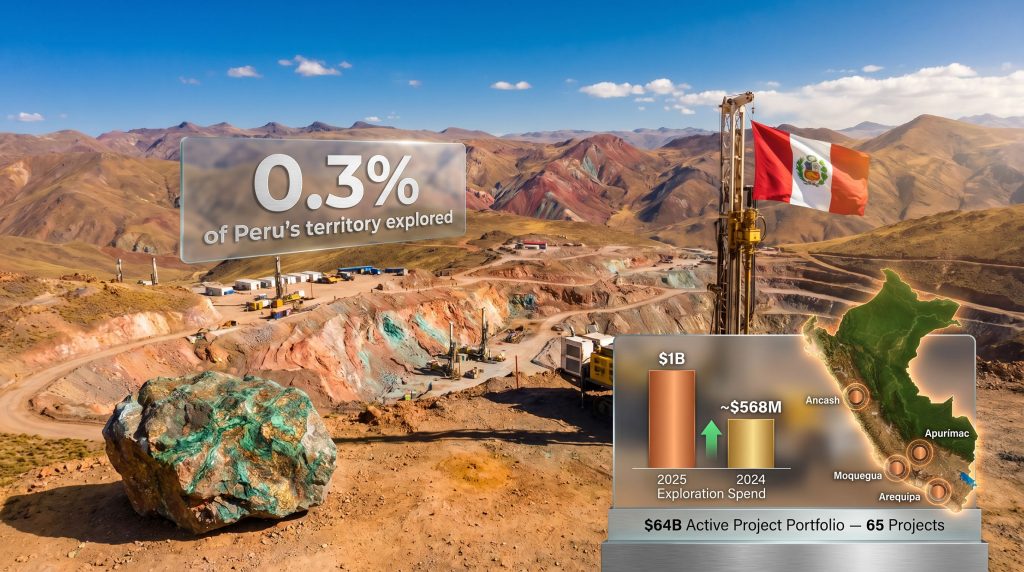
Industry figures consistently cited by Peru's mining sector indicate that only approximately 0.3% of Peru's total land area has been formally explored for mineral resources. For a country whose Andean geology hosts some of the planet's most prolific porphyry copper systems, that figure represents an extraordinary exploration gap.
What Makes Peruvian Geology So Compelling?
Porphyry copper deposits — the large, low-to-moderate grade ore bodies that supply the bulk of the world's copper — form preferentially in Andean arc settings where subducting oceanic plates drive magmatic activity deep into the continental crust. Peru sits almost perfectly within this geological sweet spot, hosting some of the most significant major copper systems found anywhere across the Andean arc.
What makes this more significant from an investment perspective is the polymetallic nature of many Peruvian deposits. Unlike single-commodity jurisdictions, Peru's ore systems frequently contain economically meaningful concentrations of gold, silver, lead, zinc, molybdenum, and increasingly, critical minerals including lithium, nickel, cobalt, tin, gallium, and germanium. A single exploration programme can therefore de-risk multiple commodity exposures simultaneously, improving the capital efficiency of early-stage investment in ways that single-commodity terrains simply cannot replicate.
Quantifying the Capital Surge: Peru's Exploration Investment Trajectory
The financial momentum behind Peru mining exploration acceleration has been building progressively. Exploration spending reached approximately $568 million in 2024, a figure representing the highest level recorded since 2014 according to industry tracking data. By 2025, that figure had climbed toward $1 billion, representing roughly 20% year-on-year growth against the prior year's already elevated baseline.
Total mining investment reached a record $6.2 billion in 2025, with the bulk of capital concentrated across four regions.
| Region | Investment Significance |
|---|---|
| Moquegua | Major copper and molybdenum systems |
| Ancash | Polymetallic corridor, established infrastructure |
| Arequipa | Large-scale copper and gold targets |
| Apurímac | High-grade copper belt, emerging infrastructure |
The broader project portfolio tracked across Peru's active mining pipeline is valued at approximately $64 billion, spanning 65 advanced-stage projects. Within that, 80 projects have been prioritised for near-term exploration, carrying combined budgets of approximately $727.5 million. Copper-focused projects account for roughly 70% of the total portfolio value, with gold, silver, lead, and zinc assets making up the remainder.
EY's Peru Mining Guide projects 3.2% annual growth in mining investment through 2028, underpinned by the current pipeline depth and ongoing regulatory improvements. That forecast carries the usual caveats associated with commodity-sensitive projections, but the directional trajectory is consistent with multiple independent tracking sources.
Investor Note: Forecasts of this nature are inherently sensitive to commodity price movements, regulatory continuity, and social licence dynamics. They should be treated as directional indicators rather than guaranteed outcomes. Past investment growth rates do not ensure future performance.
proEXPLO 2026: Reading the Market Signal
Peru's flagship exploration industry forum, proEXPLO, held in May 2026, functioned as a real-time barometer for institutional confidence in the sector. Industry conferences of this type serve a structural purpose beyond networking: they accelerate deal flow between junior explorers seeking capital, major mining houses seeking optionality on early-stage assets, and state entities communicating regulatory intent. Record-level participation at such events tends to precede increases in exploration licensing activity, suggesting that forward momentum in Peru's pipeline remains intact as of mid-2026.
The Regulatory Architecture Shift That Changed the Investment Calculus
For decades, one of the most persistent deterrents to exploration capital in Peru was not geological risk or commodity price uncertainty — it was procedural delay. Environmental permit applications and water use approvals operated as sequential processes, meaning a project could satisfy one requirement entirely before being permitted to begin the next. In practice, this created multi-year approval windows that compressed project internal rates of return and deterred smaller explorers with limited balance sheet capacity to absorb prolonged pre-production timelines.
Peru's Ministry of Energy and Mines addressed this bottleneck through a simultaneous permitting decree that allows companies to file environmental and water use permit applications concurrently. The practical impact was immediate: eight major projects were unlocked in 2025 directly attributable to the reform. Two flagship assets now scheduled for launch under the new framework illustrate the scale of value that had been sitting in procedural limbo.
| Project | Estimated Capital Value | Status |
|---|---|---|
| Galeno | $3.5 billion | Scheduled for 2026 launch |
| Michiquillay | $2.5 billion | Scheduled for 2026 launch |
In March 2026, the Peruvian government released new exploration concession areas with confirmed multi-metal potential spanning copper, gold, silver, lead, and zinc. The strategic design of this release targeted projects across varying scales, allowing both junior explorers and major mining houses to participate simultaneously rather than competing exclusively for the same large-tenure positions.
Regulatory Watch: The simultaneous permitting model represents a structural departure from Latin America's historically sequential approval culture. If this framework is sustained and expanded, it could compress project development timelines by two to four years, which materially improves the internal rate of return for exploration-stage investments. The critical caveat is that regulatory momentum in the region has historically been subject to policy reversals tied to electoral cycles.
What Sequential Permitting Was Actually Costing the Sector
The financial cost of sequential permitting is rarely discussed in terms that investors find immediately intuitive, but the arithmetic is straightforward. A copper exploration project requiring $50 million in pre-feasibility capital and facing a three-year permitting delay loses substantial net present value at any reasonable discount rate.
At a 10% discount rate, three additional years of delay reduces a project's NPV by roughly 25% before a single tonne of ore has been moved. For a $3.5 billion project like Galeno, the magnitude of that compression becomes significant enough to determine whether the project enters capital allocation queues at a major mining house.
The Discovery Gap: Why 2026 Exploration Determines 2035 Production
Quellaveco, commissioned in 2022 as Anglo American's large-scale copper operation in Moquegua, represents the most recent major mine brought into production in Peru. The gap between that commissioning and the next wave of large-scale production assets is a function of the exploration-to-production pipeline, which typically spans a decade or more from initial discovery through feasibility, financing, construction, and commissioning.
This timeline creates a structural imperative: without sustained grassroots exploration investment today, Peru's production capacity faces a ceiling in the mid-to-late 2030s regardless of what commodity prices do in the interim. The country currently holds the second-largest copper production position globally behind Chile, but defending that ranking requires continuous conversion of exploration capital into advanced-stage assets. Consequently, the mineral exploration importance of maintaining investment momentum cannot be overstated.
The broader exploration pipeline tracked by Industrial Info Resources sits at approximately $47 billion, with a significant proportion concentrated in grassroots and early-stage work. This is the raw material from which the next generation of major Peruvian mines will eventually emerge.
Junior Explorers, Majors, and the Discovery Engine
How Grassroots Risk Gets Distributed Across the Mining Sector
One of the least understood dynamics in mining investment is the functional division of geological risk between junior and major mining companies. Major producers with large operating cash flows and institutional shareholder bases are structurally incentivised to avoid the binary risk profile of early-stage exploration, where the probability of a commercially viable discovery from any individual drill hole is typically measured in low single-digit percentages.
Junior exploration companies absorb this risk profile as their core business model, funded by equity capital from investors who accept the asymmetric return structure: most exploration programmes fail to find economic mineralisation, but the ones that do can generate returns that dwarf the capital deployed. This risk transfer mechanism is why junior explorers are responsible for a disproportionately large share of significant mineral discoveries globally.
Firetail Resources illustrates this dynamic within the Peru context. Selected for BHP's Xplor 2025 programme, the company is actively drilling high-potential copper targets in Peru, including the Chancho al Palo and Ilo Este projects. BHP's Xplor initiative functions as a structural bridge between the major and junior tiers, and these majors-juniors partnerships are increasingly recognised as a core mechanism for accelerating early-stage discovery pipelines across the Andes.
BHP gains optionality on early-stage discovery upside without direct balance sheet exposure at the grassroots phase, while Firetail benefits from the de-risking signal that major-programme selection provides to capital markets. Juniors that enter BHP Xplor or similar programmes typically find subsequent equity raises more efficiently priced and more quickly oversubscribed.
Radius Gold represents another junior actively pursuing Peruvian exploration targets amid the current metals price environment, though its specific project details are best reviewed through the company's own regulatory filings for current accuracy.
Near-Term Production as a Cash Flow Bridge Strategy
An increasingly common strategy among junior explorers operating in Peru involves using near-term, small-scale production to generate operating cash flows that fund broader exploration programmes, reducing dilution from repeated equity raises.
Peruvian Metals (TSXV: PER) is pursuing this model through its Mercedes property, targeting first gold production in 2026. The operational approach involves shipping high-grade ore, estimated at 10 to 15 troy ounces per tonne, to an external toll processing facility rather than constructing dedicated processing infrastructure. The anticipated operating profit of approximately C$1 million annually from this arrangement is not transformative in isolation, but it provides a funding bridge for the company's wider exploration pipeline without requiring equity dilution at potentially unfavourable valuations.
Disclosure: Information about specific junior mining companies and their projects, including production timelines, ore grades, and financial projections, should be verified against current regulatory filings and technical reports before being used as the basis for any investment decision. Junior mining stocks carry significant risk of capital loss.
The next major ASX story will hit our subscribers first
Risk Architecture: What Could Compress Peru's Exploration Trajectory
The Social Licence Variable
Peru's exploration sector has experienced some of the most well-documented social conflicts in Latin American mining history. Community opposition has caused significant delays and permanent cancellations across multiple projects, with disputes typically centring on land access rights, downstream water use impacts, and the distribution of economic benefits between operating companies and host communities.
The post-2022 period represented a particularly challenging phase, combining political instability at the national level with heightened community activism in key mining regions. The current recovery narrative is credible but incomplete: the structural tensions around water access and benefit-sharing that historically fuel conflict have not been resolved — they have been temporarily de-escalated. Any serious due diligence framework for Peruvian exploration investment must weight social licence risk as a first-order variable rather than a secondary consideration.
Geological Complexity and the Depth Problem
A less frequently discussed risk within Peru's exploration pipeline is the progressive deepening of ore body targets. Near-surface mineralisation — the kind accessible through relatively shallow drilling programmes — has been the dominant target of Peru's exploration history. As the most accessible portions of known geological corridors become better characterised, new discoveries increasingly require deeper drilling, more sophisticated geophysical surveys, and higher capital intensity per metre of exploration.
This trend has meaningful implications for junior explorers with constrained balance sheets. Advanced geophysical technologies, including induced polarisation surveys, magnetotellurics, and 3D seismic methods adapted from oil and gas exploration, are becoming standard requirements for credible deep-target programmes. The cost differential between a shallow historical drill programme and a modern deep-target programme can be substantial, compressing the exploration budgets that smaller companies can deploy.
Macro and Commodity Price Sensitivity
The entire $64 billion project portfolio valuation is implicitly conditional on copper prices remaining within ranges that support project economics. A sustained correction in copper prices, driven by demand-side factors such as slower-than-anticipated EV adoption or supply-side surprises from competing jurisdictions, could compress exploration budgets across the sector.
Furthermore, the broader critical minerals demand trajectory underpinning Peru's investment case remains sensitive to policy decisions in major consuming economies. Peru's partial hedge through polymetallic deposit exposure provides some protection, but copper remains the primary economic driver for the majority of the portfolio.
Three Scenarios for Peru's Exploration Trajectory Through 2028
| Scenario | Exploration Spend by 2027 | Key Conditions | Production Implications |
|---|---|---|---|
| Accelerated Growth (Base Case) | Exceeds $1.2B | Reforms sustained; community engagement improves | Multiple projects advance to feasibility; top-two copper production by 2030 |
| Constrained Growth (Moderate Case) | Plateaus at $1.0B–$1.1B | Partial reform benefits; selective social conflict delays | Conversion rates below potential; current global ranking maintained |
| Disrupted Growth (Downside Case) | Retreats to $700M–$800M | Commodity correction; regulatory momentum stalls; social conflict re-escalates | Major project launches deferred; production gap widens |
The base case scenario requires watching several specific milestones through the next 24 months:
- Launch confirmation and financing for Galeno ($3.5B) and Michiquillay ($2.5B)
- Conversion rate of the 80 prioritised projects into advanced-stage assets
- Annual exploration spend trajectory against the $1 billion benchmark
- First gold production delivery from Peruvian Metals' Mercedes property
- New concession area uptake volumes following the March 2026 land release
Peru in Global Context: Competitive Positioning Among Latin American Mining Jurisdictions
| Dimension | Peru | Chile | Brazil | Argentina |
|---|---|---|---|---|
| Primary Commodity Focus | Copper, Gold, Silver | Copper, Lithium | Iron Ore, Nickel | Lithium, Copper |
| 2025 Exploration Spend | ~$1 billion | High (established) | Growing | Emerging |
| Territory Formally Explored | ~0.3% | Moderate | Moderate | Low |
| Regulatory Reform Momentum | High (2025–2026 decrees) | Moderate | Moderate | Improving |
| Social Licence Risk Profile | Moderate to High | Moderate | Low to Moderate | Moderate |
| Polymetallic Critical Mineral Depth | High (Cu, Li, Ni, Co, Ga, Ge) | Very High (Li dominant) | High (Ni, Co) | Very High (Li dominant) |
Chile's dominant position in global lithium supply creates a different competitive dynamic than its copper sector. Peru's comparative advantage lies specifically in polymetallic porphyry copper systems, where a single project can yield multiple critical minerals relevant to energy transition supply chains. For institutional investors seeking broad critical minerals exposure from a single jurisdiction, junior mining exploration in Peru offers a structurally different value proposition compared to assembling portfolios across multiple countries.
The Strategic Imperative: What the 0.3% Figure Actually Means for Long-Term Investors
Peru mining exploration acceleration is not a trend that emerged from a single regulatory reform or a short-term commodity cycle. It is the convergence of geological endowment, structural demand, and a regulatory environment that is, for the first time in many years, actively reducing friction between capital and discovery.
The 0.3% explored territory statistic is the single most important anchor for understanding the long-term investment thesis. Most mature mining jurisdictions operate in geological environments where the easy discoveries have been made, forcing exploration into higher-cost, higher-risk terrain. However, Peru has exceptional conditions to become a key player in mining exploration precisely because the vast majority of its prospective terrain has never been systematically drilled, surveyed with modern geophysical methods, or evaluated against contemporary ore deposit models.
That condition, combined with a regulatory architecture that is actively compressing approval timelines, a project pipeline valued at $64 billion, and demand fundamentals that favour copper-heavy jurisdictions for the duration of the energy transition, creates the structural foundation for what may prove to be a sustained, multi-decade exploration cycle in the Andes.
General Disclaimer: This article is intended for informational and educational purposes only and does not constitute financial or investment advice. Mining exploration involves substantial risk, including the risk of total capital loss. Forecasts, projections, and scenario analyses reflect available industry data and analytical frameworks but cannot predict actual outcomes. Readers should conduct independent due diligence and consult qualified financial advisors before making any investment decisions related to companies or projects discussed in this article.
Want to Capitalise on the Next Major ASX Mineral Discovery Before the Broader Market?
Discovery Alert's proprietary Discovery IQ model delivers real-time alerts on significant ASX mineral discoveries — including copper, gold, and critical minerals — turning complex geological data into actionable investment insights the moment they hit the exchange. Explore historic discoveries and the substantial returns they have generated, then begin your 14-day free trial at Discovery Alert to position yourself ahead of the market.