June 8, 2026
Understanding Peru's Mining Export Transformation Over Two Decades
Global commodity markets have witnessed structural shifts that transcend traditional cyclical patterns, fundamentally altering how resource-rich nations position themselves within international trade frameworks. These transformations extend beyond simple price fluctuations, encompassing technological advancement, supply chain evolution, and demand profile changes that reshape entire economic sectors over multi-decade periods.
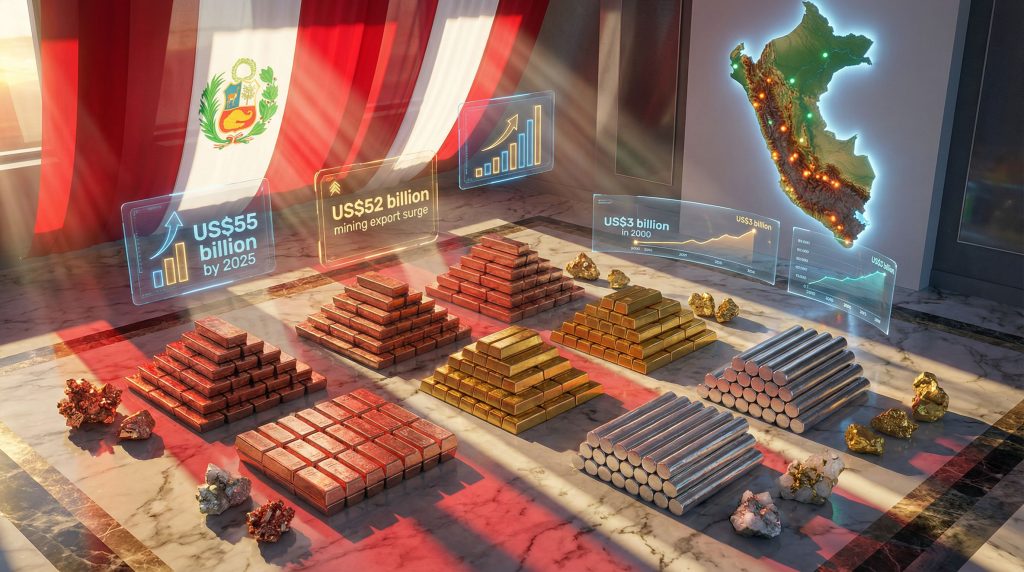
Peru's mineral export trajectory exemplifies this broader transformation, with shipment values expanding from approximately US$3 billion in 2000 to projected levels approaching US$55 billion by 2025. This 25-year growth cycle represents an 1,733% expansion that reflects Peru's strategic positioning within global supply chains serving energy transition demand, artificial intelligence computational demands, and emerging market industrialisation. The scale of Peru mining exports 2025 positions the nation as a critical supplier in global commodity markets.
The scale of this transformation positions Peru among the world's dominant mineral producers across multiple commodity categories. According to U.S. Geological Survey data, Peru maintains the number two global ranking in copper production after Chile, silver production after Mexico, zinc production after China, and lead production after China. Additionally, Peru ranks sixth globally in gold production, creating a diversified portfolio that reduces single-commodity dependency risks.
This diversification across precious and base metals creates revenue stability during commodity price volatility while capturing upside exposure to structural demand growth. The evolution from single-commodity dependence to multi-product portfolio management demonstrates how geological endowments can translate into sustained economic development when supported by appropriate investment climates and infrastructure development.
When big ASX news breaks, our subscribers know first
What Factors Explain Peru's US$52 Billion Mining Export Surge?
Structural Demand Drivers Beyond Price Volatility
The International Energy Agency's World Energy Outlook 2024 projects copper demand increases of 50% by 2050, driven primarily by renewable energy infrastructure deployment and transportation electrification. This demand growth stems from copper's essential role in energy transition technologies, where solar photovoltaic installations require 5.5 tonnes of copper per megawatt of capacity and wind turbines require 4-7 tonnes per megawatt.
Artificial intelligence infrastructure expansion creates additional copper demand through data center construction, with global data center copper requirements projected to increase 12-15% annually through 2028. Average hyperscale data centers require 200-400 tonnes of copper per facility, supporting multi-year demand visibility for copper producers. Furthermore, the global copper supply outlook indicates potential constraints that could support continued price strength.
Electric vehicle adoption acceleration further amplifies copper demand, with EVs requiring 83 kg of copper per vehicle compared to 23 kg in internal combustion engines. Global EV sales reached 14 million units in 2023, with projections indicating growth to 35 million units by 2030, creating sustained demand for copper mining operations.
Table: Peru Mining Export Growth Factors (2020-2030)
| Growth Driver | Impact Level | Time Horizon | Copper Demand Impact |
|---|---|---|---|
| Energy Transition Infrastructure | High | 2020-2035 | +25-30% by 2030 |
| AI Data Center Construction | Medium-High | 2022-2028 | +12-15% annually |
| Electric Vehicle Adoption | High | 2024-2030 | +200% unit demand |
| Emerging Market Industrialisation | High | 2005-2030 | +15-20% baseline |
Peru's export performance through September 2025 demonstrates these demand fundamentals' practical impact, with copper shipments generating US$17.264 billion, representing approximately 30% of total mining exports. Gold exports contributed US$10.999 billion, comprising 24.4% of sector revenues, with both commodities benefiting from elevated quotations reflecting structural rather than cyclical demand factors.
Commodity-Specific Performance Metrics
Peru's mining sector demonstrates remarkable geographic and geological advantages that support sustained production across multiple commodity categories. The nation's copper production primarily occurs at high-altitude operations including Las Bambas (operated by MMG Limited), Antamina (Freeport-McMoRan/BHP/Glencore consortium), and Cerro Verde (Freeport-McMoRan), with facilities operating at 3,500-4,500 meter elevations in challenging Andean environments.
These operations showcase Peru's technical capabilities in complex metallurgical processing, with most facilities producing copper concentrates requiring further smelting and refining rather than direct cathode copper production. This concentrate production model integrates Peru into global copper supply chains serving Asian manufacturers and European industrial consumers.
Peru's Global Mining Position by Commodity (2024 Data):
• Copper: World's #2 producer, ~10% global market share
• Silver: World's #2 producer, ~15% global market share
• Gold: World's #6 producer, ~4% global market share
• Zinc: World's #2 producer, ~10% global market share
• Lead: World's #2 producer, ~8% global market share
The Antamina complex exemplifies Peru's polymetallic mining capabilities, jointly operated by Freeport-McMoRan (52.5%), BHP (33.75%), Glencore (11.125%), and Mitsubishi (2.625%). This world-class asset produces copper, zinc, molybdenum, silver, and gold from a single operation, demonstrating the geological complexity and operational sophistication characteristic of Peru's mining sector.
Gold production characteristics differ significantly from copper operations, with Peru's primary gold mines including Yanacocha (Newmont Corporation) and gold as by-product from copper operations at Antamina and Cerro Verde. Peru's annual gold production reaches approximately 130-140 tonnes (4.2-4.5 million ounces), generating vastly higher revenue per unit mass than copper due to gold's current pricing near US$63,000 per kilogram versus copper at approximately US$9,500 per tonne.
Central bank gold accumulation strategies provide additional demand support beyond traditional jewellery and industrial applications. Emerging market central banks, particularly China, India, and Russia, increased reserve accumulation to approximately 1,037 tonnes in 2023, representing the highest annual total since 1967 and reflecting long-term confidence in gold's monetary role. This trend supports the broader gold market surge witnessed throughout 2025.
How Does Mining Investment Pipeline Support Future Export Growth?
Project Development Portfolio Analysis
Peru's Ministry of Economy and Finance has ratified mining investments exceeding US$23 billion across 65 distinct projects in various development stages, providing multi-year visibility for export growth continuation. This investment pipeline spans immediate deployment projects entering construction through long-term capacity initiatives in exploration stages.
Confirmed Investment Projects (2025-2030):
• Immediate deployment (2025-2026): 11 projects worth approximately US$8 billion entering construction phase
• Medium-term expansion (2027-2029): Major copper projects including Tía María and Zafranal advancing through pre-construction and permitting phases
• Long-term capacity (2030+): Exploration-stage initiatives targeting emerging commodity demands with estimated US$5 billion investment potential
The immediate deployment phase includes projects positioned to contribute to Peru mining exports 2025 performance and extend growth momentum through 2026. These near-term additions offset natural resource depletion at existing mines experiencing declining ore grades, maintaining production levels despite operational challenges at legacy facilities.
Medium-term expansion projects focus primarily on copper development, aligning with structural demand growth from energy transition infrastructure. The Tía María project represents Southern Copper Corporation's expansion of copper production capacity, while Zafranal advances as a significant copper-gold development targeting multi-metal production. However, this development occurs alongside broader mining industry evolution affecting operational approaches globally.
Geographic Distribution and Infrastructure Requirements
Investment concentration across Peru's mining regions creates economic multiplier effects through infrastructure development, regional employment generation, and supply chain integration. The geographic distribution reduces single-point-of-failure risks while maximising national economic impact through regional development.
Peru's mining operations demonstrate unique infrastructure requirements due to high-altitude locations and remote geographic positioning. Transportation networks connecting mines to Pacific export terminals require specialised equipment capable of operating in extreme elevation conditions, with many facilities located above 3,500 meters where atmospheric pressure and temperature variations create operational complexity.
The development of these infrastructure networks supports broader economic activity beyond direct mining operations, including equipment supply, maintenance services, transportation logistics, and financial services. This infrastructure foundation enables Peru's mining sector to maintain competitive cost structures despite challenging operating environments.
What Role Does Mining Play in Peru's Macroeconomic Stability?
Foreign Exchange Generation and Trade Balance
Mining exports function as Peru's primary foreign currency generator, contributing approximately 60-64% of total export revenues and providing essential support for the nation's external accounts. This dominance creates macroeconomic stability through sustained foreign exchange generation, supporting currency stability and international reserve accumulation.
Trade Balance Projections:
• 2025 surplus: Projected US$32.893 billion driven by mining export performance
• 2026 forecast: Estimated US$38.208 billion reflecting continued commodity demand strength
• Total export potential: US$100+ billion by 2027 incorporating full investment pipeline contributions
The sector's foreign exchange generation capacity provides Peru with external stability during global economic uncertainty, reducing vulnerability to capital flow volatility that affects many emerging market economies. Mining exports create predictable foreign currency inflows based on production capacity and long-term supply agreements with international buyers.
Peru's total export projection approaches US$90 billion for 2025, with mining contributing approximately 61% of this total. This concentration demonstrates mining's critical role in maintaining Peru's external balance and supporting import capacity for essential goods and capital equipment required for economic development.
GDP Contribution and Economic Multipliers
Mining's direct GDP contribution of 8.5-10% understates the sector's broader economic impact through backward and forward linkages that generate additional economic activity throughout Peru's economy. Backward linkages include equipment procurement, professional services, transportation, and input supply, while forward linkages encompass processing, logistics, and financial services.
Regional development effects extend beyond direct mining employment, creating opportunities in supporting industries and service sectors. Mining operations require sophisticated supply chains encompassing specialised equipment maintenance, technical consulting, environmental services, and workforce development programmes that benefit local communities.
The sector's high-value production generates significant tax revenues supporting government spending on infrastructure, education, and social programmes. Mining operations typically operate under fiscal regimes that ensure resource extraction benefits translate into public revenue streams supporting broader economic development objectives.
How Do Global Market Dynamics Influence Peru's Export Performance?
Commodity Price Cycles and Demand Fundamentals
Copper markets demonstrate fundamental demand support extending beyond traditional cyclical patterns, with energy transition infrastructure requirements creating multi-year demand visibility. The metal's essential role in electrical conductivity applications limits substitutability, supporting price stability even during economic uncertainty periods.
Current copper price performance reflects structural demand factors rather than speculative positioning, with recent weekly increases of 3.5% and annual gains reaching 46% by late January 2026. These price levels consolidate near multi-year highs, supported by supply constraints and sustained demand from renewable energy deployment and AI infrastructure construction.
Gold market dynamics reflect both investment demand and industrial applications, with central bank accumulation strategies providing price support alongside traditional jewellery consumption. The precious metals complex benefits from inflation hedging demand despite higher interest rates, indicating investor confidence in gold's monetary value preservation characteristics. Consequently, analysts continue to maintain optimistic views in their gold price forecast through 2025 and beyond.
"Peru's mining export performance demonstrates resilience during commodity price volatility due to diversified production across precious and base metals, providing portfolio stability for investors seeking commodity exposure."
Supply Chain Positioning and Competitive Advantages
Peru maintains several structural competitive advantages supporting long-term mining sector growth, including world-class ore bodies across multiple commodity types and established infrastructure developed through decades of mining investment. Transportation networks connecting Andean mining operations to Pacific coast export terminals provide efficient market access for Asian buyers.
The nation's regulatory framework offers stability through established mining codes and investment protection mechanisms that encourage long-term capital deployment. This legal foundation supports multi-billion dollar project development requiring 5-10 year development timelines from exploration through production.
Geographic positioning provides strategic advantages for Asian market penetration, with Pacific coast access reducing transportation costs and delivery times compared to Atlantic-facing competitors. This positioning proves particularly valuable as Asian economies drive global commodity demand growth through infrastructure development and manufacturing expansion.
What Challenges Could Constrain Future Export Growth?
Production Capacity Limitations
Near-term production growth faces constraints despite robust investment pipelines, primarily through declining ore grades at existing mines experiencing natural resource depletion. Legacy operations require increasing processing volumes to maintain output levels, raising production costs and capital requirements.
Project development timelines create execution risks for investment pipeline realisation, with regulatory approval and construction delays potentially postponing production contributions. Complex environmental permitting processes, community consultation requirements, and technical challenges in remote, high-altitude environments extend development periods.
Technical complexity increases as operations target deeper, more challenging extraction environments requiring specialised equipment and expertise. These technical requirements raise capital intensity and operational costs while potentially reducing production efficiency compared to historical performance levels.
Operational and Regulatory Risks
Critical Risk Categories:
• Illegal mining expansion: Environmental degradation and security challenges in remote regions affecting operational continuity
• Community relations: Social licence requirements for new project development and ongoing operations
• Infrastructure bottlenecks: Transportation and processing capacity limitations constraining production growth
• Environmental compliance: Evolving sustainability standards and potential carbon pricing implementation
Illegal mining activities in remote regions create security risks and environmental damage that can affect legitimate operations through increased regulatory scrutiny and community tensions. These activities complicate social licence maintenance and regulatory compliance for established operators. For instance, with prices rising, Peru could export 40% more illegal gold in 2025, highlighting the challenges facing legitimate operations.
Water resource availability represents a growing constraint as mining operations compete with agricultural and municipal users for limited water supplies in arid regions. Climate change effects on precipitation patterns and glacier retreat create additional uncertainty for water resource planning.
The next major ASX story will hit our subscribers first
How Should Investors Interpret Peru's Mining Export Trajectory?
Investment Thesis Evaluation Framework
Peru's mining sector offers compelling investment characteristics through exposure to multiple structural growth themes while maintaining diversification across commodity types. Energy transition infrastructure requirements support copper demand visibility, while precious metals provide portfolio diversification and inflation hedging characteristics.
Bullish Investment Indicators:
• Sustained global commodity demand: Energy transition and AI infrastructure driving structural consumption growth
• Robust project pipeline: US$23 billion ratified investments providing production growth visibility
• Stable macroeconomic environment: Mining export revenues supporting currency stability and external balance
• Government sector support: Policy framework encouraging mining investment and development
The sector's proven ability to generate foreign exchange during global economic uncertainty provides defensive characteristics valuable during market volatility periods. Peru's diversified commodity portfolio reduces exposure to single-metal price cycles while capturing upside from multiple demand drivers.
Risk Considerations for Investment Analysis:
• Commodity price volatility: Cyclical downturns affecting revenue and profitability despite structural demand growth
• Operational complexity: High-altitude, remote environments creating technical and logistical challenges
• Political and regulatory stability: Policy consistency requirements for long-term investment security
• Environmental and social governance: Evolving ESG standards affecting operational permits and social licence
Portfolio Allocation Strategies
Peru's mining sector enables targeted exposure to specific investment themes through commodity selection, with copper providing direct exposure to energy transition beneficiaries and precious metals offering portfolio diversification during economic uncertainty.
Investment Theme Exposure:
• Base metals focus: Copper exposure for renewable energy and electrification themes
• Precious metals allocation: Gold and silver for inflation hedging and currency diversification
• Specialty minerals: Zinc, lead, and molybdenum for industrial applications
• Infrastructure investment: Transportation, processing, and service provider opportunities
Individual investors should consider Peru's mining exposure as part of broader emerging market commodity allocation, balancing growth potential against operational and political risks inherent in resource extraction investments.
What Does the 2026 Outlook Suggest for Sustained Growth?
Short-Term Performance Expectations
Economic projections indicate continued export growth momentum through 2026, with 5% export value increases anticipated based on current commodity price levels and production capacity expansion. This growth rate reflects both volume increases from new project contributions and sustained pricing for key commodities.
Near-term production additions include contributions from the San Gabriel gold mine and Antamina expansion projects, providing incremental output supporting export value growth. These facility expansions demonstrate Peru's ability to maintain production growth despite challenges at legacy operations experiencing natural resource depletion.
Gold and copper performance continues driving sector revenues, with both commodities maintaining elevated quotations reflecting fundamental demand support rather than speculative positioning. This pricing stability provides revenue predictability supporting investment planning and expansion decisions.
Long-Term Strategic Positioning
Peru's mining sector demonstrates strong positioning for sustained growth through technology adoption including artificial intelligence, automation systems, and operational efficiency improvements. These technological advances enable productivity gains offsetting challenges from declining ore grades and increasing operational complexity.
Sustainability leadership initiatives address evolving environmental and social governance requirements while maintaining operational efficiency. These programmes include water conservation, renewable energy adoption, and community development initiatives that strengthen social licence for continued operations.
Market diversification beyond traditional commodity buyers creates opportunities for value-added processing and downstream integration. Peru's strategic location and established infrastructure position the nation to capture additional value through mineral processing and refined product exports.
Value-added processing opportunities enable Peru to move beyond raw material exports toward higher-value products serving specialised industrial applications. This processing capability development reduces dependency on commodity price cycles while creating additional employment and economic value.
The sector's transformation from a US$3 billion annual export base to projected US$55 billion levels demonstrates Peru's successful evolution into a global mining powerhouse. Structural foundations including geological endowments, infrastructure development, and regulatory stability support continued expansion through 2030 and beyond. The success of Peru mining exports 2025 positions the nation as an increasingly important supplier in global commodity markets across multiple metal categories.
Disclaimer: This analysis contains forward-looking projections based on current market conditions and government forecasts. Commodity markets remain subject to price volatility, and mining operations face operational risks including regulatory changes, environmental factors, and technical challenges. Investment decisions should consider these risks alongside potential returns.
Ready to Capitalise on Mining Sector Opportunities?
Discovery Alert provides instant notifications on significant ASX mineral discoveries, powered by its proprietary Discovery IQ model, helping investors identify actionable opportunities in companies exposed to the same commodities driving Peru's remarkable export growth. Visit Discovery Alert's dedicated discoveries page to understand how major mineral discoveries can generate substantial returns, and begin your 14-day free trial today to position yourself ahead of the market.