July 12, 2026
Peru's mining sector stands at a critical juncture where peru political stability mining exports must be carefully balanced to achieve the nation's ambitious economic growth targets. The convergence of political uncertainty and export potential creates both unprecedented opportunities and significant challenges for one of the world's most mineral-rich countries. Furthermore, understanding this dynamic requires examining how institutional stability directly correlates with export performance and foreign investment attraction.
Global Economic Forces Reshape Mining Investment Priorities
International commodity markets are experiencing unprecedented volatility as central banks worldwide adjust monetary policies amid shifting geopolitical alliances. Mining jurisdictions across Latin America face increasing scrutiny from international investors who now prioritise institutional reliability over pure geological endowment. This fundamental shift in capital allocation criteria has elevated the importance of political stability as a primary investment determinant, particularly for copper-dependent economies requiring multi-billion-dollar infrastructure commitments.
Moreover, the relationship between gold prices record highs and investment decisions has become increasingly complex. Peru's mining sector represents a critical case study in how political uncertainty translates directly into measurable economic consequences. While the nation maintains world-class mineral reserves and established production capabilities, persistent governmental transitions have created investment hesitancy that constrains export growth potential below fundamental capacity levels.
When big ASX news breaks, our subscribers know first
Peru's Position Within Global Mining Supply Chains
World-Class Mineral Endowment and Production Capacity
Peru occupies strategic positions across multiple critical mineral markets, maintaining second-place global copper production with approximately 11-12% of worldwide output. The U.S. Geological Survey reports Peru produced 2.3 million metric tons of copper in 2024, supported by the world's third-largest proven copper reserves at approximately 19 million metric tons.
Beyond copper dominance, Peru demonstrates remarkable mineral diversification across precious and base metals. The nation ranks as the world's sixth-largest gold producer with annual output of approximately 130 metric tons, while maintaining second-place global positions in both zinc and silver production. Additionally, strategic positions include third-place tin production and fourth-place molybdenum output globally.
This diversified production portfolio provides natural hedging against single-commodity price volatility while supporting multiple revenue streams. However, copper price movements remain the dominant driver of overall mining export performance due to volume concentration. Furthermore, the sector's integration with critical raw materials supply chains demonstrates Peru's strategic importance in global markets.
Economic Integration and Multiplier Effects
Mining's economic footprint extends far beyond direct production metrics. The sector accounts for 60-68% of Peru's total merchandise exports, establishing mining as the primary foreign exchange generator. Direct GDP contribution ranges between 10-14%, though secondary multiplier effects through logistics, services, and supplier industries expand total economic impact to an estimated 15-20% of national economic activity.
Employment statistics reveal the sector's broad economic integration:
• Direct mining employment: 150,000-170,000 workers
• Indirect employment through supplier industries: Additional 250,000-330,000 positions
• Total mining-related employment: Approximately 400,000-500,000 jobs (2.5-3% of national workforce)
Infrastructure investments by mining companies have created lasting economic benefits beyond sector boundaries. Port facilities in Ilo and Matarani, originally developed for mining exports, now handle diverse cargo including agricultural products. Transportation networks, energy systems, and water infrastructure funded by mining operations serve regional economies throughout operational lifespans.
Comparative Global Positioning Analysis
| Country | Copper Production (MT, 2024) | Global Market Share | Primary Competitive Advantage |
|---|---|---|---|
| Chile | 5.7 million | 24% | Established infrastructure, political stability |
| Peru | 2.3 million | 11% | Geological diversity, cost competitiveness |
| Australia | 0.9 million | 4% | Regulatory predictability, advanced technology |
| Canada | 0.6 million | 3% | Investment security, environmental standards |
Peru's competitive positioning relies heavily on geological advantages and operational cost structures. However, institutional reliability increasingly determines investor preferences among jurisdictions with comparable resource endowments. Consequently, addressing peru political stability mining exports becomes crucial for maintaining competitive advantage.
Investment Decision Framework for Large-Scale Mining Projects
Capital Requirements and Financial Risk Assessment
Modern mining operations require extraordinary capital commitments with extended payback periods that amplify political risk concerns. Typical greenfield copper-gold projects demand $1.5-5 billion initial investment with development timelines spanning 8-15 years from exploration through production. These substantial commitments create acute sensitivity to regulatory changes, tax policy modifications, or permitting delays during operational lifespans of 15-30 years.
Project economics depend critically on stable fiscal frameworks throughout multi-decade operational periods. Break-even copper prices for Peruvian operations typically range $2.80-3.20 per pound for marginal deposits, with most major operations profitable above $3.00 per pound. However, these calculations assume consistent tax rates, environmental regulations, and permit validity throughout project lifespans.
Investment risk assessments incorporate specific political stability metrics:
• Regulatory continuity probability: Assessment of policy consistency across electoral cycles
• Contract sanctity: Historical precedent for honouring long-term agreements
• Dispute resolution mechanisms: Judicial system reliability and international arbitration access
• Social licence sustainability: Community relations stability and protest risk
Financing Cost Implications of Political Uncertainty
Political risk directly impacts project financing costs through multiple channels. Mining operations in stable jurisdictions typically secure project financing at LIBOR + 2.5-3.5%, while politically unstable environments face LIBOR + 5-8% premium requirements. These differentials compound substantially over 15-20 year financing periods.
Political risk insurance premiums for Latin American mining operations range 2-5% of total project financing costs depending on country-specific assessments. Additional risk mitigation expenses include:
• Enhanced due diligence and legal review: $2-5 million per major project
• Stakeholder engagement and community relations: $10-50 million annually for large operations
• Government relations and regulatory compliance: $5-15 million annually
• Security and asset protection: $3-10 million annually in high-risk areas
Permitting Timeline Sensitivity and Regulatory Predictability
Permitting processes demonstrate acute sensitivity to political transitions and administrative changes. Stable institutional environments typically require 3-5 years for major project approvals with clearly defined review stages. Political instability introduces multiple risk factors that affect Grade King permitting processes.
Regulatory Process Disruptions:
• Permit review suspension during administrative transitions
• Environmental assessment re-initiation following political pressure
• Stakeholder consultation requirement changes mid-process
• Technical standard modifications affecting completed studies
Each additional year in permitting delays typically costs $100-300 million in financing expenses and inflation adjustments for major projects. This uncertainty creates measurable 10-15% capital cost premiums for politically unstable jurisdictions compared to regulatory predictable environments.
Quantifying Political Instability's Economic Impact on Peru's Mining Sector
Presidential Transition Frequency and Market Response
Peru has experienced six presidential administrations in approximately ten years (2016-2026), creating persistent uncertainty about policy continuity. This turnover rate significantly exceeds regional averages and creates unique challenges for long-term investment planning. The impact on peru political stability mining exports becomes evident through market responses to each transition.
Presidential Tenure Analysis (2016-2026):
| President | Duration | Transition Cause | Market Impact |
|---|---|---|---|
| Pedro Pablo Kuczynski | 20 months | Corruption charges resignation | Mining equity decline 12-15% |
| Martín Vizcarra | 31 months | Congressional removal | Temporary permit delays |
| Francisco Sagasti | 8 months | Interim mandate completion | Policy uncertainty period |
| Pedro Castillo | 17 months | Auto-coup attempt, arrest | Foreign investment pause |
| Dina Boluarte | 25 months | Electoral cycle completion | Gradual confidence restoration |
| José María Balcázar | 13+ months | Interim capacity (ongoing) | Cautious investor sentiment |
Each presidential transition has correlated with measurable economic impacts including temporary foreign direct investment pauses, mining equity volatility, and project timeline extensions. The cumulative effect has been persistent investor uncertainty about regulatory continuity.
Foreign Direct Investment Patterns During Political Transitions
Mining-focused foreign direct investment demonstrates clear correlation with political stability periods. Preliminary data suggests:
• 2016-2018 (Kuczynski period): $4.2 billion mining FDI with 8.3% export growth
• 2018-2020 (Vizcarra administration): $3.8 billion mining FDI with -2.1% export contraction
• 2020-2021 (Sagasti interim): $2.1 billion mining FDI with 15.4% export recovery
• 2021-2022 (Castillo period): $1.9 billion mining FDI with 12.8% export growth
• 2022-2025 (Boluarte transition): $5.2 billion mining FDI with 20.6% export acceleration
The data suggests foreign investment responsiveness to political stability signals, with capital flows increasing during periods of perceived institutional continuity. Additionally, companies navigate complex global taxes and royalties frameworks when making investment decisions.
Congressional Dynamics and Policy Implementation Challenges
Peru's fragmented congressional structure has contributed to executive-legislative tensions affecting mining policy implementation. Recent administrations have faced opposition-controlled congresses that challenged mining development initiatives, environmental regulations, and fiscal policy proposals.
This dynamic creates policy implementation uncertainties even when presidential positions favour mining development. Key areas of legislative-executive tension include:
• Mining royalty rates and tax policy modifications
• Environmental regulation standards and enforcement
• Indigenous consultation requirements and territorial rights
• Infrastructure development funding and prioritisation
• Labour law modifications affecting mining operations
The fragmented political landscape requires consensus-building across multiple parties, extending policy implementation timelines and creating uncertainty about regulatory durability.
Export Growth Potential: From Current Performance to $120 Billion Target
Baseline Export Performance Analysis
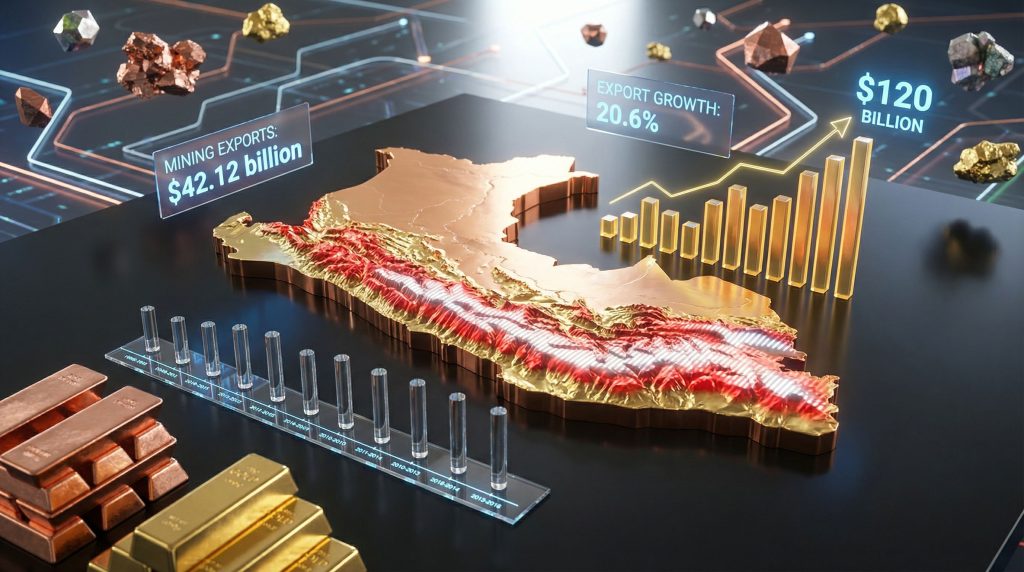
Peru's total merchandise exports reached approximately $85-89 billion in 2025, with mining commodities representing the dominant component. Metallic mining exports through September 2025 totalled $42.12 billion, demonstrating 20.6% growth compared to the same period in 2024.
This growth acceleration reflects both commodity price improvements and production capacity utilisation optimisation. However, current performance operates below theoretical maximum capacity due to infrastructure constraints, regulatory delays, and investment postponements during political uncertainty periods.
Export Composition Breakdown (2024-2025):
• Copper and copper concentrates: 45-50% of mining export value
• Gold: 25-30% of mining export value
• Zinc and zinc concentrates: 12-15% of mining export value
• Silver, tin, molybdenum, and other metals: 5-10% of mining export value
Infrastructure Bottlenecks and Capacity Expansion Requirements
Achieving $120 billion annual export targets requires substantial infrastructure investments to eliminate current bottlenecks. Critical constraint areas include port capacity limitations, transportation networks, and processing facilities.
Port Capacity Limitations:
Current port facilities handle approximately 90-95% of maximum theoretical capacity during peak periods. Expansion requirements include:
• Additional berths and loading equipment: $2-3 billion investment requirement
• Storage and processing facility expansion: $1-2 billion additional capacity
• Channel deepening and navigation improvements: $500 million-1 billion
Transportation Network Adequacy:
Mine-to-port transportation represents a critical bottleneck for increased export volumes:
• Railway capacity expansion: $3-5 billion for new lines and rolling stock
• Highway infrastructure improvements: $2-4 billion for mining corridor upgrades
• Intermodal facility development: $500 million-1 billion
Market Demand Projections and Price Environment
Export growth to $120 billion depends critically on sustained commodity demand and favourable pricing environments. Global copper demand projections through 2030 indicate 3-4% annual growth driven by electrification trends, renewable energy infrastructure, and electric vehicle adoption.
Peru's current 11% global market share positions the country to benefit from demand expansion, provided production capacity increases appropriately. Central bank purchasing, geopolitical uncertainty, and inflation hedging demand support gold price stability. Peru's gold production could expand through exploration success and technology improvements at existing operations.
What Are the Investment Climate Enhancement Requirements for Export Acceleration?
Institutional Framework Strengthening Priorities
Achieving Peru's export potential requires comprehensive institutional improvements that address investor concerns about regulatory predictability and contract enforcement. The evolution of mining industry evolution trends demonstrates the importance of institutional capacity building.
Judicial System Reliability:
Mining investment decisions depend heavily on contract enforcement mechanisms and dispute resolution predictability. Institutional improvements needed include:
• Specialised commercial courts: Mining and commercial dispute expertise development
• Alternative dispute resolution: Arbitration systems and mediation capabilities
• International arbitration access: Treaty compliance and enforcement mechanisms
• Judicial independence: Political insulation and professional development
Regulatory Agency Capacity:
Technical regulatory oversight requires substantial institutional capacity building:
• Environmental assessment expertise: Scientific and technical capability enhancement
• Mining engineering oversight: Safety and operational standard enforcement
• Economic analysis capability: Tax policy and revenue optimisation
• Interagency coordination: Streamlined permitting and policy consistency
The next major ASX story will hit our subscribers first
How Can Political Risk Be Measured in Economic Terms?
Quantifying Risk Premium Components
Political instability creates measurable cost increases across multiple operational and financial categories. These premiums compound over project lifespans, creating substantial differences in project economics between stable and unstable jurisdictions.
Insurance and Risk Mitigation Costs:
Political risk insurance for Peruvian mining operations typically costs 2-5% of total project financing, compared to 1-2% in stable jurisdictions like Canada or Australia. For a $3 billion project, this represents $30-120 million in additional insurance expenses over the project lifespan.
Financing Cost Differentials:
The 2-4% financing cost premium for politically unstable jurisdictions creates substantial cumulative costs:
• $2 billion project financing: Additional $40-80 million annually in interest costs
• 15-year financing period: $600 million-1.2 billion in cumulative premium costs
• Net present value impact: 15-25% reduction in project economics
Case Study: Economic Impact of Social Unrest and Mine Disruptions
Mining operations in Peru have experienced significant disruptions due to social protests and community conflicts, creating measurable economic losses that demonstrate political instability costs.
Las Bambas mine disruptions have resulted in approximately $800 million in lost copper exports over multiple closure periods, illustrating how social unrest translates directly into quantifiable economic losses for Peru's mining sector and national export performance.
Disruption Cost Analysis:
• Direct production losses: $500,000-5 million per day for major operations
• Fixed cost continuation: $200,000-2 million daily during shutdowns
• Market share deterioration: Long-term customer relationship impacts
• Insurance claim processing: Administrative costs and coverage gaps
Regional Economic Development Through Mining Export Expansion
Geographic Distribution of Mining Investment Impact
Peru's mining operations are concentrated in specific regions that experience disproportionate economic impacts from sector performance. Understanding this geographic distribution is crucial for policy development and investment prioritisation.
Primary Mining Regions and Economic Contributions:
| Region | Major Operations | Employment Impact | GDP Contribution |
|---|---|---|---|
| Puno | Multiple gold/copper mines | 25,000-35,000 jobs | 40-50% regional GDP |
| Cusco | Las Bambas, Antapaccay | 15,000-25,000 jobs | 35-45% regional GDP |
| Ancash | Antamina, Pierina | 20,000-30,000 jobs | 45-55% regional GDP |
| Huancavelica | Various operations | 10,000-15,000 jobs | 30-40% regional GDP |
| Cajamarca | Yanacocha, others | 15,000-20,000 jobs | 25-35% regional GDP |
Employment Creation Potential and Skills Development
Expanding mining exports from $49 billion to $60-80 billion could generate substantial additional employment opportunities across skill levels and geographic regions. Based on current employment-to-export ratios, mining export growth could create:
• Additional direct mining jobs: 30,000-60,000 positions
• Indirect employment through suppliers: 75,000-150,000 positions
• Induced employment in services: 50,000-100,000 positions
Skills Development Requirements:
Mining sector expansion requires substantial investment in technical education and workforce development across multiple specialisations including mining engineering, technical training, digital skills, and environmental expertise.
Global Market Positioning and Strategic Competitive Advantages
Peru vs. Competitor Analysis: Cost Structure and Competitive Position
Peru's competitive position in global mining markets depends on multiple factors beyond pure geological endowment. Comprehensive cost analysis reveals both advantages and challenges relative to major competitors.
Production Cost Benchmarking (Copper, USD per pound):
| Country/Region | All-in Sustaining Costs | Transportation Costs | Labour Costs | Energy Costs |
|---|---|---|---|---|
| Peru | $2.85-3.15 | $0.15-0.25 | $0.35-0.45 | $0.20-0.30 |
| Chile | $2.75-3.05 | $0.10-0.20 | $0.40-0.50 | $0.25-0.35 |
| Australia | $3.20-3.60 | $0.20-0.30 | $0.60-0.80 | $0.15-0.25 |
| Canada | $3.40-3.80 | $0.25-0.35 | $0.70-0.90 | $0.10-0.20 |
Peru maintains several structural competitive advantages including labour cost competitiveness 20-40% lower than developed mining jurisdictions, geographical proximity to Asian markets, and ore grade diversity providing natural hedging.
Strategic Metal Diversification Beyond Traditional Commodities
Peru's geological endowment extends beyond current production focus, creating opportunities for strategic diversification into critical minerals demanded by energy transition and technology sectors. This includes lithium resources, rare earth elements, cobalt and nickel, and specialty minerals.
Value-Added Processing Integration:
Moving beyond raw commodity exports toward processed products could substantially increase export values:
• Copper wire and cable manufacturing: 15-25% value addition over concentrate exports
• Gold jewellery and technology applications: Premium pricing for finished products
• Zinc alloy production: Industrial application development and higher margins
• Silver technology applications: Electronics and renewable energy sector integration
The relationship between peru political stability mining exports remains crucial for achieving these diversification goals and capturing enhanced value propositions in global markets. Consequently, addressing institutional challenges becomes essential for realising Peru's full mining export potential and supporting sustainable economic development across multiple regions and sectors.
External references for additional context on Peru's mining challenges include detailed analysis of the country's political turbulence and copper dependency as well as comprehensive assessment of mining sector investment opportunities that demonstrate the complex relationship between political stability and economic development in Peru's mining-dependent regions.
Ready to Capitalise on Latin American Mining Opportunities?
Discovery Alert's proprietary Discovery IQ model delivers real-time alerts on significant ASX mineral discoveries, instantly empowering subscribers to identify actionable opportunities ahead of the broader market. Begin your 14-day free trial today and secure your market-leading advantage whilst understanding why historic discoveries can generate substantial returns.