August 11, 2026
Brazil's Barreirinhas Basin and the Case for Onshore Gas Exploration
For decades, Brazil's upstream energy narrative has been dominated by the spectacular pre-salt offshore plays in the Santos and Campos basins. These deepwater giants attract billions in capital and command global attention, yet they have also cast a long shadow over the country's onshore sedimentary systems, many of which remain systematically underexplored. As Brazil's gas market undergoes structural liberalisation and regional energy demand in the northeast intensifies, a quiet reassessment of inland basins is underway — and the Barreirinhas Basin is emerging as one of the most consequential frontiers in that reassessment.
The Barreirinhas Basin stretches across the northeastern state of Maranhão, representing a large onshore sedimentary system that has historically received far less technical attention than Brazil's prolific deepwater equivalents. Its relative neglect is partly a product of capital allocation priorities during the pre-salt boom, and partly a reflection of the historical dominance of Petrobras in domestic exploration. However, Brazil's gas market reforms over recent years have created new commercial pathways for independent operators, making previously marginal onshore plays more attractive on a risk-adjusted basis.
The distinction between associated and non-associated gas is particularly important in this context. Associated gas is produced alongside crude oil and its volumes are largely dictated by oil field development decisions. Non-associated gas, by contrast, is produced independently from dedicated gas accumulations, giving operators far greater control over supply timing, volumes, and commercial arrangements. For a region like northeastern Brazil, where industrial gas demand and thermoelectric power generation needs are growing, access to independent, locally produced gas supply carries significant economic value — with LNG market implications that resonate well beyond the basin itself.
When big ASX news breaks, our subscribers know first
The São João Field: Full Operatorship and Independent Resource Validation
Against this backdrop, the Petro Victory SJ-12 well offshore Brazil gas discovery in the São João field represents a technically meaningful data point for the Barreirinhas Basin. Petro Victory Energy Corp. holds 100% working interest and full operatorship of the São João field, a position that was formalised following regulatory approval by Brazil's Agência Nacional do Petróleo (ANP) in August 2022. That full working interest structure is commercially significant: it eliminates the complexity of joint-venture decision-making and allows the operator to move with speed and capital discipline at each stage of appraisal and development.
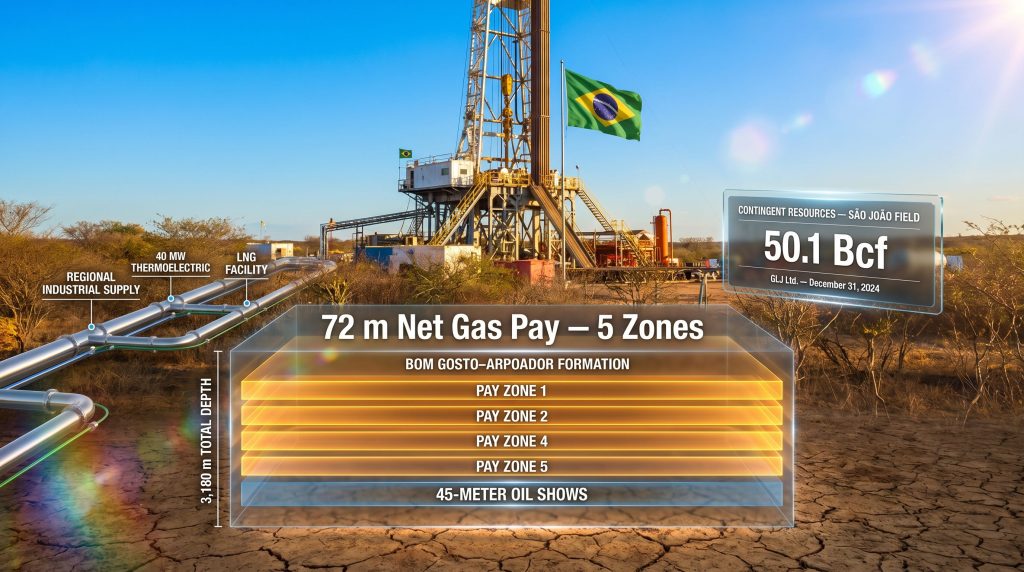
The field's resource base was independently assessed by GLJ Ltd., a respected petroleum engineering consultancy, with an effective date of December 31, 2024. That assessment identified 50.1 billion cubic feet (1.4 billion cubic meters) of risked best-estimate development pending contingent resources of non-associated gas.
What are contingent resources in oil and gas? Contingent resources are quantities of hydrocarbons estimated to be potentially recoverable from known accumulations, but which are not yet classified as formal reserves because key commercialisation conditions, such as confirmed deliverability or finalised regulatory and commercial frameworks, have not been fully satisfied.
The distinction matters considerably for investors and technical audiences alike. A contingent resource classification does not imply the same certainty as booked reserves, but it does confirm that a recognised accumulation exists and that independent technical professionals have assessed its scale. The GLJ Ltd. figure established a quantitative baseline against which the SJ-12 well result could subsequently be evaluated.
SJ-12 Well: Technical Breakdown of the Discovery
Drilling on the Petro Victory SJ-12 well commenced in early March 2026, with the discovery reported on April 28, 2026. The well reached a total depth of 3,180 metres, penetrating the Bom Gosto-Arpoador formation, which served as the primary target horizon.
The results confirmed a stacked gas pay system of notable scale. The following table summarises the key technical parameters from the SJ-12 well:
| Parameter | SJ-12 Result |
|---|---|
| Total Depth Drilled | 3,180 metres |
| Target Formation | Bom Gosto-Arpoador |
| Gross Interval Encountered | ~280 metres |
| Net Gas Pay Identified | 72 metres across five zones |
| Oil Shows (Shallower Intervals) | ~45 metres |
| Drilling Commencement | Early March 2026 |
| Discovery Reported | April 28, 2026 |
The gross interval of approximately 280 metres yielded 72 metres of net gas pay across five discrete reservoir zones, with an additional 45 metres of oil shows encountered in shallower intervals above the primary gas target.
Understanding Stacked Pay Architecture
What is a stacked gas pay system? A stacked pay system describes multiple separate hydrocarbon-bearing intervals encountered vertically within a single wellbore, with each zone representing a distinct productive reservoir. This architecture increases total recoverable resource potential from a single drilled location while simultaneously reducing per-unit development costs by enabling multi-zone completions from fewer wellbores.
The presence of five separate net gas pay zones within the Bom Gosto-Arpoador formation is technically meaningful for several reasons. Furthermore, understanding the broader exploration importance of stacked systems like this one helps contextualise why results of this scale attract significant technical and commercial attention:
- Each productive zone represents an independently viable reservoir interval, reducing single-zone dependency risk
- Multi-zone completion strategies can be deployed from a single wellbore, substantially improving capital efficiency per unit of recoverable gas
- The stacked architecture increases the statistical probability that future appraisal and development wells will encounter productive intervals
- Vertical stacking within a single structural trap suggests the field benefits from multiple charge events or continuous long-term hydrocarbon migration
The net-to-gross ratio implied by the 72-metre net pay figure within a 280-metre gross interval is approximately 26%, which while not exceptional on a standalone basis, reflects the multi-zone nature of the system and is consistent with realistic development planning in comparable onshore gas systems.
Petrophysical Analysis and Pressure Continuity
Wireline logging operations were conducted across the reservoir intervals to characterise porosity, fluid saturation, and net pay thickness for each of the five gas-bearing zones. The integrated petrophysical analysis that identified the 72-metre net pay figure draws on multiple log measurements, typically including gamma ray, neutron-density crossplots, and resistivity data, to discriminate gas-saturated rock from water-bearing or tight intervals.
Critically, formation testing indicated pressure continuity across the reservoir, which supports the interpretation of a connected hydrocarbon system rather than a series of isolated, compartmentalised accumulations. This is an important technical de-risking milestone. Compartmentalised reservoirs, where individual zones are hydraulically isolated by faults or lithological barriers, can significantly reduce the recoverable volumes accessible from a single well location.
Pressure connectivity across multiple zones within the Bom Gosto-Arpoador formation suggests the field may behave as a more unified system during production, with implications for both recovery factors and the number of development wells ultimately required.
Gas samples recovered under downhole conditions were characterised as low-density gas, a descriptor that carries meaningful commercial implications. Low-density gas compositions typically correspond to lighter hydrocarbon molecules, primarily methane, with reduced concentrations of heavier condensate-range hydrocarbons. This translates to simpler surface processing requirements, lower facility capital costs, and fewer complications in pipeline transportation and gas sales specifications.
How SJ-12 Compares to Pre-Drill Expectations
Pre-drill prognoses for exploration and appraisal wells are closely held technical documents, but the characterisation of this Petro Victory SJ-12 well offshore Brazil gas discovery as significantly exceeding expectations provides a directional benchmark. A gross interval of approximately 280 metres and net gas pay of 72 metres across five zones suggests the reservoir encountered was both thicker and more laterally continuous than the pre-drill geological model predicted.
The additional 45 metres of oil shows in shallower intervals was described as unanticipated. While oil shows do not constitute a confirmed oil discovery, their presence indicates that the petroleum system responsible for charging the gas accumulations in the Bom Gosto-Arpoador formation has also sourced and migrated liquid hydrocarbons into shallower structural traps. This is an important observation for broader basin prospectivity, suggesting the São João field structure may be prospective across multiple stratigraphic levels, not just the primary gas target horizon.
Development Pathways and Commercialisation Options
The SJ-12 result advances the São João field toward the next critical technical and commercial milestone: deliverability confirmation through a formal well testing programme. This is the step that separates a confirmed hydrocarbon discovery from a commercially productive reservoir. In addition, the drilling programs required to advance appraisal activities will be central to converting the current resource assessment into actionable reserve classifications.
Well testing for an onshore gas well of this depth and reservoir complexity typically involves:
- Flow testing across individual zones or combined intervals to measure gas rates under controlled drawdown conditions
- Pressure transient analysis to characterise reservoir transmissibility, skin factors, and boundary conditions
- Reservoir performance evaluation to estimate sustainable production profiles and decline rates
- Gas sample collection and compositional analysis to confirm quality specifications for downstream markets
Once deliverability is confirmed, three distinct commercialisation pathways exist for São João gas:
- Regional industrial supply through direct pipeline arrangements to industrial users across northeastern Brazil
- Thermoelectric power generation, with a 40 MW capacity facility already under discussion with identified buyers, representing an unusual demand-side validation at this early stage of development
- LNG facility arrangements that could enable broader domestic or export market access through liquefaction and distribution infrastructure
The identification of prospective buyers for a 40 MW thermoelectric facility prior to formal reserve certification is an atypical commercial signal at this stage of field development. It suggests that local gas demand in northeastern Brazil is sufficiently strong to motivate buyer interest even before deliverability is fully confirmed.
The Eneva S.A. Partnership
Eneva S.A. is identified as a development partner supporting continued appraisal and commercialisation activity at the São João field. Eneva is a Brazilian energy company with established operations in the gas and power generation sectors, particularly in northern and northeastern Brazil, where it has developed vertically integrated models combining gas production with thermoelectric generation. Its involvement at São João provides access to existing infrastructure networks and market relationships that a standalone independent operator would typically take years to replicate.
From Contingent Resources to Reserves: The Reclassification Journey
The following table summarises the complete SJ-12 discovery metrics and field-level data in a single reference framework:
| Metric | Detail |
|---|---|
| Field | São João, Barreirinhas Basin, Brazil |
| Well | SJ-12 |
| Total Depth | 3,180 metres |
| Net Gas Pay | 72 metres (5 zones) |
| Gross Interval | ~280 metres |
| Oil Shows | ~45 metres (shallower intervals) |
| Contingent Resources (Field) | 50.1 Bcf (GLJ Ltd., Dec 2024) |
| Working Interest | 100% (Petro Victory) |
| Development Partner | Eneva S.A. |
| Next Milestone | Well testing programme for deliverability |
| Power Generation Opportunity | 40 MW thermoelectric (buyers identified) |
Reclassifying the 50.1 Bcf of contingent resources into formal reserves requires completing several sequential steps. Consequently, the feasibility study process that underpins reserve reclassification demands rigorous technical and commercial validation at each stage:
- Deliverability confirmation through a successful well testing programme
- Finalisation of commercial arrangements, including gas sales agreements or power purchase contracts
- Regulatory approvals from the ANP covering development plans and production licences
- An updated independent reserve assessment reflecting the confirmed productive capacity of the field
The SJ-12 result meaningfully advances the first step by confirming the existence of a connected, multi-zone gas system with pressure continuity. Each subsequent step carries its own timeline and execution risk, and investors should note that resource reclassification is not automatic or guaranteed following a discovery well result.
The next major ASX story will hit our subscribers first
Broader Significance for the Barreirinhas Basin
The Petro Victory SJ-12 well offshore Brazil gas discovery carries implications that extend beyond a single operator's portfolio. A confirmed stacked gas discovery with pressure continuity and commercially oriented development partners validates the Barreirinhas Basin as a genuine gas-prone exploration system, capable of hosting multi-zone accumulations of meaningful scale. For other licence holders and exploration companies operating in or evaluating positions in the basin, SJ-12 provides a technical data point that was previously absent from the public domain.
Brazil's broader domestic gas strategy increasingly incorporates onshore supply as a counterbalance to the capital intensity and lead times associated with deepwater pre-salt development. Regional gas supply from northeastern basins like Barreirinhas can serve local industrial and power generation markets more efficiently than gas transported over long distances from offshore fields, reducing infrastructure costs and improving supply reliability for regional end-users. Furthermore, the performance of Australia's resource and energy exports offers a useful international reference point for how onshore gas discoveries can reshape domestic and export market dynamics over time.
According to a formal announcement from Petro Victory Energy, the SJ-12 result not only surpassed pre-drill technical expectations but also materially strengthens the commercial case for accelerated appraisal activity across the São João field. However, as with all early-stage discoveries, the pathway from discovery to sustained commercial production involves multiple execution milestones, each carrying its own risk profile.
Disclaimer: This article is intended for informational purposes only and does not constitute financial or investment advice. Resource and reserve estimates are subject to technical and commercial uncertainty. Forecasts and development timelines referenced herein involve assumptions that may not be realised. Readers should conduct their own due diligence before making any investment decisions.
Want to Stay Ahead of Significant Resource Discoveries as Soon as They Hit the ASX?
Discovery Alert's proprietary Discovery IQ model scans ASX announcements in real time, instantly identifying high-potential mineral and energy discoveries and translating complex data into actionable investment insights — explore historic discovery returns on the Discovery Alert discoveries page to understand what early positioning can mean for investors, then start your 14-day free trial at Discovery Alert to secure your market-leading edge.