July 24, 2026
When Infrastructure Age Meets Regulatory Scrutiny: The P-52 Shutdown in Context
Offshore oil production is, at its core, a battle against entropy. Floating production platforms operating in deepwater environments face relentless mechanical stress, chemical corrosion, and thermal cycling that steadily erode the integrity of their most critical components. When those components fail, the consequences extend far beyond a single asset, rippling through production schedules, regulatory relationships, and investor confidence in ways that can take years to fully resolve.
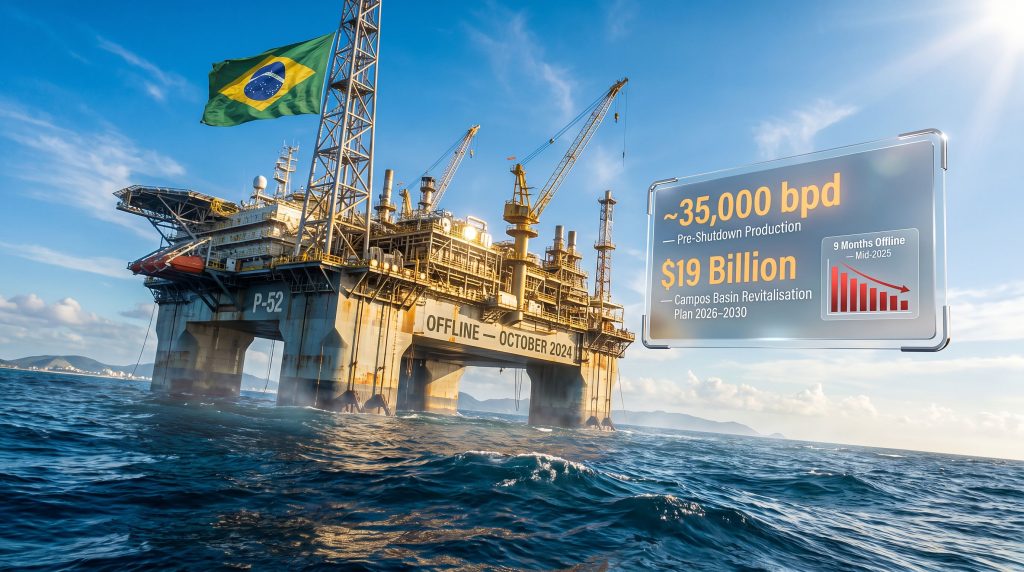
The Petrobras P-52 platform restart delay after a gas leak in October 2024 illustrates exactly this dynamic. Nine months after an emergency shutdown at the Roncador field in Brazil's Campos Basin, the platform remains offline with no confirmed return-to-service date. A working group is racing against an October 2025 assessment deadline, and Brazil's oil regulator is maintaining a firm prohibition on operations. Understanding how a single component failure evolved into one of the most prolonged offshore safety shutdowns in recent Brazilian history requires examining the technical, regulatory, and strategic dimensions of the situation together.
Furthermore, broader oil price movements in global energy markets add another layer of complexity to how operators like Petrobras manage extended asset outages within their overall portfolio strategy.
When big ASX news breaks, our subscribers know first
The Mechanics of Failure: What Gas-Lift Risers Do and Why They Break Down
Gas-lift systems are among the most widely used artificial lift technologies in offshore oil production. The principle is straightforward: pressurised gas is injected into the production tubing, reducing the density of the fluid column and enabling hydrocarbons to flow more easily to the surface. In deepwater environments, this method is particularly valuable because natural reservoir pressure often declines faster than in shallower fields.
The risers that carry gas from the platform to the subsea injection points are mechanically demanding structures. They must withstand:
- Dynamic loading caused by the motion of the floating production unit responding to waves, currents, and wind
- Corrosion fatigue from continuous exposure to seawater, produced fluids, and high-pressure gas
- Thermal cycling stress as production temperatures fluctuate during normal operations and planned shutdowns
- Material degradation accelerated in high-pressure, high-temperature reservoir environments
When the P-52 emergency shutdown was initiated in October 2024, the suspected cause was a rupture in one of these gas-lift risers. On a floating production platform, any uncontrolled release of flammable gas triggers immediate precautionary protocols under Brazilian maritime safety regulations, making an instantaneous halt non-negotiable.
Why the Second Riser Discovery Changed Everything
What transformed this from a standard incident into a prolonged shutdown was the subsequent discovery during post-shutdown inspections that similar degradation had developed in at least one additional riser. According to reporting on the incident, this finding is significant in ways that extend well beyond the immediate repair logistics.
When two risers on the same platform show comparable degradation, the pattern points toward a systemic condition rather than an isolated failure. The implication is that the degradation mechanism — whether corrosion fatigue, inspection gaps, or material performance issues — may have been operating across the platform's riser network for some time before the triggering rupture occurred.
Key Facts at a Glance
| Data Point | Detail |
|---|---|
| Platform | P-52 (Floating Production Unit) |
| Location | Roncador Field, Campos Basin, Brazil |
| Shutdown Initiated | October 2024 |
| Duration Offline (as of mid-2025) | Approximately 9 months |
| Suspected Cause | Gas-lift riser rupture |
| Additional Risk Identified | Degradation in a second riser |
| Pre-Shutdown Production Rate | ~35,000 bpd |
| Design Capacity | 180,000 bopd |
| Confirmed Injuries | None |
Key Insight: The P-52 was already producing at less than 20% of its nameplate capacity before the shutdown, a figure that underscores pre-existing operational constraints at the Campos Basin asset level that predate the October 2024 incident.
ANP's Regulatory Response: A Three-Part Compliance Framework
Brazil's National Petroleum Agency, the ANP, did not treat the P-52 incident as routine. In December 2024, the regulator formally directed Petrobras not to resume platform operations until three distinct conditions had been satisfied:
- Completion of a thorough investigation into the root cause of the riser failure
- Implementation of verified corrective measures addressing identified risks
- Demonstrated elimination of all critical operational safety hazards
As of mid-2025, the ANP publicly confirmed that Petrobras had not yet submitted evidence demonstrating compliance with these conditions. This posture reflects a more assertive enforcement approach that has been developing within Brazil's offshore regulatory framework since earlier incidents in the Campos and Santos basins.
The regulatory timeline illustrates how quickly a single mechanical event can evolve into a sustained compliance process:
October 2024     → Emergency shutdown initiated following gas leak detection
October 2024     → Petrobras forms internal investigation commission; no injuries confirmed
Post-October     → Inspection reveals degradation in a second gas-lift riser
December 2024    → ANP formally instructs Petrobras not to resume operations
Mid-2025         → Working group given until October 2025 to finalise assessment
July 2025        → No restart date confirmed; return to production this year uncertain
The October 2025 working group deadline functions as more than an administrative milestone. It represents the effective boundary of Petrobras's ability to communicate any credible restart scenario for the 2025 operational year. If the assessment is not completed and compliance conditions are not met before that window closes, a 2025 return to service becomes arithmetically improbable.
The Roncador Field and Why One Platform's Absence Has Outsized Impact
The Roncador field sits within Brazil's Campos Basin, located off the northern coast of Rio de Janeiro state and extending toward the southern coast of Espírito Santo. Petrobras operates the field with a 75% stake, with Norwegian energy company Equinor ASA holding the remaining 25%. The field is served by four active production platforms, of which P-52 is one.
| Platform Status | Context |
|---|---|
| P-52 | Offline since October 2024 |
| Remaining Roncador Platforms | Operational, but none at full nameplate capacity |
| Basin-Wide Capacity Utilisation | Below full capacity across all platforms |
| Field Operator | Petrobras (75%) + Equinor ASA (25%) |
According to statements from Petrobras's executive director of engineering, technology and innovation, not a single platform in the Campos Basin is currently operating at its design capacity. This is not a situation in which one offline asset can be absorbed by surplus production elsewhere in the basin. Instead, P-52's extended absence reduces a system that is already operating below its theoretical maximum, compounding the basin's structural output challenge.
Campos Basin production peaked in 2011 and has been on a structural decline trajectory since then. The basin's significance to Brazil's upstream history is substantial: it was Campos that transformed Petrobras from a regional player into a major deepwater operator during the late 20th century. Monitoring current crude oil prices is therefore particularly relevant for understanding the financial pressure Petrobras faces while managing this prolonged shutdown against a backdrop of weakening basin output.
Analyst Note: The Campos Basin decline is not simply a production volume story. It reflects the deeper challenge of managing a first-generation deepwater asset portfolio through the back half of its operational life, when maintenance intensity increases and inspection regimes must become more sophisticated.
Strategic Pressure: The $19 Billion Revitalisation Plan and Its Credibility Test
Petrobras's 2026-2030 strategic plan allocates approximately $19 billion toward revitalising mature Campos Basin fields. This investment thesis rests on the assumption that existing infrastructure can be rehabilitated and production rates improved through targeted capital deployment. The Petrobras P-52 platform restart delay stress-tests that assumption in real time.
The production loss from nine months of downtime at the pre-shutdown rate of approximately 35,000 barrels per day amounts to a cumulative shortfall of roughly 9.45 million barrels of oil equivalent. At Brent crude prices in the range of $75–85 per barrel, the revenue impact of that lost production is a material figure even within Petrobras's portfolio scale.
In addition, the extended downtime raises three strategic concerns:
- Revitalisation credibility: Investors evaluating Petrobras's Campos Basin recovery narrative will assess whether the company can restore legacy assets on reasonable timelines, or whether aging infrastructure repeatedly absorbs capital without delivering production improvement
- Capital allocation efficiency: Unplanned extended outages force maintenance budgets to compete with revitalisation spending, potentially delaying other planned interventions
- Platform depreciation acceleration: Operating a nearly 18-year-old platform — the P-52 was commissioned in 2007 — beyond its original design assumptions creates accelerating depreciation risk if major component replacement is required
Hypothetical Scenario: If the working group's assessment concludes that full replacement of multiple gas-lift riser systems is necessary, the restart timeline could extend well into 2026. That outcome would push P-52's return to service beyond the commencement period of the very strategic plan whose investment is supposed to address Campos Basin decline.
Three Restart Scenarios the Working Group Is Likely Evaluating
- Full riser replacement across all gas-lift systems on the platform, offering the highest safety assurance but requiring the longest timeline and most significant capital outlay
- Selective riser remediation, targeting only the confirmed degraded components while validating the integrity of remaining systems, representing a medium-timeline option with moderate cost
- Operational reconfiguration using only risers confirmed to be in serviceable condition, potentially allowing faster restart but at a meaningfully reduced production rate and with ongoing monitoring requirements
Each scenario carries different implications for the timeline, cost, and the platform's sustainable production rate upon return to service.
Benchmarking the P-52 Case Against Global Offshore Safety Shutdown Patterns
Not all offshore platform shutdowns follow the same trajectory. The severity of the regulatory response, the duration of the halt, and the ultimate production impact depend heavily on how the root cause is classified. Placing the P-52 situation within a broader comparative framework provides useful context.
| Incident Classification | Typical Shutdown Duration | Regulatory Response | Production Impact |
|---|---|---|---|
| Contained minor gas release | Days to weeks | Internal review | Minimal |
| Single riser integrity failure | 1 to 6 months | Regulator notification | Moderate |
| Systemic infrastructure degradation | 6 to 18+ months | Formal prohibition order | Significant |
| Catastrophic structural failure | Indefinite or decommission | Full multi-agency inquiry | Severe |
Based on available evidence, the P-52 case fits the systemic infrastructure degradation profile. The discovery of degradation across multiple risers, rather than a single isolated failure point, is precisely the pattern that tends to generate formal prohibition orders rather than standard incident notifications. ANP's December 2024 directive followed this logic directly.
Brazil's regulatory response also reflects an important institutional evolution. ANP's current posture — requiring demonstrated compliance rather than accepting self-certification — represents a shift toward standards more comparable to those applied by Norway's Petroleum Safety Authority and the UK's North Sea Transition Authority. Consequently, any eventual oil price rally may provide limited relief to Petrobras if regulatory conditions continue to delay the platform's return.
The next major ASX story will hit our subscribers first
The Age Factor: What 18 Years of Deepwater Service Means for Riser Integrity
The P-52 entered service in 2007, making it nearly 18 years old as of the time of the shutdown. In deepwater offshore terms, this places the platform at the boundary of its original design life assumptions for many critical components, including gas-lift riser systems.
Riser integrity in aging assets is influenced by several compounding factors that are not always visible through standard inspection cycles:
- Cumulative fatigue damage accumulates non-linearly over time, meaning component condition can deteriorate faster in later years than early operational data would predict
- Deepwater riser inspection is inherently challenging, requiring remotely operated vehicles and specialised ultrasonic or electromagnetic techniques to assess wall thickness and crack propagation
- Corrosion inhibition programmes that were adequate in a platform's early years may require upgrading as produced fluid chemistry changes with reservoir depletion
- Original design margins, set at commissioning, may not account for the specific loading history the platform has experienced over nearly two decades
The fact that degradation was found in a second riser after the initial rupture strongly suggests that whatever mechanism drove the failure had time to develop across more than one component. This pattern is characteristic of systemic maintenance or inspection gaps rather than a one-off manufacturing defect or operational error.
For the broader Campos Basin asset fleet, this raises a question that extends beyond P-52: if riser systems on a platform approaching 18 years of service developed undetected degradation, what is the likely condition of analogous components on other Campos Basin platforms of similar vintage? Reviewing crude oil price trends alongside these operational risks gives investors a clearer picture of the commercial stakes involved.
Furthermore, as Petrobras has demonstrated in other recent safety incidents, the company's ability to resume production following safety halts varies considerably depending on the nature and extent of the underlying infrastructure issue.
Key Takeaways for Industry and Market Observers
The Petrobras P-52 platform restart delay after the gas leak of October 2024 is simultaneously a safety story, a regulatory story, and a strategic story. Each audience draws different lessons from the same sequence of events.
- For operators: The P-52 case reinforces that proactive riser inspection investment — using advanced non-destructive testing techniques before a triggering incident occurs — is both operationally and reputationally essential in aging deepwater asset management
- For regulators: ANP's structured compliance framework, requiring demonstrated rather than declared safety assurance, sets a precedent for how Brazil will manage future aging-asset incidents across its offshore portfolio
- For investors: Extended unplanned downtime on a platform producing below 20% of nameplate capacity directly challenges production guidance credibility and raises legitimate questions about execution risk within the broader Campos Basin revitalisation narrative
- For the energy sector globally: Brazil's challenge with the P-52 is a concentrated version of a challenge facing mature deepwater basins worldwide, where first-generation production infrastructure is reaching or exceeding its original design assumptions at the same time operators are being asked to extract more value from existing assets. Understanding the trade war impact on oil pricing further complicates investment decisions in this environment
This article contains forward-looking references and scenario projections based on publicly available information as of mid-2025. Production estimates, strategic plan allocations, and regulatory timeline projections are subject to change. Nothing in this article constitutes investment advice. Readers should consult independent financial and energy sector advisors before making investment decisions.
For further context on Brazilian offshore regulatory frameworks and Campos Basin operational history, readers may find additional background through World Oil's coverage of South American upstream developments at worldoil.com.
Want to Stay Ahead of the Next Major Resource Discovery?
While Petrobras navigates the complexities of ageing offshore infrastructure and regulatory scrutiny, commodity investors focused on actionable opportunities can gain a real-time edge through Discovery Alert, whose proprietary Discovery IQ model instantly identifies significant ASX mineral discoveries across more than 30 commodities — start your 14-day free trial today and see why historic discoveries like those made by De Grey Mining and WA1 Resources have delivered extraordinary returns.