June 21, 2026
India's Fuel Price Crisis: Understanding the Forces Behind Four Consecutive Petrol and Diesel Price Hikes
Every time a lorry driver refuels, every time a two-wheeler owner tops up the tank, and every time a small business owner calculates freight costs, they are absorbing the consequences of decisions made thousands of kilometres away in diplomatic corridors, commodity trading floors, and currency markets. The petrol and diesel price hike in India that unfolded across May 2026 is not a simple story of government policy. It is the convergence of geopolitical rupture, structural import dependency, currency erosion, and a financially strained oil marketing sector that could no longer defer the inevitable.
When big ASX news breaks, our subscribers know first
The Structural Vulnerability That Makes India Uniquely Exposed
Before examining what happened in May 2026, it is worth understanding why India is so sensitive to global crude oil shocks in the first place. Approximately 85% of India's total crude oil requirements are met through imports, making it one of the most import-dependent major economies in the world when it comes to energy. The global importance of oil to economies like India cannot be overstated, particularly when supply chains are disrupted.
This dependency creates a dual-layered exposure that few other large economies face simultaneously:
- Commodity price risk: When global crude benchmarks rise, India's procurement costs increase in direct proportion to the volume of barrels imported.
- Currency exchange risk: Because crude oil is priced and settled in US dollars globally, any depreciation of the Indian rupee against the dollar amplifies the cost increase in rupee terms, even if the global oil price in dollars remains unchanged.
These two risks do not operate in isolation. When geopolitical conflict drives crude prices higher, it often simultaneously undermines emerging market currencies like the rupee, as global capital shifts toward safe-haven assets. The result is a compounding cost burden that hits Indian oil marketing companies (OMCs) from both directions at once.
"Structural Risk Insight: India's combination of near-total import reliance and dollar-denominated procurement means domestic fuel consumers bear both global commodity market volatility and macroeconomic currency risk every time they fill a tank. This is not a temporary problem; it is an architectural feature of India's current energy landscape."
How the West Asia Conflict Triggered a Crude Price Spiral
The catalyst for the current petrol and diesel price hike in India was the escalation of conflict between the United States and Iran, which created sustained disruption across one of the world's most critical maritime energy corridors: the Strait of Hormuz. Furthermore, the intersection of oil prices and geopolitics has rarely been more consequential for import-dependent nations than during this period.
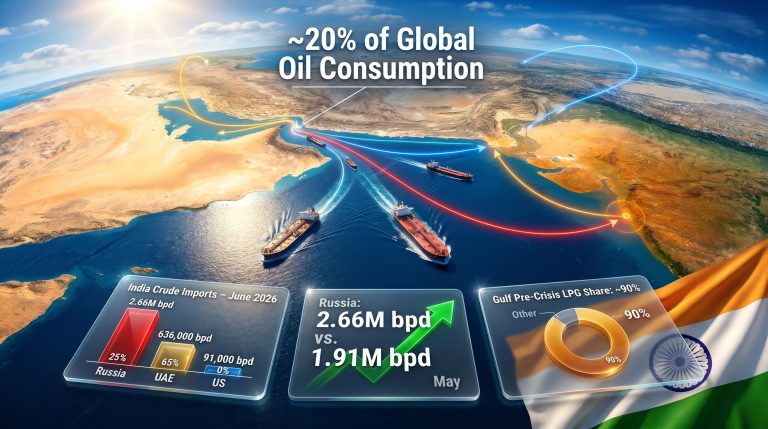
The Strait of Hormuz is a roughly 33-kilometre-wide channel between the Gulf of Oman and the Persian Gulf, through which an estimated 20% of global oil trade transits daily. It functions as an irreplaceable chokepoint in the global energy supply chain, and any disruption to shipping through it has immediate consequences for crude availability worldwide.
Months of port blockades, shipping restrictions, and physical disruptions to energy transit routes pushed benchmark crude prices sharply higher:
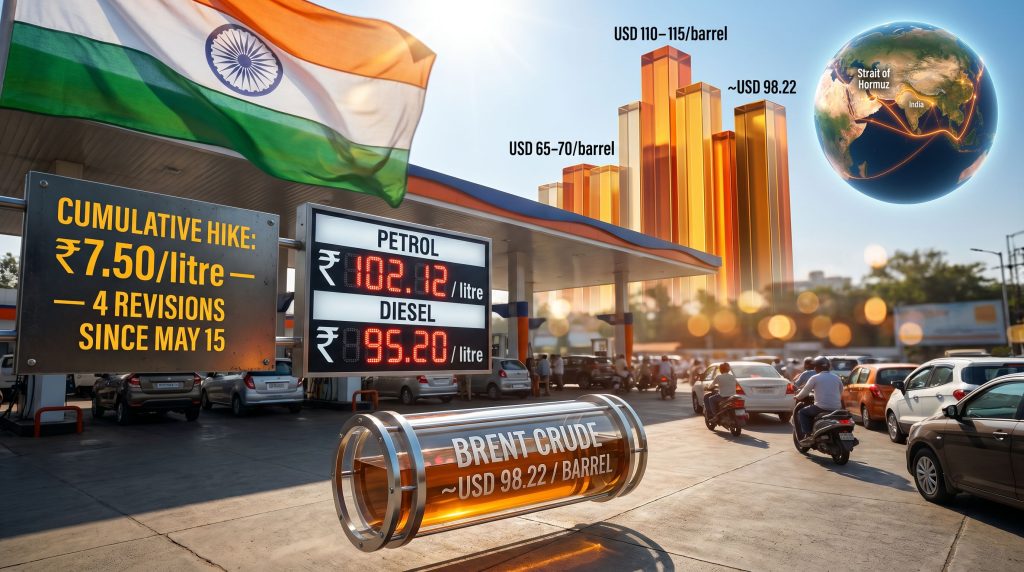
- Brent crude climbed from a pre-conflict range of USD 65 to 70 per barrel to peak levels of USD 110 to 115 per barrel during peak geopolitical tension.
- This represents a price surge of approximately 60 to 70% over a relatively compressed timeframe.
- By late May 2026, with diplomatic signals of a potential ceasefire circulating, Brent had retreated somewhat, trading at around USD 98.22 per barrel according to AFP data, while West Texas Intermediate (WTI) fell to approximately USD 91.57 per barrel before partially recovering.
The crude market's behaviour during this period illustrated a well-documented dynamic in energy markets: prices respond rapidly to geopolitical headlines, falling on peace signals and spiking on deterioration, creating a cycle of volatility that makes long-term procurement planning extremely difficult for importing nations. ONGC's Director of Exploration noted publicly that crude oil price trends remain highly reactive to conflict signals, dipping when peace negotiations appear to advance and surging when those prospects fade.
Why a Ceasefire Is Not Enough
A ceasefire agreement between Washington and Tehran, which has been in place since April 8, 2026, has not been sufficient to normalise crude supply flows. Iran's continued controls on Gulf shipping and US port blockades of Iran mean physical supply disruptions persist even under a technical ceasefire.
US President Donald Trump publicly tempered expectations of an imminent settlement, indicating that negotiations should not be rushed. Until the actual maritime corridors reopen and Iranian crude supply is physically restored to global markets, the structural upward pressure on prices will persist regardless of diplomatic progress in formal negotiations.
Four Hikes in Under Two Weeks: A Timeline of India's Petrol and Diesel Price Revisions
The most immediate manifestation of these global forces on Indian consumers was a rapid series of upward fuel price revisions following the lifting of a 76-day price freeze on May 15, 2026. Notably, the trade war impact on oil markets provided an additional layer of pricing pressure during this period, compounding the geopolitical disruption already underway.
Revision Sequence and Cumulative Impact
| Revision Event | Petrol Increase (₹/litre) | Diesel Increase (₹/litre) | Cumulative Rise |
|---|---|---|---|
| May 15, 2026 | Price freeze lifted | Revision cycle begins | Baseline reset |
| Earlier revisions (combined) | Incremental increases | Incremental increases | Approaching ₹5/litre |
| Third hike (approx. May 23) | ₹0.87 | ₹0.91 | ~₹5/litre cumulative |
| Fourth hike (May 25) | ₹2.61 | ₹2.71 | ~₹7.50/litre cumulative |
The fourth revision was the most significant in size, with petrol rising by ₹2.61 per litre and diesel by ₹2.71 per litre in a single adjustment. According to reporting by Reuters, in Delhi specifically, petrol moved from ₹99.51 to ₹102.12 per litre, while diesel reached ₹95.20 per litre from ₹92.49.
Current Retail Prices Across Major Indian Cities
| City | Petrol (₹/litre) | Diesel (₹/litre) |
|---|---|---|
| Delhi | ₹102.12 | ₹95.20 |
| Mumbai | ₹108.49 | Data pending |
| Kolkata | ₹110.64 | Data pending |
| Chennai | ₹105.31 | Data pending |
The variation between cities reflects differences in state-level VAT rates, local cess levies, and logistics costs layered on top of a uniform OMC base price, not differences in the base procurement cost itself.
Why the Price Freeze Was Unsustainable: The ₹1,000 Crore Daily Loss Problem
Understanding the petrol and diesel price hike in India requires understanding what preceded it. The 76-day price freeze was not cost-free; it simply transferred the cost from retail consumers to state-owned OMCs, which were required to sell fuel below their actual procurement cost.
This gap between procurement cost and permitted retail price is known in the sector as under-recovery. It is a structural loss position, and when it persists over weeks or months, it erodes the financial health of the companies responsible for maintaining India's fuel supply infrastructure.
Former senior marketing leadership at BPCL publicly stated that public sector oil companies remained in heavy under-recoveries throughout this period, with procurement costs consistently exceeding revenue from retail sales. The scale of this loss was not marginal.
"Key Financial Pressure Point: During the price freeze, OMCs including Indian Oil Corporation, BPCL, and Hindustan Petroleum were collectively absorbing estimated losses of approximately ₹1,000 crore per day. Sustained over 76 days, this represents a total under-recovery burden running into the tens of thousands of crores."
At a certain threshold, the financial damage to these state-owned enterprises becomes a concern not just for their balance sheets, but for their capacity to fund the infrastructure investment required to maintain fuel supply across India's extensive logistics network. This is ultimately what forced the resumption of market-linked price revisions.
How India's Dynamic Daily Pricing Mechanism Works in Practice
India transitioned from a fortnightly fuel price revision model to a dynamic daily pricing system designed to allow more granular, frequent adjustments aligned with global crude benchmarks and currency movements. In theory, this system prevents the accumulation of large under-recoveries by making continuous small adjustments rather than periodic large corrections.
In practice, however, the system is frequently overridden by political considerations, particularly during periods of high inflation or approaching elections. When this happens:
- Retail prices are held artificially stable regardless of underlying cost movements.
- Under-recoveries accumulate silently within OMC balance sheets.
- When the political cost of continued suppression exceeds the political cost of visible price increases, a correction becomes unavoidable.
- Consumers then experience a rapid series of hikes that appear sudden but are in fact the lagged transmission of costs that were building for months.
This pattern explains the acceleration seen in May 2026: four revisions in under two weeks reflects a catch-up phase, not a new trend in daily pricing behaviour.
Understanding the Tax Layers Behind Pump Prices
The retail price Indian consumers pay is constructed from multiple components stacked on the OMC base price:
| Price Component | Who Sets It | Variation Across India |
|---|---|---|
| OMC base price | Central OMCs (IOC, BPCL, HPCL) | Uniform nationally |
| Central excise duty | Government of India | Uniform nationally |
| State VAT and cess | State governments | Significant variation (20-30%+ in some states) |
| Dealer commission | Regulated | Largely uniform |
| Local body levies | Municipal/local authorities | City-specific |
This layered architecture means that when OMCs raise the base price by ₹2.61 per litre, the absolute rupee impact on consumers in high-VAT states is proportionally larger than in lower-VAT states, because the VAT percentage is applied to a higher final price.
The next major ASX story will hit our subscribers first
The Downstream Economic Consequences of Rising Fuel Prices
The petrol and diesel price hike in India carries economic consequences that extend well beyond the forecourt. Diesel is the circulatory fuel of India's logistics economy, powering road freight, agricultural machinery, fishing vessels, and backup power generators across the country. Monitoring current crude oil prices remains essential for understanding how quickly these downstream pressures may intensify.
Second-Order Inflation: How Fuel Costs Move Through the Economy
- Rising diesel prices increase the operating costs of every truck, three-wheeler commercial vehicle, and tractor in India.
- Higher logistics costs flow into the retail prices of food, consumer goods, raw materials, and manufactured products.
- This creates a second-order inflationary effect that amplifies headline consumer price inflation beyond what energy sector data alone would suggest.
- The Reserve Bank of India must account for this transmission effect when calibrating monetary policy, making fuel price dynamics relevant to interest rate decisions as well.
Who Bears the Heaviest Burden?
Certain groups face disproportionately severe consequences from sustained fuel price increases:
- Small transport operators running one or two vehicles have limited pricing power and thin margins, making fuel cost increases directly income-reducing.
- Auto-rickshaw and taxi drivers using petrol or CNG-adjacent fuels face compressed earnings relative to fixed fare structures.
- Agricultural users dependent on diesel-powered irrigation pumps and farm machinery see input costs rise directly.
- Delivery workers and gig economy participants whose fuel costs are often self-funded absorb price increases personally.
- Urban two-wheeler commuters in the lower-middle income bracket face a meaningful real reduction in disposable income.
As reported by DW, the economic strain on ordinary consumers has been widely noted, with public calls for government intervention and fuel price regulation growing louder following each successive hike.
Government Policy Options Available to Provide Relief
| Policy Tool | Mechanism | Primary Trade-Off |
|---|---|---|
| Central excise duty reduction | Lowers the base tax component per litre | Reduces central government revenue |
| State VAT cuts | Reduces state-level tax burden on consumers | Requires individual state government cooperation |
| Direct compensation to OMCs | Covers under-recoveries without price increases | Widens fiscal deficit |
| Strategic petroleum reserve release | Adds temporary domestic supply | Limited volume and short-term in nature |
| Accelerated EV transition support | Reduces long-run oil dependency | Structural solution, not an immediate remedy |
What Comes Next: Scenarios for Indian Fuel Prices
The trajectory of fuel prices in India from this point is conditional on several interconnected variables, none of which are fully within India's control.
Scenarios That Could Drive Further Increases
- Continued geopolitical stalemate in West Asia keeping Brent crude above USD 100 per barrel on a sustained basis.
- Further rupee depreciation against the dollar compounding procurement costs in local currency terms.
- OMC under-recoveries persisting at levels that make further price suppression financially untenable.
- OPEC+ production restraint limiting the supply response to elevated prices.
Scenarios That Could Stabilise or Reduce Prices
- A durable diplomatic settlement between the US and Iran that physically reopens the Strait of Hormuz to normal commercial shipping.
- Restoration of Iranian crude volumes to global markets, easing supply tightness.
- A meaningful strengthening of the Indian rupee against the dollar.
- Government intervention through central excise duty reductions to provide visible consumer relief.
- A coordinated OPEC+ production increase that caps benchmark crude prices.
"Analyst Perspective: The rapid sequence of four revisions in under two weeks is characteristic of a catch-up phase following prolonged price suppression. Once OMC under-recoveries are brought to near-zero, the frequency of revisions should moderate significantly. However, the absolute level at which prices stabilise will depend entirely on where global crude benchmarks settle once geopolitical conditions clarify."
Frequently Asked Questions: Petrol and Diesel Price Hike in India
Why have petrol and diesel prices increased so sharply in India in May 2026?
The increases reflect the combined impact of elevated global crude oil prices driven by conflict-related disruption in West Asia, months of shipping blockades affecting the Strait of Hormuz, a weakening Indian rupee, and the end of a 76-day price freeze during which OMCs were absorbing losses estimated at approximately ₹1,000 crore per day.
How much have petrol and diesel prices increased since the freeze was lifted?
Across four revisions since May 15, 2026, the cumulative increase for both petrol and diesel stands at approximately ₹7.50 per litre.
What is the current petrol price in Delhi?
Following the fourth revision on May 25, 2026, petrol in Delhi is priced at ₹102.12 per litre, up from ₹99.51 before the latest hike.
Why do fuel prices differ between Indian cities?
City-level variation is driven by differing state VAT rates, local cess charges, and transportation costs applied on top of a uniform OMC base price. Consumers in high-VAT states pay a larger absolute rupee amount per litre.
How does India's fuel pricing system work?
India operates a dynamic daily pricing framework under which OMCs are meant to adjust retail prices daily based on global crude benchmarks, refining margins, and rupee-dollar exchange rates. In practice, extended freezes periodically override this mechanism, creating conditions for compressed catch-up corrections when revisions resume.
India's Fuel Price Crisis: Key Metrics at a Glance
| Metric | Figure |
|---|---|
| Cumulative petrol/diesel price increase since May 15 | ~₹7.50/litre |
| Number of price hikes in under two weeks | 4 |
| Duration of preceding price freeze | 76 days |
| Estimated daily OMC losses during freeze | ~₹1,000 crore/day |
| India's crude oil import dependency | ~85% of total requirements |
| Crude price range before conflict escalation | USD 65-70/barrel |
| Crude price at peak conflict tension | USD 110-115/barrel |
| Brent crude price (late May 2026) | ~USD 98.22/barrel |
| WTI crude price (late May 2026) | ~USD 91.57/barrel |
| Delhi petrol price post-fourth hike | ₹102.12/litre |
| Delhi diesel price post-fourth hike | ₹95.20/litre |
This article contains forward-looking analysis regarding fuel price trajectories and economic impacts. Such analysis is based on available information as of late May 2026 and should not be treated as financial or investment advice. Global crude oil prices, currency movements, and geopolitical developments can change rapidly and unpredictably.
For ongoing coverage of India's oil and gas sector and related energy market developments, ET EnergyWorld provides detailed reporting and expert analysis at energy.economictimes.indiatimes.com.
Want to Know Which ASX-Listed Energy and Commodity Companies Could Benefit From Global Oil Price Volatility?
Discovery Alert's proprietary Discovery IQ model delivers real-time alerts on significant ASX mineral and commodity discoveries, instantly translating complex market data into actionable investment insights — explore historic discovery returns on Discovery Alert's dedicated discoveries page to see how major finds have generated substantial market returns, and begin your 14-day free trial to position yourself ahead of the next significant market move.