August 12, 2026
Complex infrastructure dependencies and supply chain vulnerabilities within Australia's petroleum distribution network have historically exposed critical gaps between national reserve adequacy and regional operational continuity. The recent escalation of Middle Eastern geopolitical tensions has amplified these structural weaknesses, particularly across remote resource extraction zones where alternative sourcing mechanisms remain limited. Furthermore, WA moves to secure fuel supply after industry concerns highlights how energy security transition becomes critical when examining the intersection of geographic isolation, inventory management protocols, and multi-jurisdictional governance frameworks that collectively determine energy security outcomes.
Geographic Distribution Networks and Remote Operation Vulnerabilities
Remote mining operations across Western Australia face fundamentally different logistical constraints compared to urban industrial centers. Unlike metropolitan distribution systems that benefit from multiple competing suppliers, redundant pipeline networks, and rapid alternative sourcing arrangements, remote mining sites depend entirely on scheduled tanker deliveries across distances that can exceed 1,000 kilometers from primary fuel distribution hubs.
According to statements made to Australian Mining, Association of Mining and Exploration Companies chief executive Warren Pearce reported that some junior and mid-tier mining companies were maintaining approximately five days of fuel supply during the March 2026 crisis period. This inventory level represents a critical vulnerability threshold where operational decisions become binary: limit fuel consumption to essential plant operations or maintain full production schedules while hoping suppliers can restore normal delivery frequency.
The technical challenges of remote fuel distribution extend beyond simple distance calculations. However, australia energy exports challenges demonstrate how storage facility capacity constraints at remote sites typically limit inventory levels based on:
- Capital allocation efficiency for storage infrastructure investment
- Working capital optimisation to minimise carrying costs during stable supply periods
- Safety and regulatory compliance requirements for bulk fuel storage
- Geographic terrain limitations affecting storage facility construction
Distribution Infrastructure Capacity Analysis
The vulnerability of remote operations becomes particularly acute when examining the concentrated nature of WA's fuel distribution infrastructure. Major distribution points include Port Hedland and Fremantle, creating potential bottlenecks when supply chain disruptions affect primary distribution routes.
Regional Fuel Distribution Metrics:
| Distribution Hub | Service Radius | Daily Capacity | Primary Transport Mode |
|---|---|---|---|
| Fremantle | 500km inland | 2.5M litres | Road tanker, pipeline |
| Port Hedland | 800km southeast | 1.8M litres | Road train, rail |
| Kalgoorlie | 300km regional | 600K litres | Road tanker only |
| Albany | 400km coastal | 400K litres | Road tanker only |
These infrastructure constraints create cascading effects during supply disruptions, as alternative routing options remain limited by both geographic barriers and transport capacity limitations.
When big ASX news breaks, our subscribers know first
Crisis Response Coordination and Government Intervention Mechanisms
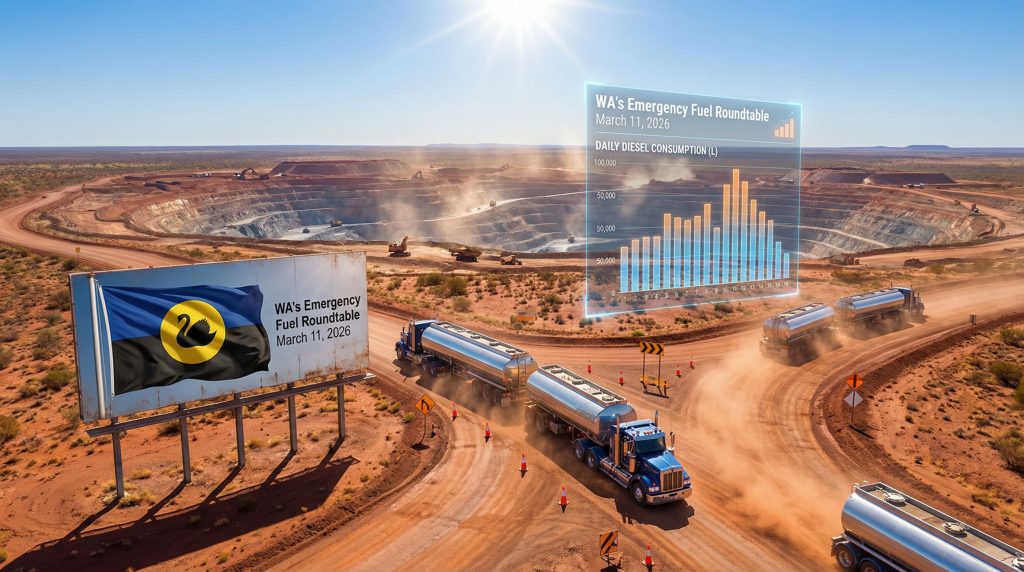
WA moves to secure fuel supply after industry concerns prompted unprecedented state-level coordination measures during March 2026. Premier Roger Cook's convening of an emergency fuel security roundtable demonstrated how regional governments adapt crisis management protocols when federal fuel security frameworks prove insufficient for addressing localised distribution challenges.
The roundtable outcomes established several critical coordination mechanisms:
- Priority allocation frameworks for fuel and fertiliser imports through WA ports
- Enhanced regional delivery coordination using higher-efficiency vehicles and road trains
- Weekly operational monitoring through dedicated industry groups
- Direct government-industry communication channels for real-time supply status assessment
According to the Government of Western Australia media statement, these measures reflected recognition that normal market mechanisms required temporary augmentation during supply chain stress periods. Moreover, this supply chain crisis impact enabled state authorities to influence regional fuel provider behaviour through industry relationships rather than formal regulatory intervention.
Multi-Tiered Governance Coordination Challenges
The fuel security crisis exposed fundamental coordination gaps within Australia's federal-state energy governance structure. While federal authorities maintain control over fuel import allocation and national reserve management, state governments bear responsibility for managing economic disruption and community impact within their jurisdictions.
The Federal Government response included convening the National Coordination Mechanism, Trusted Information Sharing Network, and National Oil Supplies Emergency Committee. However, these coordination forums primarily emphasise information sharing and market-based solutions rather than direct supply allocation intervention, creating potential timing gaps between crisis identification and effective response implementation.
Industry-Specific Operational Impact Assessment
Mining Sector Fuel Dependency Patterns
The mining industry's operational structure creates unique vulnerabilities during fuel supply disruptions. Unlike manufacturing sectors that can temporarily reduce production levels, mining operations involve complex equipment coordination and workforce scheduling that make partial operations economically inefficient.
Warren Pearce's statements to The Australian revealed that affected mining companies faced strategic decisions regarding production continuation versus fuel conservation. These operational choices reflect the industry's high fixed-cost structure where partial operations may generate insufficient revenue to cover ongoing expenses whilst full operations maximise revenue generation during constrained supply periods.
Mining Operation Fuel Consumption Characteristics:
- Major integrated operations: 50,000-100,000 litres daily consumption with 7-10 day strategic reserves
- Mid-tier mining companies: 10,000-25,000 litres daily with 5-7 day operational reserves
- Junior exploration operations: 1,000-5,000 litres daily with 3-5 day minimal reserves
The vulnerability hierarchy reflects both operational scale and financial capacity. In addition, major operations maintain longer reserve periods and possess alternative sourcing capabilities through direct supplier relationships, while smaller operators face critical constraints due to limited purchasing power and cash flow considerations.
Agricultural Sector Time-Sensitive Operations
Agricultural fuel consumption patterns create distinct vulnerability windows based on seasonal operational requirements. Unlike continuous industrial processes, agricultural operations concentrate fuel usage during specific periods that cannot be deferred without significant yield impacts.
Critical Agricultural Fuel Demand Periods:
- Spring planting operations: Intensive diesel consumption for land preparation and seeding equipment
- Harvest scheduling: Compressed timeframes requiring sustained high-capacity equipment operation
- Fertiliser application windows: Time-sensitive crop nutrition delivery during optimal growth periods
- Livestock management cycles: Regular transport and feed distribution requirements
The roundtable's specific emphasis on fertiliser import prioritisation alongside fuel supplies demonstrates recognition of these interconnected agricultural dependencies. Fertiliser production and distribution rely heavily on diesel fuel for manufacturing processes and transport logistics, creating compound vulnerabilities during supply disruptions.
Economic Impact Analysis and Financial Risk Assessment
Regional Price Volatility Mechanisms
Perth fuel prices reaching $2.37 per litre during the March 2026 crisis represented a 23% premium compared to baseline pricing of approximately $1.93 per litre. This price volatility creates disproportionate impacts across different economic sectors based on their fuel intensity and operational flexibility.
Consequently, regional operations face additional challenges due to:
- Limited supplier competition in remote markets reducing price negotiation options
- Higher baseline transportation costs for fuel delivery to remote locations
- Reduced inventory turnover creating extended exposure to price volatility
- Limited alternative energy substitution options for diesel-dependent equipment
Sectoral Economic Vulnerability Matrix:
| Sector | Fuel Cost Share | Price Sensitivity | Operational Flexibility |
|---|---|---|---|
| Agriculture | 15-25% | High | Low (seasonal constraints) |
| Mining | 8-15% | Moderate | Moderate (production scaling) |
| Transport/Logistics | 35-45% | Critical | High (route optimisation) |
| Construction | 12-20% | Moderate | Moderate (project scheduling) |
Investment Implications and Infrastructure Development
The crisis highlighted significant investment opportunities within Australia's fuel distribution infrastructure. Regional storage capacity expansion, alternative transport mode development, and supply chain resilience enhancement represent areas where private investment could address structural vulnerabilities while generating commercial returns.
Infrastructure Investment Opportunities:
- Regional strategic reserve facilities to reduce distribution bottlenecks
- Alternative transport infrastructure including rail and pipeline capacity
- Renewable energy substitution for mining operations reducing diesel dependency
- Supply chain technology systems enabling real-time inventory monitoring
These investment themes reflect both immediate crisis response needs and longer-term structural adaptations to enhance energy security resilience across remote Australian regions.
International Energy Security Framework Comparisons
Strategic Reserve Distribution Models
International energy security best practices suggest that geographically distributed strategic reserves provide more effective crisis response capability than centralised storage systems. Countries including Germany and Japan maintain regional reserve networks that ensure equitable geographic access during supply disruptions, contrasting with Australia's concentration of reserves in major port cities.
The International Energy Agency coordination mechanism that released 400 million barrels from member country emergency reserves demonstrates multilateral approaches to supply crisis management. However, this global coordination primarily addresses international price stability rather than regional distribution challenges within member countries.
Public-Private Partnership Crisis Response Frameworks
The WA roundtable model parallels crisis coordination mechanisms used in Nordic countries, where government agencies maintain direct communication channels with private fuel suppliers to enable rapid response during supply chain disruptions. These frameworks balance market efficiency with strategic coordination capability.
Effective Crisis Response Elements:
- Pre-established communication protocols between government and industry
- Clear priority allocation criteria for critical economic sectors
- Regular monitoring and assessment mechanisms for supply status evaluation
- Flexibility to adapt responses based on evolving crisis conditions
Policy Reform Implications and Long-Term Resilience Enhancement
Regional Strategic Reserve Requirements
Implementing mandatory regional fuel reserve requirements for critical industries could significantly reduce vulnerability to distribution disruptions whilst maintaining market-based allocation mechanisms for general consumption. Such requirements would need to balance strategic security objectives with economic efficiency considerations.
Policy Design Considerations:
- Industry-specific reserve minimums based on operational criticality and economic contribution
- Geographic distribution requirements ensuring adequate regional coverage
- Cost-sharing mechanisms between government and industry for strategic reserve maintenance
- Emergency access protocols defining circumstances and procedures for reserve utilisation
Enhanced Supply Chain Transparency Systems
Real-time fuel inventory reporting systems for critical sectors would enable more effective government intervention timing whilst reducing information asymmetries that contribute to panic buying behaviours. Furthermore, oil price movements analysis shows how these systems could provide early warning capabilities for emerging supply constraints.
The weekly operational group structure established following the WA roundtable represents an initial step toward enhanced transparency, creating ongoing communication channels between government authorities and industry participants.
The next major ASX story will hit our subscribers first
Market Psychology and Behavioural Economics During Crisis Periods
Regional Market Dynamics and Consumer Behaviour
Limited supplier competition in regional fuel markets amplifies demand volatility during crisis periods as consumers engage in precautionary stockpiling behaviours. These behavioural responses create artificial scarcity conditions that exacerbate underlying supply constraints.
Understanding these psychological factors becomes critical for crisis management effectiveness:
- Information asymmetries between government assurances and local availability perceptions
- Risk-averse hoarding behaviour during uncertainty periods
- Supply chain confidence degradation affecting normal purchasing patterns
- Regional communication networks influencing collective behavioural responses
Premier Cook's public statements aimed to address community anxiety whilst providing government assurance, demonstrating recognition of psychological factors in crisis management beyond technical supply chain coordination.
Future Energy Security Architecture and Strategic Planning
Integration of Alternative Energy Sources
Fuel security vulnerabilities may accelerate adoption of alternative energy sources across mining and agricultural operations, creating opportunities for renewable energy infrastructure investment and electric vehicle technology adaptation for industrial applications.
Energy Transition Acceleration Factors:
- Supply security concerns driving diversification away from petroleum dependence
- Cost competitiveness improvements in renewable energy technologies
- Infrastructure investment incentives for strategic energy security enhancement
- Operational flexibility benefits from multiple energy source options
Risk Management Integration and Strategic Planning
The crisis demonstrated the importance of integrating fuel security considerations into broader economic risk management frameworks. However, mining industry evolution shows that regional economic development planning, infrastructure investment decisions, and industry support policies require enhanced consideration of supply chain resilience factors.
What Are the Key Lessons for Australia's Energy Future?
WA moves to secure fuel supply after industry concerns provides critical insights for national energy policy development. The crisis revealed how geographic isolation, limited infrastructure redundancy, and coordination gaps between federal and state authorities create systemic vulnerabilities that require integrated solutions.
The March 2026 experience highlighted the need for proactive infrastructure investment, enhanced coordination mechanisms, and strategic reserve distribution to address regional vulnerabilities. For instance, establishing regionally distributed strategic reserves and implementing mandatory industry reserve requirements could significantly improve crisis resilience.
This analysis is based on publicly available information and government statements. Energy security situations remain dynamic and subject to rapid change based on geopolitical developments and market conditions. Readers should verify current information from official sources before making operational or investment decisions.
Understanding Australia's fuel security vulnerabilities requires ongoing monitoring of both international supply conditions and domestic distribution infrastructure capabilities. The March 2026 crisis provided valuable insights into coordination mechanisms and response frameworks that will inform future energy security policy development across all levels of government, particularly as WA moves to secure fuel supply after industry concerns continue to shape national energy resilience strategies.
Could Australia's Fuel Security Crisis Signal New Investment Opportunities?
Discovery Alert's proprietary Discovery IQ model helps investors identify emerging opportunities in energy security and critical infrastructure sectors across ASX-listed companies, delivering real-time alerts on significant discoveries that could reshape Australia's resource landscape. Explore historical examples of major discoveries and begin your 14-day free trial today to position yourself ahead of market developments in Australia's evolving energy sector.