June 6, 2026
The Structural Foundations of Petroleum-Dependent Fiscal Architecture
Modern economies built around hydrocarbon extraction face inherent vulnerabilities that extend far beyond market price fluctuations. When petroleum revenues comprise the overwhelming majority of government income, nations become trapped in cyclical patterns of boom-bust economics, fiscal inflexibility, and structural dependency that can persist across decades. This macroeconomic reality creates systemic risks that reverberate through domestic markets, international trade relationships, and regional stability frameworks.
Iran's oil economy instability exemplifies these broader challenges, representing one of the most complex cases of petroleum dependency operating under sustained external pressure. The nation's fiscal architecture demonstrates how hydrocarbon-centric economic models can become simultaneously resilient and fragile, maintaining production capacity while experiencing severe revenue constraints and institutional stress.
Understanding these dynamics requires examining not just immediate political developments, but the underlying structural mechanics that govern petroleum-dependent economies, their vulnerability patterns, and the long-term sustainability questions that emerge when traditional revenue models face sustained disruption.
When big ASX news breaks, our subscribers know first
How Petroleum Revenue Concentration Creates Systemic Economic Risk
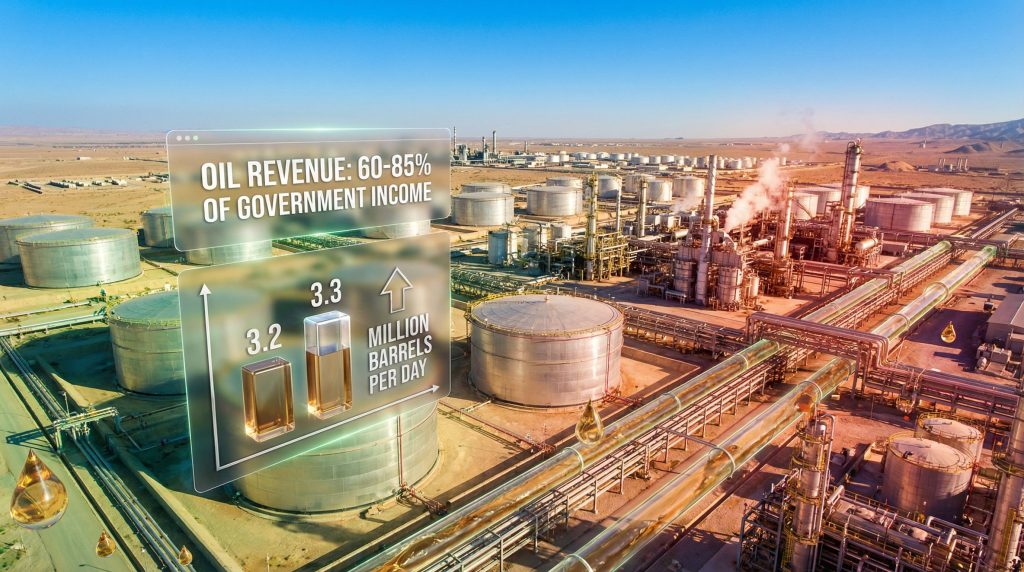
Iran's fiscal model exemplifies extreme hydrocarbon dependency, with oil and gas revenues accounting for approximately 80% of government export earnings and roughly 60-85% of total fiscal income depending on global price cycles and external constraints. This concentration level places the economy among the most petroleum-dependent globally, creating structural vulnerabilities that compound during periods of market volatility or geopolitical tension.
The government's revenue architecture relies heavily on direct petroleum sales through the National Iranian Oil Company (NIOC), supplemented by allocations to the National Development Fund (NDF) that theoretically receives 48% of hydrocarbon export revenues under Iran's Sovereign Wealth Fund Law. However, actual execution differs significantly from legal frameworks, with the NDF experiencing systematic depletion that has accelerated dramatically in recent years.
Historical Revenue Volatility and Fiscal Vulnerability
Iran's fiscal experience across major oil price cycles illustrates the inherent instability of petroleum-dependent economic models. Furthermore, our comprehensive oil price rally analysis reveals the complex interplay between global pricing dynamics and revenue realisation for dependent economies.
- 2008 commodity peak ($132/barrel): Government oil revenues reached $85-95 billion annually
- 2015 price collapse ($35/barrel): Revenues contracted to $15-20 billion range
- 2018 sanctions reimposition: Revenue collapse to sub-$10 billion levels despite higher global prices
- 2022-2023 price recovery ($100-110/barrel): Limited benefit realisation at $18-24 billion due to sanctions constraints
This volatility demonstrates both price sensitivity and the additional constraints imposed by sanctions mechanisms, creating a "double vulnerability" where Iran cannot fully capitalise on favourable market conditions while remaining exposed to downside price risk.
National Development Fund Depletion Patterns
The systematic erosion of Iran's sovereign wealth fund represents a critical indicator of fiscal unsustainability:
| Year | NDF Balance (USD Billions) | Annual Change |
|---|---|---|
| 2011 | $27.0 | Baseline |
| 2020 | $20.0 | -$7.0 billion (9-year period) |
| 2024 | $3.7 | -$16.3 billion (4-year acceleration) |
The fund balance declined by 82-86% over 13 years, with drawdown acceleration averaging $4.08 billion annually between 2020-2024. Parliamentary reviews indicate no oil revenues have been deposited into the fund since early 2023, while approximately 30% of remaining assets are being loaned back to the state for immediate financing needs.
Current Production Dynamics Versus Revenue Realisation
Iran has maintained crude oil production at 3.2-3.3 million barrels per day throughout 2024-2025, representing approximately 82-85% capacity utilisation of its theoretical maximum output. This production plateau demonstrates technical resilience but masks significant challenges in revenue capture and long-term sustainability.
Production Maintenance Through Brownfield Development
The sustained output levels rely primarily on brownfield redevelopment rather than new field development, creating a "managed sustainability model" with inherent limitations:
- Natural decline rates in mature fields average 5-6% annually
- Offset capacity of approximately 160,000-200,000 barrels per day brought online annually through workovers and operational optimisation
- South Pars field development contributes 35% of total production capacity through phased expansion programmes
Key producing assets demonstrate the ageing field challenge:
- Gachsaran Field: 450,000 bpd from assets in production since 1928
- Ahvaz Field: 380,000 bpd with natural decline rates of 5-7% annually
- Foruz Field: 310,000 bpd maintained through enhanced oil recovery techniques
Technology Access Constraints and Production Optimisation
Limited access to international technology providers creates operational inefficiencies that compound over time:
- Maintenance costs estimated 30-50% higher than international norms due to supply chain friction
- Spare parts availability constraints for major service company equipment
- Production optimisation software limitations reducing reservoir management capabilities
These constraints prevent optimisation of mature field production and limit the effectiveness of enhanced oil recovery programmes, creating a "treadmill effect" where increasing effort is required to maintain stable output levels.
The Economics of Sanctions Evasion and Shadow Trade Networks
Iran's oil economy instability is significantly amplified by the hidden costs associated with circumventing international sanctions through shadow trade networks. These mechanisms, while enabling continued exports, impose substantial economic penalties that reduce revenue realisation and create additional operational risks.
Shadow Fleet Configuration and Operating Costs
Iran operates an estimated 400-500 vessel shadow fleet engaged in sanctions evasion, primarily consisting of ageing tankers with average ages of 20-25 years, well above industry standards. This fleet configuration creates multiple cost layers:
| Cost Component | Per Barrel Cost | Impact |
|---|---|---|
| Shadow fleet charter premiums | $2-3 | Higher insurance/risk costs |
| Ship-to-ship transfer operations | $1.50-2.50 | Labour, logistics, spillage risk |
| Grey market insurance coverage | $1-2 | Elevated premium rates |
| Intermediary and broker fees | $0.75-1.50 | Payment complexity costs |
| Indirect routing inefficiencies | $0.50-1 | Extended logistics chains |
The total evasion cost premium ranges from $9-15 per barrel, representing a 25-35% discount to benchmark Brent crude pricing. This structural discount persists regardless of global oil price levels, creating a permanent revenue disadvantage.
Revenue Leakage Through Circumvention Mechanisms
The financial impact of sanctions evasion can be quantified through comparative analysis:
- Theoretical benchmark revenue: 1.9M bpd × $84/barrel × 365 days = $58.3 billion annually
- Actual realised revenue: 1.9M bpd × $60/barrel × 365 days = $41.6 billion annually
- Annual revenue loss: $16.7 billion (28.6% of potential)
This represents the "hidden tax" of sanctions circumvention, creating a permanent structural disadvantage that compounds other economic vulnerabilities. Furthermore, the broader implications of oil price trade war dynamics further constrain Iran's ability to optimise revenue realisation.
China Dependency and Strategic Trade Vulnerabilities
China accounts for approximately 90% of Iran's crude exports, creating a dangerous concentration risk that extends beyond simple trade dependency. This relationship operates through yuan-denominated payment systems and barter arrangements that further constrain Iran's economic flexibility.
Monopsony Market Dynamics
The extreme concentration of Iranian oil sales to Chinese refiners creates monopsony conditions where:
- Price discovery mechanisms are limited to bilateral negotiations rather than market-based pricing
- Payment terms increasingly favour Chinese counterparts through extended credit arrangements
- Quality premiums for Iranian crude grades are minimised due to lack of alternative buyers
Chinese refiners have leveraged this position to secure significant discounts, with Iranian crude trading at $8-15 below comparable grades in international markets. These discounts reflect not just sanctions risk but the underlying market power imbalance.
Strategic Vulnerability Assessment
The China dependency creates multiple strategic risks:
- Payment system constraints: Limited to yuan-denominated transactions or barter arrangements for Chinese goods
- Infrastructure lock-in: Investment in China-specific export terminals and pipeline infrastructure
- Diplomatic leverage: Chinese ability to adjust purchase volumes for geopolitical purposes
This concentration represents a fundamental shift from Iran's historical export diversification across European, Asian, and regional markets, creating new forms of economic vulnerability. However, the US-China trade impact on global markets may offer some potential opportunities for alternative relationships.
Fiscal Budget Assumptions and Reality Gaps
Iran's budget planning reveals growing pessimism about export potential and price realisation, with government assumptions becoming increasingly conservative relative to production capacity. Furthermore, the broader context of US tariffs and inflation creates additional pressure on global trade relationships.
Export Volume and Price Projections
Recent budget parameters demonstrate declining expectations:
- Oil sales assumptions: Reduced from 1.85 million to 1.0 million barrels per day
- Price benchmarks: Lowered from $63 to $57 per barrel
- Budget growth: Nominal increase from $98 billion to $111 billion inadequate for 40% inflation rates
These assumptions suggest recognition of structural constraints that limit monetisation of physical production capacity, creating a widening gap between theoretical output potential and budget-realisable revenue.
Revenue Allocation and Military Funding
The distribution of oil export earnings reflects competing institutional priorities:
- NIOC official allocation: 14.5% of total export revenues
- IRGC transfers: Approximately one-third of oil export earnings
- NIOC effective share: Reduced to approximately 10% after military allocations
This funding structure leaves NIOC with insufficient resources for operational costs and field development, creating a self-reinforcing cycle of underinvestment and production decline risk.
The next major ASX story will hit our subscribers first
Infrastructure Ageing and Technical Decline Challenges
Iran's oil economy instability is compounded by accelerating technical challenges in ageing petroleum infrastructure. Natural decline rates in mature fields are increasing due to chronic underinvestment in maintenance and redevelopment programmes.
Field-Level Decline Rate Analysis
Iranian oil fields experience varying decline rates based on maturity and geological conditions:
- Young/developing fields: 2-3% annual decline
- Mature producing fields: 5-8% annual decline (majority of production)
- Depleted/end-of-life fields: 10-15% annual decline
- Portfolio-weighted average: 5-6% annual decline across all Iranian assets
The maintenance of 3.2-3.3 million bpd output requires bringing approximately 160,000-200,000 bpd of new capacity online annually through workovers and efficiency improvements, representing a significant technical and financial challenge.
Capital Investment Shortfalls
Limited access to international capital markets and technology providers creates compounding constraints:
- Estimated investment requirement: $40-50 billion over 5-7 years to reach 4.0-4.2 million bpd capacity
- Realistic near-term ceiling: 3.3-3.5 million bpd achievable with modest brownfield projects
- Technology access limitations: Reduced availability of advanced extraction and reservoir management systems
These constraints create a "capability trap" where Iran can maintain current production through operational efficiency but cannot significantly expand capacity without external technology and capital access.
Domestic Unrest and Economic Stability Indicators
Rising domestic protests and social unrest create additional layers of risk for Iran's oil economy instability, potentially threatening both production infrastructure and regime stability. The December 2025 demonstrations represent escalating economic grievances linked directly to petroleum revenue constraints.
What are the key economic stress indicators?
Key indicators of domestic economic pressure include:
- Inflation rates: Approximately 40% annually, eroding purchasing power
- Real budget growth: Negative after inflation adjustment despite nominal increases
- Banking sector stress: Bank Ayandeh failure in October 2025 indicating systemic financial instability
The combination of high inflation, limited budget flexibility, and financial sector weakness creates conditions for sustained social unrest that could threaten oil infrastructure and export operations. Analysing Iran's internal tensions reveals that labour strikes pose more immediate risks than military conflict.
Infrastructure Security and Production Risk
While current protests have not directly targeted petroleum production facilities, the potential for infrastructure disruption creates additional risk factors:
- Production facility protection: Current security arrangements adequate but potentially vulnerable to escalation
- Transportation infrastructure: Pipeline and terminal facilities represent potential targets
- Workforce stability: Technical personnel retention challenges during periods of social unrest
International Policy Response and Market Implications
External policy responses to Iran's oil economy instability continue evolving through multiple diplomatic and economic channels, creating additional uncertainty for both Iranian revenues and global energy markets. Furthermore, potential Venezuela oil policy shifts may affect regional petroleum market dynamics.
Sanctions Escalation and Secondary Effects
Recent policy developments include:
- January 2026 tariff announcements: 25% tariffs on Iran-trading nations create compliance costs for international partners
- September 2025 UN sanctions: Failed extension attempts but continued bilateral enforcement
- Secondary sanctions expansion: Increased targeting of financial, maritime, and insurance sectors
These measures compound existing constraints while creating additional compliance costs for countries and companies engaged in Iranian trade.
Global Market Disruption Scenarios
Potential market impact scenarios depend on the scale and duration of any supply disruptions:
| Scenario | Probability | Production Impact | Price Effect | Duration |
|---|---|---|---|---|
| Status Quo Continuation | 60% | Stable 3.2M bpd | +$4-6/barrel premium | Ongoing |
| Negotiated Settlement | 25% | Potential increase to 4M bpd | -$8-12/barrel relief | 12-24 months |
| Major Disruption | 15% | 6-18 month supply loss | +$20-40/barrel spike | Variable |
The 2026 global oil supply glut of 3.2 million barrels per day surplus suggests limited immediate market impact from Iranian supply constraints, but full disruption scenarios could create significant price volatility.
Strait of Hormuz Strategic Considerations
Iran's geographic position controlling access to the Strait of Hormuz, through which 20% of global oil flows transit, creates additional strategic leverage despite domestic economic constraints. Any escalation affecting this chokepoint could trigger $91/barrel crude prices according to full disruption modelling scenarios.
Moreover, Iran's economic failures demonstrate how domestic instability compounds external pressure, potentially affecting regional energy security.
Long-Term Economic Sustainability and Reform Requirements
The structural challenges facing Iran's oil economy instability require comprehensive economic diversification and institutional reforms that extend far beyond immediate revenue optimisation. Current petroleum-dependent models appear increasingly unsustainable under existing constraint conditions.
Economic Diversification Imperatives
Sustainable economic stability requires reducing oil dependency from current 60-85% of government revenues to more manageable levels:
- Non-oil revenue development: Expansion of manufacturing, services, and technology sectors
- Tax system modernisation: Increasing non-petroleum revenue collection from current 7-9% of GDP
- Industrial capacity building: Developing value-added processing capabilities for petroleum products
However, sanctions limitations significantly constrain access to technology, capital, and international markets necessary for diversification programmes.
Institutional Reform Necessities
Structural economic improvements require addressing institutional inefficiencies:
- Revenue allocation transparency: Reducing IRGC economic role and increasing NIOC operational funding
- National fund management: Restoring NDF deposits and implementing fiscal discipline mechanisms
- Banking sector rehabilitation: Addressing systemic financial institution weaknesses
These reforms face significant political obstacles given existing institutional power structures and military funding requirements.
Risk Assessment and Strategic Implications for Global Energy Markets
Iran's oil economy instability represents both immediate market risks and longer-term structural challenges that could affect regional stability and global energy security. Understanding these dynamics requires assessing multiple timeframes and scenario probabilities.
Sustainability Timeline Analysis
Current economic models face several critical timeline constraints:
- 2-3 years: Current production plateau sustainable absent major disruption
- 5-8 years: Potential decline to 2.8-3.0 million bpd if capital constraints worsen
- 5-7 years: Recovery to 3.5-4.0 million bpd possible with sanctions relief and $15-20 billion investment
The intersection of technical decline rates, fiscal constraints, and political stability creates a narrow window for sustainable economic management under current conditions.
Strategic Risk Factors for International Markets
Key risk factors extending beyond Iran include:
- Regional stability effects: Iranian economic instability could affect neighbouring petroleum producers
- China energy security: Disruption of Iranian supplies could shift Chinese purchasing to other suppliers
- Sanctions enforcement: Escalating secondary sanctions could affect global trade compliance costs
The sustainability of Iran's current economic model depends on managing an increasingly complex set of internal and external constraints while maintaining petroleum production capacity under deteriorating fiscal conditions. The outcome will significantly influence both regional stability and global energy market dynamics over the next decade.
Searching for Energy Investment Opportunities in an Unstable Market?
With petroleum markets facing increasing volatility and geopolitical complexity, Discovery Alert's proprietary Discovery IQ model provides instant notifications on significant ASX mineral discoveries, helping investors navigate beyond traditional energy dependencies. Visit Discovery Alert's discoveries page to see how historic mineral discoveries have delivered exceptional returns during periods of global market uncertainty, then begin your 30-day free trial to identify actionable opportunities ahead of the broader market.