
May 14, 2026
The Evolving Landscape of Petroleum Regulation in Emerging Markets
The global energy sector has witnessed a remarkable transformation in recent decades, with emerging markets increasingly positioning themselves as significant players in the upstream petroleum industry. This shift has created an urgent need for robust regulatory frameworks that can effectively balance investor confidence with national resource management objectives. Countries with newly discovered hydrocarbon reserves face the complex challenge of developing comprehensive legal structures that meet international standards while protecting domestic interests.
Modern petroleum regulation extends far beyond traditional licensing procedures, encompassing sophisticated governance mechanisms, environmental protections, and economic participation frameworks. The most successful emerging hydrocarbon provinces have demonstrated that regulatory clarity and institutional efficiency serve as fundamental prerequisites for attracting the substantial capital investments required for deepwater exploration and development projects.
When big ASX news breaks, our subscribers know first
Namibia's Regulatory Foundation and Reform Imperatives
Namibia's current petroleum regulatory framework, established through the Petroleum (Exploration and Production) Act of 1991, reflects the legislative standards of its era but has increasingly struggled to address the complexities of modern upstream operations. The original legislation was designed for a substantially different operating environment, lacking provisions for contemporary governance standards, environmental compliance protocols, and investor protection mechanisms that have become industry benchmarks.
The regulatory gaps have become particularly apparent as Namibia transitions from an exploration frontier to a potential production hub. International operators require predictable regulatory processes, standardised approval timelines, and clear compliance frameworks when making multi-billion dollar investment decisions. The absence of these elements can significantly impact capital allocation decisions, particularly when investors are evaluating multiple competing opportunities across different jurisdictions.
Contemporary petroleum regulation in emerging markets must address several critical areas that were not adequately covered in earlier legislative frameworks. These include sophisticated environmental impact assessment procedures, comprehensive local content requirements, advanced revenue management systems, and robust anti-corruption measures. Furthermore, understanding the broader industry regulatory evolution provides valuable context for how regulatory modernisation efforts have involved extensive stakeholder consultation and benchmarking against international best practices.
Structural Reforms in the Petroleum Amendment Bill 2025
The proposed Petroleum Amendment Bill 2025 introduces fundamental structural changes designed to enhance regulatory efficiency and transparency. The establishment of a centralised Upstream Petroleum Unit directly under presidential oversight represents a significant departure from the previous decentralised approach, concentrating decision-making authority to accelerate licensing processes and reduce bureaucratic inefficiencies.
This centralisation model reflects global trends toward specialised petroleum regulatory institutions capable of managing complex technical and commercial evaluations. Successful examples from other jurisdictions demonstrate that dedicated petroleum units with appropriate technical expertise and adequate resources can significantly reduce approval timelines whilst maintaining rigorous evaluation standards.
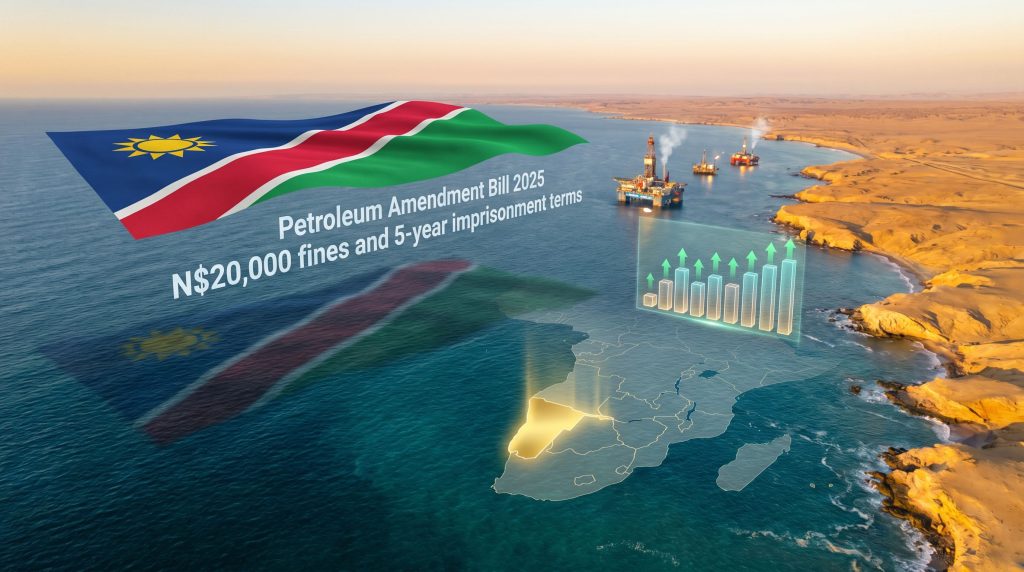
The enhanced governance provisions within the amendment bill address critical transparency concerns through mandatory asset declarations for senior officials and comprehensive conflict-of-interest protocols. These measures include specific penalties of N$20,000 fines and potential five-year imprisonment terms for officials found in violation of financial interest prohibitions. Consequently, this establishes clear accountability frameworks that align with international anti-corruption standards and addresses investment risk red flags commonly identified by international operators.
Key governance enhancements include:
• Standardised licensing procedures with defined timelines
• Enhanced due diligence requirements for all stakeholders
• Comprehensive reporting mechanisms for regulatory compliance
• Strengthened environmental assessment protocols
• Improved dispute resolution procedures
Investment Climate Transformation Through Regulatory Modernisation
Regulatory certainty serves as a fundamental driver of international investment in frontier petroleum markets. Investors typically evaluate regulatory frameworks across multiple criteria including policy stability, administrative efficiency, transparency levels, and enforcement consistency. The proposed reforms address each of these evaluation factors through specific institutional and procedural improvements.
The streamlined licensing processes under the new framework are designed to reduce approval timelines whilst maintaining comprehensive technical and environmental assessments. International operators have consistently identified regulatory delays and uncertainty as primary investment risks in emerging markets, often leading to capital reallocation toward more established jurisdictions with proven regulatory track records.
Comparative analysis of successful petroleum provinces reveals that countries achieving rapid development transitions typically implement regulatory reforms proactively, before significant commercial discoveries create time pressures. This strategic approach allows for comprehensive stakeholder consultation and system testing before high-stakes development decisions must be made.
The enhanced compliance monitoring capabilities proposed in the amendment bill provide additional investor confidence through predictable enforcement mechanisms. Clear regulatory expectations combined with consistent application of standards create the stable operating environment that international petroleum companies require for long-term investment commitments.
What Are the Implementation Challenges and Risk Mitigation Strategies?
Centralised regulatory authority, whilst offering efficiency benefits, introduces potential risks related to institutional concentration and decision-making bottlenecks. The placement of the Upstream Petroleum Unit under direct presidential oversight may enhance coordination but could also create concerns about political interference in technical regulatory decisions.
International best practices suggest that successful petroleum regulatory institutions maintain appropriate independence whilst ensuring alignment with national policy objectives. This balance requires clear mandates, adequate technical staffing, and transparent decision-making processes that can withstand political transitions and changing government priorities.
The transitional period during regulatory reform implementation presents particular challenges for ongoing operations and pending applications. Effective transition management requires comprehensive grandfathering provisions for existing licences, clear timelines for new procedures, and maintained operational continuity throughout the reform process. Moreover, insights from permitting process insights demonstrate the importance of maintaining clear communication channels during regulatory transitions.
Critical implementation considerations include:
• Adequate staffing and technical capacity building for new institutions
• Comprehensive training programmes for regulatory personnel
• Stakeholder communication strategies throughout the transition
• Performance monitoring systems to evaluate reform effectiveness
• Contingency planning for potential implementation delays
Orange Basin Development Integration with Regulatory Reform
The timing of Namibia oil law reform coincides strategically with accelerating exploration and appraisal activities across the Orange Basin deepwater province. Major international operators have committed substantial resources to advancement programmes, with Chevron's Nabba-1X exploration well scheduled for late 2026 representing one of several high-profile drilling campaigns planned for the region.
Rhino Resources is simultaneously advancing its Capricornus project, whilst TotalEnergies progresses toward potential final investment decisions on the Venus development. This concentration of activity creates an urgent timeline for regulatory framework completion, as operators require certainty about applicable regulations before making final development commitments.
The Orange Basin's geological characteristics present both significant opportunities and complex regulatory challenges. Deepwater developments typically require sophisticated environmental management protocols, advanced technology applications, and substantial infrastructure investments that must be supported by appropriate regulatory frameworks.
Successful integration of regulatory reform with development timelines requires coordinated planning between government institutions and industry operators. This coordination becomes particularly critical when multiple major projects are progressing simultaneously, creating potential resource constraints and administrative bottlenecks that could impact overall development schedules.
The next major ASX story will hit our subscribers first
Economic Framework Integration and Revenue Optimisation
The petroleum amendment bill operates within broader economic frameworks designed to maximise national benefits from hydrocarbon development. Article 100 of Namibia's Constitution establishes state ownership principles for natural resources, requiring integration between regulatory reforms and revenue management systems to ensure optimal economic outcomes.
The requirement for 25% previously disadvantaged Namibian participation in petroleum projects represents a significant economic empowerment component that must be effectively coordinated with technical and commercial project requirements. Successful implementation requires clear guidelines, appropriate capacity building programmes, and flexible mechanisms that can accommodate diverse project structures.
Revenue optimisation frameworks under the new regulatory structure must balance competitive fiscal terms with appropriate government participation levels. International experience demonstrates that excessive fiscal burdens can discourage investment, whilst insufficient government participation may limit long-term economic benefits for host countries. In addition, global market dynamics such as oil price rally dynamics continue to influence fiscal framework design across petroleum provinces worldwide.
Economic integration priorities include:
• Alignment with Vision 2030 development objectives
• Local content requirement implementation
• Skills development and technology transfer protocols
• Infrastructure development coordination
• Economic diversification beyond extractive industries
Regional Competitive Positioning and Global Market Integration
Namibia's regulatory modernisation occurs within a highly competitive West African petroleum market where multiple countries are simultaneously seeking to attract international investment and develop newly discovered hydrocarbon resources. Regional competitors including Ghana, Senegal, and Guyana have established regulatory precedents that influence investor expectations and evaluation criteria.
The Orange Basin's deepwater characteristics position it among the world's most promising new petroleum provinces, but successful development requires regulatory frameworks that meet international standards for environmental protection, operational safety, and commercial transparency. Deepwater projects typically involve investment commitments exceeding several billion dollars, making regulatory certainty a critical factor in final investment decisions.
However, Namibia's approach must also consider global licensing trends, as demonstrated by developments in Saudi Arabia exploration licenses, which illustrate how regulatory frameworks can influence international investment flows. Global supply chain integration for deepwater development projects requires sophisticated logistical coordination and regulatory frameworks capable of managing complex international partnerships.
Competitive positioning factors include:
• Regulatory approval timeline competitiveness
• Environmental compliance standard alignment
• Local content requirement competitiveness
• Technology transfer facilitation capabilities
• Infrastructure development support systems
Long-term Sustainability Planning and Adaptive Management
Beyond first oil production, Namibia oil law reform must address long-term sustainability challenges including resource depletion management, environmental legacy planning, and economic transition preparation. International best practices emphasise the importance of establishing these frameworks early in the development cycle rather than addressing them reactively as production declines.
Decommissioning and environmental restoration protocols represent increasingly significant components of modern petroleum regulation, requiring sophisticated financial assurance mechanisms and technical standards that must be established before development begins. The proposed regulatory reforms provide opportunities to integrate these requirements from project inception.
Adaptive management capabilities within the regulatory framework allow for continuous improvement based on operational experience and evolving international standards. Successful petroleum provinces typically implement regular review processes that enable framework updates without compromising operational certainty or investment confidence.
The integration of technology transfer requirements and local capacity building mechanisms ensures that regulatory frameworks contribute to broader economic development objectives beyond direct hydrocarbon revenues. This approach requires sophisticated planning and coordination across multiple government agencies and educational institutions.
How Will Future Regulatory Evolution Be Managed?
The proposed Namibia oil law reform establishes foundations for continuous regulatory enhancement through adaptive management mechanisms. These systems enable framework updates whilst maintaining operational certainty for investors and operators throughout the production lifecycle.
Future regulatory evolution priorities include:
• Production phase optimisation procedures
• Enhanced environmental monitoring requirements
• Advanced technology integration protocols
• Comprehensive stakeholder engagement mechanisms
• International best practice adoption frameworks
For instance, Namibia's expedited legislative process demonstrates the government's commitment to aligning regulatory frameworks with development timelines. Furthermore, comprehensive regulatory alignment initiatives continue to address historical licensing challenges whilst establishing clear precedents for future operations.
The successful implementation of Namibia oil law reform will ultimately depend on maintaining balanced stakeholder engagement, ensuring adequate institutional capacity, and establishing clear performance metrics for ongoing regulatory effectiveness. These elements collectively contribute to creating the stable investment climate necessary for successful petroleum province development in emerging markets.
Disclaimer: This analysis is based on publicly available information and industry observations. Petroleum sector investments involve substantial risks including regulatory changes, market volatility, technical challenges, and environmental factors. Potential investors should conduct comprehensive due diligence and seek professional advice before making investment decisions. Future regulatory developments may differ from current proposals, and actual implementation outcomes may vary from projected scenarios.
Looking for Your Next Strategic Oil and Gas Investment Opportunity?
Discovery Alert's proprietary Discovery IQ model delivers real-time alerts on significant energy sector discoveries across the ASX, instantly empowering subscribers to identify actionable opportunities ahead of the broader market. Explore why major discoveries can lead to substantial market returns by visiting Discovery Alert's dedicated discoveries page and begin your 14-day free trial today to position yourself ahead of the market.