June 15, 2026
Strategic Implications of PetroSA's Offshore Partnership Decision
The recent development where PetroSA approves Shell as majority partner in block offshore South Africa marks a pivotal moment in the country's petroleum sector evolution. This strategic decision reflects broader industry trends where national oil companies increasingly seek international partnerships to access advanced technology and capital resources for complex deep-water exploration programmes.
Furthermore, global energy markets have experienced significant volatility, with oil price rally insights demonstrating how geopolitical factors influence investment decisions in frontier petroleum provinces. The Shell-PetroSA partnership positions South Africa to capitalise on favourable market conditions while mitigating exploration risks through proven international expertise.
When big ASX news breaks, our subscribers know first
Strategic Framework Analysis of Shell's Block 2C Partnership Structure
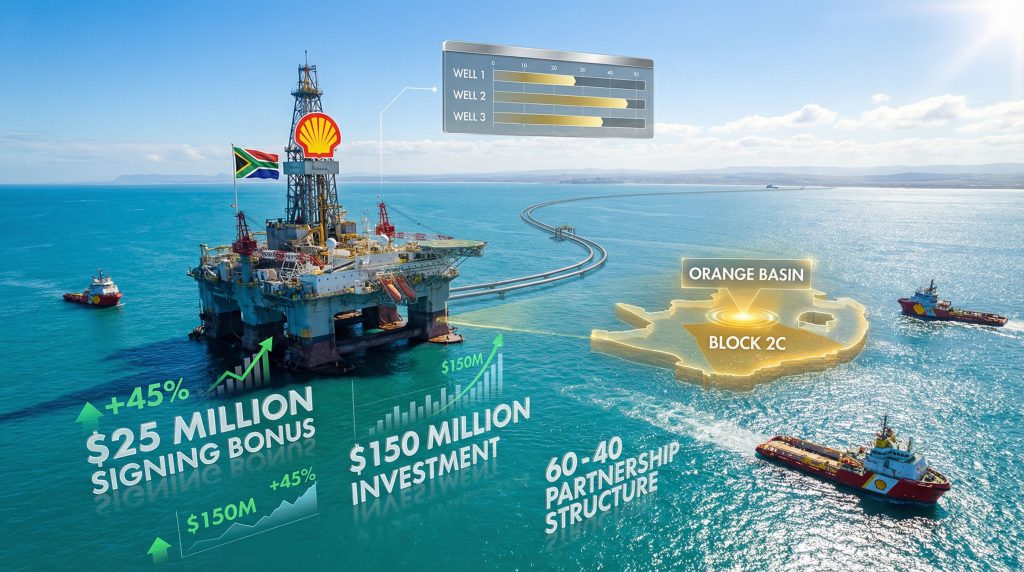
The recent farm-in agreement between Shell and PetroSA represents a carefully calibrated risk-sharing mechanism designed to optimise exploration outcomes while preserving South African government participation in offshore petroleum development. Shell's acquisition of a 60% working interest in Block 2C demonstrates the international major's commitment to securing operational control whilst maintaining strategic alignment with national energy objectives.
However, industry analysts note that oil price stagnation factors could influence the timing of major capital commitments in frontier exploration projects. Consequently, the partnership structure includes built-in flexibility mechanisms to adapt to changing market conditions.
Financial Architecture of the $175 Million Investment Commitment
The deal's financial structure reveals sophisticated risk allocation principles commonly employed in frontier basin exploration. Shell's $25 million signing bonus provides immediate capital injection to PetroSA, whilst the $135-150 million cost carry commitment ensures complete exploration risk transfer during the critical discovery phase.
This full cost carry arrangement means Shell assumes 100% of drilling expenses for the three-well programme, despite holding only 60% working interest. Such structures typically indicate high geological confidence levels and represent Shell's strategic assessment of Orange Basin prospectivity relative to global portfolio opportunities.
| Investment Component | Value (USD Million) | Risk Allocation | Timeline |
|---|---|---|---|
| Signing Bonus | 25 | Immediate to PetroSA | Upon completion |
| Exploration Cost Carry | 135-150 | Full Shell responsibility | 24-36 months |
| Working Interest Split | 60% Shell / 40% PetroSA | Shared future revenue | Post-discovery |
Partnership Governance and Decision-Making Frameworks
The 60-40 partnership structure provides Shell with majority voting control over operational decisions whilst preserving PetroSA's strategic influence in project development phases. This governance model facilitates efficient decision-making processes essential for complex deep-water drilling operations requiring rapid technical and commercial responses.
Moreover, PetroSA's transition from 100% operator to 40% working interest partner represents a fundamental shift in South Africa's approach to offshore resource development. The national oil company's incorporation into the South African National Petroleum Company adds institutional complexity that may influence future operational protocols and government coordination mechanisms.
Orange Basin Competitive Dynamics and Regional Context
South Africa's Orange Basin has emerged as one of the world's most attractive frontier exploration regions following significant discoveries in neighbouring Namibian waters. The basin's geological potential stems from extensive Cretaceous sedimentary sequences that mirror productive formations across the South Atlantic conjugate margin.
In addition, recent analyses of oil price movements analysis suggest that successful exploration outcomes in the Orange Basin could significantly impact regional energy dynamics and international investment flows.
Geological Prospectivity Assessment
Block 2C's location within the Orange Basin positions the partnership to target similar geological formations that have yielded commercial discoveries in Namibian territory. The planned three-well exploration programme will test multiple prospect concepts across different structural and stratigraphic settings.
Deep-water exploration in this region typically encounters water depths exceeding 1,500 metres, requiring specialised drilling capabilities and advanced seismic interpretation techniques. Shell's technical expertise in ultra-deep water operations provides significant advantages in navigating the complex geological conditions characteristic of passive margin environments.
Competitive Positioning Against Regional Operators
Shell's simultaneous pursuit of both Block 2C and the Northern Cape Ultra Deep Block demonstrates comprehensive Orange Basin exposure spanning multiple geological fairways. The company's July 2025 environmental authorisation for five wells in the Northern Cape block establishes operational precedent for navigating South African regulatory frameworks.
TotalEnergies' discoveries in neighbouring Namibian waters have validated the region's commercial potential, creating competitive pressure for accelerated exploration programmes across national boundaries. According to Reuters' recent analysis, the Orange Basin's emergence as a strategic petroleum province has attracted investment commitments exceeding $2 billion across multiple operator programmes.
Economic Impact Analysis and Revenue Generation Mechanisms
The Shell-PetroSA partnership creates multiple economic value streams for South African fiscal authorities and energy sector development. Revenue generation occurs through various channels including royalty payments, corporate taxation, and potential production sharing arrangements.
Nevertheless, global market uncertainties, including declining oil production impacts, underscore the importance of securing long-term supply diversification through domestic exploration success.
Government Revenue Optimisation
PetroSA's retained 40% working interest ensures government participation in any commercial discoveries, providing direct exposure to production revenues beyond standard fiscal instruments. This participation mechanism aligns with South African policy objectives of maintaining strategic control over petroleum resources whilst leveraging international technical expertise.
The $25 million signing bonus flows directly to South African National Treasury through PetroSA's ownership structure, providing immediate fiscal benefits independent of exploration outcomes. Such upfront payments demonstrate international confidence in the country's petroleum potential and regulatory stability.
The partnership structure ensures South African government participation in potential discoveries whilst transferring exploration risk to an experienced international operator with proven deep-water capabilities.
Infrastructure Integration Opportunities
PetroSA's existing gas-to-liquids facility at Mossel Bay, currently under care and maintenance, represents potential downstream integration opportunities for offshore gas discoveries. The facility's reactivation would require substantial capital investment but could provide domestic energy supply enhancement and processing capability for regional gas resources.
The Mossel Bay facility's strategic location on South Africa's southern coast positions it optimally for processing Orange Basin gas production through subsea pipeline infrastructure. Reactivation economics depend heavily on discovery size and gas composition, with break-even scenarios requiring sustained production volumes exceeding 150 million standard cubic feet per day.
Regulatory Framework Navigation and Environmental Authorisation
South African offshore petroleum exploration operates within comprehensive regulatory frameworks administered by the Petroleum Agency South Africa (PASA). The authorisation process requires extensive environmental impact assessments, stakeholder consultation programmes, and technical competency demonstrations.
Additionally, international policy developments, particularly drilling policy shifts in major petroleum provinces, influence South African regulatory approaches and industry best practices.
Environmental Assessment Precedents
Shell's successful environmental authorisation for the Northern Cape Ultra Deep Block in July 2025 establishes important precedent for similar Orange Basin projects. The authorisation covers up to five deep-water wells, demonstrating regulatory pathway viability for large-scale exploration programmes.
However, ongoing litigation surrounding Shell's Block 5/6/7 exploration rights illustrates potential regulatory risks facing offshore operators. Environmental advocacy groups have successfully obtained court injunctions blocking exploration activities, creating execution uncertainty that may affect project timelines and investment decisions.
PASA Approval Process Timeline
The Petroleum Agency South Africa has confirmed that formal application for Block 2C stake transfer has not yet been submitted, indicating the regulatory approval process remains in preliminary stages. Standard processing timelines for major stake transfers typically require 6-12 months depending on technical review complexity and stakeholder consultation requirements.
Key regulatory milestones include:
- Environmental impact assessment completion
- Community consultation programme implementation
- Technical competency verification
- Financial capability demonstration
- Operational safety protocol approval
Technology Transfer and Capacity Building Implications
Shell's operational leadership in Block 2C creates opportunities for substantial technology transfer and local capacity development within South Africa's petroleum sector. Deep-water drilling expertise, seismic interpretation capabilities, and project management systems represent valuable knowledge assets for domestic industry development.
Skills Development Framework
International oil company partnerships typically include mandatory training programmes for local technical personnel, supporting long-term capacity building objectives. Shell's global expertise in subsea engineering, reservoir management, and production optimisation provides comprehensive learning opportunities for South African petroleum professionals.
The partnership structure enables PetroSA personnel to participate directly in exploration planning, drilling operations, and reservoir evaluation activities. This hands-on experience proves invaluable for developing domestic technical capabilities essential for future independent operations.
Local Content Integration
South African petroleum legislation includes local content requirements designed to maximise domestic economic benefits from offshore exploration and production activities. These requirements typically mandate minimum percentages of local goods and services procurement across various project phases.
Marine services, supply base operations, and technical support functions represent immediate opportunities for local supplier participation during the exploration phase. Successful discoveries could generate substantial downstream opportunities in engineering services, fabrication activities, and logistics support.
The next major ASX story will hit our subscribers first
Investment Risk Assessment and Success Probability Analysis
Deep-water frontier exploration carries inherent geological, technical, and commercial risks that require sophisticated evaluation frameworks. The Orange Basin's emerging status as a petroleum province provides both opportunity and uncertainty regarding ultimate commercial potential.
Technical Risk Factors
Primary technical risks include:
- Reservoir quality uncertainty in untested geological formations
- Structural complexity requiring advanced drilling techniques
- Water depth challenges exceeding 2,000 metres in some areas
- Weather window limitations during South African winter months
- Infrastructure distance from existing production facilities
Commercial Viability Thresholds
Commercial discoveries in the Orange Basin typically require minimum reserves of 100-200 million barrels of oil equivalent to justify development economics. Break-even oil prices for deep-water developments generally range between $45-60 per barrel, depending on reservoir characteristics and infrastructure requirements.
Gas discoveries face additional commercialisation challenges related to domestic market size and export infrastructure requirements. Liquefied natural gas development scenarios require minimum reserves exceeding 2-3 trillion cubic feet to support project economics.
Regional Energy Security and Strategic Implications
Successful petroleum development in Block 2C could significantly enhance South African energy security by reducing dependence on petroleum product imports. The country currently imports approximately 70% of its liquid fuel requirements, creating substantial foreign exchange exposure and supply vulnerability.
Import Substitution Potential
Domestic crude oil production could reduce import requirements whilst generating export revenue if discoveries exceed domestic refining capacity. South African refineries possess combined processing capacity of approximately 525,000 barrels per day, providing domestic market outlets for moderate production volumes.
Regional energy integration opportunities exist through pipeline connections to neighbouring countries experiencing growing energy demand. Botswana, Namibia, and Zimbabwe represent potential export markets for petroleum products and natural gas.
Strategic Petroleum Reserve Considerations
Government policy frameworks increasingly emphasise strategic petroleum reserve development as energy security enhancement. Domestic production capabilities reduce vulnerability to international supply disruptions whilst providing greater price stability for domestic consumers.
Comparative Analysis with African Success Stories
The Shell-PetroSA partnership structure mirrors successful models implemented across African petroleum provinces, particularly in West African offshore developments. Ghana's Jubilee Field development exemplifies effective international-national oil company collaboration in frontier basin exploration.
Best Practice Integration
Successful African petroleum partnerships typically incorporate several common elements:
- Majority international operator control ensuring technical expertise application
- Significant national oil company participation maintaining government involvement
- Comprehensive cost carry arrangements reducing exploration risk for host countries
- Technology transfer obligations supporting local capacity development
- Environmental stewardship protocols meeting international standards
Angola's deep-water development model demonstrates how effective partnerships can generate substantial government revenues whilst maintaining foreign investment attraction. The country's production sharing contract framework provides useful benchmarks for optimising fiscal arrangements.
Future Development Scenarios and Timeline Projections
The Block 2C exploration programme timeline extends approximately 24-36 months from drilling commencement to completion of the three-well programme. Successful exploration outcomes would trigger comprehensive development planning processes requiring additional 3-5 years before production commencement.
Success Case Development Framework
Commercial discovery scenarios would necessitate:
- Appraisal drilling programmes to define reservoir extent
- Development planning including subsea infrastructure design
- Environmental authorisation for production facilities
- Pipeline routing to processing or export terminals
- Financial investment decisions requiring $2-5 billion in development capital
Alternative Outcome Planning
Exploration failure scenarios require careful consideration of alternative value creation opportunities. Gas discoveries below commercial thresholds might support domestic market supply, whilst oil shows could indicate potential for future exploration programmes in adjacent acreage.
In conclusion, the strategic decision where PetroSA approves Shell as majority partner in block offshore South Africa represents a transformative moment for the country's petroleum sector. The partnership's success metrics extend beyond immediate exploration outcomes to include technology transfer effectiveness, local capacity development achievements, and regulatory framework improvements that benefit future petroleum sector investments.
Furthermore, industry insights from Upstream Online's coverage suggest that this partnership model could serve as a template for similar arrangements across the African continent. The partnership's success metrics extend beyond immediate exploration outcomes to include technology transfer effectiveness, local capacity development achievements, and regulatory framework improvements that benefit future petroleum sector investments.
Disclaimer: This analysis is based on publicly available information and industry best practices. Actual exploration outcomes, commercial discoveries, and development timelines may vary significantly from projections discussed. Investment decisions should be based on comprehensive due diligence and professional financial advice.
Looking to Capitalise on Energy Sector Investment Opportunities?
Discovery Alert's proprietary Discovery IQ model delivers real-time alerts on significant mineral discoveries across the ASX, including critical energy transition minerals that power both traditional and renewable energy sectors. Begin your 30-day free trial today and position yourself ahead of the market with instant notifications on actionable investment opportunities.