August 5, 2026
Phosphate-based fertilizers represent a cornerstone of modern agricultural systems, with their complex pricing mechanisms and supply chains creating ripple effects across global food production networks. The intricate relationships between production costs, transportation logistics, and regional demand patterns shape market dynamics in ways that extend far beyond simple commodity trading. Understanding these mechanisms becomes essential as geopolitical tensions, environmental regulations, and technological innovations continue to reshape traditional fertilizer distribution channels.
Resource Endowment and Strategic Geographic Positioning
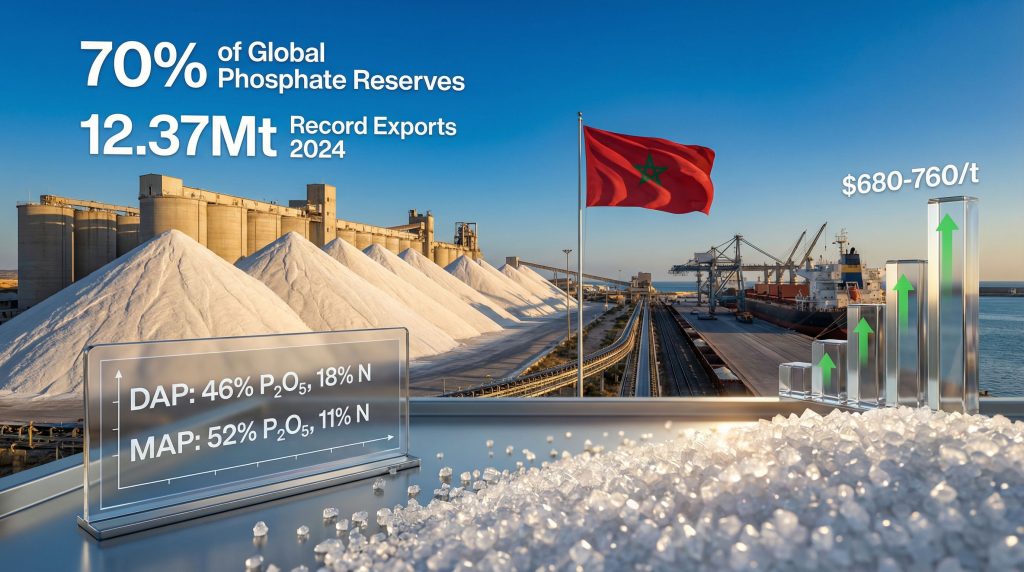
Morocco's position in global phosphate markets stems from extraordinary geological advantages that competitors cannot easily replicate. The country controls approximately 70% of global proven phosphate rock reserves, containing an estimated 50 billion tonnes of phosphate rock according to the U.S. Geological Survey's 2024 mineral commodity summaries. These deposits concentrate primarily in the Khouribga, Youssoufia, and Ben Guerir regions, where favorable geology enables cost-effective extraction.
The strategic geographic positioning of Morocco's production facilities creates substantial competitive advantages. The Jorf Lasfar Industrial Complex, positioned near Safi on Morocco's Atlantic coast, reduces transportation distances to key markets significantly. European destinations lie approximately 1,800-2,200 nautical miles from Moroccan ports, while Sub-Saharan African markets range from 2,500-4,500 nautical miles. Even distant Asia-Pacific markets, accessible via the Suez Canal, require only 6,000-8,500 nautical miles of ocean transport.
Morocco's phosphate deposits exhibit particularly favourable characteristics, with ore concentrations averaging 30-35% P₂O₅ in mineable deposits. This concentration level provides consistent cost advantages compared to alternative sources such as Florida's leached deposits or Australian hard-rock phosphate operations, which require significantly higher capital expenditure and operational complexity for similar output levels.
When big ASX news breaks, our subscribers know first
Technical Specifications and Agricultural Applications
The phosphate fertilizer market revolves around three primary products, each serving distinct agricultural requirements and transportation economics:
| Product Type | Phosphorus Content (P₂O₅) | Nitrogen Content | Primary Applications |
|---|---|---|---|
| DAP (Diammonium Phosphate) | 46% | 18% | Balanced nutrient supply for crop establishment |
| MAP (Monoammonium Phosphate) | 52% | 11% | Precision agriculture with lower nitrogen requirements |
| TSP (Triple Super Phosphate) | 46% | 0% | Phosphorus-only supplementation in blended formulations |
Recent market transactions demonstrate the practical application of these specifications. Furthermore, Morocco's OCP sells DAP and MAP across multiple regions, with December 2025 data showing distinct product preferences by destination. European markets favoured DAP shipments totalling 7,000 tonnes at premium pricing, while Asia-Pacific destinations absorbed larger volumes including 32,000 tonnes of MAP 10-50 grade fertilizer.
The MAP 10-50 specification represents a specialised formulation containing 10% nitrogen and 50% phosphorus, differing from standard MAP ratios. This customisation reflects growing demand for precision agriculture applications where reduced nitrogen input aligns with environmental regulations and soil management practices.
DAP and MAP function as foundational products in international trade because their high nutrient density optimises transportation economics. MAP's 52% P₂O₅ content particularly reduces per-nutrient freight costs compared to lower-concentration alternatives, making these products preferred for long-distance commerce.
Regional Demand Patterns and Market Segmentation
Seasonal agricultural cycles create distinct demand patterns that influence global fertilizer trade flows. European winter application cycles generate Q4-Q1 demand peaks, as evidenced by January loading dates for recent European shipments. This timing aligns with farmers' preparation for spring planting seasons when phosphorus availability becomes critical for root development and early plant establishment.
In addition, the December 2025 shipments to Oceania and East Asia reflect different seasonal dynamics. Australia's grain sowing typically occurs during March-May, creating demand peaks in February-April for fertilizer inventory building. Asian markets follow varied patterns, with rice planting in monsoon regions occurring May-July and wheat planting happening September-November in temperate zones.
Market segmentation by region reveals sophisticated pricing strategies. European markets command premium pricing, with recent DAP sales achieving $750-760/t CFR compared to $680-685/t FOB for identical products shipped to Asia-Pacific destinations. This $45-80/t premium reflects three fundamental factors:
- Transportation economics: Shorter European routes reduce absolute freight costs per tonne
- Regional demand intensity: European agricultural markets support higher price points due to specialty crop cultivation and organic premium markets
- Market liquidity: European phosphate markets demonstrate tighter bid-ask spreads, supporting premium pricing versus more price-sensitive emerging markets
Volume-Price Relationship Analysis
Transaction data reveals classic bulk-discount economics in phosphate trading. Large Australian contracts encompassing 23,000-32,000 tonnes achieve pricing at $680-685/t FOB, while smaller European parcels of 5,000-7,000 tonnes maintain $725-740/t FOB pricing levels. The 2.5-3x volume differential does not proportionally reduce per-tonne prices, suggesting relatively inelastic supply conditions in current market environments.
This pricing structure reflects strategic portfolio management by major producers. Premium European positioning through smaller, high-value shipments maximises margin capture, while volume-focused Asia-Pacific sales ensure market share retention and production capacity utilisation.
FOB versus CFR Pricing Mechanisms
International phosphate trade operates through two primary pricing structures that allocate transportation costs and risks between buyers and sellers:
Free on Board (FOB) terms include merchandise costs up to vessel loading, with buyers assuming all transport, insurance, and risk costs thereafter. Recent transactions show FOB pricing ranging from $680-760/t depending on destination and product specifications.
Cost and Freight (CFR) terms require sellers to cover transportation to destination ports, while buyers assume insurance and risk upon vessel loading. The $50-60/t differential observed in European transactions between $750-760 CFR and $725-740 FOB pricing reflects approximate freight costs from Morocco to Western European ports.
These pricing mechanisms allow market participants to optimise risk allocation based on their operational capabilities and market access. Producers with established shipping networks often prefer CFR terms to capture additional margin from transportation services, while buyers with efficient logistics operations favour FOB terms to control delivery timing and costs.
Supply Chain Disruption Impacts
Ammonia price volatility significantly influences phosphate fertilizer production economics and product portfolio decisions. December 2024 Tampa ammonia settlements reached $650/t CFR Tampa, representing substantial cost pressure for nitrogen-containing phosphate grades. However, understanding how US economy tariffs affect these dynamics remains crucial for market participants.
Rising ammonia feedstock costs create economic incentives for producers to shift toward lower-nitrogen formulations. DAP production, requiring 18% nitrogen content, demands less ammonia input than alternative nitrogen-rich phosphates. The specialised MAP 10-50 grade referenced in recent OCP sales further reduces ammonia dependency compared to conventional formulations.
Furthermore, new US ammonia production capacity totalling 2.3 million tonnes annually from Gulf Coast facilities is expected to soften ammonia prices and indirectly impact global phosphate product economics. The Gulf Coast Ammonia facility in Texas City began production in November 2025 with 1.2 million tonnes/year capacity, while Woodside Energy's Beaumont facility adds 1.1 million tonnes/year capacity in early 2026.
This supply expansion could reduce input cost pressures on phosphate producers globally. For instance, Morocco's fertiliser producer OCP Group continues adapting its production strategies to optimise costs whilst maintaining competitive positioning.
The next major ASX story will hit our subscribers first
Geopolitical Trade Route Modifications
The European Union's Carbon Border Adjustment Mechanism, implemented January 1, 2025, affects ammonia imports and NPK blends containing embedded ammonia content. Recent revisions increased the US ammonia default emissions value from 2.0 to 3.41 tonnes CO2e per tonne, making US ammonia less competitive for European importers during the CBAM transition period.
This regulatory change potentially benefits non-US ammonia suppliers, including those in Morocco and the Middle East, by creating cost advantages in European markets. The mechanism demonstrates how environmental regulations reshape traditional supply chains and competitive positioning in fertilizer markets.
Extended outages at major facilities continue disrupting global supply patterns. Nutrien's Trinidad ammonia facility, with 2.2 million tonnes/year capacity, remains offline, affecting global ammonia availability and indirectly influencing phosphate product economics through input cost pressures.
Capacity Expansion Economics
Historical capacity development demonstrates the scalability potential within phosphate production systems. Morocco's OCP sells DAP and MAP through systematic infrastructure investments, achieving record exports of 12.37 million tonnes in 2024 that reflect decades of strategic development.
The expansion from 3 million tonnes to 9 million tonnes annual capacity at Jorf Lasfar illustrates how integrated industrial complexes can achieve economies of scale. This tripling of capacity required coordinated development of mining operations, processing facilities, transportation infrastructure, and port handling capabilities.
Technology upgrades enable product diversification beyond standard fertilizer grades. The development of specialty formulations like NP 5-42 grades and MAP 10-50 demonstrates how producers adapt to evolving agricultural requirements and environmental regulations whilst optimising input costs.
Investment opportunities emerge across the phosphate value chain, from upstream mining operations to downstream specialty product development. Regional blending facilities reduce transportation costs for final markets, while direct-to-farmer distribution channels capture additional margin through value-added services.
Environmental Regulations and Market Evolution
Carbon footprint reduction initiatives drive technological development across phosphate production systems. Process efficiency improvements target energy intensity reduction, whilst renewable energy integration at production facilities addresses scope 2 emissions from electricity consumption. In addition, decarbonisation benefits extend beyond environmental compliance to include operational cost reductions and competitive advantages.
Transportation optimisation through regional hub development represents another pathway for emissions reduction. Establishing blending and finishing facilities closer to end markets reduces ocean freight requirements whilst enabling customised product formulations for local soil conditions and crop requirements.
Sustainable agriculture trends influence product innovation toward controlled-release fertilizer formulations and micronutrient-enhanced phosphate products. These developments command premium pricing whilst addressing environmental concerns about nutrient runoff and soil health degradation.
How is Technology Reshaping the Industry?
Technology disruption potential emerges from precision agriculture platforms that optimise nutrient application timing and placement. Whilst these technologies reduce total fertilizer requirements, they often increase demand for high-quality, consistent products that justify premium pricing. Moreover, industry evolution trends indicate significant technological advances affecting production efficiency and environmental compliance.
Alternative phosphorus sources development includes recycling initiatives and circular economy approaches to phosphorus recovery from organic waste streams. These technologies remain nascent but could influence long-term supply dynamics, particularly in regions with limited phosphate rock resources.
Digital platforms continue transforming procurement and distribution channels, enabling direct connections between producers and end-users whilst providing real-time market intelligence and price discovery mechanisms. These developments may reduce traditional intermediary roles whilst creating new opportunities for value-added services across the phosphate supply chain.
Future Market Dynamics and Strategic Positioning
Demand growth projections reflect population expansion and food security requirements in developing markets. Climate change adaptation strategies increasingly require enhanced soil fertility management, supporting long-term phosphate demand fundamentals despite precision agriculture reducing total fertilizer application rates.
However, the sector faces environmental challenges requiring innovative solutions. Mine reclamation innovation becomes increasingly important as producers balance extraction activities with environmental stewardship responsibilities.
Consequently, phosphate mining in Morocco continues evolving to meet these dual objectives of production efficiency and environmental responsibility.
What Are the Long-Term Implications?
Morocco's OCP sells DAP and MAP in increasingly sophisticated markets characterised by environmental regulations, technological innovation, and evolving agricultural practices. The company's strategic positioning reflects broader industry trends toward sustainability, efficiency, and market segmentation.
Alternative phosphorus sources remain nascent, ensuring continued relevance for traditional phosphate rock mining and processing operations. Nevertheless, technological advancement and environmental considerations will continue reshaping production methods, product formulations, and distribution strategies.
Disclaimer: This analysis contains forward-looking statements and market projections that involve inherent uncertainties. Commodity prices, trade flows, and regulatory environments can change rapidly due to geopolitical events, weather patterns, and technological developments. Readers should conduct independent research and consult qualified professionals before making investment or business decisions based on this information.
Ready to capitalise on emerging mining opportunities?
Discovery Alert's proprietary Discovery IQ model delivers real-time alerts on significant ASX mineral discoveries, instantly empowering subscribers to identify actionable opportunities ahead of the broader market. Begin your 30-day free trial today and secure your market-leading advantage in the rapidly evolving resources sector.