June 22, 2026
The Pilbara Ports Dampier upgrades represent a transformative infrastructure investment that will fundamentally enhance Western Australia's iron ore export capabilities. These extensive modernisation projects demonstrate the critical importance of strategic port infrastructure development in maintaining Australia's competitive position in global commodity markets. Furthermore, the upgrades showcase innovative engineering solutions designed to accommodate increasing vessel traffic while ensuring operational continuity throughout the construction phases.
Engineering Specifications Behind the 57-Meter Connection
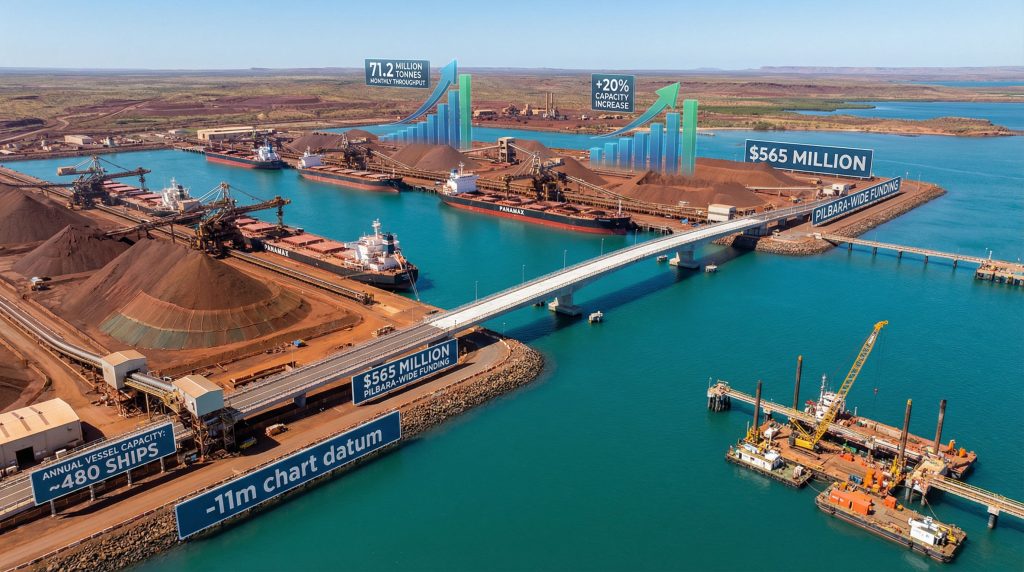
The Dampier Link Bridge construction represents a sophisticated marine engineering project that extends far beyond simple concrete placement. This 57-metre reinforced concrete structure connects the existing Dampier Cargo Wharf with the newly constructed Dampier Bulk Handling Facility, creating an integrated operational platform for enhanced cargo movement efficiency.
Reinforced Concrete Deck Construction Methodology
Marine-grade concrete specifications for tropical port environments require specialised formulations resistant to salt-water corrosion and extreme weather conditions. The construction methodology incorporates several critical technical elements that align with global industry evolution trends:
- Corrosion-resistant reinforcement systems using epoxy-coated or galvanised steel bars
- High-performance concrete mixtures with reduced permeability ratings
- Thermal expansion joint systems accommodating temperature variations in tropical climates
- Surface treatment applications providing additional protection against marine exposure
The NRW Brady Joint Venture, comprising NRW Pty Ltd and Brady Marine and Civil Pty Ltd, brings specialised marine construction expertise to this complex project. Their scope encompasses demolition of the existing Southern Mooring Dolphin, comprehensive piling works, and complete reinforced concrete deck installation.
Piling Foundation Requirements for Marine Environments
Foundation systems in marine environments face unique challenges that distinguish them from terrestrial construction projects. Piling works must penetrate through variable seabed conditions to reach stable bearing layers while withstanding dynamic loads from vessel movements and wave action.
Critical piling considerations include:
- Soil investigation data determining bearing capacity requirements
- Driven pile versus bored pile selection based on seabed geology
- Pile corrosion protection systems for extended operational life
- Dynamic load calculations incorporating vessel berthing forces and cargo handling equipment operations
The foundation design must accommodate both static loads from the bridge structure and dynamic loads from mobile material handling equipment operating across the deck surface.
Multi-User Facility Design Philosophy
Common-user infrastructure design fundamentally differs from dedicated terminal models in operational flexibility and access protocols. The Pilbara Ports Dampier upgrades embrace this multi-user approach, enabling diverse mining operators to access enhanced port facilities without requiring individual infrastructure investments.
This design philosophy provides several operational advantages:
- Shared infrastructure costs reducing individual operator investment requirements
- Operational redundancy through multiple access points and handling systems
- Commodity diversification potential beyond traditional iron ore exports
- Competitive service delivery through shared facility utilisation
The multi-user model creates particular benefits for mid-tier mining operators who require access to export infrastructure but lack the scale to justify dedicated terminal construction.
When big ASX news breaks, our subscribers know first
Capacity Enhancement Through Standardised Marine Infrastructure
Construction progress on the Dampier Bulk Handling Facility demonstrates the complexity of coordinating multiple concurrent operations within an active port environment. Dredging operations, wharf construction, and infrastructure integration require careful sequencing to maintain operational continuity while delivering significant capacity improvements.
Construction Progress Timeline Analysis
The facility construction has progressed through several completed phases with current focus on wharf construction activities. Completed elements include demolition works, dredging operations, drilling and blasting activities, establishing the foundation for subsequent construction phases.
Dredging to -11m chart datum specifications represents a critical technical achievement. Chart datum refers to the reference level from which water depths are measured, typically corresponding to the lowest astronomical tide level. This standardised depth capability eliminates previous constraints where variable berth depths required tide-dependent vessel scheduling.
The construction timeline targets first half 2026 completion for the Dampier Bulk Handling Facility, with the link bridge achieving full operational capability by late 2026. This phased approach ensures export operations continue uninterrupted while delivering enhanced capacity incrementally. However, these developments must also address potential resource export challenges that may emerge during the implementation phase.
Operational Capacity Projections
Infrastructure improvements translate directly into measurable capacity enhancements across multiple operational metrics. The standardised berth depth capability represents perhaps the most significant improvement, enabling predictable vessel scheduling regardless of tidal variations.
| Performance Metric | Current Capability | Enhanced Capability | Improvement |
|---|---|---|---|
| Annual vessel movements | ~400 ships | ~480 ships | +20% increase |
| Berth depth standard | Variable by location | -11m chart datum | Consistent access |
| Commodity handling | Iron ore focused | Multi-commodity ready | Diversified |
| Vessel scheduling | Tide-dependent | Tide-independent | Operational flexibility |
The 20% increase in vessel movements translates to approximately 80 additional annual ship visits, requiring enhanced support services including pilotage, vessel traffic management, and port service coordination.
Strategic Investment Framework for Port Competitiveness
Government infrastructure investment in port facilities creates strategic advantages that extend beyond immediate operational improvements. The $565 million Australian Government commitment to common-user port infrastructure across the Pilbara region demonstrates recognition of ports as critical economic infrastructure requiring public investment support.
Funding Allocation Strategy
Dampier's $115 million allocation represents approximately 20.4% of the total $565 million regional commitment. This proportional distribution reflects Dampier's role as a secondary but strategically important export facility complementing the dominant Port Hedland operations.
The common-user infrastructure prioritisation creates several strategic benefits:
- Reduced market concentration risk through diversified facility access
- Lower barriers to entry for emerging mining operators
- Enhanced operational resilience through infrastructure redundancy
- Public investment leverage amplifying private sector development
Economic Multiplier Effects on Regional Operations
Port infrastructure improvements generate cascading economic benefits throughout the regional mining ecosystem. Enhanced export capability reduces logistics costs for mining operators, improves export scheduling predictability, and enables optimised inventory management at mine sites. These improvements contribute significantly to the broader WA economic impact of the resources sector.
Infrastructure Investment Impact: Common-user port facilities create positive externalities across multiple mining operators, amplifying the economic return on public infrastructure investment through shared access benefits and reduced individual company infrastructure requirements.
The investment strategy positions Dampier as a competitive alternative to dedicated company terminals, providing smaller mining operators with access to world-class export infrastructure previously available only to major integrated miners.
Iron Ore Export Optimisation and Mining Industry Growth
Iron ore dominates Dampier's throughput profile, accounting for 86% of total port volumes, with LNG, salt, and condensate comprising the remaining 14%. This concentration makes infrastructure improvements directly relevant to major mining operators, particularly Rio Tinto, which utilises Dampier as a significant export facility for Pilbara iron ore operations. These developments align closely with current iron ore demand insights across global markets.
Vessel Traffic Management and Operational Planning
The projected 80 additional annual ship movements creates specific operational requirements for enhanced port services and coordination systems. Modern vessel traffic management systems must accommodate increased complexity while maintaining safety standards and operational efficiency.
Key operational considerations include:
- Pilotage service expansion for safe vessel navigation in confined port areas
- Berth allocation optimisation balancing vessel scheduling across multiple facilities
- Weather-dependent protocols during cyclone seasons affecting tropical port operations
- Safety zone management with increased vessel interaction frequency
Enhanced infrastructure enables improved vessel scheduling flexibility, reducing congestion during peak export periods and providing mining operators with greater control over export timing relative to market conditions.
Panamax Vessel Accommodation Strategy
The standardised -11m chart datum berth depth specifically accommodates Panamax-class bulk carriers, which represent the economic sweet spot for iron ore export operations. These vessels typically feature:
- Cargo capacity: 52,000-60,000 deadweight tonnes for bulk carrier configuration
- Maximum draft: Approximately 10.7 metres when fully loaded
- Length overall: 225 metres typical for modern Panamax bulk carriers
- Operational efficiency: Optimal cost-per-tonne shipping economics for medium-distance routes
Consistent berth depth capability eliminates weather-dependent scheduling constraints, enabling mining operators to optimise export timing based on market conditions rather than tidal windows.
Technical Challenges in Marine Infrastructure Modernisation
Large-scale port modernisation projects integrate multiple complex engineering disciplines within operational environments that cannot accommodate extended shutdowns. The Pilbara Ports Dampier upgrades exemplify these challenges through concurrent marine construction, infrastructure integration, and operational continuity requirements.
Marine Engineering Complexities
Tropical marine environments present unique challenges for major construction projects. The Pilbara region experiences significant seasonal weather variations, including cyclone activity during summer months that constrains marine construction windows.
Tidal Range Considerations:
Australian ports experience varying tidal ranges, typically between 2-10 metres depending on geographic location and lunar cycles. Dredging operations to achieve specific chart datum requirements must account for:
- Work sequencing during optimal tidal conditions
- Material disposal strategies for dredged sediments
- Depth tolerance management ensuring consistent berth pocket specifications
- Environmental impact mitigation during excavation activities
Cyclone-Resistant Design Requirements:
Infrastructure in tropical regions requires enhanced structural specifications to withstand extreme weather events:
- Wind load resistance for Category 4-5 cyclone conditions
- Storm surge protection for elevated water level events
- Structural redundancy ensuring operational recovery post-storm
- Emergency protocol integration for facility shutdown and restart procedures
Construction Sequencing for Operational Continuity
Maintaining export operations during major infrastructure construction requires sophisticated project management and operational coordination. The phased delivery approach minimises disruption to existing cargo movements while systematically implementing facility enhancements.
Construction phases incorporate:
- Site preparation and demolition during low-activity periods
- Marine works and dredging coordinated with vessel scheduling
- Structural construction with operational buffer zones
- Systems integration and commissioning during planned maintenance windows
Risk management protocols address weather-dependent marine construction limitations, contractor coordination requirements, and operational safety during concurrent construction and export activities.
Strategic Positioning for Regional Mining Development
Infrastructure improvements position Dampier as a critical component in the broader Pilbara logistics network, complementing Port Hedland's dominant position while providing operational alternatives for mining operators. This strategic positioning creates competitive advantages through reduced logistics costs and improved export scheduling flexibility. Additionally, the facility's enhanced capabilities position it to support Australia's emerging green metals leadership initiatives.
Performance Metrics and Investment Validation
Successful infrastructure projects demonstrate measurable improvements across key operational indicators. The Pilbara Ports Dampier upgrades target specific performance enhancements that justify the $115 million investment through quantifiable operational benefits.
| Key Performance Indicator | Current Performance | Target Improvement | Economic Impact |
|---|---|---|---|
| Vessel turnaround efficiency | Baseline requirement | -15% reduction | Lower demurrage costs |
| Cargo handling throughput | Current capacity | +25% increase | Improved scheduling |
| Berth utilisation optimisation | Variable scheduling | Standardised access | Enhanced predictability |
These metrics provide validation frameworks for infrastructure investment returns while establishing benchmarks for future port development planning across the Pilbara region.
Integration with Pilbara Port Network Strategy
The December 2025 record throughput of 71.2 million tonnes across Pilbara Ports demonstrates the system is operating near capacity, justifying infrastructure expansion investments. This performance record, driven primarily by iron ore shipments through Port Hedland and Dampier, indicates strong demand for enhanced export capability.
Dampier's role within the broader network includes:
- Load balancing during peak export periods at Port Hedland
- Operational redundancy for supply chain resilience planning
- Commodity diversification beyond traditional iron ore focus
- Technology integration opportunities for automated handling systems
The next major ASX story will hit our subscribers first
Future Market Positioning and Operational Readiness
The completion timeline establishes clear milestones for enhanced operational capability, with the Dampier Bulk Handling Facility commissioning scheduled for first half 2026 and link bridge full operational capability by late 2026. These timelines position Dampier to capture increasing iron ore export demand while providing infrastructure for potential commodity diversification.
Long-Term Strategic Planning Through Infrastructure Investment
Master planning approaches integrate current construction with future expansion potential, ensuring infrastructure investments support long-term growth rather than merely addressing immediate capacity constraints. The common-user facility model enables adaptation to evolving commodity export requirements and changing mining industry dynamics.
Critical minerals potential in the Pilbara region may require different handling specifications compared to traditional iron ore operations. Enhanced infrastructure provides the foundation for accommodating diverse commodity types, supporting regional economic diversification beyond traditional bulk iron ore exports. Furthermore, the Port of Dampier's strategic location enables it to serve as a crucial gateway for these emerging mineral exports.
Operational Readiness and Market Integration
Completion of the Dampier upgrades positions the facility to accommodate increased vessel traffic while maintaining operational efficiency standards. The integration testing and performance validation phases will establish baseline performance metrics and identify optimisation opportunities for ongoing operational improvements.
Strategic Infrastructure Investment: The $115 million Dampier allocation within the broader $565 million Pilbara infrastructure commitment demonstrates government recognition of port facilities as essential economic infrastructure requiring coordinated public investment to maintain Australia's competitive position in global commodity markets.
Environmental compliance considerations and sustainability requirements increasingly influence port development planning. Modern facilities must integrate environmental management systems with operational efficiency objectives, ensuring compliance with evolving regulatory frameworks while maintaining competitive operational performance.
The enhanced marine infrastructure supports mining industry growth through reduced logistics costs, improved export scheduling predictability, and increased operational resilience. These benefits translate directly into improved project economics for mining operators and enhanced competitiveness for Australian iron ore in global markets.
Investment decisions and infrastructure development projects involve inherent risks and uncertainties. Performance projections are based on engineering estimates and market analysis that may differ from actual operational results. Infrastructure completion timelines remain subject to weather conditions, construction challenges, and regulatory approval processes.
Ready to Capitalise on Australia's Mining Infrastructure Boom?
The Pilbara Ports Dampier upgrades demonstrate how strategic infrastructure investment drives mining sector growth and creates profitable opportunities for informed investors. Discovery Alert's proprietary Discovery IQ model delivers real-time alerts on significant ASX mineral discoveries, ensuring subscribers identify actionable opportunities ahead of the broader market and position themselves to benefit from Australia's expanding resources infrastructure.