
June 22, 2026
Understanding Pipeline Dependencies in Central Asian Energy Systems
Modern energy infrastructure operates through interconnected networks where individual components can trigger cascading effects across entire supply chains. When examining the technical architecture of oil export systems, the relationship between upstream production, midstream transportation, and terminal facilities reveals critical vulnerabilities that extend far beyond simple mechanical failures. These dependencies become particularly pronounced in regions where geographic constraints limit alternative routing options, creating concentrated risk exposure that can rapidly translate operational disruptions into market-wide supply constraints.
The sophistication of contemporary pipeline systems masks an underlying fragility inherent in their design. Unlike distributed networks that can reroute flows through multiple pathways, many export-dependent oil producers rely on singular infrastructure corridors that concentrate throughput capacity at specific chokepoints. This concentration creates operational leverage where small-scale disruptions at critical facilities can force proportionate production adjustments across entire upstream networks, demonstrating how technical dependencies shape market dynamics in ways that traditional supply-demand analysis often overlooks.
When big ASX news breaks, our subscribers know first
Kazakhstan's Export Infrastructure Bottlenecks
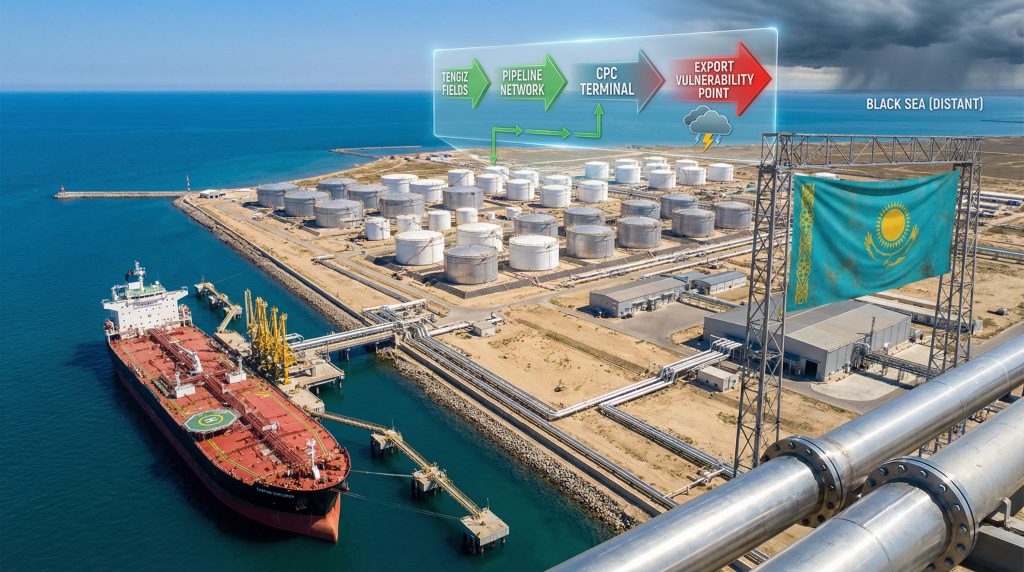
Kazakhstan's oil export capabilities centre around a sophisticated but vulnerable pipeline network that channels approximately 60% of the country's crude production through a single terminal facility on Russia's Black Sea coast. The Caspian Pipeline Consortium terminal at Novorossiysk represents a critical infrastructure node where 1.93 million barrels per day of production capacity must compete for access to international markets through weather-exposed loading facilities. This infrastructure dependency has become increasingly evident as Kazakhstan's Oil Exports Black Sea Suspension events demonstrate the country's vulnerability to operational disruptions.
Recent operational data reveals the practical implications of this infrastructure dependency. Following the November 29, 2025 drone attack on CPC terminal facilities, Kazakhstan's crude production declined 6% month-on-month in December 2025, with the Chevron-operated Tengiz field implementing the most significant output reductions. This immediate production response illustrates how export infrastructure constraints force real-time operational adjustments across upstream facilities located hundreds of kilometres from the actual disruption site.
Storage Capacity Limitations
The technical specifications of the CPC terminal reveal inherent limitations that amplify operational vulnerabilities. Storage infrastructure at the facility operates within defined capacity parameters that cannot accommodate extended production volumes during export disruptions. When weather conditions or security incidents prevent tanker loading operations, accumulated crude inventory rapidly approaches terminal storage limits, forcing upstream producers to curtail output rather than risk operational shutdowns from storage overflow.
This storage constraint creates a cascading operational requirement where production planning must continuously account for export facility availability. Unlike refineries that can adjust processing rates or utilities that can store energy in alternative forms, crude oil production faces immediate physical storage limitations that translate disruptions at export terminals into forced production adjustments within 48-72 hours.
Pipeline Network Architecture
The 1,511-kilometre CPC pipeline system demonstrates both the engineering sophistication and operational vulnerability characteristic of modern energy infrastructure. The pipeline connects multiple producing fields across Kazakhstan to a single export outlet, creating a hub-and-spoke architecture where individual field operators share common export capacity but also inherit collective exposure to downstream disruptions.
Technical operations along the pipeline require continuous pressure maintenance, temperature management, and flow optimisation that responds to real-time changes in throughput demand. When export operations cease at the terminal, operators must implement coordinated pressure reduction procedures across the entire pipeline network, affecting flow dynamics for all connected producing fields regardless of their individual operational status.
Geographic Risk Factors Affecting Export Operations
Kazakhstan's dependence on Black Sea export routes exposes the country's oil sector to meteorological patterns that operate independently of market conditions or operational planning. The November-March period represents peak storm season for the Black Sea region, with weather systems generating wind speeds, wave heights, and barometric pressure variations that frequently exceed the operational parameters required for safe tanker loading operations.
Recent weather-related disruptions demonstrate the recurring nature of this vulnerability. December 2025 storm conditions forced suspension of crude oil loadings at the CPC terminal, creating immediate upstream constraints despite continued production from Kazakh oil fields. Furthermore, the storm forced halt to Kazakhstan's oil exports from the Black Sea, highlighting the region's exposure to severe weather patterns.
These weather interruptions follow predictable seasonal patterns but vary in intensity and duration, making precise operational planning challenging for producers dependent on terminal access. Kazakhstan's Oil Exports Black Sea Suspension events have become increasingly frequent during winter months.
Coastal Terminal Exposure
The positioning of export infrastructure along the northeastern Black Sea coast creates inherent exposure to severe weather systems that cannot be mitigated through operational procedures alone. Loading arms, pumping systems, and tanker mooring facilities require specific environmental conditions to maintain safety protocols during crude oil transfer operations. When wind speeds exceed operational thresholds or wave action affects vessel stability, loading operations must cease regardless of upstream production schedules or contractual delivery requirements.
Modern terminal operations employ motion-compensated loading systems and automated environmental monitoring to extend operational windows during marginal weather conditions. However, these technologies provide incremental improvements rather than fundamental solutions to geographic exposure. When meteorological conditions exceed critical thresholds, physics-based limitations require operational suspension independent of technological sophistication.
Alternative Route Constraints
Kazakhstan's limited export routing options amplify the impact of individual facility disruptions on overall market access. The country's oil export infrastructure includes several pathways:
- CPC Pipeline System: Primary route handling 60% of export capacity
- Atyrau-Samara-Mozyr Pipeline: Russian domestic system with restricted third-party access
- Kazakhstan-China Pipeline: Operating at capacity with limited expansion availability
- Caspian Sea Transportation: Weather-dependent with higher per-unit costs
This infrastructure configuration means disruptions at the CPC terminal cannot be offset through alternative channels without significant economic penalties or volume constraints. Unlike regions with multiple export options, Kazakhstan's producers face binary access conditions where terminal availability directly determines market participation capability.
Upstream Production Response Mechanisms
The operational response to export infrastructure constraints demonstrates the technical complexity of managing integrated oil production systems. When the November 2025 drone attack damaged CPC terminal facilities, upstream operators faced immediate decisions about production scheduling, well management, and reservoir pressure maintenance that would affect long-term recovery rates beyond the duration of the export disruption.
Tengiz field operations, representing Kazakhstan's largest producing asset, implemented production curtailments totalling approximately 120,000+ barrels per day in response to export constraints. This reduction required coordinated well shut-in procedures, pressure system adjustments, and injection well modifications that affect reservoir performance characteristics for months beyond the initial curtailment period. The US oil production decline provides a parallel example of how infrastructure constraints can force upstream adjustments.
Well Management Complexities
Modern oil fields operate through sophisticated pressure maintenance systems where production wells, injection wells, and processing facilities function as integrated networks. Shutting in production wells disrupts reservoir pressure equilibrium, requiring careful management to prevent formation damage that could permanently reduce recovery rates. Restarting wells after extended shutdown periods typically requires 10-14 days to restore normal flow characteristics, creating additional production losses beyond the initial curtailment period.
The technical challenge extends to injection well operations that maintain reservoir pressure through water or gas injection. When production wells are shut in, injection rates must be adjusted to prevent over-pressurisation that could damage formation integrity. These adjustments require reservoir engineering analysis and gradual implementation procedures that complicate rapid production restart capabilities.
Economic Impact Calculations
The financial implications of production curtailments extend beyond simple revenue calculations based on daily output reductions. At ICE Brent crude oil pricing of $62 per barrel, the 120,000 barrel per day curtailment represents approximately $7.44 million in daily revenue losses. However, the total economic impact includes additional factors:
- Operational restart costs: Engineering and equipment expenses for well reactivation
- Reservoir performance effects: Long-term production decline from repeated shut-in cycles
- Contract penalty exposure: Financial obligations from delivery schedule disruptions
- Market positioning costs: Competitive disadvantage versus reliable suppliers
These compounding factors mean the actual economic impact of export disruptions significantly exceeds simple production volume calculations, particularly for repeated or extended interruptions. In addition, the broader implications align with current oil price rally analysis showing how supply disruptions affect global markets.
Infrastructure Resilience Enhancement Strategies
Improving operational resilience at export terminals requires significant capital investment in storage expansion, weather protection systems, and automated operational technologies. Storage tank construction represents the most direct approach to buffering production against export disruptions, with industry-standard costs ranging from $500 million to $1.2 billion for meaningful capacity additions.
Additional storage infrastructure would allow continued upstream production during temporary export interruptions, reducing the frequency of production curtailments and associated reservoir management complications. However, storage expansion requires 24-36 months from permitting through commissioning, representing a long-term solution rather than immediate operational improvement.
Advanced Loading Technologies
Modern terminal facilities can implement technological solutions to extend operational availability during marginal weather conditions:
Motion-Compensated Systems:
- Electrohydraulic loading arms that adjust for vessel movement
- Cost: $50-100 million per terminal installation
- Operational improvement: 5-10% additional availability during storm seasons
- Physical limitations: Still subject to maximum wave height thresholds
Environmental Monitoring Integration:
- Real-time measurement of wind speed, barometric pressure, wave height
- Automated decision logic for optimising loading windows
- Cost: $20-40 million for comprehensive system implementation
- Benefit: Improved scheduling precision and safety margin optimisation
Predictive Maintenance Systems:
- Condition-based monitoring reducing unplanned shutdowns by 15-25%
- Implementation cost: $30-60 million for pipeline network coverage
- Payback period: 3-5 years based on avoided downtime
Operational Efficiency Improvements
Supervisory control and data acquisition systems provide continuous monitoring across the 1,511-kilometre pipeline network, enabling proactive maintenance interventions before critical failures occur. Modern SCADA implementation includes automated anomaly detection, weather forecasting integration, and optimised scheduling algorithms that maximise throughput during available operational windows.
Terminal automation reduces manual operational delays and provides weather-responsive shutdown capabilities that prevent equipment damage during rapidly changing conditions. Complete automation upgrades typically require $150-300 million in capital investment but deliver 5-8% throughput improvements plus enhanced safety performance.
Geopolitical Security Vulnerabilities
The November 29, 2025 drone attack on CPC terminal infrastructure demonstrates how modern energy facilities face security threats that extend beyond traditional operational risks. The attack directly caused Kazakhstan's 6% month-on-month production decline, illustrating the precision with which hostile actors can target critical infrastructure to achieve disproportionate economic impact. This event represents another significant Kazakhstan's Oil Exports Black Sea Suspension incident affecting global supply chains.
Export terminals present concentrated targets where relatively limited physical damage can disrupt export capabilities for extended periods. Unlike distributed pipeline networks that can potentially reroute around damaged sections, terminal facilities represent singular chokepoints where security incidents immediately affect entire export operations. Moreover, these vulnerabilities connect to broader energy transition challenges facing the global energy sector.
Critical Asset Protection
Modern export terminals require integrated security systems that address multiple threat vectors:
- Aerial threats: Drone attacks on loading infrastructure and storage facilities
- Maritime security: Underwater threats to loading platforms and dock infrastructure
- Cyber vulnerabilities: Control system intrusions affecting operational safety
- Personnel security: Access control and insider threat mitigation
Comprehensive security upgrades for critical energy infrastructure typically require $200-500 million in capital investment, including radar systems, automated defence platforms, cyber security infrastructure, and enhanced physical barriers. However, security improvements must balance protection capabilities with operational efficiency requirements.
Regional Stability Dependencies
Kazakhstan's export infrastructure operates within a complex geopolitical environment where regional tensions can affect operational continuity through multiple pathways. The CPC pipeline crosses international boundaries and operates under joint ownership structures that require ongoing cooperation between multiple governments and commercial entities.
Cross-border infrastructure dependencies create operational vulnerabilities that extend beyond technical or commercial considerations. Diplomatic tensions, sanctions regimes, or regional conflicts can affect pipeline operations through regulatory changes, operational restrictions, or direct military action that impacts infrastructure functionality.
The next major ASX story will hit our subscribers first
Long-Term Strategic Implications for Energy Security
Kazakhstan's experience with export infrastructure vulnerabilities reflects broader challenges facing energy-dependent economies in an increasingly complex geopolitical environment. The concentration of export capacity through single infrastructure corridors creates strategic vulnerabilities that extend beyond immediate operational concerns to affect long-term economic development and market positioning.
Diversification imperatives require significant capital investment and extended development timelines that may exceed the timeframe for addressing immediate operational constraints. Alternative export route development involves complex international negotiations, environmental assessments, and technical challenges that require 5-10 years for implementation. These considerations intersect with broader oil price crash factors affecting global market stability.
Market Position Consequences
Repeated export disruptions affect Kazakhstan's competitive position in global oil markets through multiple mechanisms:
- Reliability perception: Long-term buyers prefer suppliers with consistent delivery capabilities
- Contract terms: Unreliable suppliers face higher risk premiums and stricter penalty clauses
- Market share erosion: Alternative suppliers gain market position during disruption periods
- Investment deterrence: Upstream investment declines when export access remains uncertain
These market positioning effects compound over time, making infrastructure resilience investment economically justified beyond immediate operational considerations. Furthermore, the broader implications align with US-China trade impact on global energy markets and supply chain stability.
Investment Prioritisation Framework
Strategic infrastructure investment requires balancing immediate operational improvements against long-term diversification objectives:
Near-term priorities (1-3 years):
- Storage capacity expansion at existing terminals
- Enhanced weather protection systems
- Improved security infrastructure
- Predictive maintenance implementation
Medium-term development (3-7 years):
- Alternative export route feasibility studies
- Regional partnership development
- Domestic refining capacity expansion
- Advanced terminal automation
Long-term strategic initiatives (7-15 years):
- New pipeline corridor development
- Alternative transportation mode evaluation
- Regional energy cooperation frameworks
- Technology innovation partnerships
Stakeholder Contingency Planning Requirements
Effective management of export infrastructure vulnerabilities requires coordinated contingency planning across multiple stakeholder groups, including upstream operators, pipeline companies, terminal operators, government entities, and international buyers. Each stakeholder faces different risk exposures and maintains distinct capabilities for responding to disruption scenarios.
Upstream operators must develop flexible production scheduling capabilities that can respond to export constraints without compromising reservoir performance or operational safety. This requires investment in automation systems, well monitoring technology, and reservoir management expertise that enables rapid response to changing export conditions.
Emergency Response Protocols
Standardised emergency response procedures should address multiple disruption scenarios. Caspian Pipeline halts oil intake as weather conditions prevent safe tanker operations, demonstrating the need for comprehensive planning.
Weather-related interruptions:
- Production scheduling adjustments for 3-7 day export suspensions
- Storage optimisation procedures to maximise buffer capacity
- Alternative transportation arrangement protocols
Security incident responses:
- Immediate production curtailment procedures
- Infrastructure damage assessment protocols
- Repair timeline estimation and communication procedures
Extended disruption management:
- Long-term production adjustment strategies
- Alternative market arrangement procedures
- Financial risk mitigation activation
Market Adaptation Mechanisms
Long-term supplier relationships require contractual structures that acknowledge infrastructure vulnerabilities while maintaining commercial viability for both parties. Modern crude oil supply agreements increasingly incorporate force majeure provisions that specifically address infrastructure-related disruptions, but these contracts must balance risk allocation with pricing competitiveness.
Strategic inventory management provides another mechanism for buffering market disruptions. Buyers can maintain additional crude oil stocks to accommodate supplier disruptions, while sellers can invest in enhanced storage capabilities to reduce the frequency of production curtailments during export constraints. Consequently, addressing Kazakhstan's Oil Exports Black Sea Suspension events requires comprehensive planning across all stakeholder groups.
Disclaimer: This analysis incorporates forward-looking statements regarding infrastructure development, investment requirements, and market projections based on current operational data and industry trends. Actual outcomes may vary significantly due to changing geopolitical conditions, technological developments, regulatory modifications, or unforeseen operational factors. Investment decisions should be based on comprehensive due diligence and professional consultation rather than projections contained in this analysis.
Ready to Capitalise on Energy Infrastructure Developments?
Discovery Alert's proprietary Discovery IQ model delivers real-time alerts on significant ASX mineral discoveries, including critical materials essential for global energy infrastructure development. Explore how historic discoveries can generate substantial returns by examining past mining successes, then begin your 30-day free trial today to position yourself ahead of market-moving announcements.