July 12, 2026
Pipeline Infrastructure Vulnerabilities and Modern Safety Systems
High-pressure natural gas transmission networks represent critical arteries in America's energy infrastructure, yet they operate under extreme conditions that can lead to catastrophic failures. The recent pipeline explosion in Louisiana highlights the urgent need to examine both operational parameters and failure mechanisms that can compromise pipeline integrity across thousands of miles of interconnected networks. Furthermore, understanding these complex systems requires examining energy export challenges that affect infrastructure development globally.
The physics of natural gas transmission involves maintaining pressurised hydrocarbon flows through steel conduits that must withstand not only internal pressure loads but also external environmental stresses ranging from soil movement to temperature fluctuations. When these systems fail, the consequences extend far beyond immediate safety concerns to encompass regulatory oversight, community relations, and long-term infrastructure development strategies.
When big ASX news breaks, our subscribers know first
What Happened During the February 2026 Louisiana Pipeline Incident?
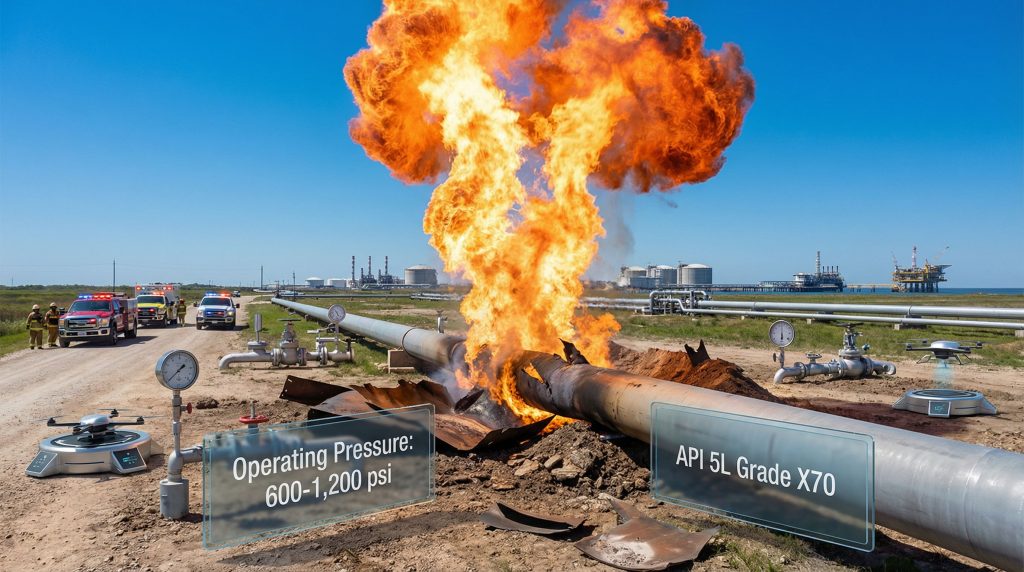
The pipeline explosion in Louisiana on February 3, 2026, occurred along a 45-kilometre natural gas transmission line serving the Delfin LNG project in Cameron Parish. Emergency responders documented the incident beginning at approximately 11:00 AM Central Time, with flames visible to nearby residents as natural gas ignited along the pipeline route.
Timeline and Initial Response Details
Louisiana State Police confirmed one person sustained minor injuries during the incident, while emergency protocols prevented more serious casualties through coordinated response efforts. The affected pipeline forms part of infrastructure designed to connect offshore floating LNG production vessels located 74 kilometres off the Louisiana coast to onshore processing facilities.
Emergency crews implemented controlled burning procedures, allowing remaining gas in the pipeline to burn off before shutting down flow systems. This approach, while visually dramatic, represents standard protocol for pressure reduction in uncontrolled gas releases, minimising the risk of explosive gas accumulation in confined spaces.
Geographic Context of Cameron Parish Energy Infrastructure
Cameron Parish serves as a critical hub for Louisiana's expanding LNG export infrastructure, hosting multiple pipeline networks and processing facilities along the Gulf Coast. The region's coastal location presents unique operational challenges, including subsidence rates of 0.5-1.5 inches per year in some areas, according to U.S. Geological Survey documentation.
The Delfin LNG system represents one of several new developments aimed at expanding U.S. liquefied natural gas export capacity to 13.2 million tonnes per annum when completed. Project partners include Samsung Heavy Industries for vessel construction and Black & Veatch for design and liquefaction technology, with parent company Delfin Midstream having announced expectations for a final investment decision within one month prior to the incident.
Emergency Services Coordination and Public Safety Measures
State authorities implemented precautionary shelter-in-place orders at Johnson Bayou school, though no widespread evacuations were required due to the incident's contained nature. The Louisiana Department of Natural Resources and local emergency management officials coordinated response efforts with Louisiana State Police, demonstrating multi-agency protocols for energy infrastructure emergencies.
Investigation procedures remained active throughout the week following the incident, with officials working to determine both the cause and sequence of events that led to the pipeline explosion in Louisiana. No disruptions to other regional energy infrastructure were reported, indicating successful containment of potential cascading effects.
How Do Natural Gas Pipeline Explosions Occur in LNG Infrastructure?
Pipeline failures in natural gas transmission systems result from complex interactions between material properties, environmental conditions, and operational stresses that can develop over decades of service life. The U.S. Pipeline and Hazardous Materials Safety Administration documents specific failure modes that account for the majority of transmission pipeline incidents nationwide.
Common Failure Mechanisms in High-Pressure Gas Systems
Third-party damage represents approximately 21% of pipeline incidents, typically resulting from excavation activities that contact buried infrastructure. Material defects and manufacturing issues contribute to 15% of incidents, often involving weld quality problems or steel composition irregularities that compromise structural integrity over time.
Corrosion accounts for approximately 25% of all pipeline incidents, with external corrosion being particularly problematic in coastal environments where saltwater exposure accelerates electrochemical degradation. Internal corrosion can also occur when moisture and sulfur compounds create acidic conditions within the pipeline.
Primary Pipeline Failure Causes:
• Third-party damage from excavation: 21%
• Corrosion-related failures: 25%
• Material and manufacturing defects: 15%
• Incorrect operation procedures: 12%
• Environmental stress and ground movement: 8%
• Other miscellaneous causes: 19%
Pipeline Integrity Challenges in Coastal Environments
Coastal Louisiana pipeline systems face distinct operational challenges that accelerate wear mechanisms compared to inland installations. The American Society of Mechanical Engineers notes that marine environments can increase external corrosion rates by 3-5 times normal rates due to galvanic coupling with seawater conductivity.
Hurricane-related stress represents another significant factor, as Gulf Coast pipelines experience extraordinary external loading from storm surge and wave action during the June through November hurricane season. Post-Katrina pipeline failure analysis indicated that wave-induced flexing contributed to unexpected failure modes not typically encountered in inland systems.
Soil subsidence creates additional complications, as coastal Louisiana experiences some of the highest subsidence rates in the United States. This geological instability can create differential loading on pipeline segments, leading to stress concentration points that may initiate crack formation over time.
Design Standards for Offshore-Connected Pipeline Networks
Modern LNG pipeline networks must comply with API RP 1111 standards for offshore hydrocarbon pipelines, which specify enhanced requirements for subsea and marine-exposed infrastructure. These standards mandate higher strength steel grades (X80, X90) to reduce wall thickness and weight in deepwater applications whilst maintaining structural integrity.
Enhanced coating systems become critical in marine environments, typically employing three-layer polyethylene (3LPE) or fusion-bonded epoxy (FBE) to minimise corrosion initiation. Increased inspection frequency requirements apply to high-risk zones, particularly brackish water transition areas where differential aeration corrosion accelerates.
What Are the Technical Specifications of Modern LNG Pipeline Systems?
Contemporary LNG pipeline infrastructure operates under demanding technical parameters that require sophisticated pressure management and safety systems. These specifications vary significantly based on pipeline location, diameter, and specific service requirements within the broader natural gas transmission network.
Pressure Management and Flow Control Technologies
Modern LNG pipeline networks typically operate at pressures ranging from 400-1,200 psig for onshore transmission lines, though submarine and subsea segments often operate at lower pressures (250-500 psi) to accommodate dynamic loading from waves and currents. Pressure reducing valves downstream help limit pressure spikes from sudden demand changes or pump activation.
Typical LNG Pipeline Operating Parameters
| Parameter | Standard Range | Safety Considerations |
|---|---|---|
| Operating Pressure | 400-1,200 psig | Variable by location |
| Wall Thickness | 0.375-0.875 inches | Diameter dependent |
| Steel Grade | X70-X90 | Marine environment enhanced |
| Inspection Frequency | 5-10 years | Risk-based scheduling |
Safety relief valves provide active pressure control, modulating flow to maintain pressure below maximum allowable levels. Rupture discs serve as fail-safe devices that rupture at predetermined pressures, allowing controlled venting if pressure exceeds design limits.
Safety Shutdown Systems and Automated Response Protocols
Supervisory Control and Data Acquisition (SCADA) systems monitor pipeline pressure at 5-10 mile intervals, detecting pressure deviations exceeding programmed thresholds typically set at ±3-5% of normal operating setpoints. These systems can automatically trigger emergency shutdown sequences within 30 seconds of anomaly detection.
Remote shutdown capabilities allow control centre operators to isolate pipeline segments from centralised locations, providing rapid response to detected anomalies. Fibre optic monitoring systems provide real-time pressure and temperature data transmission, enabling immediate assessment of pipeline conditions.
Emergency Response System Components:
• Pressure monitoring at 5-10 mile intervals
• Automated leak detection with 30-second response times
• Remote shutdown capabilities from control centres
• Smart pig inspection tools for internal assessment
Material Selection for Corrosive Marine Environments
Pipeline steel selection for LNG applications requires careful consideration of strength, corrosion resistance, and weldability characteristics. API 5L Grade X70 steel (70,000 psi minimum yield strength) represents the standard for most applications, though higher grades (X80, X90) are increasingly used in challenging environments.
Wall thickness calculations depend on diameter and operating pressure relationships. A 12-inch diameter pipeline operating at 1,000 psi typically requires approximately 0.375-inch wall thickness, whilst 36-inch diameter systems at the same pressure require approximately 0.875-inch thickness to maintain equivalent safety margins.
Cathodic protection systems prevent external corrosion by applying controlled electrical current to pipeline surfaces, creating electrochemical conditions that inhibit metal oxidation. These systems require regular monitoring and maintenance to ensure continued effectiveness in marine environments.
How Do Investigators Determine Pipeline Explosion Causes?
Pipeline incident investigations employ sophisticated forensic techniques to determine root causes and contributing factors in system failures. The National Transportation Safety Board successfully determines definitive root causes in approximately 85-90% of investigated pipeline incidents through comprehensive analysis procedures.
Forensic Analysis Techniques for Metal Failure
Fractography represents a critical investigation tool, involving microscopic examination of fracture surfaces to determine crack initiation points and propagation mechanisms. Beach marks on fracture surfaces indicate fatigue crack growth patterns, whilst river patterns suggest brittle fracture behaviour.
Scanning electron microscopy provides resolution capabilities of 1-10 nanometers, allowing investigators to identify microscopic features that reveal failure mechanisms. This technology can detect manufacturing defects, corrosion patterns, and stress concentration points that may have contributed to pipeline failure.
Laboratory Analysis Procedures:
• X-ray fluorescence testing for steel composition verification
• Inductively coupled plasma mass spectrometry for contaminant detection
• Vickers and Rockwell hardness testing for material property assessment
• Dye penetrant and ultrasonic weld examination
Environmental Factor Assessment in Coastal Regions
Coastal pipeline investigations must account for unique environmental stressors including saltwater exposure, soil subsidence, and hurricane-related loading. Investigators analyse soil samples, corrosion patterns, and structural deformation to understand how environmental conditions may have contributed to failure.
Temperature cycling effects receive particular attention in LNG applications, where extreme temperature differentials between liquid natural gas (-162°C) and ambient conditions create thermal stress cycles that can contribute to fatigue crack development over time.
Third-Party Damage Investigation Protocols
Third-party damage investigations focus on excavation records, utility marking compliance, and construction activity timelines in the vicinity of pipeline failures. Digital mapping systems help investigators correlate construction activities with pipeline locations to identify potential interference.
Typical investigation phases require 2-4 weeks for field assessment, 4-12 weeks for laboratory analysis, and 6-18 months for comprehensive root cause determination. Final investigation reports are typically published 12-24 months after incident occurrence.
What Emergency Response Protocols Apply to Gas Pipeline Incidents?
Emergency response to natural gas pipeline incidents follows established protocols designed to protect public safety whilst minimising environmental impact. These procedures have evolved through decades of experience with high-pressure gas system failures across various operational environments.
Controlled Burn Procedures for Natural Gas Releases
Controlled burning of escaping natural gas represents the preferred emergency response strategy when conditions permit safe ignition. This approach prevents dangerous gas accumulation that could create explosion hazards in confined spaces or populated areas.
Emergency responders evaluate wind conditions, proximity to structures, and gas flow rates before implementing controlled burn procedures. The combustion process converts methane to carbon dioxide and water vapour, eliminating the explosive hazard whilst the underlying pipeline problem is addressed.
Emergency response protocols prioritise controlled burning of natural gas releases to prevent explosive accumulation. This approach, whilst visually dramatic, represents the safest method for pressure reduction and fire containment in most pipeline incident scenarios.
Evacuation Decision-Making Frameworks
Evacuation decisions depend on multiple factors including gas flow rates, wind direction, population density, and available shelter options. Emergency managers typically establish evacuation zones based on pipeline diameter and operating pressure, with larger diameter, high-pressure systems requiring broader evacuation areas.
Shelter-in-place orders may be preferred over evacuation when meteorological conditions favour gas dispersion and when transportation could expose residents to greater hazards than remaining in secure buildings. This decision-making process involves coordination between pipeline operators, emergency management officials, and local authorities.
Multi-Agency Coordination in Energy Infrastructure Emergencies
Pipeline incident response involves coordination between state police, fire departments, emergency management agencies, and regulatory authorities. Each agency brings specific expertise and resources to incident management, from hazardous materials response to public communications.
The Pipeline and Hazardous Materials Safety Administration provides federal oversight and technical expertise for major incidents, whilst state regulatory agencies coordinate with local emergency services. This multi-layered approach ensures comprehensive response capability whilst maintaining clear command structures.
The next major ASX story will hit our subscribers first
How Does Louisiana's LNG Export Infrastructure Compare Globally?
Louisiana's Gulf Coast represents one of the world's most concentrated LNG export development regions, with multiple projects in various stages of planning, construction, and operation. This infrastructure density creates both operational synergies and concentrated risk profiles that distinguish the region from other global LNG hubs.
Gulf Coast Pipeline Network Density and Capacity
The Gulf Coast pipeline network includes thousands of miles of interconnected transmission lines serving multiple LNG export facilities. This infrastructure density provides operational flexibility but also creates complex interdependencies where individual incidents can affect multiple projects.
Regional pipeline capacity significantly exceeds current LNG export demand, providing redundancy that enhances system reliability. However, this excess capacity also represents substantial capital investment that must be justified through sustained LNG export growth.
Floating LNG Technology Integration Challenges
Floating LNG systems like the Delfin project represent emerging technology that connects subsea production infrastructure to onshore pipeline networks through dynamic positioning systems and flexible risers. These connections must accommodate vessel movement whilst maintaining pipeline integrity.
Major U.S. LNG Export Projects Under Development
| Project Type | Capacity (MTPA) | Development Status | Expected Timeline |
|---|---|---|---|
| Gulf Coast Fixed | 13-20 | Construction Phase | 2026-2028 |
| Floating Systems | 8-15 | Pre-Investment Decision | 2027-2030 |
| Expansion Projects | 5-12 | Planning Stage | 2028-2032 |
Investment Trends in U.S. LNG Export Facilities
U.S. LNG export capacity has experienced rapid expansion since domestic shale gas production reduced natural gas prices and created export arbitrage opportunities. This investment wave has concentrated significant capital in Gulf Coast infrastructure, creating economic benefits but also infrastructure risk concentration.
Global competition for LNG export projects has intensified as countries worldwide develop export capabilities. U.S. projects compete on the basis of feedgas costs, technological capabilities, and proximity to key markets including Europe and Asia.
What Are the Economic Implications of Pipeline Infrastructure Incidents?
Pipeline incidents create both immediate response costs and long-term economic impacts that extend beyond direct property damage. These economic effects influence project development timelines, insurance costs, and community acceptance of energy infrastructure development.
Project Timeline Impacts and Construction Delays
Pipeline incidents during construction or early operational phases can delay project completion by months or years, depending on investigation duration and required modifications. These delays translate directly into carrying costs for project debt and deferred revenue from delayed production.
The Delfin LNG project's expected final investment decision timeline could be affected by investigation findings and any required design modifications. Investors typically require comprehensive incident analysis before committing capital to large-scale infrastructure projects.
Construction insurance typically covers direct incident costs but may not fully compensate for schedule delays or reputation impacts. Project developers must balance schedule acceleration costs against the risks of additional incidents during rushed construction periods.
Insurance and Risk Management Considerations
Pipeline incident insurance covers multiple risk categories including property damage, business interruption, and liability claims. Premium calculations consider historical incident rates, pipeline specifications, environmental conditions, and operator safety records. In addition, modern approaches to data-driven operations provide enhanced predictive capabilities for risk assessment.
Risk management strategies increasingly emphasise predictive maintenance and real-time monitoring to prevent incidents rather than simply insuring against their consequences. These proactive approaches can reduce insurance premiums whilst improving operational reliability.
Regulatory Compliance Costs Following Incidents
Pipeline incidents trigger comprehensive regulatory reviews that can result in additional compliance requirements, enhanced inspection protocols, and modified operating procedures. These regulatory responses create ongoing operational costs that extend far beyond immediate incident response expenses.
State and federal regulatory agencies may require pipeline operators to implement enhanced safety measures across their entire system networks, not just at incident locations. These systemic improvements represent significant capital investments that affect project economics.
How Do Coastal Communities Balance Energy Development and Safety?
Coastal Louisiana communities have extensive experience with energy infrastructure development, creating complex relationships between economic benefits and safety concerns. These communities must balance employment opportunities and tax revenue against environmental and safety risks from industrial operations.
Environmental Justice Concerns in Industrial Zones
Energy infrastructure development often concentrates in communities with limited political and economic resources to oppose industrial projects. These environmental justice concerns have gained increased attention from regulatory agencies and community advocacy organisations.
Cumulative impact assessments examine how multiple industrial projects affect community health and safety, rather than evaluating each project in isolation. This approach recognises that communities may experience disproportionate risk burdens from concentrated industrial development.
Community benefit agreements increasingly provide mechanisms for energy developers to share project benefits with affected communities through employment programs, infrastructure improvements, and environmental monitoring initiatives. Furthermore, concerns about investment market impact influence development patterns in these regions.
Community Engagement in Pipeline Route Planning
Pipeline route selection processes now typically include extensive community consultation to identify sensitive areas and address local concerns. These engagement processes can identify alternative routes that minimise impacts on schools, residential areas, and environmentally sensitive locations.
Geographic information systems help planners optimise pipeline routes by analysing multiple factors including population density, environmental sensitivity, geological conditions, and existing infrastructure. This data-driven approach supports more informed decision-making whilst providing transparent justification for route selection.
Long-term Health and Safety Monitoring Programmes
Long-term monitoring programmes track air quality, water quality, and noise levels around pipeline infrastructure to verify that operations meet environmental standards and protect community health. These monitoring programmes often continue for decades after pipeline construction.
Community health studies examine potential correlations between industrial operations and health outcomes, though establishing definitive causal relationships requires extensive longitudinal data collection and analysis.
What Technological Advances Improve Pipeline Safety Monitoring?
Modern pipeline safety monitoring employs increasingly sophisticated technologies that provide real-time operational data and predictive maintenance capabilities. These technological advances significantly enhance safety performance compared to traditional inspection approaches.
Real-Time Pressure and Flow Monitoring Systems
Fibre optic sensing technology provides continuous monitoring along entire pipeline lengths, detecting pressure variations, temperature changes, and potential third-party interference. This technology can identify developing problems before they result in incidents.
Wireless sensor networks complement traditional SCADA systems by providing additional monitoring points at relatively low installation costs. These sensors can monitor soil conditions, cathodic protection effectiveness, and pipeline movement in response to environmental changes.
Modern Pipeline Safety Technologies:
• Pressure and temperature sensors every 5-10 miles
• Automated leak detection systems with 30-second response times
• Remote shutdown capabilities from control centres
• Smart pig inspection tools for comprehensive internal assessment
Predictive Maintenance Using IoT Sensors
Internet of Things sensor networks provide continuous equipment condition monitoring that enables predictive maintenance scheduling based on actual equipment condition rather than predetermined time intervals. This approach optimises maintenance costs whilst improving reliability.
Machine learning algorithms analyse sensor data patterns to identify early indicators of equipment degradation or potential failure modes. These predictive capabilities allow maintenance teams to address problems before they affect pipeline operations or safety.
Drone and Satellite Inspection Technologies
Unmanned aerial vehicles equipped with thermal imaging and gas detection sensors provide cost-effective pipeline corridor inspection capabilities. These systems can identify vegetation stress patterns that may indicate underground gas leaks or other pipeline problems.
Satellite-based interferometry detects ground movement along pipeline routes, providing early warning of geological instability that could affect pipeline integrity. This technology is particularly valuable in coastal areas subject to subsidence.
How Will This Incident Influence Future LNG Infrastructure Development?
The pipeline explosion in Louisiana will likely influence multiple aspects of future LNG infrastructure development, from regulatory oversight to community acceptance and investment decision-making processes. Moreover, changing natural gas price trends may affect development strategies across the industry.
Regulatory Review Processes and Permit Modifications
Pipeline incidents typically trigger comprehensive reviews of existing regulatory frameworks to identify potential improvements in safety standards, inspection requirements, and operational protocols. These reviews can result in modified permit conditions for future projects.
State regulatory agencies may implement enhanced requirements for pipeline route selection, community consultation, and emergency response planning. These regulatory changes affect project development costs and timelines for future LNG infrastructure projects.
Federal oversight through the Pipeline and Hazardous Materials Safety Administration may result in updated technical standards for LNG pipeline design, construction, and operation. These standard updates influence industry practices nationwide.
Industry-Wide Safety Protocol Updates
The LNG industry typically implements lessons learned from significant incidents across all member companies and projects. This collaborative approach to safety improvement helps prevent similar incidents at other facilities.
Professional engineering organisations and industry associations may update recommended practices and technical standards based on incident investigation findings. These updates influence design criteria for future pipeline projects.
Investment Community Risk Assessment Changes
Investment decisions for LNG infrastructure projects incorporate risk assessments that consider historical incident rates, regulatory environments, and community acceptance factors. Pipeline incidents can influence these risk assessments and associated financing costs.
Insurance markets may adjust premium structures or coverage terms for LNG pipeline projects based on updated risk assessments following significant incidents. These insurance market changes affect project economics and feasibility.
Frequently Asked Questions About Pipeline Safety
Understanding pipeline safety requires addressing common concerns and misconceptions about natural gas transmission infrastructure and LNG facility operations.
How often do natural gas pipeline explosions occur in the United States?
The U.S. Pipeline and Hazardous Materials Safety Administration reports that serious natural gas transmission pipeline incidents occur at a rate of approximately 0.5 incidents per 1,000 miles of pipeline per year. However, explosion incidents represent only a subset of total pipeline incidents, with most incidents involving smaller leaks or equipment failures that do not result in ignition.
Pipeline safety performance has improved significantly over the past decades through enhanced materials, improved inspection technologies, and updated regulatory requirements. Modern pipelines installed according to current standards have substantially lower incident rates than older infrastructure.
What safety measures protect communities near LNG facilities?
LNG facilities employ multiple layers of safety protection including automated gas detection systems, fire suppression systems, emergency shutdown capabilities, and comprehensive emergency response planning. Facility designs incorporate substantial setback distances from property boundaries and public areas.
Emergency response planning involves coordination with local fire departments, emergency management agencies, and community officials to ensure rapid and effective response to any incidents. Regular emergency response drills test these coordination procedures and identify improvement opportunities.
How do floating LNG systems differ from traditional onshore facilities?
Floating LNG systems process natural gas on vessels located offshore, potentially reducing onshore safety risks but creating new challenges related to marine operations, weather exposure, and subsea pipeline connections. These systems must accommodate vessel movement whilst maintaining process safety.
Offshore location provides inherent separation from populated areas, but creates challenges for emergency response and maintenance operations. Floating systems typically incorporate enhanced automation and remote monitoring capabilities to address these operational constraints. Meanwhile, broader considerations of energy security and transition influence offshore development strategies.
What role do state versus federal agencies play in pipeline oversight?
Federal agencies including the Pipeline and Hazardous Materials Safety Administration establish nationwide safety standards and conduct incident investigations, whilst state agencies implement these standards and provide additional oversight tailored to local conditions and concerns.
State environmental agencies typically oversee environmental aspects of pipeline operations including water quality protection, air emissions, and wetlands impacts. This dual oversight structure provides both national consistency and local responsiveness to community concerns.
The full scope of the Cameron Parish pipeline explosion investigation continues to develop, with authorities examining multiple potential contributing factors to determine comprehensive root causes and prevent similar incidents in the future.
Disclaimer: This analysis is based on publicly available information and industry standard practices. Specific incident details are subject to ongoing investigation, and findings may change as additional information becomes available. Readers should consult official sources and qualified professionals for project-specific safety and technical information.
Want to Stay Ahead of Australia's Next Major Energy Discovery?
Discovery Alert's proprietary Discovery IQ model delivers instant alerts on significant ASX mineral discoveries, including energy sector developments that could impact global infrastructure projects like those discussed above. Explore Discovery Alert's historic discoveries to understand how major finds generate substantial market returns, then begin your 14-day free trial today to position yourself ahead of the market.