May 16, 2026
Modern industrial operations depend on complex network infrastructures that often remain invisible to operational oversight until critical failures occur. These underground arteries carry essential resources across vast geographical distances, operating under extreme conditions that would challenge any engineered system. The resource extraction sector, in particular, relies on these distribution networks to maintain continuous production cycles that can span decades of operation, making pipeline integrity and maintenance a critical component of data-driven operations.
The engineering complexity of these systems extends far beyond simple transportation mechanisms. Multiple fluid types, varying pressure requirements, temperature extremes, and corrosive environments create operational challenges that demand sophisticated monitoring approaches and preventive strategies.
How Critical Are Pipeline Systems to Industrial Infrastructure?
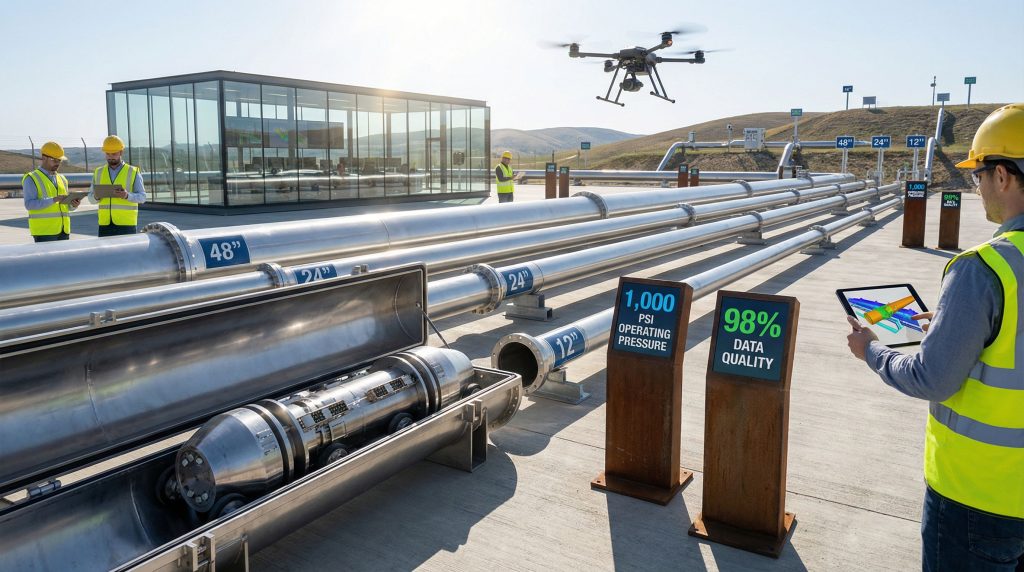
Pipeline networks represent the circulatory system of resource-intensive operations, transporting water, gas, fuel, and processed materials across hundreds of kilometers. These systems operate continuously under pressures exceeding 1,000 PSI while managing temperatures ranging from -40°C to 400°C, creating operational demands that few other industrial assets face.
Economic Impact of System Failures
The financial consequences of pipeline integrity failures create cascading effects throughout industrial operations:
- Immediate operational shutdowns can halt entire production cycles within minutes
- Revenue losses from unplanned downtime often exceed millions annually for major operations
- Environmental remediation costs frequently reach tens of millions for significant incidents
- Regulatory penalties and compliance violations compound long-term financial impacts
- Supply chain disruptions affect downstream operations and contractual obligations
Infrastructure Vulnerability Assessment
Resource operations demonstrate particular vulnerability to pipeline failures due to their remote locations and integrated operational dependencies. Mining sites in Queensland's Mt Isa region, Western Australia's Goldfields, and Northern Territory's remote locations depend on gas pipeline networks that span thousands of kilometers through challenging terrain.
The Carpentaria and Northern gas pipelines supply critical energy to Mt Isa mining operations, while the Goldfields gas pipeline delivers essential fuel to Kalgoorlie's extensive mining district. Furthermore, the Tanami gas pipeline was constructed to power stations servicing Newmont's gold mining operations in the remote Northern Territory, demonstrating the strategic importance of reliable pipeline infrastructure.
When these systems experience integrity issues, the impacts extend beyond individual operations to affect entire regional resource extraction activities and export commitments. This interconnectedness highlights the growing importance of industry innovation trends that prioritise resilient infrastructure development.
When big ASX news breaks, our subscribers know first
What Are the Core Components of Pipeline Integrity Management?
Comprehensive integrity management requires systematic approaches that address multiple threat categories and operational variables. Industry experts emphasise that effective programs must transition from reactive maintenance philosophies to proactive data-driven strategies that prioritise risk assessment and preventive intervention.
Risk-Based Assessment Frameworks
Modern integrity management categorises potential threats into three primary classifications:
Time-dependent threats include corrosion mechanisms, stress corrosion cracking, and fatigue-related deterioration that develop gradually over operational lifecycles.
Stable threats encompass manufacturing defects, construction anomalies, and equipment design limitations that remain consistent unless external factors create changes.
Time-independent threats involve third-party damage, natural disasters, operational errors, and external interference that can occur unpredictably regardless of asset age or condition.
Integrity Management System Architecture
| Component | Function | Frequency | Technology Application |
|---|---|---|---|
| Baseline Assessment | Initial condition mapping | Once per asset lifecycle | Hydrostatic testing, inline inspection |
| Threat Identification | Risk categorisation analysis | Annual comprehensive review | Data analytics, field inspection protocols |
| Risk Assessment | Probability and consequence evaluation | Bi-annual detailed analysis | Modelling software, historical performance data |
| Integrity Assessment | Current condition evaluation | Variable based on risk ranking | Smart pigging systems, non-destructive testing |
| Response Actions | Repair and replacement decisions | As required by assessment results | Engineering analysis, regulatory compliance |
Regulatory Compliance Structures
Australian pipeline integrity programs must align with AS/NZS 2566.2 standards for buried flexible pipelines, along with NATA certification requirements that ensure testing accuracy and methodological consistency. These frameworks establish minimum performance thresholds while allowing operators to implement enhanced monitoring approaches based on specific operational requirements.
Industry professionals describe pipeline assessment as analogous to annual medical examinations – operators may avoid or postpone inspections, but comprehensive evaluations typically reveal manageable issues rather than catastrophic problems when conducted regularly.
Which Inspection Technologies Deliver Maximum Detection Capabilities?
Advanced inspection technologies have revolutionised pipeline integrity assessment through sophisticated sensor systems that provide detailed internal condition analysis without requiring operational shutdowns. In addition, these systems employ multiple detection methodologies to identify different defect types and material degradation patterns.
Inline Inspection Technology Matrix
Magnetic Flux Leakage (MFL) Systems excel at detecting metal loss, corrosion patterns, and pitting degradation with accuracy levels reaching ±10% wall thickness measurement precision. These systems operate at speeds between 3-5 metres per second and are specifically designed for ferromagnetic pipeline materials.
Ultrasonic Testing (UT) Platforms provide superior crack detection capabilities and precise wall thickness measurements with ±1mm accuracy standards. Operating speeds range from 1-3 metres per second, and these systems maintain compatibility with all pipeline materials, including non-ferromagnetic compositions.
Electromagnetic Acoustic Transducer (EMAT) Tools specialise in stress corrosion cracking and fatigue crack identification with sub-millimetre detection resolution. These systems operate at 2-4 metres per second and are optimised for specific defect type identification.
Advanced Sensor Integration Capabilities
Modern inline inspection tools incorporate multiple sensor technologies simultaneously, enabling comprehensive defect characterisation through high-resolution imaging systems that create precise defect mapping protocols. Furthermore, three-dimensional visualisation capabilities allow operators to analyse complex anomaly patterns, while real-time data processing provides immediate threat assessment feedback.
The integration of AI in mining operations has enhanced these inspection systems significantly, providing automated pattern recognition and predictive analysis capabilities.
Industry partnerships have enabled Australian operators to access world-leading inspection technologies through strategic collaborations. Companies like Pipeline Integrity Solutions have established exclusive access arrangements to advanced inspection systems through international technology partnerships, providing customised tool development for unique pipeline configurations.
Every pipeline system presents distinct operational characteristics requiring customised inspection approaches. Tool selection involves detailed consultation processes that analyse pipeline diameter, material composition, operational history, and specific condition requirements before manufacturing specialised inspection equipment.
How Do Hydrostatic Testing Protocols Ensure Structural Integrity?
Hydrostatic testing represents the gold standard for pipeline structural verification, involving controlled pressurisation using water as the test medium to verify strength, leak tightness, and overall system integrity. However, this methodology proves particularly suitable for new installations, major repair verification, and asset re-rating projects.
Testing Methodology Framework
Standard hydrostatic testing protocols involve pressurising pipeline segments to 1.5 times maximum allowable operating pressure (MAOP) using water as the testing medium. This approach provides definitive structural verification while minimising environmental risks compared to gas-based testing methods.
Pressure Testing Calculations
Test Pressure Formula:
Test Pressure = 1.5 × MAOP × Temperature Compensation Factor
Hold Time Requirements specify:
- Minimum hold duration of 4 hours at test pressure
- Pressure monitoring within ±2% tolerance throughout test periods
- Temperature compensation adjustments for thermal expansion effects
Quality Assurance Protocol Matrix
| Test Phase | Duration Range | Acceptance Criteria | Documentation Requirements |
|---|---|---|---|
| Pre-test Inspection | 2-4 hours | Complete visual assessment | Comprehensive inspection checklist |
| Pressure Ramp-up | 30-60 minutes | Controlled rate increase | Continuous pressure monitoring charts |
| Pressure Hold | 4+ hours minimum | No pressure loss exceeding 2% | Real-time monitoring log documentation |
| Post-test Evaluation | 1-2 hours | No visible damage identification | Final condition inspection reports |
Recent Project Applications
Recent mobilisation to Gove, Northern Territory, demonstrated comprehensive hydrostatic testing applications for major mining operations. The project involved three sections of 20-inch pipeline across more than 6 kilometres, with all testing completed in accordance with AS/NZS 2566.2 standards and NATA certification requirements.
This commissioning project for one of the world's largest mining companies showcased the integration of hydrostatic testing with complementary integrity verification methodologies, including specialised pigging operations designed to optimise system performance before operational deployment.
What Maintenance Strategies Optimise Pipeline Performance?
Proactive maintenance strategies focus on condition-based monitoring systems that utilise data-driven approaches to optimise intervention timing and resource allocation. Consequently, these methodologies prioritise predictive analysis over reactive repair responses, extending asset lifecycles while reducing unplanned downtime incidents.
Predictive Maintenance Architecture
Advanced monitoring programmes employ multiple sensor technologies to track asset condition continuously:
Condition-Based Monitoring Systems:
- Corrosion rate tracking using electrochemical sensor networks
- Vibration analysis for rotating equipment at pump and compressor stations
- Flow rate monitoring to detect efficiency degradation patterns
- Pressure differential analysis across pipeline segments to identify restriction development
Preventive Maintenance Scheduling Framework
Quarterly Maintenance Calendar Structure:
- Q1 Focus: Cathodic protection system testing and calibration procedures
- Q2 Emphasis: Above-ground facility inspections and valve exercising protocols
- Q3 Priority: Pipeline route surveys and right-of-way maintenance activities
- Q4 Concentration: Emergency response equipment testing and personnel training
Corrective Action Protocols
Response strategies follow risk-based prioritisation systems that categorise defects by severity and timeline requirements:
- Immediate repairs: Defects exceeding 80% wall loss or active leak conditions
- Scheduled repairs: Defects measuring 50-80% wall loss requiring intervention within 180 days
- Monitored defects: Defects below 50% wall loss with increased inspection frequency protocols
Industry experts emphasise that comprehensive asset assessment represents the foundation of effective integrity management. This involves detailed inspection procedures, data collection protocols, and condition analysis to develop tailored integrity management plans that prioritise risk factors while scheduling maintenance activities to support safe, reliable operational performance.
Furthermore, the adoption of sustainable mining transformation practices has influenced pipeline integrity and maintenance protocols, emphasising environmental stewardship alongside operational reliability.
How Does Pigging Technology Enhance Pipeline Operations?
Pigging technology encompasses specialised tools designed to travel through pipelines for cleaning, inspection, and maintenance purposes. These systems prove vital for maintaining flow efficiency, preventing corrosion development, and enabling early defect detection before critical failures occur.
Pigging Classification Systems
Utility Pig Applications:
- Cleaning pigs remove accumulated debris, paraffin deposits, and scale buildup
- Batching pigs separate different product streams during multi-product operations
- Displacement pigs remove residual liquids or facilitate pipeline content changes
Smart Pig Technologies (Inline Inspection Tools):
- Geometry pigs detect structural deformation, dents, ovalities, and bend radius irregularities
- Metal loss pigs identify corrosion patterns and wall thickness variations with high precision
- Crack detection pigs locate stress corrosion cracking and fatigue-related defects
Pigging Programme Optimisation Requirements
Launch and Receive Facility Specifications:
- Launcher systems requiring full-bore closure capabilities and pressure rating compatibility
- Receiver chambers with minimum 1.5× pig length capacity for safe tool recovery
- Bypass system integration to maintain operational flow during pigging operations
- Comprehensive safety systems including pressure relief valves and pig detection sensors
Performance Metrics Tracking Matrix
| Performance Metric | Target Achievement | Measurement Methodology | Monitoring Frequency |
|---|---|---|---|
| Cleaning Efficiency | >95% debris removal | Pre/post-operation flow comparison | Per cleaning operation run |
| Inspection Coverage | 100% pipeline length verification | GPS tracking with odometer wheel systems | Per inline inspection deployment |
| Pig Speed Control | 3-5 m/s average velocity | Timing measurements between checkpoints | Real-time continuous monitoring |
| Data Quality Standards | >98% valid sensor readings | Signal strength and clarity analysis | Post-processing comprehensive review |
Advanced Pigging Technologies
Intelligent pigging systems utilise high-resolution sensor arrays to detect internal pipeline conditions including corrosion development, structural cracking, deformation patterns, and weld defect identification. These systems enable operators to transition from reactive repair methodologies to data-driven integrity management approaches that prioritise maintenance scheduling, extend asset operational life, reduce unplanned downtime, and ensure regulatory compliance.
Recent technological partnerships have provided Australian operators with access to world-leading inspection tool technologies through strategic international collaborations. These arrangements enable customised tool development based on specific pipeline characteristics, diameter requirements, operational conditions, and defect detection priorities.
The next major ASX story will hit our subscribers first
What Role Does Corrosion Management Play in Asset Longevity?
Corrosion represents one of the most significant long-term threats to pipeline integrity, requiring comprehensive management strategies that address both external and internal degradation mechanisms. For instance, effective corrosion control programmes integrate multiple protection methodologies with continuous monitoring systems.
Corrosion Threat Assessment Matrix
External Corrosion Risk Factors:
- Soil resistivity measurements below 1,000 ohm-cm indicate elevated corrosion risk environments
- pH level variations outside the 6.5-8.5 range accelerate corrosion rate development
- Seasonal moisture fluctuations create variable corrosion activity patterns
- Stray current interference from AC/DC sources compounds corrosion acceleration
Internal Corrosion Variables:
- Fluid chemistry analysis focusing on CO₂, H₂S, and oxygen content levels
- Flow velocity impacts where speeds exceeding 15 ft/sec create erosion-corrosion conditions
- Temperature effects that accelerate corrosion rate development at elevated operating conditions
- Microbiological activity particularly sulfate-reducing bacteria presence and proliferation
Cathodic Protection System Design Principles
Impressed Current System Specifications:
- Rectifier capacity sized for 20% future expansion to accommodate system growth
- Anode bed configurations utilising deep well or distributed surface installation approaches
- Current output requirements typically ranging 0.5-2.0 mA per square foot of pipeline surface area
- Monitoring infrastructure with test stations positioned every 1-3 km along pipeline routes
Pipeline Coating System Performance
Advanced Coating Technologies:
- Fusion-bonded epoxy (FBE) systems providing single-layer protection for moderate environmental conditions
- Three-layer polyethylene (3LPE) applications delivering enhanced mechanical protection capabilities
- Liquid epoxy formulations designed for field-applied repairs and tie-in connection protection
- Specialised coating systems engineered for high-temperature or chemical-resistant applications
Corrosion management programmes require integration with overall integrity management strategies, ensuring that protection systems receive regular testing, calibration, and maintenance to maintain effectiveness throughout pipeline operational lifecycles.
How Do Emergency Response Protocols Minimise Incident Impact?
Comprehensive emergency response systems integrate advanced leak detection technologies with rapid response protocols to minimise incident consequences and environmental impacts. These systems require continuous monitoring capabilities combined with pre-positioned response resources and trained personnel.
Leak Detection System Architecture
Computational Pipeline Monitoring (CPM) Capabilities:
- Mass balance calculations providing real-time flow input versus output analysis
- Pressure point analysis utilising statistical evaluation of pressure deviation patterns
- Detection sensitivity capable of identifying 1-2% flow rate changes during normal operations
- Response time performance generating alarms within 5-15 minutes of anomaly detection
Distributed Acoustic Sensing (DAS) Technology:
- Fibre optic cable systems enabling continuous monitoring along entire pipeline lengths
- Acoustic signature analysis utilising pattern recognition algorithms for leak identification
- Environmental noise filtering through advanced algorithms that reduce false alarm incidents
- Location accuracy pinpointing leak positions within ±5 metre precision ranges
Emergency Isolation Procedures
Automatic Shut-off Valve (ASV) System Integration:
- Activation criteria based on pressure drop rates exceeding predetermined threshold levels
- Closure timing achieving complete system isolation within 60-120 seconds
- Backup power systems providing battery operation for minimum 72-hour periods
- Remote operation capabilities through SCADA system integration for manual activation procedures
Incident Response Team Structure
| Response Role | Maximum Response Time | Primary Responsibilities | Essential Equipment Requirements |
|---|---|---|---|
| On-call Operator | <30 minutes | Initial assessment and system isolation | Mobile communication systems, personal protective equipment |
| Emergency Coordinator | <60 minutes | Incident command and stakeholder notifications | Command vehicle, documentation systems |
| Technical Specialist | <2 hours | Repair planning and safety assessment | Inspection tools, emergency repair materials |
| Environmental Specialist | <4 hours | Impact assessment and remediation planning | Sampling equipment, containment systems |
Emergency response effectiveness depends on pre-established protocols, regular training exercises, and maintained equipment inventories positioned strategically along pipeline routes to enable rapid deployment during incident conditions.
What Are the Financial Implications of Proactive Pipeline Management?
Investment in comprehensive pipeline integrity and maintenance programs demonstrates substantial return on investment through failure cost avoidance, extended asset lifecycles, and operational efficiency improvements. Consequently, financial analysis consistently supports proactive management approaches over reactive repair strategies.
Cost-Benefit Analysis Framework
Preventive Maintenance Investment Requirements:
- Annual inspection programmes ranging $50-200 per kilometre for comprehensive assessment protocols
- Inline inspection deployments requiring $100,000-500,000 per complete system evaluation
- Routine maintenance activities costing $10,000-50,000 per kilometre annually for ongoing programmes
- Technology upgrade investments ranging $1-5 million for advanced monitoring system implementation
Failure Cost Avoidance Benefits:
- Emergency repair incidents averaging $500,000-2,000,000 per major structural failure
- Environmental cleanup operations ranging $1-10 million depending on incident scope and location
- Production loss impacts reaching $100,000-1,000,000 per day during extended downtime periods
- Regulatory penalty assessments spanning $50,000-500,000 per compliance violation incident
Return on Investment Calculations
Maintenance ROI Mathematical Framework:
ROI Percentage = [(Failure Costs Avoided - Maintenance Investment) / Maintenance Investment] × 100
Typical ROI Performance Ranges:
- Mature pipeline systems achieving 300-500% ROI through comprehensive integrity programmes
- New installation projects demonstrating 200-400% ROI with proactive management implementation
- High-risk operational environments reaching 500-800% ROI due to elevated failure cost potential
Financial justification for proactive pipeline integrity and maintenance programmes becomes increasingly compelling when considering the cascading effects of unplanned shutdowns on production schedules, contractual commitments, and long-term operational sustainability.
How Do Regulatory Requirements Shape Pipeline Integrity Programs?
Australian regulatory frameworks establish minimum performance standards while encouraging industry best practices that exceed baseline requirements. In addition, compliance structures integrate safety, environmental, and operational considerations into comprehensive management systems.
Compliance Framework Structure
Australian Standards Integration Requirements:
- AS/NZS 2566.2 governing buried flexible pipeline design and installation protocols
- AS 2885 establishing gas and liquid petroleum pipeline operational standards
- AS 4799 defining installation requirements for underground utility services
- AS/NZS 1547 addressing on-site domestic wastewater treatment system integration
Documentation Requirements Matrix
Integrity Management Plan Essential Components:
- Asset inventory systems providing complete pipeline mapping and technical specifications
- Risk assessment protocols incorporating threat identification and consequence analysis methodologies
- Inspection scheduling frameworks defining frequency and methodology for each pipeline segment
- Emergency response procedures outlining incident protocols and repair decision criteria
- Performance metrics tracking establishing KPIs for system reliability and safety achievement
Audit and Verification Processes
Third-Party Verification Requirements:
- NATA certification standards ensuring laboratory testing accuracy and calibration protocols
- Independent assessment programmes requiring annual reviews by qualified engineering professionals
- Regulatory reporting obligations including incident notifications and performance summary documentation
- Continuous improvement mandates requiring programme updates based on industry best practice evolution
Regulatory compliance extends beyond minimum standard adherence to encompass comprehensive risk management approaches that demonstrate commitment to operational excellence and environmental stewardship.
What Future Technologies Will Transform Pipeline Integrity Management?
Emerging technologies promise revolutionary advances in pipeline monitoring, assessment, and maintenance through digital integration, artificial intelligence applications, and autonomous inspection capabilities. These developments will enable unprecedented precision in condition assessment and predictive maintenance optimisation.
The evolution of underground engineering marvels demonstrates how advanced technologies are reshaping subsurface infrastructure management across various industrial applications.
Digital Twin Implementation Capabilities
Advanced modelling platforms create virtual pipeline replicas that simulate real-time operating conditions through integrated sensor data feeds. These systems enable predictive failure analysis using machine learning algorithms that process historical performance data, optimisation scenarios for maintenance scheduling and resource allocation, and comprehensive training environments for operator skill development.
Artificial Intelligence Applications
Machine Learning Algorithm Integration:
- Anomaly detection systems utilising pattern recognition for unusual operating condition identification
- Predictive maintenance algorithms calculating failure probability based on comprehensive historical data analysis
- Automated image analysis providing defect identification from inspection footage and sensor data
- Dynamic risk optimisation enabling real-time threat assessment with continuous data update integration
Autonomous Inspection System Development
Robotic Inspection Platform Capabilities:
- Drone surveillance systems providing aerial pipeline route monitoring with thermal imaging integration
- Internal crawling robots enabling pipeline inspection without service interruption requirements
- Submersible inspection units offering underwater pipeline assessment capabilities for crossing installations
- AI-guided analysis systems delivering automated defect classification and comprehensive reporting
The evolution toward autonomous inspection and AI-driven analysis represents a paradigm shift in pipeline integrity management, enabling continuous condition monitoring with reduced human intervention requirements while improving assessment accuracy and response timing.
These technological advances will complement existing inspection methodologies, providing enhanced data collection capabilities and analytical precision that support more informed decision-making processes for maintenance prioritisation and resource allocation optimisation.
Pipeline integrity and maintenance programmes continue evolving through technological innovation, regulatory development, and industry best practice refinement, ensuring that critical infrastructure assets maintain reliable performance throughout extended operational lifecycles while meeting increasingly stringent safety and environmental standards.
Looking to Stay Ahead of Infrastructure Investment Opportunities?
Discovery Alert's proprietary Discovery IQ model delivers real-time alerts on significant ASX mineral discoveries, instantly identifying actionable opportunities in resource companies that depend on critical infrastructure networks. Explore how major mineral discoveries can generate substantial market returns by visiting Discovery Alert's dedicated discoveries page and begin your 14-day free trial today to position yourself ahead of the market.