
June 18, 2026
When Supply Cannot Answer the Call: Understanding Platinum's Structural Market Imbalance
Commodity markets periodically enter phases where geological reality and industrial necessity pull in opposite directions. In those windows, the gap between what the earth can deliver and what modern economies require becomes a defining feature of the market, shaping prices, accelerating exploration activity, and reordering supply chains. Platinum is currently inside one of those windows, and the forces driving platinum demand growth and supply deficit are more complex, and more durable, than a surface reading of the headline numbers suggests.
The prevailing narrative around platinum demand growth and supply deficit tends to focus narrowly on the electric vehicle transition, treating the decline of autocatalyst consumption as the dominant story. That framing misses the more consequential development unfolding simultaneously: a broadening of platinum's end-market base that is fundamentally changing the metal's risk profile, even as mine supply remains structurally constrained.
When big ASX news breaks, our subscribers know first
The Structural Shift Redefining Platinum's Demand Profile
From a Single-Sector Metal to a Multi-Industry Critical Resource
For the better part of two decades, platinum's commercial identity was shaped almost entirely by the automotive sector. Catalytic converters used in internal combustion engine vehicles have historically accounted for roughly 40% of annual platinum demand, creating a feedback loop between platinum's market fortunes and global vehicle production cycles. That concentration introduced a specific and well-understood vulnerability: any technology capable of displacing the internal combustion engine threatened to undermine platinum's demand foundation.
Battery electric vehicles have now made that threat concrete. As BEV adoption rises across major automotive markets, autocatalyst demand is declining, with the World Platinum Investment Council (WPIC) forecasting a 2% fall in automotive platinum demand in 2026. Jewellery, another traditional pillar, is projected to contract by 12% over the same period.
What the headline figures obscure, however, is that structural decay in two legacy demand categories is being partially offset by expansion in several others. Industrial applications, hydrogen technologies, and technology-sector infrastructure are collectively adding demand that does not correlate with vehicle production, consumer jewellery spending, or any other traditional platinum demand driver. Furthermore, critical minerals demand across the broader energy transition is reinforcing platinum's strategic importance in ways that were less apparent just a few years ago.
The significance of this shift is not that any single new demand category replaces autocatalysts in volume terms. It is that platinum's demand base is becoming fundamentally less dependent on any one sector, which reduces the metal's exposure to a single point of demand failure.
Why the Decline of Autocatalyst Demand Does Not Signal a Bearish Platinum Outlook
Platinum-for-palladium substitution in autocatalysts, stricter emissions standards requiring higher catalyst loadings, and continued hybrid vehicle production are partially cushioning the automotive demand decline. More importantly, a simultaneous deceleration in automotive demand and acceleration in industrial and technology-sector demand means the net directional pressure on total demand is more nuanced than a single-sector model would suggest.
Investors who anchor their platinum analysis exclusively to BEV penetration rates are, in effect, modelling only one variable in a multi-variable system. The metal's evolving demand architecture requires a more differentiated analytical approach.
What Do the 2026 Platinum Supply and Demand Numbers Actually Tell Us?
Breaking Down the WPIC 2026 Platinum Market Forecast
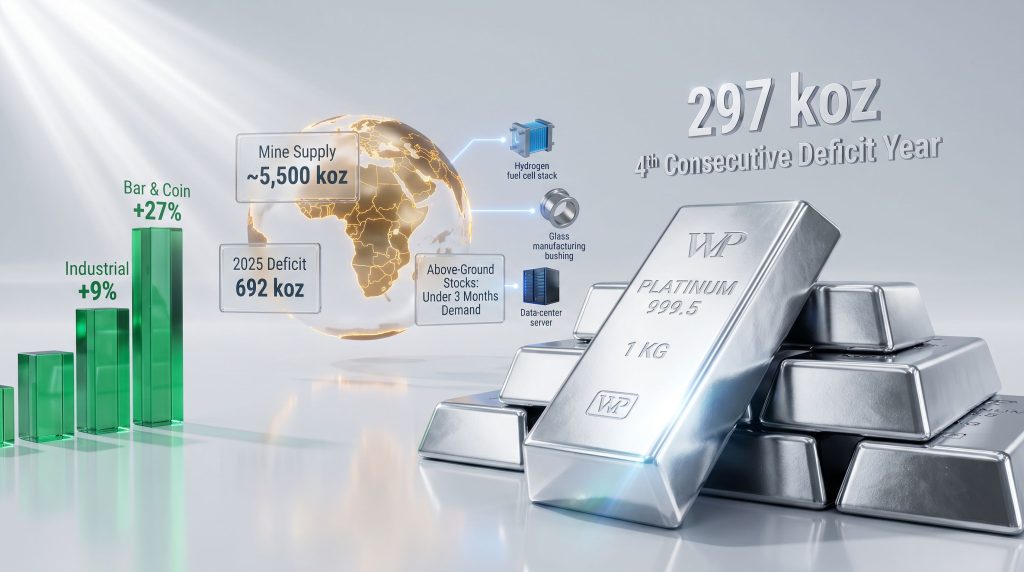
The WPIC's 2026 platinum market forecast presents a picture that appears contradictory at first glance: total demand is forecast to fall approximately 9%, yet the market is still expected to record a supply deficit of 297 koz. Understanding how both outcomes can occur simultaneously is essential to interpreting the data correctly.
| Demand Segment | 2026 Forecast (koz) | Year-on-Year Change |
|---|---|---|
| Industrial | 2,238 | +9% |
| Automotive | ~2,900 (est.) | -2% |
| Jewellery | Declining | -12% |
| Bar and Coin Investment | 718 | +27% |
| Total Demand | 7,674 | -9% |
| Mine Supply | ~5,500 | Flat |
| Recycling Supply | Increasing | +9% |
| Market Deficit | 297 koz | 4th Consecutive Year |
Why Total Demand Can Fall 9% While a Supply Deficit Persists
The apparent paradox resolves when investment demand is separated from structural consumption. A significant portion of the 2025 demand figure was inflated by exceptional ETF inflows and exchange-stock accumulation that are not expected to repeat at scale in 2026. When that one-time investment demand normalises, total demand contracts even though underlying industrial, automotive, and emerging technology consumption remains broadly stable or growing.
The structural demand floor — consisting of industrial, automotive, and hydrogen-related consumption — is therefore more relevant to long-term market analysis than the total demand headline. That floor remains well above available supply.
Above-Ground Platinum Stocks and the Inventory Threshold
By the end of 2026, above-ground platinum stocks are projected to fall to just under three months of demand coverage, a level that has historically been associated with tightening market conditions and heightened price sensitivity to demand shocks.
This trajectory matters because above-ground stocks function as a buffer between supply disruptions and market shortages. As that buffer erodes across consecutive deficit years, the market's ability to absorb unexpected demand spikes or supply interruptions diminishes, increasing price volatility risk. According to Kitco's platinum market analysis, tight supply conditions are expected to persist well into the latter half of the decade.
The Multi-Year Deficit Trajectory: 2025 Through 2030
The 2026 deficit does not exist in isolation. It is the fourth instalment in a series of consecutive annual shortfalls that represent a structural, rather than cyclical, supply-demand imbalance:
- The 2025 platinum market deficit reached an estimated 692 koz
- The 2026 deficit is forecast at 297 koz
- WPIC projects average annual deficits of approximately 331 koz per year from 2026 to 2030
- Four consecutive deficit years reflect a persistent gap between supply capacity and underlying demand, not a temporary market anomaly
Why Is Platinum Mine Supply So Difficult to Grow?
The Geographic Concentration Problem
Platinum supply faces a structural challenge that higher prices alone cannot resolve: the overwhelming majority of primary production is concentrated in three countries, which together account for approximately 90% of global PGM output. South Africa dominates this picture, with Zimbabwe and Russia contributing the remainder of meaningful primary supply. This geographic concentration creates systemic exposure to country-specific risks, including labour disruptions, energy infrastructure constraints, currency volatility, and regulatory uncertainty. PGM supply constraints of this nature are notoriously difficult to resolve within a short timeframe.
Supply Decline Despite Rising Prices
Primary mine supply has fallen from over 6 million ounces in 2021 to approximately 5.5 million ounces forecast for 2026, a contraction that has occurred against a backdrop of significantly rising platinum prices. This dynamic illustrates a critical concept in resource economics: supply inelasticity. When a commodity's supply cannot respond meaningfully to price signals, the usual market self-correction mechanism — higher prices attracting new production — does not function as expected.
The reasons for this inelasticity are structural rather than temporary:
- Long project development timelines mean new mining capacity cannot be activated quickly in response to price movements
- Capital intensity of shaft sinking and underground infrastructure in southern African deposits creates multi-year lead times
- Energy infrastructure constraints in South Africa have persistently limited production throughput
- Labour cost pressures and operational complexity in deep-level mining reduce the economic incentive for rapid capacity expansion
As noted by industry participants familiar with the PGM sector, primary platinum mine production declining over a five-year period during which the metal price doubled is a powerful illustration of just how resistant platinum supply is to price-driven expansion. (Source: ValOre Metals, as cited in Crux Investor research, June 2026)
Why Recycling Growth Cannot Close the Supply Gap
Recycling supply is growing, forecast to increase approximately 9% in 2026, driven by higher autocatalyst scrap collection and improved recovery rates from spent industrial catalysts. However, recycling growth is constrained by the volume of platinum that entered circulation in prior years and the time required for end-of-life material to return to the supply chain. Recycling cannot overcome a structural primary supply deficit; it can only moderate its severity.
Which Industries Are Driving Platinum Demand Growth in 2026?
Industrial Demand: The Largest Growth Engine
Industrial applications represent the most significant near-term demand growth driver for platinum. WPIC forecasts industrial platinum demand rising 9% to 2,238 koz in 2026, with glass-manufacturing capacity expansion as the primary catalyst. In glass production, platinum is used in bushings — the nozzle systems through which molten glass is drawn into fibres — and in crucibles used for specialty glass melting. These components wear over time and require periodic replacement, creating recurring demand tied to industrial capital spending cycles rather than consumer behaviour.
Additional industrial demand originates from:
- Chemical processing applications where platinum functions as a catalyst in nitric acid and other chemical production
- Petroleum refining where platinum catalysts are used in catalytic reforming processes
- Electrical applications including hard disk drives and specialised electronic components
- Medical devices and laboratory equipment requiring high-purity platinum components
The critical insight for investors is that industrial platinum demand responds to manufacturing investment cycles and capital expenditure budgets, not vehicle production schedules. This makes industrial demand analytically independent from automotive demand, and the two should be modelled separately in any rigorous platinum demand forecast.
Hydrogen Technologies: A Structurally Distinct Demand Driver
Platinum's role in hydrogen technology is rooted in fundamental electrochemistry. In proton-exchange membrane (PEM) electrolysers, platinum-group catalysts enable the water-splitting reaction that produces green hydrogen. In fuel cells, platinum catalysts facilitate the reverse reaction, converting hydrogen back into electricity with high efficiency. Both applications require platinum loadings that cannot be easily substituted with cheaper alternatives at current performance standards.
PEM technology expansion is consequently emerging as a structurally distinct demand driver that responds to government infrastructure spending rather than consumer purchasing decisions. As governments prioritise domestic hydrogen production for energy security, spending on electrolysis infrastructure links platinum demand to public policy commitments. This represents a qualitative shift in demand durability: policy-mandated industrial infrastructure spending tends to be stickier than consumer-facing demand.
Hydrogen-related platinum demand remains modest in absolute volume terms in 2026, but its trajectory through the late 2020s depends on the pace of electrolyser deployment and the stability of national hydrogen strategies — factors that investors should monitor independently of automotive demand trends.
Artificial Intelligence Infrastructure: An Emerging and Underappreciated Demand Channel
WPIC has identified AI-related infrastructure investment as a new, if still modest, source of platinum consumption. Optical communications hardware and advanced data-storage technologies used in high-density data centres incorporate platinum in components where the metal's unique physical properties — including corrosion resistance, electrical conductivity, and thermal stability — make it difficult to substitute.
The significance of this demand channel lies less in its current volume than in its independence from every traditional platinum demand driver. Data-centre investment cycles respond to technology adoption curves and enterprise IT spending, creating a demand variable with no correlation to vehicle production, glass manufacturing capacity, or jewellery consumer sentiment.
Investment Demand: The Wildcard Variable
Bar and coin investment demand is forecast to rise 27% to 718 koz in 2026, reflecting growing interest in physical platinum exposure. However, ETF inflows and exchange-stock accumulation at the scale seen in 2025 are not expected to repeat, meaning investment demand introduces significant inter-year volatility into the market balance. Investors building long-term platinum models should treat physical investment demand as a high-variance variable and stress-test their forecasts across a range of scenarios.
How Does Demand Diversification Change the Long-Term Investment Case?
Modelling Platinum Demand Correctly: A Framework for Differentiation
A common analytical error in platinum market assessment is treating all demand categories as equivalent in durability, growth trajectory, and sensitivity to macro conditions. The table below illustrates why a differentiated framework produces more accurate long-term forecasts:
| Demand Category | Primary Driver | Durability | Key Risk |
|---|---|---|---|
| Automotive (ICE) | Emissions regulations | Declining | BEV adoption rate |
| Industrial | Capital investment cycles | Moderate-High | Economic slowdowns |
| Hydrogen | Government policy | High (if stable) | Policy reversal risk |
| AI Infrastructure | Technology investment | Growing | Capex cycle compression |
| Jewellery | Consumer sentiment | Low-Moderate | Price sensitivity |
| Investment (ETF/Coin) | Investor positioning | Variable | Highly volatile |
The Implications of Structural Deficits for Future Supply Development
Four consecutive years of supply deficits carry a specific implication for resource development: the strategic value of new platinum mine supply increases as above-ground stocks are drawn down. Projects outside southern Africa, which could diversify the geographic concentration of primary production, carry additional strategic relevance beyond their volume contribution alone.
This dynamic elevates the importance of exploration-stage and development-stage platinum resources in jurisdictions with established permitting frameworks and existing infrastructure. In addition, renewable energy in mining operations is increasingly influencing project economics and investor appetite, particularly for development-stage assets in politically stable jurisdictions. Definitive feasibility studies that demonstrate robust project economics are consequently becoming a key differentiator for pre-production platinum assets seeking to attract institutional capital.
It is important to note, however, that favourable macro conditions do not eliminate project-level risk. Metallurgical performance, economic study outcomes, permitting timelines, and financing execution remain the determinants of whether a project's resource potential translates into investable returns. Macro tailwinds improve the environment; project fundamentals determine outcomes.
The next major ASX story will hit our subscribers first
What Are the Risks That Could Undermine the Platinum Demand Growth Thesis?
Key Downside Scenarios Investors Should Stress-Test
No structural demand thesis is complete without a rigorous assessment of the conditions under which it could fail. For platinum demand growth and supply deficit dynamics, the principal downside scenarios include:
- Accelerated BEV adoption beyond current forecasts eroding autocatalyst demand faster than industrial and hydrogen demand growth can compensate
- Hydrogen programme delays caused by policy reversals, infrastructure financing constraints, or slower-than-expected electrolyser deployment reducing the medium-term demand pipeline
- Significant recycling supply increases triggered by sustained high platinum prices, which could partially offset primary supply constraints more meaningfully than current forecasts assume
- Industrial capital spending contractions during global economic slowdowns reducing glass, chemical, and petroleum sector demand simultaneously
- Investment demand reversal if investor sentiment shifts, converting a net demand contributor into a net supply source through ETF liquidations
A well-constructed platinum demand model should assign probability weights to each of these scenarios and test the market balance under each outcome. The four-consecutive-deficit baseline is robust under moderate stress assumptions, but it is not immune to a combination of several adverse scenarios occurring simultaneously.
Frequently Asked Questions: Platinum Demand Growth and Supply Deficit
What is causing the platinum supply deficit in 2026?
The deficit reflects flat-to-declining primary mine supply, forecast near 5.5 million ounces and down from over 6 million ounces in 2021, combined with demand that continues to outpace available supply across industrial, investment, and emerging technology sectors. Recycling supply is growing at approximately 9%, but not at a pace sufficient to close the structural gap.
Is platinum demand actually growing if total demand is forecast to fall 9% in 2026?
Total demand is declining primarily because of a normalisation in investment demand following exceptionally large ETF and exchange-stock inflows in 2025 that are not expected to repeat at the same scale. Structural demand from industrial applications is growing 9%, while hydrogen and technology-sector consumption are expanding from a smaller base. The underlying industrial demand trajectory is positive even as the headline total demand figure contracts.
How many consecutive years has the platinum market recorded a supply deficit?
The platinum market is forecast to record its fourth consecutive annual supply deficit in 2026, with the 2025 deficit estimated at 692 koz and the 2026 deficit projected at 297 koz. WPIC's multi-year outlook projects average annual deficits of approximately 331 koz per year through 2030.
Why is platinum mine supply not responding to higher prices?
Platinum mine supply exhibits significant structural inelasticity. The majority of primary production is concentrated in southern Africa, where operating costs, labour dynamics, energy infrastructure constraints, and long project development timelines limit the speed at which new supply can enter the market. A sustained period of rising platinum prices has not translated into meaningful new production, illustrating the depth of these structural barriers.
What role does hydrogen play in platinum demand growth?
Platinum is a key catalyst in proton-exchange membrane electrolysers used to produce green hydrogen and in fuel cells that convert hydrogen back into electricity. As governments invest in domestic hydrogen production for energy security reasons, platinum demand becomes increasingly tied to infrastructure investment commitments rather than consumer spending cycles. Hydrogen demand is not yet a major volume contributor in 2026 but represents a potentially significant structural growth driver through the late 2020s.
What would need to happen for the platinum supply deficit to close?
Closing the deficit would require some combination of meaningful new mine supply entering production, a significant increase in recycling volumes, a sustained decline in industrial or investment demand, or a delay in hydrogen and technology-sector demand growth. Given current project development timelines and the geographic concentration of supply, a rapid resolution of the structural deficit is considered unlikely under most forecast scenarios.
What the 2026 Platinum Market Balance Means for Long-Term Supply Strategy
The Core Investment Implication
A platinum market characterised by broadening demand across industrial, hydrogen, and technology sectors, combined with constrained mine supply and four consecutive years of deficits, creates a structurally supportive environment for new supply development. The progressive erosion of above-ground stocks toward the equivalent of three months of demand coverage means the market's tolerance for supply disruptions is diminishing.
For investors evaluating platinum exposure, the key analytical distinction is between the macro demand environment and project-level execution reality. The former provides a favourable backdrop; the latter determines whether that backdrop translates into investment returns. Furthermore, the WPIC's platinum quarterly reports provide granular data on supply-demand dynamics that investors should incorporate into any rigorous analytical framework.
Why Geographic Diversification of Platinum Supply Has Become a Market Priority
With roughly 90% of primary PGM production concentrated in three countries, the strategic case for developing platinum resources in alternative jurisdictions has strengthened alongside the structural demand case. Projects in geologically favourable regions outside southern Africa that can offer established permitting pathways, existing infrastructure access, and manageable metallurgical complexity are positioned to attract growing attention from both industrial users and financial investors seeking supply security.
A platinum market defined by broadening demand, constrained supply, and four consecutive deficit years creates a structurally supportive environment for new mine supply development. However, the translation of favourable macro conditions into investment returns at the project level still depends on metallurgical performance, economic study outcomes, permitting timelines, and financing execution. Macro tailwinds improve the ceiling; project fundamentals determine the floor.
Disclaimer: This article is intended for informational purposes only and does not constitute financial advice. Forecasts and projections referenced herein, including those from the World Platinum Investment Council, involve assumptions and uncertainties and should not be relied upon as guarantees of future market outcomes. Investors should conduct their own due diligence before making any investment decisions. Past market deficits do not guarantee future price appreciation. Exploration-stage projects carry specific risks including metallurgical, permitting, financing, and execution uncertainties that are independent of macro demand conditions.
For further reading on platinum market dynamics and supply-demand fundamentals, the World Platinum Investment Council publishes quarterly and annual market forecasts, supply-chain analysis, and demand-sector breakdowns at platinuminvestment.com.
Want to Capitalise on the Next Major Mineral Discovery Before the Broader Market?
Discovery Alert's proprietary Discovery IQ model delivers real-time alerts on significant ASX mineral discoveries across platinum, critical minerals, and the full spectrum of commodities driving the energy transition — turning complex geological and market data into actionable investment insights for both short-term traders and long-term investors. Explore historic discoveries and their extraordinary returns to understand what's possible, then begin your 14-day free trial at Discovery Alert to position yourself ahead of the market.