June 19, 2026
Precious Metals at a Crossroads: Why Platinum Jewellery Demand Is Rewriting the Market Narrative
For much of the past decade, platinum occupied an awkward position in the luxury goods ecosystem. Once the undisputed king of prestige metals, trading at a consistent premium above gold, it gradually lost ground to shifting consumer tastes, a weakening Chinese market, and the relentless rise of gold as both an investment asset and a fashion statement. Yet the very forces that compressed platinum's price have now become its most powerful commercial tailwind. Platinum jewellery demand has emerged as a structural recovery story, and the jewellery sector is where that transformation is most visibly unfolding.
When big ASX news breaks, our subscribers know first
Platinum Jewellery Demand Reaches a Multi-Year Peak
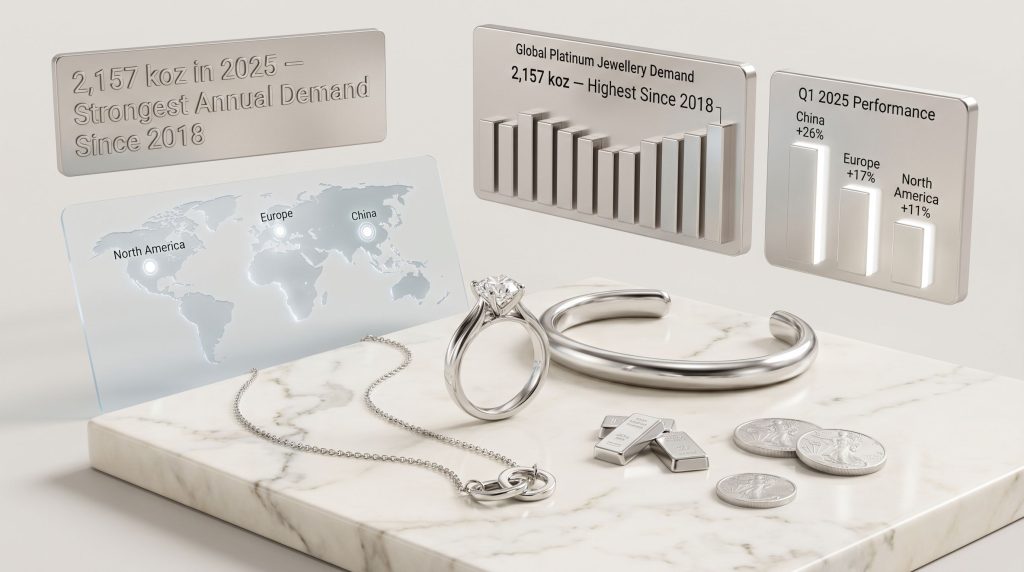
Global platinum jewellery demand reached approximately 2,157 koz in 2025, marking the strongest annual performance since 2018 and representing a roughly 7% year-on-year increase over the prior period. This figure is significant not simply because of its magnitude, but because of what it reveals about the underlying mechanics of the recovery.
The first quarter of 2025 alone contributed 533 koz, rising 9% year-on-year and signalling that demand momentum was front-loaded rather than dependent on seasonal factors alone. This kind of quarterly acceleration is particularly meaningful in commodity markets because it suggests fabricators and retailers are building inventory in anticipation of sustained consumer demand rather than simply responding to short-term pricing signals.
Platinum Jewellery Demand: Five-Year Trend at a Glance
| Year | Estimated Global Demand (koz) | YoY Change | Primary Driver |
|---|---|---|---|
| 2020 | ~1,850 | Declining | COVID-19 disruption |
| 2021 | ~1,950 | Recovering | Post-lockdown rebound |
| 2022 | ~2,000 | Flat | China weakness offsetting gains |
| 2023 | ~2,020 | Marginal | Price competitiveness emerging |
| 2024 | ~2,015 | Flat | Pre-recovery consolidation |
| 2025 | ~2,157 | +7% YoY | Multi-region acceleration |
It is worth noting that according to Mining Weekly's June 2026 reporting, platinum jewellery had generated its highest demand level since 2019, which aligns broadly with the 2025 figures reflecting a genuine structural rebound rather than a temporary cyclical bounce.
Key Insight: The 2025 recovery is not a single-market story. It reflects simultaneous demand acceleration across China, Europe, and North America, each driven by distinct but reinforcing factors. When multiple independent demand engines fire together, the resulting trend has far greater durability than one driven by a single regional catalyst.
The Gold Price Inversion: Platinum's Most Powerful Commercial Catalyst
Understanding why platinum jewellery demand is surging requires grasping a price dynamic that most casual observers overlook. Historically, platinum commanded a meaningful premium over gold, sometimes in the range of 20% to 50%. That relationship has inverted dramatically. Furthermore, gold record highs have widened this gap considerably, making platinum's sustained discount a structural anomaly by historical standards that has fundamentally altered the commercial calculus for jewellery manufacturers and retailers.
This price inversion creates several compounding demand effects:
- Jewellery manufacturers can produce platinum pieces at a lower material cost while retaining the metal's premium aesthetic positioning
- Retailers can offer consumers a metal that is genuinely rarer in geological terms and more durable than white gold, at a price point below yellow gold
- In bridal and gifting categories specifically, platinum's perceived prestige combined with its lower price relative to gold has become a compelling sales narrative
- Price-sensitive but quality-conscious consumers in emerging markets who previously could not access platinum jewellery at gold-equivalent pricing are now entering the category
Analyst Perspective: The self-regulating nature of this dynamic deserves attention. As platinum prices rise toward gold parity, the substitution-driven demand advantage narrows, naturally moderating fabrication growth. This creates a price ceiling of sorts for jewellery-driven demand, but also provides a durable demand floor as long as the discount persists.
Regional Breakdown: Where Platinum Jewellery Demand Is Accelerating Fastest
Regional Q1 2025 Performance Summary
| Region | Q1 2025 YoY Growth | Primary Demand Driver |
|---|---|---|
| China | +26% | Fabrication rebound, younger consumer targeting |
| Europe | +17% | Luxury retail recovery, white metal preference |
| North America | +11% | Bridal market expansion, gold substitution |
| India | Positive | Wedding season, aspirational luxury positioning |
| Japan | Stable | Structural cultural demand |
China: The World's Largest Platinum Jewellery Market Finds Its Footing Again
China's role in the global platinum jewellery story cannot be overstated. The country remains the single largest market by fabrication volume, and its decade-long demand contraction was the primary reason global platinum jewellery demand eroded from peak levels. That contraction was not driven by price alone. Chinese consumers shifted decisively toward yellow gold and K-gold products through the 2010s, partly reflecting changing lifestyle aesthetics and partly a response to aggressive marketing by the gold industry targeting younger demographics.
The 2025 reversal is therefore significant on multiple levels. Chinese platinum jewellery fabrication rose an estimated 26% year-on-year in Q1 2025, with full-year 2025 demand projected at approximately 474,000 ounces, representing a 15% annual increase according to World Platinum Investment Council data. The industry's response has included targeted marketing campaigns positioning platinum as the metal of choice for younger Chinese consumers, emphasising its purity credentials and contemporary design versatility.
A lesser-known dynamic within the Chinese market is the role of platinum's hallmarking and purity conventions. Chinese consumers place exceptional weight on metal purity labelling, and platinum's standard Pt950 or Pt990 markings (indicating 95% or 99% purity) compare favourably against the complexity of gold alloy products. This transparency in purity grading has become a subtle but meaningful competitive advantage as quality-conscious younger consumers re-engage with platinum.
Europe and North America: Structural Shifts in Consumer Preference
Europe's 17% Q1 2025 growth reflects more than post-inflationary consumer confidence. A generational aesthetic shift toward minimalist, white-metal design in fine jewellery has been underway across Western markets for several years. Platinum's natural white lustre, which does not require rhodium plating to maintain its appearance unlike white gold, aligns directly with consumer preferences for low-maintenance, enduring jewellery pieces.
North America's 11% Q1 2025 growth is concentrated in the bridal segment, where platinum has long maintained its strongest positioning. The metal's hypoallergenic properties, exceptional durability, and secure prong settings for gemstones make it technically superior to alternatives in engagement ring applications. As gold prices have surged, the price competitiveness of platinum in this category has attracted both consumers and retailers.
Platinum's Place Within the Broader Demand Ecosystem
Jewellery accounts for approximately 24% to 30% of total global platinum demand, making it the second-largest end-use category by volume. Understanding where this sits within the full demand picture matters for investors and market analysts. In addition, broader platinum and palladium dynamics across the precious metals complex also influence how capital flows between these closely related markets.
Platinum End-Use Demand: Approximate Composition
| End-Use Category | Share of Total Demand (%) |
|---|---|
| Automotive (Autocatalysts) | ~38%–42% |
| Jewellery | ~24%–30% |
| Industrial (Chemical, Petroleum, Glass) | ~18%–22% |
| Investment (ETFs, Bars, Coins) | ~5%–10% |
The strategic importance of jewellery demand is amplified by the structural pressures facing the automotive segment. Platinum's use in catalytic converters for internal combustion engine vehicles represents its largest single demand source, but the long-term trajectory of this demand faces genuine uncertainty as electric vehicle adoption accelerates in key markets. The energy transition mineral demand shift, however, introduces hydrogen fuel cell vehicles as a potential future demand offset, though the timeline and scale of this transition remain highly uncertain.
Against this backdrop, a sustained jewellery demand recovery carries disproportionate strategic importance. Jewellery demand is driven by consumer sentiment, cultural traditions, and relative pricing dynamics rather than technological substitution risk, making it a genuinely stabilising pillar within the broader demand structure.
Strategic Note: The convergence of a recovering jewellery sector and a platinum market already operating in supply deficit creates a compounding structural argument for tighter platinum fundamentals over the medium term. Physical demand absorption from jewellery fabrication directly reduces available above-ground inventory.
The Supply Side: Why Demand Recovery Matters More Than Usual
Platinum supply is geographically concentrated to a degree that few commodities match. Approximately 70% to 75% of global platinum mine supply originates from South Africa's Bushveld Igneous Complex, one of the most geologically unique ore bodies on Earth. The Bushveld hosts platinum-bearing reefs at depths and grades that are unmatched globally, but extraction is increasingly capital-intensive and operationally complex as mines extend to greater depths.
This supply concentration means the market is structurally exposed to South African operational disruptions, energy availability constraints, and labour dynamics in a way that diversified commodity markets are not. The platinum market has operated in a supply deficit for consecutive years, meaning mine supply plus recycling has failed to fully cover demand. A strengthening jewellery sector adds incremental demand pressure to an already tight physical market.
Key supply-side considerations include:
- South African electricity supply constraints continue to affect processing throughput at smelting and refining operations
- Palladium-rich ore processing economics influence whether platinum-dominant or palladium-dominant reef sections are prioritised at some operations
- Recycling supply from autocatalyst scrap flows is a meaningful secondary supply source but subject to collection rate variability and vehicle age dynamics
- New greenfield platinum supply outside the Bushveld is limited, with the Great Dyke in Zimbabwe representing the most developed alternative resource base
The next major ASX story will hit our subscribers first
Long-Term Outlook: Stability With Selective Upside
Industry forecasts suggest global platinum jewellery demand is likely to hold near the 2,150 koz level through 2029, with trajectory highly dependent on three variables: China's sustained recovery, the platinum-to-gold price relationship, and broader consumer sentiment in key markets. Furthermore, the gold price forecast through 2025 and beyond will directly influence how compelling platinum's discount narrative remains for consumers and fabricators alike.
Scenario Modelling: Platinum Jewellery Demand Pathways to 2029
| Scenario | 2029 Demand Estimate | Key Assumption |
|---|---|---|
| Bull Case | ~2,400–2,500 koz | China sustains recovery, gold premium widens further |
| Base Case | ~2,150–2,250 koz | Stable multi-region demand, modest China growth |
| Bear Case | ~1,900–2,000 koz | China reversal, gold price correction narrows discount |
Risk Factors That Could Constrain the Recovery
- Gold price correction reducing platinum's relative price advantage and dampening substitution demand
- Chinese macroeconomic headwinds slowing consumer spending on discretionary luxury categories
- Lab-grown diamond proliferation disrupting the broader fine jewellery market, indirectly affecting premium metal settings demand
- Currency volatility in emerging markets like India, where local currency weakness can compress platinum jewellery affordability despite stable USD pricing
- Recycling supply increases if high platinum prices incentivise greater scrap collection, adding secondary supply that partially offsets demand tightening
Frequently Asked Questions: Platinum Jewellery Demand
Why is platinum jewellery demand at its highest level in years?
The recovery reflects a convergence of factors: platinum's significant price discount relative to gold creating a powerful substitution incentive, a rebound in Chinese jewellery fabrication after nearly a decade of decline, accelerating growth in European and North American markets driven by bridal demand and white-metal aesthetic preferences, and sustained structural demand from culturally important markets like India and Japan. Consequently, central bank gold demand pushing gold prices higher has indirectly reinforced this dynamic by widening the price gap between the two metals.
Why does platinum trade below gold when it is rarer?
Platinum's price is influenced by multiple demand categories, particularly automotive catalytic converter applications. As electric vehicle adoption has grown and uncertainty around long-term autocatalyst demand has increased, investor sentiment toward platinum has been cautious. Gold, by contrast, benefits from enormous investment and central bank demand that has driven its price significantly higher. The rarity of platinum in the Earth's crust does not automatically translate to a price premium when demand structure and investor positioning differ so materially between the two metals.
How does jewellery demand affect platinum prices?
Jewellery demand contributes to physical platinum absorption, reducing above-ground inventory and tightening supply-demand balances. In a market already operating in supply deficit, strengthening jewellery fabrication reinforces the structural case for price support. However, jewellery demand is not the primary short-term price driver; investment flows and autocatalyst demand dynamics exert greater near-term price influence.
Which market poses the greatest upside risk for platinum jewellery demand?
China represents both the greatest risk and the greatest opportunity. As the world's largest platinum jewellery fabrication market, even marginal shifts in Chinese consumer behaviour carry outsized implications for global demand totals. A sustained Chinese recovery driven by younger consumer engagement with the category could push global demand materially above base case projections.
Key Takeaways
- 2025 represents a genuine structural inflection, with global platinum jewellery demand reaching approximately 2,157 koz, the highest level since 2018 and consistent with Mining Weekly reporting of the highest level since 2019
- China's 26% Q1 2025 fabrication rebound is the single most consequential regional development, with full-year demand projected at 474,000 ounces
- Platinum's discount to gold is the primary commercial catalyst, creating durable substitution demand across bridal, gifting, and lifestyle jewellery segments
- Europe (+17%) and North America (+11%) delivered strong Q1 2025 performance, underpinned by genuine consumer preference shifts toward white metals and low-maintenance luxury
- Jewellery's 24%–30% share of total platinum demand makes it a critical stabilising pillar as automotive demand faces long-term structural pressure from electrification trends
- Supply concentration in South Africa and a multi-year market deficit amplify the price relevance of any sustained demand recovery in the jewellery segment
- Long-term forecasts point to stability near current levels, with meaningful upside contingent on China's trajectory and the persistence of platinum's price advantage relative to gold
This article contains forward-looking statements, demand projections, and scenario analyses that are inherently speculative. Commodity markets are subject to significant volatility and the factors discussed may change materially. Nothing in this article constitutes financial or investment advice. Readers should conduct their own research and consult qualified advisers before making investment decisions.
Want to Capitalise on the Next Major Precious Metals Discovery Before the Broader Market?
Discovery Alert's proprietary Discovery IQ model delivers real-time alerts on significant ASX mineral discoveries — instantly converting complex geological data into actionable investment insights for both short-term traders and long-term investors. Explore historic discoveries and their exceptional returns on Discovery Alert's dedicated discoveries page, or start your 14-day free trial today to position yourself ahead of the market.