June 21, 2026
The Quiet Revolution Reshaping Hard-Rock Lithium Supply
Battery mineral markets operate in long cycles, and the producers who move during downturns tend to capture disproportionate gains during recoveries. This pattern has played out repeatedly across commodities, from iron ore to copper, and it now appears to be unfolding again in the spodumene concentrate market. While lithium spot prices remain well below their 2022 peaks, capital allocation decisions being made today will determine who controls meaningful production capacity when demand inflects upward again. Against this backdrop, the PLS Pilgangoora P2000 project funding boost represents one of the most significant strategic commitments in Australian critical minerals development this decade.
When big ASX news breaks, our subscribers know first
What the P2000 Project Actually Represents
Pilgangoora: A Resource Base That Changes the Conversation
Located in the Pilbara region of Western Australia, the Pilgangoora lithium-tantalum deposit is among the largest known hard-rock lithium resources on the planet. Its mineralogy centres on spodumene, a lithium aluminium inosilicate mineral that, when processed into concentrate, forms the primary feedstock for downstream lithium chemical conversion facilities. Pilgangoora's resource scale and consistency of grade have made it a reference asset for institutional investors benchmarking lithium exposure.
What separates Pilgangoora from many peer operations is the combination of resource tonnage, average spodumene grade, and existing infrastructure. The site already benefits from established crushing, dense media separation, and flotation processing circuits built during the earlier P680 expansion phase. This infrastructure foundation is a critical factor in the economic case for the P2000 project, since greenfield construction costs are largely avoided at the processing plant level.
From P680 to P2000: Understanding the Scale Shift
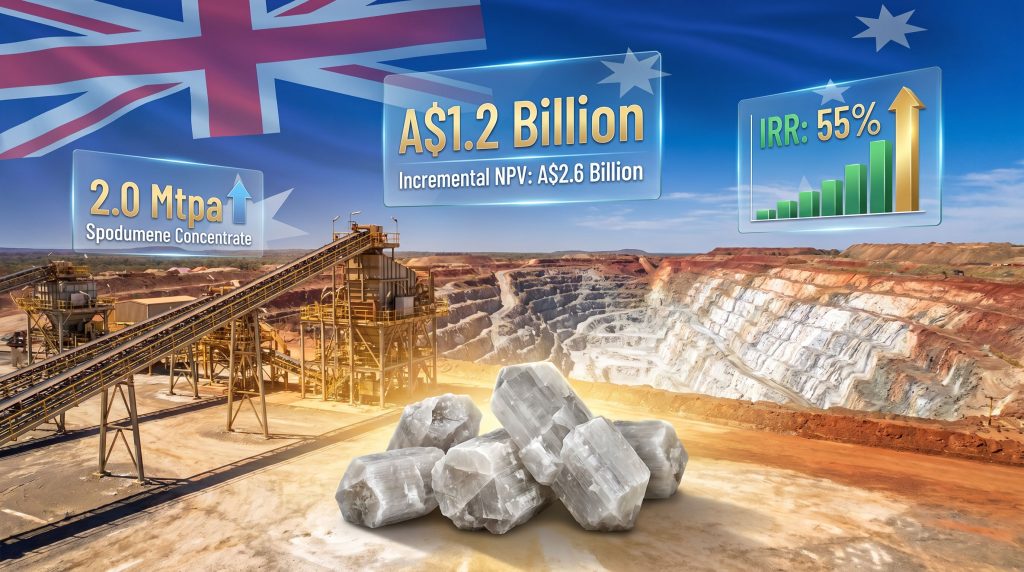
The designation P2000 refers to a target processing throughput of more than 2.0 million tonnes per annum (Mtpa) of spodumene concentrate. To contextualise this, the operation's earlier P680 phase targeted approximately 680,000 tonnes per annum. The progression from P680 to P2000 is therefore not a linear upgrade but a structural step-change in the operation's position within global lithium supply hierarchies.
Spodumene concentrate is typically produced at grades of around 5.5% to 6% lithium oxide (Li₂O), which is the benchmark specification demanded by lithium chemical converters in China, South Korea, and increasingly in emerging refining hubs across Europe. At 2.0 Mtpa of concentrate output, Pilgangoora would be supplying feedstock capable of producing a very material volume of lithium hydroxide or lithium carbonate annually, placing it in direct relevance to gigafactory supply chains globally.
"The P2000 Project is not an incremental capacity addition. It is a deliberate repositioning of Pilgangoora as one of the defining hard-rock lithium supply nodes in the global battery materials ecosystem for the 2030s."
Breaking Down the PLS Pilgangoora P2000 Project Funding Boost
Pre-FID Capital: What A$175 Million Actually Buys
Pilbara Minerals (ASX: PLS) has approved approximately A$175 million in pre-final investment decision (pre-FID) capital expenditure to accelerate the P2000 project. This category of spending is often misunderstood by retail investors. Pre-FID capital is not construction expenditure. It covers a range of activities that reduce timeline risk between feasibility completion and first dirt being turned, including:
- Early works engineering and detailed design progression
- Long-lead equipment procurement and vendor engagement
- Site preparation, earthworks mobilisation planning, and geotechnical studies
- Definitive feasibility study (DFS) advancement and independent review processes
- Regulatory approvals, environmental studies, and heritage consultations
By committing this capital before a formal FID, Pilbara Minerals is effectively purchasing time. When the FID is eventually sanctioned, the gap between that decision and meaningful construction activity is materially compressed. In a commodity cycle context, this matters enormously. The difference between first production in 2029 versus 2031 could represent billions of dollars in revenue capture, depending on where lithium prices sit during that window.
Federal Financing Agencies and Non-Binding Letters of Support
Australian federal financing agencies have provided non-binding letters of support for up to A$400 million in debt financing for the P2000 project. It is important to understand precisely what this means and what it does not mean. Non-binding letters of support indicate that financing agencies have assessed the project as worthy of further engagement and have expressed conditional willingness to participate in the debt structure. They do not represent committed facilities, approved drawdown mechanisms, or guaranteed funding.
The distinction is commercially meaningful. Projects that carry non-binding support still face credit committee processes, independent technical review, and covenant negotiation before any facility is confirmed. However, from a market signalling perspective, these letters validate the project's bankability profile and reduce perceived financing risk for equity investors assessing the total capital structure.
The precedent for federal involvement at Pilgangoora is well established. The P680 expansion was supported by both the Northern Australia Infrastructure Facility (NAIF) and Export Finance Australia, two agencies with a track record of participating in large-scale resource infrastructure with national supply chain significance. This institutional familiarity with the asset base arguably simplifies the diligence pathway for any subsequent P2000 facility.
Total Capital Structure: How the Numbers Stack Up
| Funding Component | Amount | Status |
|---|---|---|
| Pre-FID capital expenditure approved | ~A$175 million | Board-approved and committed |
| Federal agency financing indication | Up to A$400 million | Non-binding letters of support |
| Total estimated project capex (PFS) | A$1.2 billion | Pre-feasibility estimate |
| Residual funding required | ~A$625 million | Cash, operating cashflows, debt, or hybrid |
The residual funding gap between the indicated federal support and the total capex estimate will likely be addressed through a combination of Pilbara Minerals' existing cash reserves, operating cashflows generated from Pilgangoora's current production, and potentially new commercial debt facilities or equity-linked instruments. No confirmed structure has been announced, and the precise mix will be determined through the ongoing DFS process.
Project Economics: What the Pre-Feasibility Study Reveals
A 55% IRR in a Depressed Market: Reading Between the Lines
The pre-feasibility study (PFS) for the P2000 project reports an incremental net present value (NPV) of A$2.6 billion and an internal rate of return (IRR) of 55%, against a total estimated capital cost of A$1.2 billion. These figures deserve careful interpretation. Furthermore, understanding the methodology behind them is essential for investors benchmarking this project against peers.
A 55% IRR is an exceptionally strong return metric by any standard in large-scale resources infrastructure. For context, major mining projects typically target threshold IRRs of 15% to 25% to clear internal hurdle rates, meaning P2000's headline number carries a substantial buffer against adverse commodity price scenarios. However, PFS-level economics are inherently subject to revision as the DFS incorporates more granular engineering, procurement, and construction cost data.
Several factors could move the final DFS numbers in either direction:
- Upward capex pressure from labour market tightness in Western Australia's resources sector and materials cost inflation
- Downward capex adjustment if engineering optimisations identify more efficient processing circuit configurations
- NPV sensitivity to the assumed long-run spodumene concentrate price used in the PFS model
- Schedule compression benefits from the pre-FID spending already approved, which may improve NPV by pulling forward production
Disclaimer: Pre-feasibility study figures are estimates based on assumptions current at the time of study completion. Actual project outcomes, including capital costs, production rates, and financial returns, may differ materially from PFS projections. This article does not constitute financial advice.
How P2000 NPV Compares to Pilbara Minerals' Existing Asset Value
An incremental NPV of A$2.6 billion is a figure that warrants comparison against Pilbara Minerals' broader market capitalisation and asset base. If realised, the value creation from P2000 alone would represent a transformative uplift to the company's intrinsic value. This is the core reason why sophisticated investors track pre-FID spending decisions closely: the capital commitment signals management's conviction that the project economics are sufficiently robust to justify exposure before full cost certainty is established.
The Strategic Logic Behind Early Capital Deployment
Why Rush Before the Final Investment Decision?
Committing A$175 million before an FID is a deliberate sequencing choice that reflects both competitive dynamics and cycle positioning. In hard-rock lithium, the race to capacity in the next upcycle is already underway among a small number of well-capitalised operators. Projects that complete their DFS and move to FID earliest will be first to market when demand growth from electric vehicle penetration and stationary storage deployment drives the next structural tightening in spodumene supply.
Lithium market analysts have broadly identified a structural supply gap potential emerging in the late 2020s, as current low prices suppress investment in new capacity while demand continues to grow. The projects that are construction-ready at that inflection point will capture the most favourable pricing environment. Pre-FID spending is therefore a form of optionality purchase, acquiring timeline advantage at a defined upfront cost. To understand how lithium mining works at scale is to appreciate why these timeline advantages compound significantly over time.
What Early Spending Signals to the Market
Board-level approval of pre-FID capital sends several simultaneous signals to institutional investors, offtake partners, and financing agencies:
- Management confidence in the project's technical and economic foundations is sufficiently high to risk capital ahead of full cost certainty
- The company's balance sheet is healthy enough to absorb A$175 million without compromising near-term operational flexibility
- The timeline for FID is being actively compressed, reducing the period of value uncertainty that typically weighs on project developer valuations
- Offtake negotiations can proceed with greater credibility, since counterparties can see tangible evidence of construction progression commitment
Spodumene Quality and Geological Factors at Pilgangoora
Why Mineralogy Matters Beyond Grade
One dimension of Pilgangoora's competitive advantage that receives less attention than headline resource tonnes is the quality characteristics of its spodumene. Not all spodumene deposits are equal in processing behaviour. Pilgangoora's ore body produces spodumene with favourable liberation characteristics, meaning the mineral separates efficiently from gangue material during dense media separation and flotation processing. Spodumene extraction at Pilgangoora consequently delivers lower processing costs per tonne of concentrate produced and better recovery rates compared to more complex or fine-grained ore bodies.
The deposit also contains tantalum as a meaningful co-product, with tantalite recovered during the spodumene concentration process. Tantalum is a high-value specialty metal used in electronics capacitors, and its recovery adds incremental revenue that partially offsets operating costs. This co-product dynamic is not replicated at all competing hard-rock lithium operations and represents a structural cost advantage embedded in Pilgangoora's geology.
Pegmatite Geology and Resource Confidence
Pilgangoora is hosted within lithium-caesium-tantalum (LCT) class granitic pegmatites, which are the geological setting responsible for most of the world's hard-rock lithium resources. The Pilbara region's tectonic history has preserved these pegmatite bodies in a structural configuration that allows for straightforward open-cut mining geometries at Pilgangoora, reducing mining complexity and associated cost relative to narrow-vein or steeply dipping pegmatite systems encountered elsewhere.
Resource confidence at Pilgangoora is high relative to many peer projects, reflecting the volume of drilling completed across multiple campaigns since the deposit's discovery. This resource confidence directly supports the bankability of the P2000 financing case, since lending agencies require demonstrated geological certainty before committing to infrastructure-scale debt facilities.
The next major ASX story will hit our subscribers first
Risk Landscape: What Could Derail the P2000 Timeline
Key Risks Investors Should Monitor
| Risk Category | Nature of Risk | Mitigation Factor |
|---|---|---|
| Lithium price cyclicality | Sustained low prices may delay FID sanctioning | IRR of 55% provides substantial price buffer |
| DFS cost revision | Engineering refinement may increase capex estimate | Pre-FID spend locks in early-works timeline regardless |
| Financing confirmation | Non-binding support may not convert to committed facilities | Multiple funding pathways identified in PFS |
| Labour and materials inflation | WA resources sector tightness elevates construction costs | Early procurement via pre-FID spend mitigates escalation |
| Regulatory and permitting | Environmental approvals may extend pre-construction timelines | Existing operational footprint reduces regulatory complexity |
The Difference Between Non-Binding Support and Confirmed Debt
Perhaps the most important risk distinction for investors to understand is the gap between the A$400 million in non-binding financing support and confirmed debt facilities. Non-binding letters represent an expression of intent, not a legal commitment to lend. The conversion of this support into an actual credit-approved facility requires completion of the DFS, satisfaction of standard project finance conditions precedent, and formal credit approval processes within each participating agency.
This gap is not unusual in project finance. Most major resource infrastructure projects move through exactly this sequence. However, it does mean that the financing picture for P2000 carries execution risk that is not fully resolved by the current announcements.
Global Context: Where P2000 Sits in the Spodumene Supply Landscape
Pilgangoora at 2.0 Mtpa: A Global Capacity Benchmark
To appreciate the significance of the P2000 target, it is useful to benchmark 2.0 Mtpa of spodumene concentrate against the global supply picture. The global lithium market is currently dominated by a small number of Western Australian hard-rock operations, with additional supply emerging from projects in Canada, Zimbabwe, and the Democratic Republic of Congo. A single operation producing more than 2.0 Mtpa of concentrate would represent a very substantial share of total seaborne spodumene supply, granting significant influence over spot price formation and long-term offtake contract negotiations.
This scale also creates leverage in downstream refining negotiations. Buyers of spodumene concentrate, including major Chinese lithium chemical converters and emerging Western refining facilities, actively seek volume security. A Pilgangoora operating at P2000 capacity becomes a tier-one counterparty in those negotiations, with the ability to anchor multi-year offtake agreements that provide revenue visibility supporting the project's financing structure.
Frequently Asked Questions: PLS Pilgangoora P2000 Project Funding
What is the P2000 Project at Pilgangoora?
The P2000 Project is Pilbara Minerals' next-phase expansion of its Pilgangoora lithium operation in Western Australia, targeting production of more than 2.0 Mtpa of spodumene concentrate. This represents a fundamental capacity step-change from the operation's P680 phase.
How much pre-FID capital has Pilbara Minerals committed?
The company's board has approved approximately A$175 million in pre-final investment decision capital expenditure to advance project engineering, procurement activities, and DFS progression.
What is the nature of the federal financing agency support?
Australian federal financing agencies have provided non-binding letters of support for up to A$400 million. These letters are indicative and conditional, not confirmed debt commitments. Conversion to a formal facility requires completion of further project development milestones and standard credit approval processes.
What does the pre-feasibility study say about project returns?
The PFS estimates an incremental NPV of A$2.6 billion and an IRR of 55% against a total capital cost estimate of A$1.2 billion. These figures are subject to revision as the DFS progresses.
When will Pilbara Minerals make the Final Investment Decision?
No confirmed FID date has been publicly announced. The decision will follow completion of the DFS, resolution of funding structures, and board review of all project parameters.
How was the P680 expansion financed, and does this create a precedent?
The P680 phase received financing support from the Northern Australia Infrastructure Facility (NAIF) and Export Finance Australia. This established familiarity between Pilgangoora and federal financing agencies, which is a relevant consideration in assessing the plausibility of similar involvement in the P2000 capital structure.
What P2000 Means for Australia's Lithium Future
A Bellwether Decision in a Critical Cycle
The decision to commit A$175 million in pre-FID capital at a point of depressed lithium prices reflects a calculated bet that the supply-demand fundamentals for spodumene concentrate will tighten materially before P2000 reaches full production. This is not speculative optimism. It is grounded in the observable dynamics of battery demand growth trajectories, the extended lead times required to bring new hard-rock lithium capacity online, and the limited number of large-scale, low-risk, infrastructure-ready projects capable of delivering meaningful new supply in the relevant timeframe.
For Australia's broader critical minerals ambitions, P2000 carries significance beyond a single company's balance sheet. Australia's lithium industry is increasingly positioning itself as the world's dominant hard-rock lithium supplier, and a Pilgangoora operating at 2.0 Mtpa of spodumene output anchors that ambition firmly. Consequently, the scale, quality, and financial robustness of the P2000 business case set a benchmark that the next generation of Australian lithium development will be measured against.
Furthermore, innovations in direct lithium extraction technology are gradually reshaping how the broader industry thinks about processing efficiency, and projects of P2000's scale are well positioned to incorporate such advances as they mature. The PLS Pilgangoora P2000 project funding boost is, in this sense, not merely a corporate capital allocation decision. It is a statement of intent about where hard-rock lithium supply leadership will reside through the 2030s.
Readers seeking broader context on Australian critical minerals project development and financing trends can explore ongoing coverage and analysis at australianminingreview.com.au, where the evolving landscape of large-scale resource development in Western Australia is reported in depth.
Want to Catch the Next Major ASX Lithium Discovery Before the Market Does?
Discovery Alert's proprietary Discovery IQ model delivers real-time alerts on significant ASX mineral discoveries — including critical battery metals like lithium — instantly cutting through complex data to surface actionable opportunities for both traders and long-term investors. Explore how historic mineral discoveries have generated substantial returns and begin your 14-day free trial at Discovery Alert to position yourself ahead of the next major find.