June 12, 2026
The Inefficiency Built Into the Global Lithium Supply Chain
For most of the past two decades, the hard-rock lithium industry has operated on a structurally fragmented model: ore extracted from geologically rich deposits in Canada, Australia, or Africa gets shipped halfway around the world before it ever becomes a functional battery material. Refineries concentrated in China have processed the overwhelming majority of global spodumene output into lithium hydroxide or lithium carbonate, creating a dependency that Western battery manufacturers are only now beginning to fully reckon with. The global lithium market reflects precisely this kind of structural imbalance.
This isn't simply a cost inefficiency. It is a supply chain architecture built on the assumption that chemical processing expertise would remain permanently concentrated in Asia, and that Western mining jurisdictions would be content supplying raw or partially processed material indefinitely. That assumption is now being challenged, and PMET Resources lithium processing in Québec represents one of the more technically credible attempts to disrupt it.
When big ASX news breaks, our subscribers know first
What Makes the Shaakichiuwaanaan Project Structurally Different
Scale, Grade, and Ownership Structure
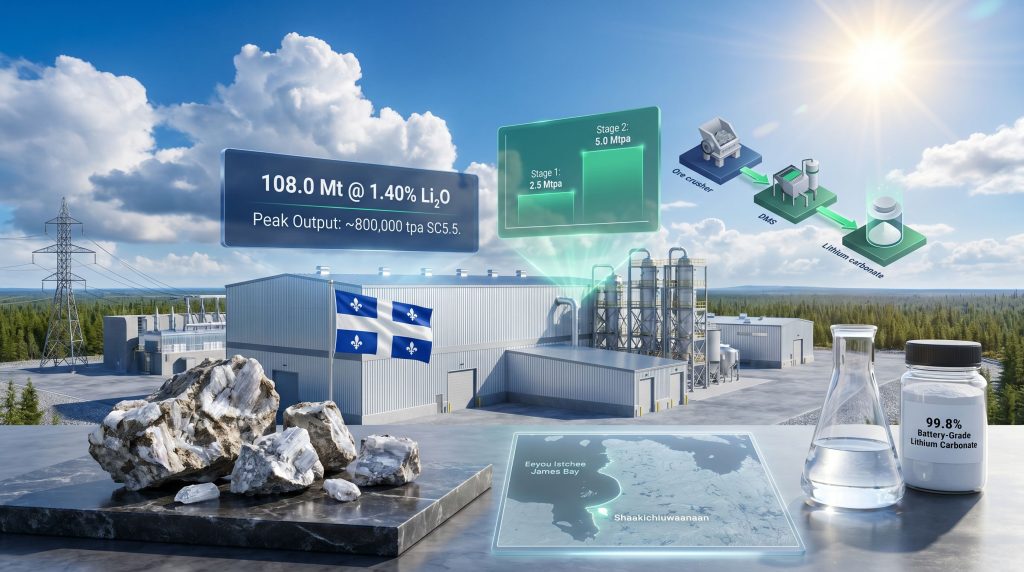
Situated in Québec's Eeyou Istchee James Bay region, the Shaakichiuwaanaan project sits within one of the most resource-dense lithium pegmatite corridors in the Western Hemisphere. The consolidated mineral resource stands at 108.0 Mt at 1.40% Li₂O (indicated) and 33.4 Mt at 1.33% Li₂O (inferred), with a maiden probable reserve of 84.3 Mt at 1.26% Li₂O established for the CV5 deposit alone.
These are not marginal numbers. In a global context where many advanced lithium projects are working with grades below 1.0% Li₂O, the consistent grade profile across Shaakichiuwaanaan's resource base is a geological differentiator. Higher grades translate directly into lower strip ratios, reduced ore processing volumes per tonne of product, and improved project economics at equivalent throughput.
PMET Resources holds 100% ownership of the project with no joint venture dilution, meaning the full economic benefit of any downstream value-add flows entirely to its shareholders.
The 2025 Prefeasibility Study Framework
The 2025 feasibility study confirmed the project is both technically feasible and economically viable for spodumene concentrate production. Core parameters include:
| Metric | Detail |
|---|---|
| Ore Throughput Capacity | Up to 5.1 Mtpa |
| Peak Annual Concentrate | Up to 800,000 tpa SC5.5 |
| Estimated Mine Life | ~20 years |
| Processing Route (Base Case) | DMS-only (no flotation) |
| Jurisdiction | Québec, Canada |
| Probable Reserve (CV5) | 84.3 Mt @ 1.26% Li₂O |
The project is designed around a phased development approach, beginning at approximately 2.5 Mtpa throughput producing roughly 400,000 tpa of concentrate in Stage 1, before scaling to full capacity in Stage 2. This capital-efficient structure reduces early commitment risk while establishing operational cash flow ahead of any downstream refining investment.
Why Dense Media Separation Matters Here
The selection of a DMS-only flowsheet deserves more attention than it typically receives in project announcements. Dense media separation works by exploiting the density differential between spodumene minerals and the surrounding gangue material, using a heavy liquid medium to achieve physical separation without chemical reagents.
For investors and project risk analysts, this matters for several reasons:
- DMS circuits are mechanically simpler than flotation plants, which require complex chemical dosing regimes and reagent management systems
- Reagent-free processing substantially reduces environmental compliance obligations and ongoing consumables costs
- Plant commissioning and ramp-up profiles for DMS operations are generally more predictable than flotation circuits
- The absence of chemical reagents simplifies site rehabilitation planning at end of mine life
The trade-off is that DMS alone typically cannot achieve the recovery rates that a combined DMS-flotation circuit might deliver on more complex ores. However, the high grade and relatively straightforward mineralogy of Shaakichiuwaanaan's pegmatite system makes DMS-only processing both technically appropriate and commercially sound.
The ALi Process: How Bench-Scale Results Reshape the Downstream Opportunity
Seven Flowsheets, One Clear Outcome
PMET conducted a rigorous structured evaluation of seven distinct processing flowsheet configurations before selecting a preferred pathway for further study. The evaluation framework weighted each option across four dimensions: economic potential, logistics efficiency, technical risk profile, and environmental footprint.
The outcome was decisive. Primero's proprietary ALi (Atmospheric Leach) process, developed by Primero as a subsidiary of ASX-listed NRW Holdings, emerged as the preferred pathway on all key criteria.
What the ALi Process Actually Does
Understanding why atmospheric pressure matters requires a brief look at conventional lithium refining chemistry. Most spodumene conversion to lithium carbonate involves a roasting step to convert alpha-spodumene into the more chemically reactive beta-spodumene phase, followed by an acid leach. Traditional high-pressure autoclave systems apply elevated temperatures and pressures to accelerate this conversion, but they introduce significant capital cost, safety complexity, and operational risk.
The ALi process achieves comparable chemical outcomes at atmospheric pressure, eliminating the need for pressure vessel infrastructure entirely. This is not merely an incremental improvement; it represents a fundamental simplification of the refining flowsheet that has material implications for the lithium carbonate supply dynamics across Western jurisdictions, including:
- Capital expenditure requirements for refining infrastructure
- Operational complexity and skilled labour requirements
- Insurance and regulatory compliance burden
- Construction timeline and commissioning risk
Bench-scale testwork conducted by Primero on actual Shaakichiuwaanaan spodumene concentrate samples produced lithium carbonate at 99.8% purity, meeting battery-grade specifications. This is a technically meaningful result because battery manufacturers typically require lithium carbonate at or above 99.5% purity for cathode active material synthesis.
The bench-scale purity result of 99.8% is not just a laboratory milestone. It is the threshold figure that determines whether a refinery's output can enter the cathode supply chain directly, without additional purification steps that would add cost and complexity.
The Electric Calcination Integration Angle
One of the less widely discussed dimensions of the concept study involves the potential integration of electric calcination technology into the processing flowsheet. Conventional spodumene calcination, the step that converts alpha to beta phase, is typically performed using gas-fired rotary kilns. In Québec, however, the provincial hydroelectric grid provides some of the lowest-cost and lowest-carbon electricity in North America.
Electrifying the calcination step using Québec's renewable power would accomplish two things simultaneously: it would reduce the carbon intensity of the refining process substantially, and it would decouple the project's energy costs from fossil fuel price volatility. For battery manufacturers operating under Scope 3 emissions reporting obligations, and increasingly subject to the EU Battery Regulation's carbon footprint declaration requirements being phased in through 2025 to 2027, sourcing lithium carbonate from a hydropower-electrified mine-gate refinery represents a genuine supply chain differentiator. Furthermore, advances in direct lithium extraction technology are reinforcing the case for processing innovation at the mine site level.
Breaking Down the Economics of Mine-Gate Refining
The Logistics Cost Arbitrage
The conventional supply chain model for hard-rock lithium carries costs that are rarely itemised in project economics discussions. Spodumene concentrate at SC5.5 grade contains roughly 5.5% Li₂O by weight, meaning that the majority of material being shipped internationally is essentially inert gangue oxide. When that concentrate is converted to lithium carbonate at the mine gate, the product weight per unit of contained lithium drops dramatically, and the value per tonne of shipped product increases sharply.
Shipping battery-grade lithium carbonate rather than spodumene concentrate therefore reduces freight volume, handling complexity, and insurance exposure simultaneously. PMET's COO Frederic Mercier-Langevin has indicated that the logistics savings from this model could be material to overall project economics, though full quantification awaits the next phase of economic modelling.
Optionality as a Risk Management Tool
A point that deserves emphasis for investors evaluating PMET's development strategy: on-site refining is explicitly structured as a staged, longer-term growth opportunity, not a prerequisite for the base spodumene concentrate project. This architectural decision is more sophisticated than it might initially appear.
By decoupling the refining investment decision from the mine development timeline, PMET Resources lithium processing in Québec preserves several layers of optionality:
- The base concentrate operation can achieve first production and cash flow generation independent of refining technology decisions
- The refining concept can be advanced through pre-feasibility and feasibility study phases while the mine is already operating
- The scale-up investment decision for refining infrastructure can be timed to match lithium carbonate market conditions
- If market conditions deteriorate, the company retains the flexibility to continue as a concentrate producer without stranded refining capital
This structure also means that the 99.8% purity bench-scale result functions primarily as an offtake negotiation credential at this stage, establishing technical credibility with potential battery manufacturer customers without requiring immediate capital commitment.
Québec's Competitive Position in the Western Lithium Landscape
Why Jurisdiction Quality Matters More Than It Used To
The lithium industry's previous tolerance for geopolitical supply chain exposure is eroding rapidly. Battery manufacturers in North America and Europe are under increasing regulatory and commercial pressure to demonstrate supply chain resilience and geographic diversification. Québec scores exceptionally well against the criteria that currently matter most to these buyers:
- Energy infrastructure: Hydro-Québec supplies electricity at rates among the lowest in North America, derived from a renewable hydroelectric base with minimal carbon intensity
- Regulatory stability: Québec operates a well-established mining regulatory framework with defined permitting pathways, reducing development timeline uncertainty
- Geographic proximity: Shaakichiuwaanaan's location in the James Bay region positions it well for both North American and transatlantic European supply chain integration
- Indigenous governance: The project operates within the Eeyou Istchee James Bay regional governance structure, providing a framework for meaningful Indigenous participation in project development
Canada's Broader Critical Minerals Policy Environment
Canada has articulated lithium as a priority material under its critical minerals strategy, which identifies domestic processing and refining as key policy objectives. Québec's provincial government has similarly designated lithium as a priority sector under its Plan québécois pour la valorisation des minéraux critiques et stratégiques.
These policy frameworks create a regulatory environment that is broadly supportive of integrated mine-to-refinery projects, though it bears noting that PMET has not announced any specific government funding, grants, or project designations in connection with the concept study results. Policy alignment and project-specific support are distinct categories, and investors should distinguish between the two when assessing development risk.
Key Risks Worth Understanding Before Drawing Conclusions
The concept study results are genuinely significant, but several risk factors warrant careful consideration:
- Lithium price sensitivity: Battery-grade lithium carbonate pricing has been extremely volatile since 2022. The economic case for on-site refining is sensitive to the assumed price spread between concentrate and carbonate, which can compress sharply during a lithium market downturn
- Technology scale-up execution: Bench-scale results and commercial-scale performance are separated by multiple development stages. Moving from laboratory testwork to a functioning industrial refinery introduces process engineering, materials handling, and operational complexity that bench results cannot fully capture
- Permitting scope expansion: Adding chemical production infrastructure to a mining and concentrate operation materially expands the regulatory footprint and may introduce environmental assessment requirements beyond those applicable to the base project
- Capital stack complexity: Financing a combined mine, concentrator, and refinery will require a more sophisticated capital structure than a concentrate-only project, with additional execution risk at each stage
Investors should treat the concept study as technical validation of a potential value-add pathway, not as confirmation of a committed development plan. The economic case for on-site refining will be tested through pre-feasibility and feasibility work before capital decisions are made.
The next major ASX story will hit our subscribers first
The Broader Template: What Mine-Gate Refining Signals for the Industry
PMET CEO and MD Ken Brinsden has described the conventional model of extracting lithium in one jurisdiction and refining it overseas as a supply chain solution that the industry has accepted by default rather than design. The concept study work at Shaakichiuwaanaan presents a technically validated alternative framework, one where battery-grade lithium carbonate is produced at the mine gate in a politically stable, low-carbon Western jurisdiction.
If the economics hold through pre-feasibility analysis, PMET Resources lithium processing in Québec would represent something more significant than a single project development decision. It would establish a replicable model for other hard-rock lithium developers in Canada and Australia who are evaluating similar downstream integration strategies. The combination of atmospheric pressure processing technology, renewable energy electrification of calcination, and mine-gate value capture addresses the three principal barriers that have historically kept Western lithium projects in the concentrate business: processing cost, carbon footprint, and capital intensity.
Whether that potential is ultimately realised depends on lithium market conditions, technology scale-up execution, and financing outcomes that remain to be determined. However, the bench-scale foundation has been established, and the case for rethinking the hard-rock lithium supply chain architecture is now technically grounded in a way it was not before.
Readers seeking broader context on Canadian critical minerals policy and lithium supply chain development can explore related coverage at Mining Weekly, which tracks ongoing developments across the global lithium sector. This article contains forward-looking statements and analysis based on publicly available information. It does not constitute financial advice. Investors should conduct independent due diligence before making investment decisions.
Want to Capitalise on the Next Major Lithium Discovery Before the Market Does?
Discovery Alert's proprietary Discovery IQ model scans ASX announcements in real time, instantly identifying significant mineral discoveries — including lithium — and delivering actionable insights to subscribers ahead of the broader market. Explore why major mineral discoveries have historically generated exceptional returns and begin your 14-day free trial at Discovery Alert to position yourself at the forefront of the next major find.