
July 28, 2026
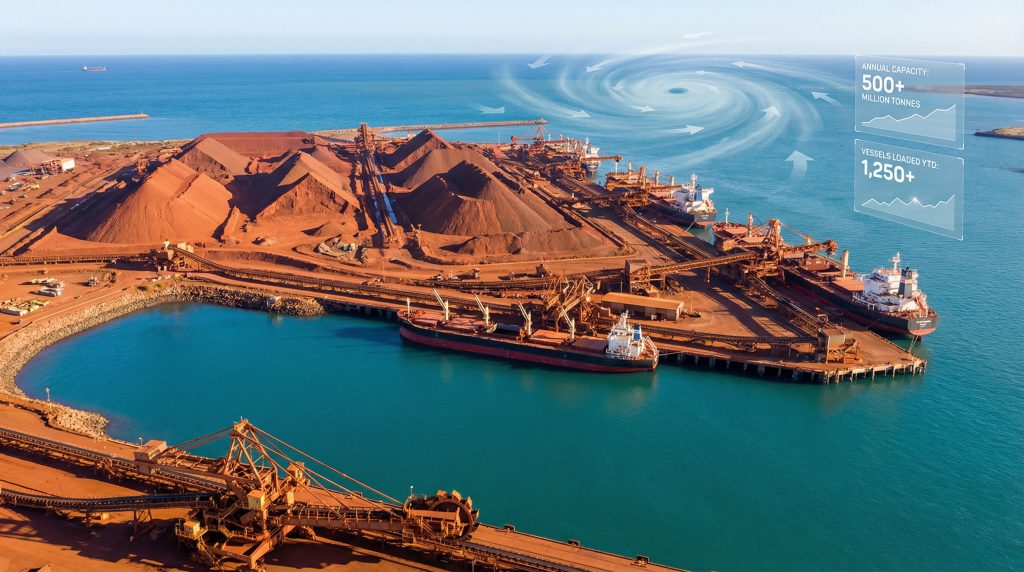
The interconnected nature of modern commodity supply chains creates cascading vulnerabilities that extend far beyond individual production facilities. When weather systems threaten critical infrastructure nodes, the ripple effects propagate through global markets with mathematical precision, revealing the delicate balance between geographic concentration and economic efficiency. Understanding these dependencies becomes essential for investors, policymakers, and industry participants navigating an increasingly volatile resource landscape, particularly when considering iron ore price trends that influence global market dynamics.
Port Hedland's Dominance in Global Iron Ore Distribution
Port Hedland operates as the world's largest single-point iron ore export terminal, processing approximately 500 million tonnes annually according to Pilbara Ports Authority capacity assessments. This massive throughput represents roughly 20-23% of global seaborne iron ore trade, creating a concentration risk that reverberates throughout international steel production networks.
The port's infrastructure encompasses eight specialized berths designed for Capesize and Panamax vessels, with maximum vessel capacity reaching 200,000 deadweight tonnage. During optimal conditions, vessel turnaround times average 24-36 hours, though this efficiency becomes vulnerable during weather events when Port Hedland cyclone evacuation protocols take precedence over operational continuity.
Global Supply Chain Dependencies
Major steel-producing nations maintain significant reliance on Australian iron ore exports through Port Hedland. China's steel mills consume approximately 60-65% of Port Hedland's annual throughput, while Japan, South Korea, and India collectively account for an additional 25-30%. This geographic concentration means that supply disruptions at Port Hedland create immediate price pressures across multiple national economies.
The Pilbara mining district contains documented reserves exceeding 50 billion tonnes of mineable iron ore, according to U.S. Geological Survey assessments. Furthermore, the region hosts some of the largest iron ore mines globally, including BHP's Newman and Yandi complexes, Rio Tinto's Paraburdoo facilities, and Fortescue's Christmas Creek operations.
These operations collectively produce over 400 million tonnes annually, with rail networks spanning 1,700 kilometers connecting mine sites to port facilities. The infrastructure integration creates systemic vulnerabilities that extend beyond individual weather events.
Infrastructure Vulnerability Analysis
The integration between mining operations and port facilities creates systemic vulnerabilities that extend beyond individual weather events. Onshore stockpile capacity totals approximately 44 million tonnes across multiple locations, though this inventory becomes exposed during cyclone events when wind dispersion and water contamination risks compromise stored materials.
Alternative global iron ore supply routes lack sufficient capacity to compensate for extended Port Hedland closures. Brazilian ports including Tubarao and Itaqui maintain combined capacity of approximately 300 million tonnes annually, while South African facilities at Saldanha Bay process roughly 80 million tonnes.
However, these alternative sources cannot rapidly scale production to offset Australian supply disruptions. This limitation becomes particularly evident given different ore grade specifications required by steel mills across various markets.
When big ASX news breaks, our subscribers know first
Emergency Evacuation Protocols and Market Response Mechanisms
The Pilbara Ports Authority's Stage 3 "Clear Port" protocol establishes stringent evacuation timelines that prioritise safety over operational continuity. When tropical cyclone warnings reach Category 3 intensity, all vessels must depart port facilities within 12-18 hours, regardless of cargo loading status or commercial considerations.
During such events, the Department for Fire and Emergency Services WA provides critical coordination and updates for emergency response protocols across the region.
Vessel Evacuation Operational Requirements
Large Capesize vessels (150,000-200,000 deadweight tonnes) require approximately 8-12 hours to travel from inner anchorage positions to safe offshore distances exceeding 150 nautical miles. Smaller Panamax vessels (65,000-100,000 deadweight tonnes) complete evacuation procedures within 5-8 hours.
Both vessel categories must commence departure when sustained winds are forecast to exceed 40 knots. Typical evacuation scenarios involve 15-25 vessels in various loading or anchorage positions.
The protocol mandates departure initiation before wind speeds reach 63 knots (cyclone-force conditions). Consequently, this provides safety buffers that often require evacuation during Category 2 intensity forecasts rather than waiting for Category 3 confirmation.
Commodity Market Volatility Patterns
Iron ore futures on Singapore Exchange (SIORFEX) demonstrate consistent response patterns during Port Hedland cyclone evacuation announcements. Historical data spanning 2015-2023 reveals immediate 2-5% price increases within 1-2 trading hours following evacuation notifications, with volatility magnitude correlating to forecasted closure duration.
These patterns reflect broader commodities market volatility trends that affect global trading strategies. Unplanned 48-hour closures generate average price increases of 3.2%, while extended multi-week disruptions (rare but documented) have produced price spikes reaching 8-12%.
The market efficiency in processing these disruptions reflects the transparency of Pilbara Ports Authority warning systems. This allows rapid price discovery rather than sustained market distortions.
Trading Volume and Hedging Activity
During evacuation announcements, iron ore futures trading volume increases by 200-400% above baseline levels as multiple market participants execute simultaneous hedging strategies. Mining companies implement protective put options, shipping firms adjust charter rate exposure, and steel mills activate procurement contingency plans.
Implied volatility of iron ore options typically increases 30-60% during the 12-24 hour period following major closure announcements. Near-term delivery contracts (March, May, June) show greater sensitivity than forward contracts (9-12 month delivery periods) due to immediate supply impact concerns.
Multi-Port Closure Economic Impact Assessment
Recent cyclone threats have demonstrated the potential for simultaneous closure of multiple Western Australian port facilities. This amplifies economic disruption beyond Port Hedland's iron ore operations significantly.
ABC News reports on Tropical Cyclone Mitchell highlighted the February 2026 cyclone warning that resulted in coordinated evacuation orders across five major facilities in the Pilbara region.
| Port Facility | Primary Commodities | Annual Capacity | Strategic Importance |
|---|---|---|---|
| Port Hedland | Iron Ore | 500+ million tonnes | Global export hub |
| Dampier | LNG, Salt | 30+ million tonnes | Energy exports |
| Cape Preston West | Iron Ore | 25 million tonnes | Secondary iron ore hub |
| Ashburton | Oil, Gas | Variable capacity | Energy logistics |
| Varanus Island | Natural Gas | Processing facility | Domestic gas supply |
Cascading Economic Effects
Simultaneous port closures create compounding effects that exceed the sum of individual facility disruptions. Steel mill production scheduling in Asia experiences immediate adjustment requirements, with procurement departments activating force majeure clauses and adjusting delivery timelines.
Shipping route diversions increase freight costs by 15-25% as vessels seek alternative destinations or extended waiting periods. Insurance claim implications extend beyond direct cargo delays to include business interruption coverage for mining companies.
Furthermore, demurrage costs for shipping operators and supply chain disruption insurance for steel manufacturers add complexity. The intricacy of multi-port closures often triggers contract renegotiation discussions between mining companies and long-term steel mill customers.
Regional Economic Disruption Analysis
The Pilbara region's economic concentration creates vulnerabilities extending beyond commodity exports. Local workforce evacuation affects approximately 45,000 mining industry employees across the region, with evacuation costs estimated at AUD 8-12 million per 48-hour event.
Essential services maintenance during emergencies requires coordination between state emergency services, mining company security teams, and federal emergency management agencies. Infrastructure interdependencies become critical during multi-facility closures.
Rail networks connecting mine sites to ports face flood risk assessments, while power grid stability requires backup generation systems during extended weather events. Recovery timeline estimation for full operations resumption typically ranges from 36-72 hours post-cyclone passage, depending on infrastructure damage assessment results.
Weather Forecasting Integration and Risk Management
Modern commodity risk management increasingly relies on sophisticated meteorological intelligence systems that provide advance warning of potential supply disruptions. The Australian Bureau of Meteorology operates specialised tropical cyclone prediction models with 48-96 hour accuracy for intensity forecasting.
However, rapid intensification events can compress warning timelines significantly. This creates challenges for Port Hedland cyclone evacuation planning and execution across multiple stakeholders.
Corporate Risk Mitigation Strategies
Mining companies maintain comprehensive weather contingency protocols that activate automatically when cyclone development probabilities exceed defined thresholds. Production scheduling flexibility allows temporary stockpile adjustments, while shipping schedule buffers provide accommodation for vessel evacuation requirements without disrupting long-term delivery commitments.
Force majeure clause activation in supply contracts typically requires specific weather intensity thresholds rather than general disruption notifications. These contractual provisions allow mining companies to suspend delivery obligations during Category 3+ cyclone events affecting port facilities.
In addition, this provides legal protection while maintaining customer relationships throughout disruption periods.
Advanced Warning Systems
Satellite tracking technology enables real-time monitoring of cyclone development with 6-hour update intervals, allowing port operators to initiate preparatory measures before formal evacuation orders. Intensity forecasting models incorporate sea surface temperature data, atmospheric pressure gradients, and wind shear analysis to predict cyclone strengthening patterns.
Corporate risk management departments utilise probabilistic weather forecasting that provides percentage likelihood estimates for various cyclone scenarios rather than binary predictions. This approach enables graduated response protocols where mining companies adjust production schedules based on 30%, 50%, or 70% probability thresholds for port closures.
Alternative Supply Chain Scenarios During Disruptions
When Port Hedland faces closure threats, global iron ore markets activate alternative supply mechanisms that reveal both competitive dynamics and structural limitations. Other Australian ports including Geraldton, Esperance, and Newcastle maintain limited iron ore capacity totaling approximately 50-60 million tonnes annually.
This capacity remains insufficient to replace Port Hedland's 500 million tonne throughput during disruption periods. The iron ore demand insights analysis reveals how these supply constraints affect global market dynamics.
Competitive Port Advantage Analysis
International iron ore suppliers experience temporary market share gains during Australian port disruptions. Brazilian mining companies including Vale and CSN can increase production scheduling flexibility by 10-15% for 30-60 day periods.
However, transportation lead times from South America to Asian steel mills add 15-20 days compared to Australian supply routes. Strategic inventory management by major steel producers becomes critical during supply disruption periods.
Chinese steel mills maintain 30-45 day iron ore inventory reserves, while Japanese integrated steel producers typically hold 45-60 day reserves. These inventory buffers provide operational continuity during short-term Australian supply interruptions but cannot accommodate extended disruptions exceeding 8-12 weeks.
Long-term Strategic Implications
Infrastructure resilience investment priorities increasingly focus on weather-hardened facilities and redundant capacity development. The mining industry evolution includes climate adaptation strategies for mining regions involving elevated stockpile areas, reinforced port infrastructure, and enhanced drainage systems.
These systems are designed to maintain operations during Category 2-3 cyclone conditions. Supply chain diversification trends among major steel producers involve increased procurement from multiple geographic sources rather than concentration in single regions.
This diversification strategy reduces exposure to weather-related supply disruptions while potentially increasing overall procurement costs by 3-8%. The increase results from higher transportation expenses and ore grade blending requirements.
Investment Implications and Market Psychology
Weather-related mining disruptions create distinct investment patterns that reveal market psychology and pricing inefficiencies. Historical cyclone impact duration on commodity prices typically follows predictable patterns.
These include immediate 2-5% price increases during evacuation announcements, price stabilisation within 24-48 hours if no actual damage occurs, and gradual normalisation over 5-10 trading days as operations resume.
Market Timing and Volatility Analysis
Recovery timeline patterns for port operations provide investment opportunities for sophisticated market participants. Options market activity during weather events often creates temporary premium expansion that reverses rapidly once evacuation periods conclude.
Put option premiums on iron ore futures increase 40-80% during evacuation periods, subsequently declining 20-30% within 48 hours of resumed operations. Seasonal weather risk pricing in mining equity valuations demonstrates market efficiency in incorporating cyclone probability.
Australian mining stocks typically trade at 2-4% discounts to fundamental valuations during November through April cyclone seasons. This discount narrows during May through October periods when weather risks diminish considerably.
Strategic Investment Considerations
Infrastructure resilience evaluation becomes increasingly important for mining company investment analysis. Companies with diversified port access, enhanced weather monitoring systems, and robust evacuation protocols maintain premium valuations of 5-12% compared to operators with single-port dependencies.
Climate risk assessment methodologies now incorporate probabilistic cyclone modeling that estimates expected annual disruption costs. These models base calculations on historical weather patterns and infrastructure vulnerability assessments.
The models suggest that climate adaptation investments of AUD 200-400 million across Pilbara port facilities could reduce expected annual disruption costs by 15-25%.
The next major ASX story will hit our subscribers first
Systemic Risk Assessment and Future Preparedness
The concentration of global iron ore exports through Port Hedland represents a single-point-of-failure vulnerability that extends beyond individual weather events to encompass broader systemic risks. Geographic concentration in the Pilbara region creates interdependencies between mining operations, port facilities, rail networks, and power infrastructure.
These interdependencies amplify disruption impacts during Port Hedland cyclone evacuation events across the broader supply chain ecosystem.
Emergency Coordination Effectiveness
Multi-agency coordination during cyclone events involves federal emergency management, state government agencies, local authorities, and private mining companies. The effectiveness of these coordination mechanisms determines both evacuation success and recovery timeline efficiency.
Recent assessments indicate that information sharing protocols and decision-making hierarchies require standardisation to optimise emergency response. International supply chain cooperation agreements between Australian mining companies and Asian steel producers increasingly include weather contingency provisions.
These agreements establish alternative supply arrangements during extended disruption periods. Consequently, they provide supply security for steel mills while offering revenue protection for mining companies during force majeure events.
Future Enhancement Opportunities
Advanced weather prediction technology integration offers potential for extended warning periods that could reduce evacuation urgency while maintaining safety standards. Machine learning algorithms applied to satellite data, ocean temperature monitoring, and atmospheric modeling may extend accurate cyclone forecasting.
The extension could increase forecasting accuracy from 48-72 hours to 96-120 hours, providing additional operational flexibility. Redundant infrastructure development priorities include alternative port capacity, enhanced rail connectivity, and weather-resistant stockpile facilities.
Cost-benefit analysis suggests that AUD 1.5-2.5 billion in infrastructure investments could reduce expected annual weather disruption costs by 30-40%. In addition, this would provide capacity for production growth across the region.
Strategic Lessons for Commodity Market Participants
The analysis of Port Hedland cyclone evacuation protocols reveals fundamental insights about global commodity market structure and risk management requirements. Weather event impact quantification requires sophisticated modeling that incorporates meteorological probability, infrastructure vulnerability, and market response patterns to develop accurate disruption cost estimates.
Supply disruption duration forecasting depends on multiple variables including cyclone intensity, infrastructure damage assessment capabilities, and recovery resource availability. Historical data analysis indicates that 95% of weather-related port closures resolve within 72 hours.
However, 5% of events extend beyond one week due to infrastructure damage or persistent weather conditions. Risk premium calculations for weather-exposed commodities require dynamic modeling that adjusts for seasonal probability changes, infrastructure improvements, and alternative supply availability.
These calculations suggest that iron ore price premiums of 1-3% during cyclone seasons reflect appropriate compensation for supply disruption risks.
Forward-Looking Strategic Considerations
Climate change adaptation requirements for mining infrastructure will likely necessitate increased investment in weather-resistant facilities, advanced monitoring systems, and emergency response capabilities. Regulatory frameworks may evolve to mandate minimum resilience standards for critical infrastructure.
This could potentially increase operational costs but reduce systemic vulnerability across the sector. Global supply chain resilience building priorities include geographic diversification, inventory optimisation, and contract flexibility enhancement.
Market participants who develop comprehensive weather risk management strategies will likely achieve competitive advantages through reduced volatility exposure and improved operational continuity during disruption periods.
Investment Disclaimer: Weather-related supply disruptions involve inherent uncertainty and forecasting limitations. Market volatility during cyclone events can exceed historical patterns, and infrastructure damage may create extended disruption periods beyond typical recovery timelines. Investment decisions should incorporate comprehensive risk assessment and diversification strategies appropriate for individual risk tolerance and market exposure objectives.
Concerned About Weather Risks Affecting Your Mining Investments?
Discovery Alert's proprietary Discovery IQ model provides instant notifications when significant mineral discoveries emerge from ASX companies, helping you identify opportunities that could benefit from supply disruptions and infrastructure resilience investments. Stay ahead of market volatility by accessing real-time intelligence on mining discoveries across all commodities, turning complex market conditions into actionable investment insights through your 14-day free trial.