May 20, 2026
When a Smelter Becomes a City's Heartbeat: The Port Pirie Nyrstar Story
Regional industrial economies operate on a logic that is fundamentally different from metropolitan ones. In large cities, economic resilience comes from diversity: dozens of industries, hundreds of employers, and millions of consumers creating a self-reinforcing web of activity. In single-industry regional towns, however, that resilience collapses into a single point of failure. When the anchor employer faces uncertainty, the entire local economy holds its breath simultaneously.
This is the structural reality confronting Port Pirie, South Australia, in 2026. The question of whether the Port Pirie Nyrstar smelter closure proceeds is not simply an industrial relations story or a government budget debate. It is a question about whether a city of roughly 13,000 people continues to function as an economically viable community, or begins the slow demographic decline that has claimed comparable regional centres across Australia's industrial history.
When big ASX news breaks, our subscribers know first
The Nyrstar Port Pirie Facility: More Than a Lead Smelter
To understand why the Port Pirie Nyrstar smelter closure debate carries such weight, it helps to understand what the facility actually does and why its output profile makes it genuinely distinctive.
Unlike single-commodity processing operations that handle one metal stream, the Port Pirie facility operates as a multi-metal processing hub, handling lead, silver, zinc fume, copper matte, and sulphuric acid simultaneously. This diversified output is significant from both a commercial and a strategic standpoint. Each metal stream creates a separate revenue line, a separate set of market relationships, and a separate category of downstream customer dependency.
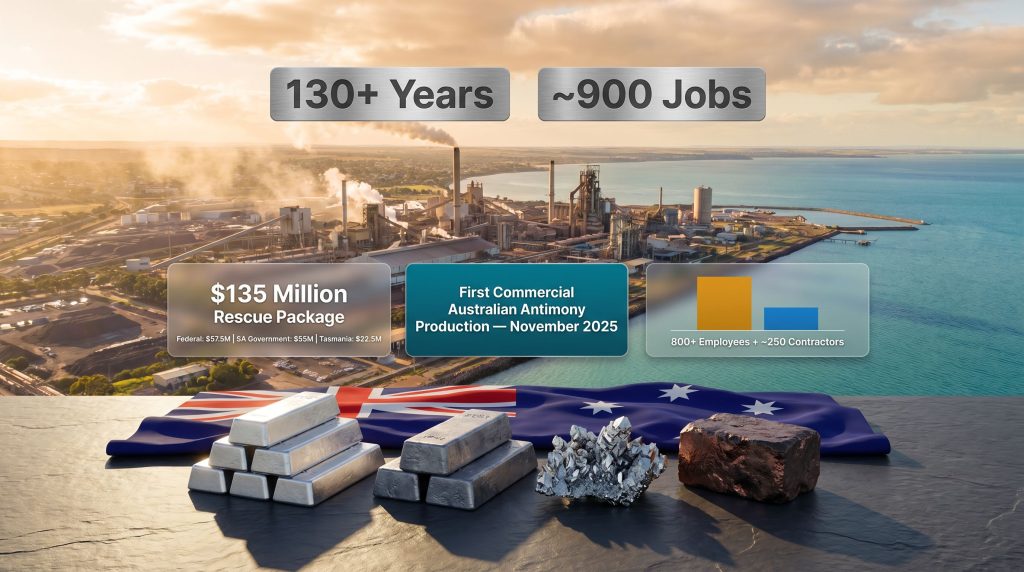
The facility has maintained continuous operation for over 130 years, a tenure that reflects its deep integration into Australian industrial supply chains rather than simply a legacy of inertia. With more than 800 direct Nyrstar employees and approximately 250 contractors, the smelter supports roughly 900 positions in total, according to reporting by ABC News.
Port Pirie Mayor Leon Stephens has described the smelter as the lifeblood of Port Pirie, noting that even relatively minor operational disruptions reverberate through the entire community. That framing reflects an economic reality: when a single employer accounts for such a large share of local payroll, its financial health becomes indistinguishable from the town's financial health.
The Financial Pressure Behind the Port Pirie Nyrstar Smelter Closure Debate
The Port Pirie Nyrstar smelter closure conversation intensified significantly through 2025 and into 2026 as structural pressures in global base metals markets deepened. Western smelting operations face a fundamental cost disadvantage against heavily capitalised Asian processing facilities, particularly those operating under state support structures that enable below-market pricing of energy and processing services.
Lead and zinc processing margins have compressed substantially over the past decade as Chinese refining capacity expanded far beyond domestic consumption needs. Furthermore, this surplus processing capacity has been redirected toward export markets at prices that legacy Western operations cannot match without external support. This dynamic is not unique to Port Pirie — it reflects a global restructuring of base metals processing toward lower-cost jurisdictions, leaving facilities in Australia, Europe, and North America caught between rising operational costs and declining market returns.
For Port Pirie specifically, the result has been chronic monthly losses that eroded the commercial case for continued private investment without some form of structural intervention. These smelter bailout pressures are increasingly familiar across Australia's industrial landscape.
The $135 Million Government Rescue Package
In August 2025, three levels of government committed a combined $135 million to sustain Nyrstar's Port Pirie and Hobart operations through a period of financial distress. The package breakdown was as follows:
| Funding Contributor | Amount Committed |
|---|---|
| Federal Government | $57.5 million |
| South Australian Government | $55 million |
| Tasmanian Government | $22.5 million |
| Total Package | $135 million |
The package was structured as a bridge arrangement, providing short-term operational continuity rather than addressing the underlying structural economics of running competitive smelting operations in a high-cost Western economy. That distinction matters enormously for assessing what comes next.
The Funding Cliff: What Happened on 1 May 2026
The $135 million assistance package expired on 1 May 2026, as confirmed by ABC News. At that point, negotiations between Nyrstar, the South Australian Government, the Tasmanian Government, and the Federal Government were continuing, but no successor arrangement had been confirmed.
This created an immediate vacuum of certainty for roughly 900 workers, hundreds of regional supply businesses, and an entire community that had been watching the clock for months. The absence of a confirmed deal at the expiry date did not mean the smelter ceased operating immediately. Operational facilities do not switch off overnight. However, the lack of a confirmed replacement arrangement triggered the kind of community anxiety that begins to cause real economic damage well before any formal closure decision is made.
"When funding uncertainty persists in a single-industry town, secondary economic damage begins accumulating immediately. Businesses reduce orders, workers start exploring other options, and population outflows begin — all before any official announcement is made. The psychological cost of prolonged uncertainty is not abstract; it shows up in retail turnover, school enrolments, and property values."
Mayor Stephens expressed frustration with the pace of negotiations, noting that he believed the four parties should have reached a more advanced position before the package expired. His view was that the community deserved clarity — whether the answer was positive or negative — so that residents and businesses could plan accordingly.
A Community That Has Seen This Before
What makes the May 2026 funding cliff particularly difficult for Port Pirie is that it does not feel like a new crisis. It feels like a recurring one. The community has experienced multiple cycles of financial pressure at the smelter, each followed by government intervention, each generating the same pattern of anxiety, partial resolution, and continued underlying structural uncertainty.
Mayor Stephens captured this sentiment precisely when he described how many residents would react to the funding expiry news: with a sense of déjà vu. He expressed disappointment that negotiations had not progressed further before the package lapsed, suggesting that the repeated nature of these episodes carries its own cumulative cost beyond the immediate financial stakes.
That cumulative cost is real. Each crisis cycle that does not result in permanent resolution erodes long-term workforce confidence, discourages business investment in the region, and accelerates the rate at which skilled workers begin assessing their options elsewhere. Consequently, the damage from uncertainty is not linear — it compounds.
How Smelter Uncertainty Flows Through a Regional Economy
Understanding the true economic exposure of the Port Pirie Nyrstar smelter closure risk requires looking beyond the 900 directly associated positions and examining how the facility functions as the economic foundation for a far larger network of regional activity.
The Supplier and Services Multiplier Effect
Danny Bartlett, managing director of Eyre Trading — an industrial supply company headquartered in Port Lincoln with operations in Port Pirie, Whyalla, and Adelaide — provided one of the most concrete illustrations of downstream vulnerability available from the current reporting period. Nyrstar is described as the single largest customer for Eyre Trading's operations, and Bartlett confirmed that a cessation of smelter activity would force a reassessment of the company's Port Pirie footprint, with direct employment consequences for the five people currently working at the Port Pirie store.
Eyre Trading represents only one supplier in what is almost certainly a much larger ecosystem of regional businesses dependent on Nyrstar procurement activity. Industrial maintenance suppliers, chemical distributors, engineering services firms, logistics operators, and transport companies all structure elements of their regional operations around the predictable procurement cycle of a large continuous-process facility.
When that anchor procurement activity disappears or becomes uncertain, furthermore, the ripple effects extend well beyond direct supply relationships into retail, hospitality, professional services, and the broader consumer economy of Port Pirie.
What Regional Economic Collapse Actually Looks Like
The phrase "ghost town" appears in prior ABC News coverage of the Port Pirie smelter situation, reflecting community fears that have been documented as far back as March 2025. Those fears are not unfounded when examined against the history of comparable Australian regional centres that lost their primary industrial employer.
The pattern typically unfolds in stages:
- Announcement or uncertainty phase: Workers begin contingency planning, some resign proactively, businesses reduce inventory orders
- Confirmation phase: Formal closure or operational wind-down announced, triggering accelerated workforce departure
- Population outmigration: Families relocate to seek employment elsewhere, school enrolments fall, housing demand collapses
- Municipal revenue contraction: Rate base shrinks, reducing council capacity to maintain services, accelerating further population decline
- Services withdrawal: Banks, retailers, medical services, and professional firms reduce their regional presence in response to the smaller customer base
Economic modelling applied to comparable regional closure scenarios suggests retail turnover contractions of 15 to 25 percent within 12 to 24 months of a major employer exit, with population outmigration beginning within the same timeframe. These are not theoretical projections — they reflect documented outcomes from post-industrial regional transitions in Australia and internationally.
The Critical Minerals Dimension: Why Port Pirie Is More Than a Legacy Smelter
Perhaps the most strategically significant development in the Port Pirie Nyrstar story occurred in November 2025, when the facility produced Australia's first commercial antimony metal through a newly commissioned pilot plant.
This milestone reframes the entire conversation about the Port Pirie Nyrstar smelter closure risk in ways that have not yet been fully absorbed into public debate.
Why Antimony Changes the Strategic Calculation
Antimony critical mineral classifications reflect its essential role in defence applications, flame retardants, semiconductor manufacturing, and emerging battery technologies. Global antimony supply is heavily concentrated, with China controlling the dominant share of both mining and processing capacity.
Australia's production of commercial antimony metal at Port Pirie represents a genuine strategic capability, not merely an incremental product line addition. In an environment where supply chain sovereignty has become a central concern for both industrial policy and national security planning, the ability to produce critical minerals domestically carries strategic weight that extends well beyond the commercial metrics that drove the original funding discussions. Indeed, antimony supply risks have become a pressing concern for defence planners and policymakers alike.
This means the case for sustaining the Port Pirie facility is no longer solely about preserving legacy base metals processing capacity. It now encompasses the question of whether Australia can maintain and develop onshore critical minerals supply chains at a moment when allied nations are actively competing to reduce their dependence on Chinese-controlled supply chains.
Australia's Broader Smelting Capacity at Risk
The Port Pirie situation does not exist in isolation. It is part of a broader pattern in which Western nations are confronting the consequences of decades of industrial policy that allowed domestic smelting and refining capacity to atrophy in favour of cheaper offshore processing. The critical minerals demand surge only intensifies the urgency of preserving these capabilities.
If Australia loses its onshore multi-metal processing capability, rebuilding it would require capital investment of a scale and timeline that makes the current government assistance package look modest by comparison. The infrastructure, workforce expertise, and established supply chain relationships embedded in the Port Pirie facility represent accumulated industrial capital that cannot be quickly or cheaply recreated once lost.
The next major ASX story will hit our subscribers first
The Labour Relations Complication
Adding complexity to an already difficult negotiating environment, approximately 50 Nyrstar workers voted in late 2025 in support of potential industrial action over enterprise bargaining disputes. The timing created an awkward political dynamic, occurring shortly after the $135 million rescue package was announced and raising questions about the relationship between public financial support and workplace stability.
Enterprise bargaining disputes in facilities receiving government support create particular difficulties for all parties involved. Governments providing public funds face legitimate questions from taxpayers about whether those funds are stabilising operations or subsidising industrial conflict. Management teams operating under financial pressure face union demands that may be commercially incompatible with the cost structures that made government support necessary. Workers, in addition, face the difficult calculus of pursuing legitimate wage claims within an environment where the facility's viability itself is in question.
No formal strike action had commenced as of the most recent reporting period, but the existence of these tensions adds another variable to an already complicated four-party negotiation.
Three Scenarios for the Port Pirie Nyrstar Smelter
As of May 2026, three broad pathways exist for the facility, each with substantially different implications for the community and the wider Australian industrial landscape.
Scenario 1: A New Funding Agreement Is Reached
If negotiations between Nyrstar and the three government parties produce a successor arrangement, the immediate crisis is resolved. However, a new funding package that simply replicates the bridge structure of the August 2025 agreement would only defer rather than resolve the underlying structural problem. Any durable arrangement would likely need to incorporate elements such as:
- Operational performance benchmarks tied to continued funding eligibility
- Environmental compliance milestones reflecting South Australia's regulatory requirements
- Workforce commitment obligations to protect against post-funding restructuring
- Critical minerals processing targets that justify public investment on strategic grounds beyond simple job preservation
The antimony production capability provides a framework for repositioning the public investment case: rather than subsidising a struggling legacy smelter, governments would be investing in a domestic critical minerals processing asset with national security dimensions.
Scenario 2: Negotiations Collapse and Operations Wind Down
A failure to reach a new arrangement would trigger consequences that extend well beyond Port Pirie's borders. Immediate workforce displacement of approximately 900 direct positions would be followed by the cascading supply chain contraction described earlier. Federal and state governments would face obligations under regional adjustment frameworks, and the long-term remediation responsibilities for a 130-year-old industrial site would represent a substantial ongoing cost regardless of the facility's operational status.
Critically, this scenario would represent a permanent loss of Australia's domestic multi-metal processing capability, with implications for supply chain resilience that would not become fully apparent until a future crisis made the absence of that capacity painfully visible.
Scenario 3: Restructuring or Ownership Transition
A third pathway involves some form of asset sale, restructuring, or partial operational continuity under new ownership arrangements. The critical minerals processing capabilities demonstrated at Port Pirie — particularly the antimony pilot plant — may attract interest from strategic investors focused on supply chain sovereignty assets rather than traditional base metals economics.
Internationally, critical minerals processing assets have attracted sovereign wealth fund interest and strategic corporate investment in recent years as the geopolitical dimensions of supply chain control have become more explicit. Whether such interest materialises for Port Pirie would depend on factors including the commercial terms of any transition, the regulatory environment, and the assessed long-term viability of the facility under reformed operations.
Key Metrics at a Glance
| Metric | Detail |
|---|---|
| Years of continuous operation | 130+ years |
| Direct Nyrstar workforce | 800+ employees |
| Contractor workforce | ~250 personnel |
| Total at-risk positions | ~900 jobs |
| 2025 rescue package total | $135 million |
| Federal contribution | $57.5 million |
| SA Government contribution | $55 million |
| Tasmanian Government contribution | $22.5 million |
| Package expiry date | 1 May 2026 |
| Metals processed | Lead, silver, zinc fume, copper matte, sulphuric acid |
| Critical minerals milestone | First commercial Australian antimony production (November 2025) |
The Policy Dilemma That Port Pirie Crystallises
The Port Pirie Nyrstar situation sits at the intersection of several competing policy priorities that do not resolve neatly.
Arguments for sustained government support centre on workforce preservation, regional economic stability, critical minerals processing sovereignty, and the long-term cost of losing industrial capabilities that are expensive and slow to rebuild. Arguments against focus on the risk of creating indefinite subsidy dependency, the opportunity cost of capital that could be directed toward emerging industries, and the fundamental question of whether market-unviable facilities should be kept alive through public funding regardless of their strategic characteristics.
How comparable economies have navigated this tension varies considerably. Canada has used long-term offtake agreements and co-investment structures to support smelting operations with strategic dimensions. Germany, furthermore, has incorporated legacy industrial facilities into broader regional transition frameworks that pair industrial support with workforce retraining investment. Japan has used strategic stockpiling arrangements to provide commercial foundations for domestic processing capacity without ongoing operational subsidies.
None of these models maps perfectly onto Port Pirie's circumstances, but each offers elements that could contribute to a durable framework. What seems clear is that a simple renewal of the bridge funding arrangement — without structural reform of the commercial foundations underpinning the facility's operations — would only delay the next funding cliff rather than prevent it.
Frequently Asked Questions
Has the Port Pirie Nyrstar smelter closed?
As of May 2026, the smelter remains operational. The facility faces ongoing financial uncertainty following the expiry of the $135 million government assistance package, with negotiations for a successor arrangement continuing between Nyrstar and the federal, South Australian, and Tasmanian governments. No closure has been confirmed.
How many jobs are at risk if the smelter closes?
Approximately 900 positions are directly associated with the smelter's operations, comprising more than 800 direct Nyrstar employees and around 250 contractors. Additional downstream jobs in regional supply and services businesses face indirect exposure, with industrial suppliers such as Eyre Trading confirming they would reduce their Port Pirie presence if the smelter ceased operations.
Why has the government provided financial support to Nyrstar?
The smelter has faced sustained financial losses driven by structural pressures in global base metals markets. Both the Port Pirie and Hobart facilities were assessed as strategically significant to Australian industrial and critical minerals processing capacity. The August 2025 rescue package was designed to provide operational continuity while longer-term structural solutions were explored.
What critical minerals does the Port Pirie smelter produce?
Beyond its traditional base metals output, the facility achieved a notable milestone in November 2025 by producing Australia's first commercial antimony metal through a pilot plant. Antimony is classified as a critical mineral under Australian and allied-nation strategic frameworks, with applications in defence, semiconductor manufacturing, and energy storage technologies.
What is the history of government intervention at the Port Pirie smelter?
The facility has experienced multiple cycles of financial pressure and government support over its operational history. A significant intervention occurred with the $135 million rescue package announced in August 2025, involving contributions from federal, South Australian, and Tasmanian governments. That package expired in May 2026 without a confirmed replacement arrangement, triggering the current period of uncertainty.
This article is based on publicly available information, including reporting by ABC News dated 1 May 2026. It is intended for informational purposes only and does not constitute financial or investment advice. Forward-looking statements, scenario projections, and economic modelling references reflect analytical frameworks applied to available data and should not be interpreted as confirmed outcomes. Readers should seek independent advice before making decisions based on this content.
Want To Stay Ahead of Critical Mineral Discoveries Shaping Australia's Industrial Future?
Discovery Alert's proprietary Discovery IQ model delivers real-time alerts on significant ASX mineral discoveries — including critical minerals like antimony that are redefining Australia's strategic supply chains — instantly converting complex data into actionable investment insights for traders and long-term investors alike. Explore historic discoveries and their extraordinary returns or start your 14-day free trial today to position yourself ahead of the market.