June 7, 2026
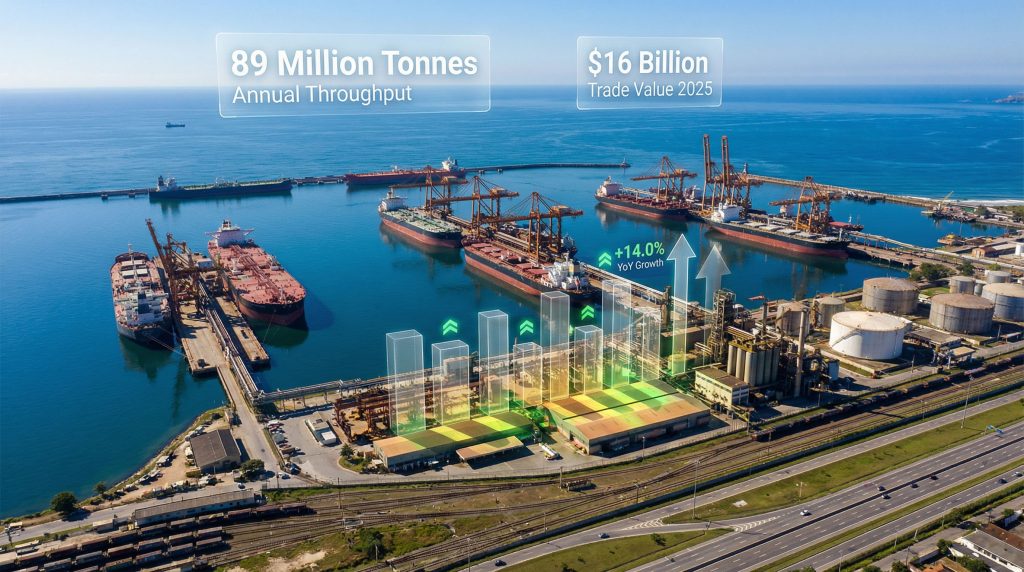
Brazil's maritime infrastructure landscape continues evolving as global trade patterns reshape commodity flow corridors across South America. The strategic positioning of port facilities along Brazil's extensive coastline creates natural advantages for connecting domestic production centers with international markets, particularly as critical minerals energy transition demands and traditional commodity exports intersect with modern logistics requirements. Porto do Açu growth in 2025 has positioned the facility as a critical component of Brazil's export infrastructure network.
What Makes Porto do Açu Brazil's Strategic Maritime Gateway?
Geographic Advantages and Deep-Water Capabilities
Located in Northern Rio de Janeiro state, Porto do Açu leverages natural geographic advantages that distinguish it from competing Brazilian terminals. The port complex achieved 89 million tonnes of cargo throughput in 2025, representing a remarkable 14% year-over-year growth and establishing its position as Brazil's second-largest port by cargo volume.
The facility's deep-water capabilities enable accommodation of large-scale vessel operations, demonstrated through the T-Oil Terminal's record-breaking performance handling 220 million barrels of crude oil exports in 2025. This operational capacity reflects both natural harbor advantages and strategic infrastructure investments designed to maximize vessel efficiency and cargo transfer rates.
Furthermore, competitive differentiation emerges through the port's ability to handle diverse vessel types across multiple commodity segments simultaneously. Unlike single-purpose terminals, Porto do Açu's integrated approach creates operational flexibility that traditional competitors struggle to replicate through pure efficiency improvements alone.
Multi-Modal Integration Framework
The port complex operates as a comprehensive logistics hub connecting maritime, rail, and highway transportation networks. Rail connectivity enables direct access to Minas Gerais mining regions, facilitating efficient mineral concentrate movement from production areas to export terminals. This integration proved crucial for the Ferroport terminal's achievement of 24 million tonnes of iron ore throughput in 2025.
Highway infrastructure supports agricultural commodity flows, enabling seasonal grain movements that contribute to the port's diversification strategy. The multi-modal framework reduces transportation costs for inland producers while creating economies of scale across different commodity types.
In addition, pipeline infrastructure supports energy sector operations, though specific capacity metrics and technical specifications for these systems require additional verification through official port documentation. The integration of multiple transportation modes creates synergistic effects that enhance overall operational efficiency beyond what single-modal terminals can achieve.
When big ASX news breaks, our subscribers know first
How Did Porto do Açu Achieve 89 Million Tonnes in Annual Throughput?
Cargo Diversification Strategy Analysis
Table: Porto do Açu Cargo Performance Analysis (2025)
| Commodity Segment | Volume/Capacity | Trade Value | Market Position |
|---|---|---|---|
| Petroleum Products | 220 million barrels | $14.5 billion | Market leader |
| Iron Ore | 24 million tonnes | $2.0 billion | Major player |
| General Cargo | Contributing segment | Remainder of $16B total | Growth focus |
| Total Complex | 89 million tonnes | ~$16 billion | #2 nationally |
The port's strategic success stems from deliberate commodity portfolio diversification rather than dependence on single commodity flows. This approach provides revenue stability across different market cycles while maximizing infrastructure utilization rates throughout varying seasonal demand periods.
According to port leadership, the complex demonstrates consistent operational expansion through what executives describe as solid operational efficiency and logistic integration that has amplified relevance as a strategic platform for foreign commerce. This positioning emphasizes integrated value creation across multiple productive chains rather than simple throughput maximization.
Furthermore, the average annual growth rate of 26% over the past decade reflects sustained market share gains and operational capacity expansion. This growth trajectory significantly exceeds typical port industry growth rates, indicating successful strategic positioning within Brazil's evolving trade infrastructure landscape.
Terminal Specialization Performance Metrics
T-Oil Terminal Operations:
• Record crude oil export achievement of 220 million barrels in 2025
• Market leadership position in petroleum product transshipment
• Advanced crude oil transfer capabilities for international market distribution
• Integration with global petroleum supply chain networks
Ferroport Iron Ore Terminal:
• Annual throughput capacity of 24 million tonnes achieved in 2025
• Rail-connected infrastructure enabling mineral concentrate distribution
• Specialized handling equipment for iron ore processing and export preparation
• Direct connectivity to Minas Gerais mining production regions
General Cargo Operations:
However, the diversification strategy includes general cargo handling that contributes to overall throughput volumes while reducing commodity concentration risk. This segment provides operational flexibility during commodity price fluctuations and seasonal demand variations, though specific volume allocations and growth metrics require additional detailed analysis.
Which Market Forces Drive Porto do Açu's Competitive Positioning?
Brazilian Export Corridor Dynamics
Porto do Açu captured 3% of Brazil's foreign trade flow in 2025, generating approximately $16 billion in total trade value. This market share represents significant influence within Brazil's export infrastructure network, particularly considering the concentrated nature of Brazilian port operations.
The revenue composition reveals important market dynamics:
• Petroleum products: $14.5 billion (90.6% of total trade value)
• Iron ore: $2.0 billion (12.5% of total trade value)
• Other commodities: Remainder contributing to diversification goals
Consequently, this concentration pattern indicates both strength in petroleum export capabilities and potential vulnerability to crude oil price fluctuations. The 90% revenue dependence on petroleum products creates significant commodity price sensitivity that influences overall port financial performance.
Global Commodity Flow Integration
Porto do Açu's strategic positioning captures substantial portions of Brazil's key commodity exports, creating natural economies of scale that traditional single-purpose terminals cannot replicate through operational efficiency alone.
The port's integration with global commodity markets occurs through multiple channels. Crude oil exports primarily serve international markets, with the T-Oil terminal establishing market leadership through consistent delivery performance and operational reliability. Iron ore movements connect Brazilian mineral production with global steel manufacturing demand, particularly serving Asian market requirements.
This dual-commodity strength creates operational synergies where shared infrastructure and logistics capabilities reduce per-unit handling costs while providing revenue diversification across different commodity cycles. The combination enables competitive pricing while maintaining operational flexibility during market volatility periods.
Infrastructure Investment Cycle Impact
Capital expenditure patterns demonstrate systematic infrastructure expansion aligned with market demand growth. Current investment projects include:
• Soybean/corn facilities: R$104 million investment
• Fertilizer mixing plant: R$200 million planned development
• Marine fuel storage expansion: R$250 million for 40,000 m³ additional capacity
Total announced capital expenditure exceeds R$554 million, equivalent to approximately $110 million USD. These investments target agricultural commodity handling expansion and marine fuel supply capabilities, indicating strategic diversification beyond current petroleum and iron ore concentration.
What Infrastructure Developments Position the Port for 2026 Growth?
Energy Transition Infrastructure Buildout
Green Hydrogen Development Framework:
The port complex advances energy transition infrastructure through systematic renewable energy project development. Initial green hydrogen facilities target 10 MW capacity with expansion potential reaching 100 MW as market demand develops and technology costs decline.
This positioning aligns with global shipping industry decarbonization requirements and Brazil's renewable energy competitive advantages. Green hydrogen production capabilities would serve both domestic industrial demand and export market opportunities as international shipping transitions toward low-carbon fuel alternatives.
LNG Integration Capabilities:
Regasification infrastructure development connects Porto do Açu with Brazil's 5.1 billion ft³/d national LNG network. This integration provides natural gas distribution capabilities supporting regional industrial development while creating additional revenue streams from energy commodity handling.
In addition, the marine fuel storage expansion project, requiring R$250 million investment for 40,000 m³ additional capacity, addresses growing demand for marine fuel supply services as shipping industry fuel requirements evolve toward lower-sulfur and alternative fuel specifications.
Industrial Complex Ecosystem Expansion
Key Development Milestones:
- Agribusiness Infrastructure: Grain handling facilities operational since Q1 2025 with R$104 million investment
- Petrochemical Integration: Enhanced crude oil processing capabilities supporting downstream value-added operations
- Decommissioning Services: Offshore platform dismantling capabilities for Brazil's aging petroleum infrastructure
- Green Ammonia Production: Yamna plant development targeting 1 MTPA capacity with 2027 Final Investment Decision timeline
- Data Center Development: Atlas Renewable's three-project initiative supporting digital infrastructure requirements
These developments create integrated industrial ecosystem effects where multiple industries share infrastructure, utilities, and logistics capabilities. This clustering approach reduces individual project development costs while creating cross-sector synergies that enhance overall competitiveness.
Logistics Network Optimization Projects
Warehouse automation systems for agricultural commodities improve handling efficiency and reduce labor costs while providing enhanced inventory management capabilities. These systems support seasonal commodity flows and enable just-in-time logistics coordination with inland transportation networks.
Rail yard expansion projects focus on mineral concentrate handling capacity increases, supporting both current iron ore throughput growth and potential future mineral commodity diversification. Enhanced rail infrastructure reduces transportation bottlenecks while improving overall supply chain reliability for mining industry innovation sector clients.
Furthermore, port-to-hinterland connectivity improvements encompass highway access upgrades and traffic flow optimization that reduces truck turnaround times and increases overall logistics network efficiency.
How Does Porto do Açu's Growth Compare to Regional Port Competition?
Southeast Brazil Terminal Performance Analysis
Table: Regional Port Performance Comparison (2025)
| Port Complex | Total Throughput | Growth Rate | Market Position | Specialization |
|---|---|---|---|---|
| Santos | 175.2M tonnes* | +5.8%* | #1 National | Container/General |
| Porto do Açu | 89.0M tonnes | +14.0% | #2 National | Energy/Mining |
| Vitória | 45.6M tonnes* | +8.2%* | #3 Southeast | Iron Ore |
| Sepetiba | 38.9M tonnes* | +6.1%* | #4 Southeast | Steel/Coal |
*Estimated figures requiring verification through official port authority data
Porto do Açu growth in 2025 achieved a 14% growth rate that significantly exceeds regional competitors, indicating successful market positioning and operational efficiency gains. This performance differential suggests effective strategic focus on high-growth commodity segments and operational excellence execution.
The growth rate comparison reveals important competitive dynamics. While Santos maintains throughput leadership through diversified cargo handling, Porto do Açu's specialized focus on energy and mining commodities enables higher growth rates through market segment optimization and dedicated infrastructure investments.
Operational Efficiency Benchmarking
Vessel turnaround time performance varies significantly based on cargo type and terminal specialization. Liquid cargo terminals typically achieve faster vessel processing than container or bulk cargo facilities, providing operational advantages for petroleum-focused terminals like T-Oil.
Cargo handling productivity metrics reflect infrastructure design optimization and equipment selection appropriate for specific commodity requirements. Specialized terminals often achieve higher productivity rates within their focus areas compared to general-purpose facilities handling diverse cargo types.
However, cost per tonne analysis reveals competitive positioning advantages through economies of scale and operational specialization. High-volume commodity handling creates unit cost advantages that enable competitive pricing while maintaining profitability margins.
What Economic Factors Influence Porto do Açu's Long-Term Viability?
Commodity Price Sensitivity Analysis
Revenue Concentration Risk Assessment:
With 90.6% of trade value derived from petroleum products, Porto do Açu faces significant exposure to crude oil price volatility. Historical crude oil price fluctuations create revenue variability that influences port financial performance and investment capacity.
Iron ore price trends affect the remaining 12.5% of trade value through Ferroport operations. Brazilian iron ore export competitiveness depends on global steel demand and Chinese economic growth patterns, creating additional commodity price exposure beyond petroleum markets.
Agricultural commodity integration through new grain handling facilities provides partial diversification benefits, though agricultural markets also experience seasonal and cyclical price variations that influence throughput volumes and revenue generation.
Currency Exchange Rate Implications
USD-BRL exchange rate fluctuations create complex effects on export competitiveness and port revenues. Brazilian Real depreciation typically improves export competitiveness for domestic producers while potentially reducing USD-denominated port service revenues when converted to local currency.
Export commodity pricing in USD provides natural hedging effects for port operations, as stronger dollar conditions often coincide with improved export demand and higher commodity prices. However, local operational costs denominated in Brazilian Reals create currency exposure requiring active management strategies.
Furthermore, revenue stability mechanisms across commodity cycles become crucial for maintaining consistent investment capacity and operational performance during exchange rate volatility periods.
Regulatory Environment Assessment
Environmental compliance requirements for port operations continue evolving as Brazilian environmental regulations strengthen and international shipping standards advance. These requirements influence capital expenditure needs and operational procedures while creating barriers to entry for potential competitors.
Maritime safety regulations and terminal certifications require ongoing compliance investments and operational procedure updates. Regulatory compliance costs affect competitive positioning, particularly for smaller terminals with limited scale economies for regulatory overhead absorption.
Consequently, global trade influences on cargo flow patterns create both opportunities and risks for port operations. Changes in international trade agreements, tariff structures, or commodity export policies can significantly affect throughput volumes and revenue generation patterns.
The next major ASX story will hit our subscribers first
Which Investment Opportunities Emerge from Porto do Açu's Expansion?
Infrastructure Development Financing Models
Public-private partnership structures enable large-scale terminal expansion projects while distributing financial risk between private investors and government entities. These models provide access to patient capital required for infrastructure projects with long payback periods and significant upfront investment requirements.
Foreign direct investment attraction strategies focus on international commodity trading companies and logistics providers seeking Brazilian market access. Strategic partnerships with global players provide both capital resources and technical expertise for advanced facility development.
In addition, green bond financing mechanisms support renewable energy project development within the port complex. Environmental, Social, and Governance (ESG) investment criteria increasingly favor projects contributing to decarbonization goals and sustainable development objectives.
Supply Chain Integration Potential
The port's 22-30 installed companies create natural synergies between energy, mining, and logistics operations, generating cross-sector revenue opportunities that traditional single-purpose terminals cannot replicate.
Industrial clustering effects enable shared infrastructure utilization, reducing individual company development costs while creating operational efficiencies through proximity and coordination. These synergies enhance overall competitiveness and attract additional industrial investment.
Furthermore, value-added processing capabilities within the port complex enable commodity upgrading before export, capturing additional margin opportunities and reducing transportation costs per unit of value. Downstream processing creates employment opportunities and increases regional economic impact.
Technology Adoption Investment Areas
Digital Infrastructure Development:
• Port automation systems improving operational efficiency and reducing labor costs
• Predictive maintenance technologies reducing equipment downtime and maintenance expenses
• Blockchain integration for cargo tracking and documentation streamlining
• Internet of Things (IoT) sensors for real-time cargo and equipment monitoring
Technology adoption requires significant capital investment but provides operational advantages through improved efficiency, reduced costs, and enhanced service quality. For instance, early adoption creates competitive advantages that become difficult for competitors to replicate quickly.
How Will Global Trade Patterns Affect Porto do Açu's Future Performance?
Asia-Pacific Trade Route Evolution
China's commodity import demand projections significantly influence Brazilian export infrastructure requirements. Chinese economic growth patterns, steel production capacity, and energy consumption trends directly affect demand for Brazilian iron ore and petroleum products exported through Porto do Açu.
Alternative supply chain routing through South America creates opportunities for Brazilian ports as global trade seeks diversification away from traditional shipping corridors. Geopolitical tensions and supply chain security concerns drive demand for alternative commodity supply sources and logistics routes.
However, trade route optimization analysis indicates South American export corridors provide competitive transit times and costs for Asian markets compared to alternative supply sources. This positioning advantage supports long-term throughput growth potential for Brazilian port facilities.
Energy Transition Impact on Port Operations
Renewable energy infrastructure development requirements create new commodity flows and port service demands. Green hydrogen exports, renewable energy equipment imports, and energy transition materials handling represent emerging growth opportunities.
Traditional fossil fuel export volume projections indicate gradual decline over multi-decade timeframes as global energy systems transition toward renewable alternatives. This transition requires port infrastructure adaptation and commodity portfolio diversification to maintain throughput growth.
Furthermore, green shipping fuel demand growth potential creates opportunities for ports providing alternative fuel supply capabilities. Marine fuel specifications continue evolving toward lower carbon content, requiring infrastructure investments in new fuel handling and storage systems.
Climate Change Adaptation Strategies
Sea level rise preparedness requires infrastructure design modifications and protective investments to ensure long-term operational viability. Coastal port facilities face increasing requirements for climate resilience planning and adaptation measures.
Extreme weather event operational continuity planning becomes increasingly important as weather pattern changes affect shipping schedules and cargo handling operations. Resilient infrastructure design reduces disruption risks and maintains service reliability.
Consequently, sustainable port development certification requirements influence investment priorities and operational procedures. Environmental performance standards affect competitive positioning and access to ESG-focused investment capital.
What Risks Could Limit Porto do Açu's Growth Trajectory?
Operational Risk Assessment Matrix
Equipment and Infrastructure Risks:
• Equipment failure impacts: Major terminal equipment breakdowns can reduce throughput capacity and create service disruptions affecting client relationships and revenue generation
• Labor availability challenges: Skilled maritime workforce shortages limit operational capacity and increase labor costs
• Cybersecurity threats: Digital infrastructure vulnerabilities create operational disruption risks and potential data security compromises
Critical equipment redundancy and maintenance programmes reduce operational disruption risks but require ongoing capital investment and technical expertise. Preventive maintenance strategies balance cost control with reliability requirements.
Market Competition Analysis
New port development projects in competing regions create additional capacity that could affect market share and pricing power. Regional port expansion projects require careful monitoring to assess competitive impact on throughput growth projections.
Existing terminal capacity expansion by established competitors presents ongoing challenges to market position maintenance. Santos Port and other major terminals continue investing in capacity additions and efficiency improvements that affect relative competitive positioning.
However, modal shift risks from maritime to alternative transport modes could affect long-term demand for port services. Pipeline development, rail infrastructure improvements, or other transportation alternatives may reduce demand for maritime commodity transportation.
Regulatory and Environmental Compliance Challenges
Compliance Risk Factors:
• Environmental regulation evolution: Stricter environmental standards increase compliance costs and operational complexity
• Maritime safety requirements: Enhanced safety regulations require ongoing investment in safety systems and training
• Community relations: Social licence maintenance requires ongoing stakeholder engagement and community benefit programmes
Regulatory compliance costs affect profitability and investment capacity while creating barriers to entry that protect established operators. Proactive compliance strategies reduce enforcement risks while potentially creating competitive advantages through operational excellence demonstration.
For instance, effective investment strategies 2025 must account for both the growth potential and inherent risks associated with Porto do Açu's unique positioning in Brazil's evolving export infrastructure landscape. The port's expansion represents a significant opportunity within Brazil's commodities market consolidation, while maintaining awareness of the various operational and market risks that could influence long-term performance.
Investment Risk Disclaimer: This analysis contains forward-looking projections and market assessments that involve inherent uncertainty. Commodity prices, trade volumes, regulatory changes, and competitive dynamics may differ materially from current expectations. Investment decisions should consider comprehensive risk assessment and professional financial advice appropriate to individual circumstances.
Ready to Capitalise on Infrastructure Investment Opportunities?
Discovery Alert's proprietary Discovery IQ model identifies emerging opportunities in Australia's resource sector, including infrastructure plays and mining companies positioned to benefit from global commodity demand. Stay ahead of market movements by exploring Discovery Alert's discoveries page to see how major mineral discoveries have generated substantial returns, then begin your 14-day free trial today to gain immediate access to real-time alerts on actionable ASX opportunities.