May 14, 2026
When Geology Rewrites the Investment Case: The Multi-Phase Story Behind the Potencial Exploratorio de Zafranal
Most copper deposits are understood as singular events: a magmatic system intrudes, hydrothermal fluids circulate, minerals precipitate, and the clock stops. The geological narrative is linear, the exploration boundary relatively well-defined. But a small number of districts in the Pacific Belt challenge this framework entirely, revealing instead a layered history of recurring mineralisation events stacked across tens of millions of years. These are the systems that consistently surprise on the upside, expanding resource inventories long after the original discovery has been fully modelled.
The potencial exploratorio de Zafranal, located in Peru's Arequipa region, belongs to this less common category. New geocronological research presented at proEXPLO 2026 has substantially deepened understanding of the district's temporal complexity, transforming the way geologists and investors alike must evaluate its full resource potential. The implications extend far beyond a single deposit update.
When big ASX news breaks, our subscribers know first
From Discovery to District: The Evolution of Zafranal Since 2004
Teck Resources first identified the Zafranal deposit in 2004 through systematic exploration of the southern Peruvian Andes, a region long recognised as sitting within one of the most productive copper metallogenic corridors on Earth. Over the following two decades, the project moved through progressive stages of geological characterisation, resource definition, environmental assessment and permitting.
The ownership structure that emerged from this process reflects a deliberate pairing of technical capability and strategic supply chain interest. Compañía Minera Zafranal S.A.C. is operated with Teck Resources holding an 80% stake and Mitsubishi Materials Corporation holding the remaining 20%. This arrangement combines world-class porphyry copper expertise with long-term Japanese industrial demand for refined copper, particularly as Mitsubishi positions itself within global supply chains for energy transition metals.
The project reached a critical regulatory milestone in 2023 with the approval of its Environmental Impact Assessment (EIA), clearing the most significant permitting hurdle that large-scale mining projects in Peru must navigate. Active exploration permits have remained in place since that approval, supporting the intensive drilling campaigns that generated the new geological data unveiled at proEXPLO 2026.
The Geology That Changes Everything: Multiple Magmatic Episodes at Zafranal
Renio-Osmio Dating and the Jurassic Nucleus
The centrepiece of the new research presented at proEXPLO 2026 is the application of Rhenium-Osmium (Re-Os) geochronology to molybdenite samples from the Zafranal system. This dating technique is widely regarded as the most precise available tool for determining mineralisation ages in porphyry copper-molybdenum systems. Unlike K-Ar or U-Pb methods applied to host rocks, Re-Os dating targets the sulphide minerals themselves, providing direct age constraints on ore-forming events rather than the broader igneous framework.
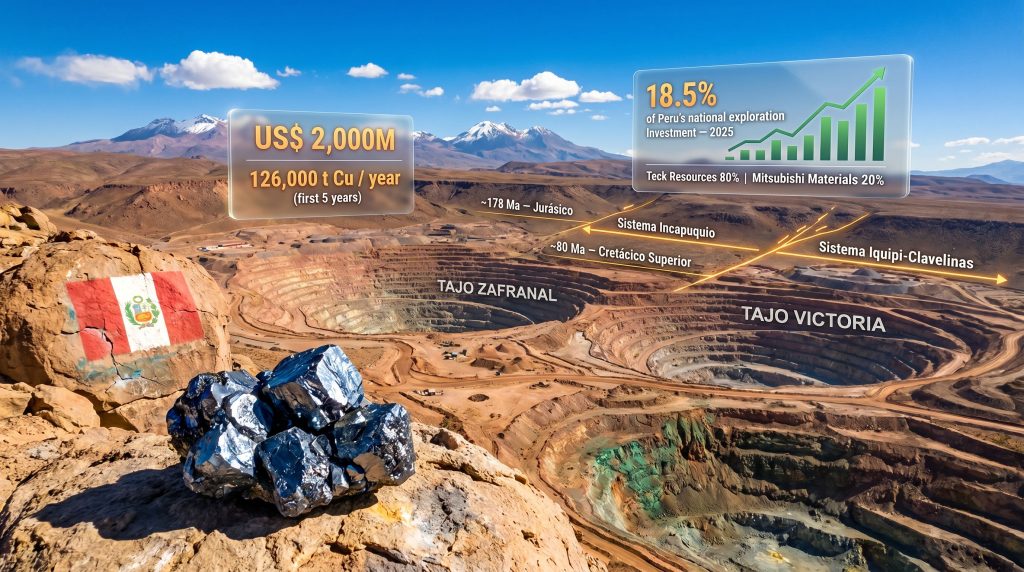
The results confirmed that the primary mineralisation nucleus at Zafranal formed approximately 178 million years ago, during the Jurassic period. This places it firmly within a Jurassic-Cretaceous magmatic arc that runs through southern Peru, a belt that has historically been underexplored relative to the better-known Paleocene-Eocene copper corridor further north. According to geological data on the Zafranal project, this Jurassic origin sets the district apart from many of its regional peers.
Late Cretaceous Reactivation: A 98-Million-Year Gap
Perhaps the most consequential finding presented at proEXPLO 2026 was not the Jurassic age itself, but the detection of a second, distinct thermal event occurring during the Late Cretaceous, approximately 80 million years ago. This places a gap of roughly 98 million years between the primary ore-forming episode and a documented later reactivation of the hydrothermal system.
This pattern of multi-phase activity is not unprecedented in large Pacific Belt districts. The presence of a secondary thermal pulse tens of millions of years after initial mineralisation is understood by exploration geologists to indicate that the structural architecture of the system remained permeable and reactive, a condition that can drive supergenic enrichment and introduce secondary copper concentration into the existing sulphide inventory.
The detection of this Late Cretaceous signal expands the conceptual boundaries of the district considerably. Rather than representing a single frozen moment in geological time, Zafranal appears to record an extended history of fluid mobility, reactivation, and potentially repeated copper deposition. Furthermore, as Teck's own presentation at proEXPLO 2026 confirmed, these new geological indicators meaningfully elevate the district's exploratory ceiling.
What the Geochronological Table Reveals
| Geological Event | Period | Approximate Age | Exploration Significance |
|---|---|---|---|
| Primary mineralisation nucleus | Jurassic | ~178 million years | Core of known Zafranal deposit |
| Secondary thermal reactivation | Late Cretaceous | ~80 million years | Potential supergenic enrichment driver |
| Additional identified targets | Early Cretaceous | Under determination | New exploration vectors being assessed |
| Younger magmatic events | To be confirmed | Under determination | Early-stage peripheral exploration |
The Supergenic Profile and Calcocita Dominance
The mineralogy of the known deposit reflects the combined influence of multiple geological episodes. The supergenic profile at Zafranal is dominated by calcocita (chalcocite), a secondary copper sulphide that forms when primary sulphide minerals are chemically transformed by near-surface oxidising conditions over geological time.
Key characteristics of this supergenic profile include:
- Dominant mineral: Calcocita (secondary copper sulphide, chemical formula Cu₂S)
- Profile thickness: Between 50 and 150 metres, a range that indicates substantial supergenic development
- Metallurgical advantage: Calcocita-dominant ores typically yield higher copper recovery rates in conventional flotation circuits compared to primary chalcopyrite, reducing processing complexity and improving project economics
- Two projected open pits: The Zafranal pit (primary nucleus) and the Victoria pit (district extension)
Structural Architecture: Why Zafranal Is Where It Is
The Intersection of Two Regional Fault Systems
The location of Zafranal within Arequipa's geological landscape is far from coincidental. The project sits near the intersection of two first-order regional fault systems: the Incapuquio Fault System and the Iquipi-Clavelinas Fault System. This structural convergence is recognised as a fundamental control on mineralisation throughout the southern Peruvian Andes.
In exploration geology, the intersection of major fault systems creates zones of enhanced brittle deformation and elevated crustal permeability. These zones act as conduits for magmatic-hydrothermal fluids rising from deeper intrusive sources, providing both the pathways and the structural traps that allow copper and molybdenum to concentrate at economic grades. The same principle applies to many of the world's largest porphyry copper deposits, where structural intersections correlate strongly with peak mineralisation grades and widths.
The Jurassic-Cretaceous Metallogenic Fringe of Southern Peru
Zafranal occupies a position within a distinct Jurassic-Cretaceous magmatic arc that differs in timing from the more heavily explored Paleocene-Eocene copper belt of central Peru. The coexistence of Jurassic and Cretaceous mineralisation ages within a single district represents what exploration geologists characterise as exceptional metallogenic fertility: evidence that the district occupied a repeatedly favourable location within the evolving Andean arc over an extended period.
This temporal overlap distinguishes Zafranal from many peer projects and adds a layer of prospectivity that single-age porphyry systems cannot offer. Consequently, the strategic implication for exploration is that targets associated with each separate episode may occupy different structural positions within the district, potentially expanding the total footprint of mineralisation well beyond the boundaries currently defined by drilling.
Investment Concentration and the Significance of Exploration Capital
Zafranal's Dominant Share of Peru's Exploration Budget
The financial commitment underpinning the current exploration programme at Zafranal is extraordinary by any regional benchmark. During the first eleven months of 2025, the project accumulated US$ 129 million in exploration investment, representing approximately 18.5% of Peru's entire national exploration spending for that period.
| Investment Metric | Figure | Period |
|---|---|---|
| Zafranal accumulated investment | US$ 129 million | January to November 2025 |
| Share of national exploration spend | 18.5% | 2025 |
| Peak monthly investment | US$ 15 million | November 2025 |
| Year-over-year growth rate | Over 110% | November 2024 vs. November 2025 |
| National sector growth rate | 241% | Full year 2025 |
| Total Peruvian exploration sector | US$ 694 million | 2025 |
The concentration of nearly one-fifth of all national exploration investment into a single district is an unusual phenomenon even within Latin American mining. It signals that Teck and Mitsubishi are not merely maintaining a position but actively accelerating the derisking of Zafranal ahead of a construction decision.
Where the Capital Is Being Deployed
The exploration activity is strategically concentrated on concessions CMZ 3 and CMZ 4, the administrative units that contain the highest-priority geological targets identified through the new multi-phase framework. The primary objectives of this investment include:
- Certifying copper reserves under international reporting standards (NI 43-101 and JORC frameworks), which are prerequisites for project financing and investment-grade feasibility studies
- Defining the geometry and grade distribution of targets associated with the Late Cretaceous and Early Cretaceous events identified through Re-Os dating
- Supporting the resource profile needed to demonstrate long-term production sustainability to infrastructure lenders and offtake counterparties
Project Economics and the Road to 2030
The Development Timeline
With the EIA approved and exploration permits active, Zafranal is following a defined pathway toward construction and production:
| Development Milestone | Target Year | Status |
|---|---|---|
| EIA approval | 2023 | Completed |
| Construction commencement | 2026 | Scheduled |
| First copper production | 2030 | Projected |
| End of projected mine life | ~2049 | Projected |
Financial Profile of the Project
The scale of Zafranal's development ambition is reflected in its capital and production parameters:
- Total estimated capital expenditure: US$ 2,000 million
- Projected mine life: 19 years
- Annual copper production (first five years): 126,000 tonnes
- Primary byproduct: Copper concentrate with associated minor gold content
At a projected output of 126,000 tonnes annually during peak production years, Zafranal would rank among the more significant copper producers in Peru's portfolio, comparable in scale to mid-tier operations currently contributing to the country's position as the world's second-largest copper producer.
The next major ASX story will hit our subscribers first
Copper, Electrification, and the Long-Term Demand Argument
Why Porphyry-Scale Projects Are Irreplaceable
The structural demand case for large porphyry copper projects rests on the mathematics of electrification. Electric vehicles require between two and four times more copper per unit than their internal combustion equivalents, while utility-scale renewable energy infrastructure demands copper at volumes that simply cannot be met by smaller, higher-grade deposits alone. Only large-tonnage, long-life porphyry systems can provide the sustained supply that industrial transition requires over multi-decade timeframes.
The calcocita-dominant profile at Zafranal provides an additional competitive advantage in this context. Higher metallurgical recoveries translate directly into lower production costs per tonne of refined copper, improving the project's position on the global cost curve and its resilience across a range of copper price scenarios. In addition, the potencial exploratorio de Zafranal continues to attract institutional attention precisely because it aligns so directly with the copper demand trajectory that electrification is driving globally.
Peru's Competitive Position
Peru's 241% growth in exploration investment during 2025 reflects a broader repositioning of the country's mining sector within global critical mineral supply chains. The pipeline of copper projects in various stages of development illustrates the competitive landscape:
| Project | Primary Operator | Annual Copper Output (Estimated) | Stage |
|---|---|---|---|
| Zafranal | Teck / Mitsubishi | 126,000 t (first 5 years) | Construction scheduled 2026 |
| Antamina (expansion) | BHP / Glencore / Teck / Mitsubishi | Under evaluation | Active operation |
| Marcobre | Minsur | ~60,000 t | Production commenced |
Risk Factors and Variables That Will Shape the District's Future
Upside Scenarios
Several developments could materially expand the investment case for Zafranal beyond its current parameters:
- Systematic drilling of Early Cretaceous targets confirming economic-grade mineralisation at depth or lateral extensions outside the current pit shells
- Detection of additional supergenic enrichment horizons associated with Late Cretaceous reactivation events, adding to the calcocita inventory
- Integration of advanced geophysical methods, including deep-penetrating IP (induced polarisation) and MT (magnetotelluric) surveys, to vector unexplored parts of the district
- Re-Os dating results from peripheral concessions confirming the presence of a third, spatially distinct mineralisation event
Risks to Monitor
- Copper price volatility relative to a US$ 2,000 million capital commitment, which requires sustained copper prices to maintain project economics above internal hurdle rates
- Social licence conditions in Arequipa, where community relations remain a critical factor for all large-scale mining projects in Peru
- Permitting timelines for additional exploration areas associated with newly identified targets outside currently authorised zones
- Capital competition from other Latin American copper districts, including projects in Chile, Argentina and Ecuador, which compete for the same pool of international exploration and project development capital
However, on balance, the combination of multi-phase geology, dominant exploration investment, and a clear construction timeline means the potencial exploratorio de Zafranal remains one of the most compelling copper development narratives in the Andean region today.
Disclaimer: This article contains forward-looking statements, production projections, and investment timelines sourced from public presentations and technical reports. These represent estimates subject to geological, regulatory, financial, and market risks. Nothing in this article constitutes financial advice. Readers should conduct independent research and consult qualified advisers before making any investment decisions related to companies or projects mentioned.
Want to Stay Ahead of the Next Major Copper Discovery on the ASX?
Discovery Alert's proprietary Discovery IQ model delivers real-time alerts the moment significant mineral discoveries are announced on the ASX, transforming complex geological and commodity data into clear, actionable insights for investors at every experience level. Explore historic examples of major mineral discoveries and their exceptional market returns, then begin your 14-day free trial to position yourself ahead of the broader market.