July 24, 2026
Power Infrastructure Transformation in Southeast Asian Industrial Development
Southeast Asia's industrial landscape faces unprecedented electricity infrastructure challenges as resource-rich nations pursue value-added manufacturing strategies. The transition from raw material exports to domestic processing creates massive baseload power requirements that test regional grid capabilities and energy planning frameworks. Furthermore, this transformation represents one of the most significant industrial power demand surges in global manufacturing history, particularly as countries focus on renewable energy transition strategies.
Modern aluminum smelting operations require continuous, high-voltage electricity supply with minimal interruptions. Even brief power outages can damage electrolytic cells and result in production losses exceeding millions of dollars. This technical reality shapes smelter location decisions and drives long-term power purchase agreements spanning decades.
When big ASX news breaks, our subscribers know first
Indonesia's Power-Intensive Industrial Transformation: A Strategic Analysis
Quantifying the Infrastructure Gap – From 1GW to 9.5GW in Four Years
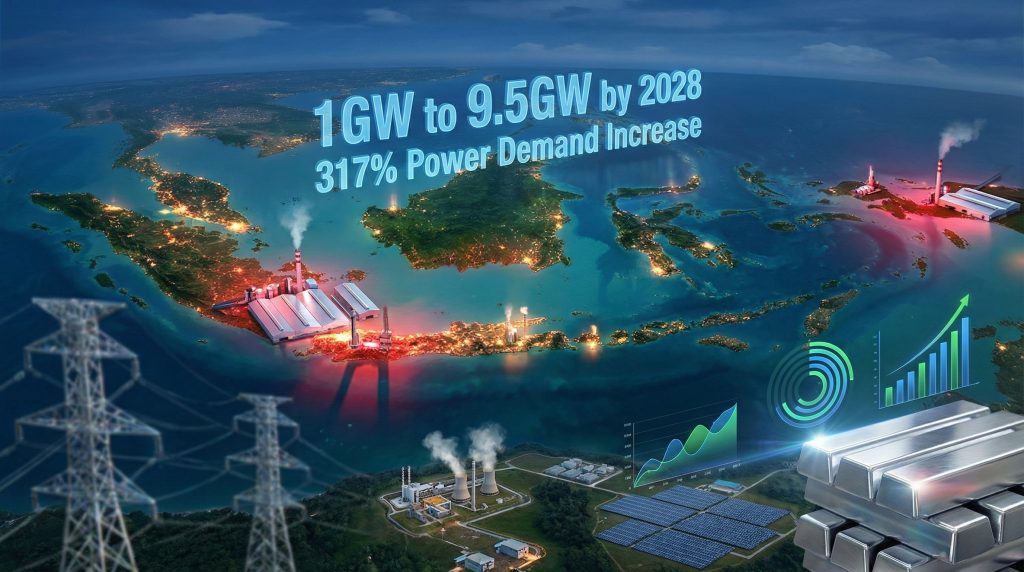
Indonesia aluminium power demand 2028 faces an extraordinary escalation trajectory through the decade. Current baseline consumption of approximately 1 gigawatt will surge to 9.5 gigawatts, representing a 317% increase in electrical infrastructure requirements. This expansion timeline compresses what typically occurs over decades into a four-year implementation window.
The projected capacity growth from 0.75 million tonnes per annum in 2024 to 3.13 million tonnes per annum by 2028 creates unprecedented regional power distribution challenges. Primary aluminum production requires 12-13 megawatt-hours of electricity per tonne, establishing continuous baseload requirements that exceed many regional grids' current capacity.
| Year | Production Capacity (MTPA) | Power Demand (GW) | Infrastructure Gap |
|---|---|---|---|
| 2024 | 0.75 | 1.0 | Baseline |
| 2026 | 1.5 | 3.5 | 150% increase |
| 2028 | 3.13 | 9.5 | 317% increase |
Regional power distribution mapping reveals concentration in North Kalimantan, West Kalimantan, Sulawesi, and Sumatra. These provinces historically operated distributed power systems serving domestic consumption rather than multi-gigawatt industrial loads. Current grid infrastructure lacks integration capabilities for synchronized industrial demand across these geographic zones.
Comparative analysis with other resource-rich economies demonstrates similar infrastructure bottlenecks during rapid industrialization phases. Australia's aluminum expansion in the 1970s-1980s required dedicated power plant construction, while Norway's smelter development coincided with massive hydroelectric projects spanning multiple decades.
The Economics of Aluminum Power Intensity – Why Electricity Dominates Production Costs
Electricity typically accounts for 30-35% of primary aluminum production costs globally, making power availability and pricing the primary competitive determinant. Modern smelters consume electricity continuously at rates comparable to medium-sized cities, creating substantial leverage effects from power cost variations.
Indonesia's current industrial electricity rates require benchmarking against established aluminum producing regions to assess competitive positioning. Iceland maintains industrial rates of $30-50 per megawatt-hour through geothermal baseload supply, while Norway's hydroelectric advantages provide similar cost structures. These examples highlight the importance of exploring decarbonisation benefits in industrial power planning.
Energy cost sensitivity modelling reveals that $10 per megawatt-hour variations translate to approximately $125-150 per tonne in production costs. This sensitivity explains why aluminum smelters historically locate near low-cost power sources rather than raw material deposits or end markets.
Break-even analysis for various power supply scenarios indicates that:
• Coal-fired captive plants: $40-60/MWh operating costs
• Grid power arrangements: $50-80/MWh depending on regional pricing
• Renewable baseload (hydro/geothermal): $25-45/MWh with higher capital requirements
• Natural gas generation: $60-90/MWh depending on fuel supply agreements
Power cost projections involve significant uncertainty based on fuel price volatility, regulatory changes, and infrastructure development timelines. Actual costs may vary substantially from these estimates.
What Drives Indonesia's Aluminum Capacity Expansion Strategy?
Post-Bauxite Export Ban Industrial Policy Analysis
Indonesia's 2023 bauxite export prohibition represents a comprehensive downstream integration strategy designed to capture value-added production within domestic borders. The policy framework redirects raw material flows from Chinese and other foreign refiners toward Indonesian processing facilities. Additionally, this approach positions Indonesia for green metals leadership in the region.
This resource nationalism approach follows similar strategies implemented globally, with varying success rates depending on infrastructure development coordination and market timing. Guinea's aluminum development initiatives and Australia's mineral processing policies provide instructive parallels for Indonesia's current trajectory.
The value-chain capture strategy transforms Indonesia from a raw material supplier to an integrated producer across multiple processing stages:
• Bauxite mining: $40-50 per tonne value
• Alumina refining: $500-700 per tonne value
• Aluminum smelting: $2,200-2,600 per tonne value
• Semi-finished products: Additional margin potential
Economic multiplier effects extend beyond mining and smelting into fabrication capabilities, automotive component manufacturing, and aerospace applications. Employment generation spans multiple skill levels from mining operations to high-technology metallurgical positions.
The RKAB regulatory structure streamlines ore processing and production workflows, reducing administrative barriers that previously constrained domestic capacity development. This framework coordination addresses historical inefficiencies in permit processing and operational approvals.
Capacity Addition Timeline and Regional Distribution
Planned aluminum smelting capacity additions total approximately 7,150 thousand tonnes across multiple regional projects. Implementation timelines concentrate in 2025-2028, creating synchronized infrastructure demands that exceed historical regional development patterns. Given these ambitious targets, companies will need to explore innovative capital raising strategies to fund such massive infrastructure investments.
Investment commitments across major industrial participants require validation through formal announcements and regulatory filings. Indonesia's aluminum power demand is projected to jump significantly by 2028, with preliminary assessments indicating substantial capital requirements ranging from $1.5-2.5 billion per million tonnes of annual capacity.
Technology upgrade pathways for existing facilities involve energy efficiency improvements and production line modernisation. Pre-baked anode technology typically achieves 13-14 MWh per tonne energy intensity, while advanced designs can reduce consumption to 12-12.5 MWh per tonne.
Regional infrastructure readiness assessment reveals varying preparation levels across proposed smelter locations:
• North Kalimantan: Hydropower potential with limited current capacity
• West Kalimantan: Coal resources and existing power infrastructure
• Sulawesi: Geothermal potential requiring development investment
• Sumatra: Natural gas availability and regional grid connections
Which Power Supply Models Could Support Indonesia's Aluminum Ambitions?
International Power-Aluminum Integration Case Studies
Iceland's geothermal-aluminum model demonstrates successful integration of renewable baseload power with large-scale smelting operations. Alcoa's Fjarðaál facility operated under long-term power purchase agreements that provided cost stability and operational security over multi-decade timeframes.
Iceland produces approximately 30% of electricity from geothermal resources, with the remainder from hydropower. Industrial electricity rates of $30-50 per megawatt-hour create substantial competitive advantages compared to coal-dependent regions experiencing fuel price volatility.
Malaysia's Sarawak development strategy explicitly links aluminum smelter projects with hydropower generation capacity. The Bakun Dam's 2,400 MW capacity was designed to support industrial power users, including aluminum processing facilities and other energy-intensive manufacturing.
Norway's renewable aluminum sector benefits from approximately 98% renewable electricity generation through extensive hydroelectric infrastructure. Norsk Hydro and other operators maintain integrated power-smelting arrangements that provide operational flexibility and cost competitiveness.
Australia's renewable aluminum transition involves solar and wind projects integrated with existing smelter operations. Alcoa's Western Australian facilities have explored renewable power procurement to reduce carbon exposure and stabilise electricity costs.
Indonesia's Power Generation Options Analysis
Coal-fired captive power plants offer flexible scaling capabilities and proven technology integration with aluminum smelters. Capital costs range from $1,000-1,500 per megawatt of installed capacity, with operating costs of $40-60 per megawatt-hour depending on coal quality and emission control requirements.
Renewable energy potential assessment reveals substantial hydropower opportunities in Kalimantan and Sulawesi, geothermal resources across volcanic regions, and solar capacity in equatorial locations. However, renewable baseload development requires significant upfront infrastructure investment and multi-year construction timelines.
Grid integration challenges for large-scale industrial power demand include:
• Transmission capacity: High-voltage infrastructure connecting generation sources to smelter locations
• Load balancing: Managing continuous industrial demand with variable renewable output
• Backup systems: Redundancy requirements for continuous operation maintenance
• Regional coordination: Multi-provincial power sharing and emergency support protocols
Power purchase agreement structures for aluminum smelters typically involve 20-30 year terms with fixed pricing mechanisms or inflation-adjusted formulas. These arrangements provide cost predictability essential for project financing and operational planning.
How Do Global Power Crises Impact Aluminum Production Economics?
European Energy Crisis Lessons for Indonesia
The 2022 European energy crisis resulted in substantial aluminum production curtailments as electricity prices exceeded economically viable operating thresholds. Multiple smelters suspended operations when power costs reached $200-300 per megawatt-hour, demonstrating the direct relationship between energy pricing and production sustainability.
Power price elasticity effects on smelter operations reveal that facilities typically begin curtailing production when electricity costs exceed 40-45% of aluminum market prices. This threshold varies by smelter efficiency, labour costs, and raw material arrangements. Such disruptions highlight the importance of maintaining an energy security outlook for industrial operations.
Supply chain disruption cascading effects extended beyond primary production into downstream manufacturing, automotive components, and packaging industries. Regional aluminum premiums increased by $200-400 per tonne as European capacity reductions created supply tightness.
Market premium impacts from production interruptions demonstrate how regional power constraints can affect global aluminum pricing dynamics. European curtailments contributed to increased import demand and elevated prices worldwide.
Power Security Risk Management Strategies
Dedicated power supply arrangement models provide operational security through exclusive generation capacity or priority access agreements. Mozambique's Mozal smelter operates under dedicated power arrangements that ensure continuous electricity availability regardless of regional grid constraints.
Long-term contract structures for price stability typically include:
• Fixed pricing periods: 5-10 year terms with predetermined rates
• Inflation adjustment mechanisms: Consumer price index or energy cost escalators
• Force majeure provisions: Protection against supply interruptions
• Take-or-pay arrangements: Minimum power purchase commitments
Backup power and redundancy planning require dual-source electricity arrangements or on-site generation capabilities. Aluminum smelters cannot tolerate extended power interruptions without significant equipment damage and restart costs.
Regulatory framework requirements for industrial power security vary by jurisdiction but typically include grid reliability standards, emergency power protocols, and industrial user priority classifications during shortage periods.
What Are the Investment and Financing Implications?
Capital Requirements for Power Infrastructure Development
Power generation investment needs for supporting Indonesia's aluminum expansion range from $8-15 billion depending on technology choices and generation sources. Coal-fired options require lower upfront investment but face increasing environmental and carbon cost exposure.
Renewable alternatives demand higher initial capital but provide long-term cost stability and regulatory compliance benefits. Hydroelectric projects cost $2,000-4,000 per installed megawatt, while geothermal development requires $3,000-5,000 per megawatt including exploration and drilling risks.
Transmission infrastructure upgrade requirements include high-voltage lines connecting generation sources to industrial zones, substation capacity expansions, and regional grid interconnection improvements. These investments typically add 15-25% to total power infrastructure costs.
Financing structure options for integrated aluminum-power projects include:
• Project finance arrangements: Non-recourse debt secured by power purchase agreements
• Development finance institutions: World Bank, Asian Development Bank infrastructure funding
• Export credit agencies: Equipment financing for power plant and smelter technology
• Private equity participation: Risk capital for early-stage development
Economic Competitiveness Analysis
Indonesia's cost position versus established aluminum producing regions depends primarily on achieving competitive electricity rates through infrastructure development. Current projections suggest potential cost advantages if power infrastructure development proceeds successfully.
Transportation and logistics cost advantages include proximity to major Asian end markets, established shipping infrastructure, and reduced freight costs compared to distant production centres. These factors can offset higher power costs if electricity pricing remains within competitive ranges.
Labour cost competitiveness provides additional advantages through skilled workforce availability and competitive wage structures compared to developed aluminum producing regions. Technical training programmes can develop specialised metallurgical expertise required for advanced smelter operations.
Total cost of ownership modelling for new smelter operations indicates break-even requirements of $1,800-2,000 per tonne aluminum production costs to achieve competitive positioning against established global producers. Furthermore, new aluminum projects in Indonesia are ramping up production, boosting daily average aluminum production outside China.
Economic competitiveness analysis involves significant uncertainty regarding power infrastructure development timelines, regulatory changes, and global aluminum market conditions. Investment decisions should incorporate comprehensive due diligence and risk assessment.
The next major ASX story will hit our subscribers first
Where Will Indonesia's Aluminum Industry Stand by 2030?
Production Capacity Scenario Modelling
Best-case scenario development assumes successful power infrastructure completion and achieves the targeted 3.13 million tonnes per annum capacity by 2028, with potential expansion to 4.5-5.0 million tonnes by 2030. This trajectory would establish Indonesia among the world's top five aluminum producing nations.
Moderate scenario projections account for power infrastructure delays and achieve 2.0-2.5 million tonnes capacity by 2030 through phased development and priority project completion. This pathway maintains substantial growth while acknowledging infrastructure development challenges.
Worst-case scenario modelling assumes significant power bottlenecks limit capacity additions to 1.5-1.8 million tonnes by 2030, concentrated in regions with existing power infrastructure or captive generation arrangements.
Market share implications for global aluminum supply vary substantially across scenarios. Successful implementation could capture 3-4% of global primary aluminum production, while constrained development might achieve 1.5-2% market share.
Strategic Recommendations for Stakeholders
Government policy priorities for power sector development should emphasise:
• Coordinated infrastructure planning: Synchronised power and industrial project timelines
• Regulatory framework clarity: Transparent permitting and operational requirements
• Investment incentive structures: Tax policies supporting power infrastructure development
• Regional development coordination: Multi-provincial cooperation frameworks
Private sector investment strategies require comprehensive risk mitigation through diversified power supply arrangements, long-term contracting, and operational flexibility planning. Due diligence should emphasise power infrastructure feasibility over traditional project development factors.
International partnership opportunities include technology transfer agreements for advanced smelter designs, financing arrangements for power infrastructure, and technical assistance for grid integration planning.
Timeline optimisation strategies recommend prioritising power infrastructure development ahead of smelter construction to avoid operational delays and cost overruns during commissioning phases.
Critical Success Factors for Indonesia's Aluminum Power Challenge
Policy Coordination Requirements Across Energy and Industrial Sectors
Successful achievement of Indonesia aluminium power demand 2028 targets requires unprecedented coordination between energy regulators, industrial development authorities, and regional governments. Historical infrastructure development patterns indicate that synchronised planning reduces costs by 20-30% compared to sequential development approaches.
Investment sequencing priorities should emphasise power generation and transmission infrastructure completion before smelter commissioning to avoid operational constraints and cost escalation during startup phases.
International best practice adoption from successful aluminum-power integration models can accelerate development timelines and reduce implementation risks. Iceland, Norway, and Malaysia provide proven frameworks for large-scale industrial power planning.
Risk management frameworks for large-scale industrial power planning must address fuel price volatility, regulatory changes, environmental requirements, and technical integration challenges through comprehensive contingency planning and diversified supply arrangements.
The Indonesia aluminium power demand 2028 projection represents one of the most ambitious industrial energy transitions in recent global history. Consequently, success depends on coordinated infrastructure development, appropriate financing structures, and effective risk management across multiple stakeholder groups and geographic regions. This transformation will ultimately determine Indonesia's position in the global aluminum supply chain and its ability to capture value-added manufacturing benefits from its abundant bauxite resources.
Ready to Capitalise on Indonesia's Industrial Energy Transformation?
Discovery Alert's proprietary Discovery IQ model provides instant notifications on significant ASX mineral discoveries, empowering subscribers to identify actionable opportunities in energy-intensive industries and resource sectors ahead of the broader market. Begin your 14-day free trial today and position yourself to benefit from the next major discovery in Australia's thriving resources sector.