May 17, 2026
Pre-Salt Geology: Brazil's Strategic Position in Global Offshore Energy Markets
Petrobras discovers hydrocarbons in Campos Basin presalt offshore Brazil, marking another significant milestone in the country's ultra-deepwater exploration programme. These geological structures, buried beneath extensive salt layers formed millions of years ago, contain hydrocarbon reservoirs that have revolutionised Brazil's position in international energy markets since their initial discovery in 2006.
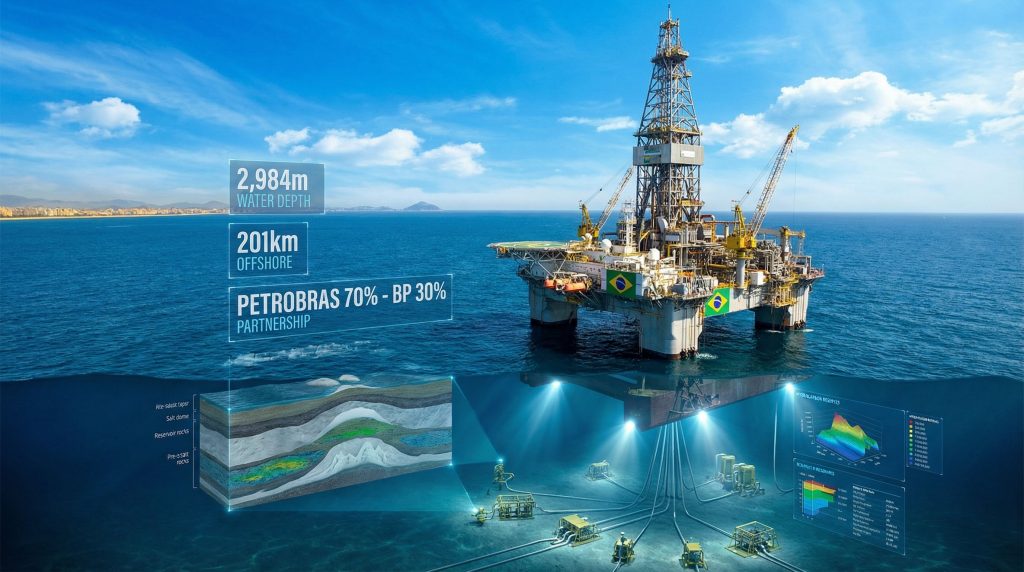
The recent confirmation of hydrocarbon presence in Block CM-477 of the Campos Basin demonstrates the continued potential of Brazil's offshore geology. Located 201 kilometres from Rio de Janeiro's coastline at 2,984 metres water depth, this discovery exemplifies the technical complexity and strategic importance of pre-salt exploration in Brazilian waters.
Understanding Pre-Salt Geological Advantages
Pre-salt formations offer unique advantages that justify the substantial investment required for ultra-deepwater development. These reservoirs typically contain high-quality crude oil with excellent flow characteristics, often exhibiting superior API gravity ratings and reduced sulfur content compared to conventional offshore discoveries.
The geological structure itself provides natural pressure maintenance through active aquifer systems, potentially extending field life and improving ultimate recovery rates. Additionally, pre-salt reservoirs frequently demonstrate substantial thickness, allowing for multiple horizontal drilling targets from single wellbores.
Campos Basin Infrastructure Integration
The Campos Basin's established infrastructure network provides significant advantages for new discoveries compared to frontier exploration areas. Existing pipeline systems, processing facilities, and export terminals create potential for accelerated development timelines and reduced capital expenditure through tie-back opportunities.
However, the 2,984-metre water depth of the Block CM-477 discovery presents operational challenges that extend beyond typical Campos Basin developments. This depth classification requires specialised drilling vessels, enhanced safety systems, and subsea equipment rated for extreme operating conditions.
When big ASX news breaks, our subscribers know first
Partnership Dynamics in Ultra-Deepwater Development
The Petrobras-BP joint venture structure in Block CM-477 reflects broader trends in international offshore development, where state-controlled national oil companies partner with global majors to access specialised technology and share capital risks in ultra-deepwater projects.
Operational Framework Analysis
Petrobras maintains a 70% operating interest whilst BP holds the remaining 30% as non-operator. This structure enables Petrobras to retain strategic control over domestic energy resources whilst accessing BP's deepwater expertise and advanced subsea technologies.
Furthermore, the operator-non-operator relationship in ultra-deepwater projects typically involves complex governance structures for major capital decisions. Joint operating committees usually establish spending thresholds between $50 million and $100 million for autonomous operational decisions, with larger investments requiring unanimous partnership approval.
Risk Distribution Mechanisms
Ultra-deepwater partnerships employ sophisticated risk-sharing mechanisms that extend beyond simple equity participation. These may include:
- Technical risk sharing: Non-operators often provide specialised equipment or services in exchange for reduced cash calls during exploration phases
- Market risk mitigation: Partners may establish crude oil marketing agreements that guarantee off-take at predetermined pricing formulas
- Regulatory compliance: Operators typically assume primary responsibility for environmental and safety compliance whilst non-operators provide technical oversight
| Partnership Structure | Operator Responsibility | Non-Operator Benefits |
|---|---|---|
| Regulatory Interface | Primary compliance and reporting | Technical review and audit rights |
| Operational Execution | Day-to-day management | Technology transfer and best practices |
| Capital Allocation | Budget development and execution | Investment decision participation |
Technical Complexity of Ultra-Deepwater Operations
The confirmation of hydrocarbons in Block CM-477 through electrical profiling, gas detection, and fluid sampling represents standard industry practice for ultra-deepwater exploration wells. However, the 2,984-metre water depth creates operational parameters that significantly impact development economics and technical requirements.
Specialised Equipment Requirements
Ultra-deepwater operations at this depth require dynamically positioned drilling vessels capable of maintaining precise station-keeping in challenging ocean conditions. These vessels typically feature advanced riser systems designed to accommodate extreme pressure differentials between seafloor and surface conditions.
Subsea production systems must operate reliably without human intervention for extended periods. Equipment redundancy becomes critical, particularly for subsea safety systems, production control infrastructure, and wellhead isolation capabilities.
Reservoir Characterisation Protocols
The multi-method confirmation approach employed in Block CM-477 provides preliminary validation of hydrocarbon presence but requires extensive laboratory analysis for commercial evaluation. Fluid samples collected during drilling operations undergo comprehensive testing to determine:
- API gravity and crude oil quality specifications
- Gas-oil ratio and solution gas characteristics
- Reservoir pressure and temperature profiles
- Fluid viscosity and flow behaviour properties
Critical Consideration: Laboratory analysis results from ultra-deepwater discoveries typically require 90-120 days for comprehensive evaluation, significantly influencing development decision timelines and follow-up exploration planning.
Infrastructure Distance Challenges
The 201-kilometre distance from shore creates logistical complexities that extend beyond standard offshore operations. Supply vessel transit times increase substantially, helicopter operational ranges approach maximum capabilities, and emergency response protocols require enhanced coordination with Brazilian maritime authorities.
Commercial Viability Assessment Framework
Ultra-deepwater pre-salt developments typically require oil prices exceeding $60-80 per barrel to achieve positive net present value, depending on infrastructure availability and reservoir characteristics. The Block CM-477 discovery's commercial potential depends on several critical factors currently under evaluation.
Understanding these oil price rally dynamics becomes crucial when evaluating project viability, particularly as market volatility continues to impact development timelines and investment decisions.
Development Cost Structures
Projects at 2,984-metre water depth typically demonstrate development costs 30-50% higher than shallow-water equivalents due to specialised equipment requirements and enhanced safety protocols. Key cost drivers include:
- Drilling and completion: Ultra-deepwater wells often require 120-180 days to drill and complete
- Subsea infrastructure: Production trees, manifolds, and flowlines rated for extreme depth conditions
- Topside facilities: Enhanced processing capability for high-pressure, high-temperature fluid streams
- Transportation systems: Specialised pipeline or floating production storage and offloading (FPSO) solutions
Recovery Factor Optimisation
Pre-salt reservoirs frequently demonstrate enhanced recovery potential through advanced completion techniques and reservoir management strategies. Horizontal drilling with multi-stage fracturing can access extensive reservoir contact areas from single wellbores.
Water injection and gas recycling programmes may achieve recovery factors exceeding 40-50% of original oil in place, substantially improving project economics compared to conventional offshore developments.
Brazil's Energy Strategy Integration
Petrobras discovers hydrocarbons in Campos Basin presalt offshore Brazil within the country's broader energy policy framework, which balances continued hydrocarbon development with renewable energy transition commitments. This strategic positioning reflects complex considerations regarding export revenues, domestic energy security, and international climate obligations.
Export Market Dynamics
Brazilian pre-salt crude oil commands premium pricing in international markets due to its high quality characteristics and favourable refining yields. Asian markets, particularly Chinese refineries, demonstrate strong demand for low-sulphur, high-API gravity crude oil suitable for gasoline and petrochemical production.
Moreover, the global trade market effects continue to influence crude oil pricing and demand patterns, particularly as geopolitical tensions affect traditional supply chains and create opportunities for high-quality Brazilian crude exports.
European markets increasingly emphasise carbon intensity accounting for imported crude oil, potentially favouring Brazilian offshore production with lower upstream emissions compared to unconventional oil sources.
Domestic Energy Security Considerations
Brazil's energy strategy prioritises domestic energy security whilst maximising export revenues from high-quality offshore production. Pre-salt developments support both objectives by:
- Generating substantial export revenues for economic development and infrastructure investment
- Maintaining domestic refining capacity utilisation with optimal crude slate blending
- Supporting technological advancement in deepwater operations and subsea engineering
Regional Economic Development Implications
The potential development of Block CM-477 would generate substantial economic activity throughout Rio de Janeiro state, building upon the established Campos Basin supply chain infrastructure and skilled workforce development programmes.
Supply Chain Integration
Rio de Janeiro's offshore oil and gas supply chain includes specialised fabrication yards, equipment suppliers, and service providers capable of supporting ultra-deepwater developments. Key infrastructure components include:
- Port facilities: Specialised heavy-lift capabilities for subsea equipment handling
- Fabrication yards: Topside module construction and subsea manifold assembly
- Service providers: Drilling services, subsea intervention, and maintenance capabilities
- Logistics support: Supply vessel fleets, helicopter services, and personnel transportation
Employment Generation Potential
Ultra-deepwater projects typically generate 3,000-5,000 direct and indirect jobs during peak construction phases, with 800-1,200 permanent operations positions throughout field life. These employment opportunities span multiple skill categories:
Direct Operations Roles:
- Offshore production operators
- Maintenance technicians
- Drilling and completion specialists
- Subsea systems engineers
Indirect Support Services:
- Supply chain logistics coordination
- Equipment manufacturing and repair
- Environmental monitoring and compliance
- Emergency response and safety services
The next major ASX story will hit our subscribers first
Investment Risk Assessment and Market Scenarios
The commercial development of Block CM-477 faces multiple risk factors that influence investment decisions and project timing. These risks encompass technical, regulatory, market, and environmental considerations requiring comprehensive evaluation.
Technical Risk Evaluation
Ultra-deepwater pre-salt developments present several technical risk categories:
- Reservoir uncertainty: Fluid properties and reservoir extent require extensive appraisal drilling
- Equipment reliability: Subsea systems must operate reliably at extreme depths for 20-25 year field life
- Environmental conditions: Ocean currents, seabed stability, and weather patterns affect operations
- Interface complexity: Integration with existing Campos Basin infrastructure may require system modifications
Market Price Sensitivity Analysis
Project economics demonstrate high sensitivity to oil price assumptions, with break-even calculations varying significantly across market scenarios. Consequently, understanding oil price crash factors becomes essential for investment planning and risk assessment.
| Price Scenario | Break-Even Range | Development Timeline | Risk Assessment |
|---|---|---|---|
| High Oil Prices ($80+ Brent) | $65-75/barrel | 5-6 years | Low commercial risk |
| Moderate Stability ($60-80 Brent) | $70-80/barrel | 6-7 years | Moderate commercial risk |
| Transition Acceleration (<$60 Brent) | $75-85/barrel | 7+ years | High commercial risk |
Comparative Analysis: Campos Basin Development Evolution
Petrobras discovers hydrocarbons in Campos Basin presalt offshore Brazil, building upon decades of exploration and development experience that provides valuable precedent for technical approaches and commercial strategies in ultra-deepwater pre-salt environments.
Historical Development Progression
Campos Basin development has evolved from shallow-water discoveries in the 1970s to ultra-deepwater pre-salt developments exceeding 3,000 metres water depth. This progression demonstrates Brazil's technological advancement and operational expertise in progressively challenging offshore environments.
Early shallow-water developments typically achieved first oil production within 3-4 years of discovery, whilst recent ultra-deepwater projects require 6-8 years due to increased technical complexity and infrastructure requirements.
Technology Transfer and Local Capability Development
The Petrobras-international partner collaboration model has facilitated substantial technology transfer and local capability development throughout the Campos Basin. This includes:
Subsea Technology Advancement:
- Local manufacturing capability for subsea trees and manifold systems
- Engineering services for ultra-deepwater project development
- Installation and maintenance expertise for complex subsea infrastructure
Drilling Technology Evolution:
- Deepwater drilling vessel construction in Brazilian shipyards
- Advanced drilling fluid systems for high-pressure, high-temperature environments
- Well completion technology optimised for pre-salt reservoir conditions
How Will Global Market Dynamics Affect Development?
The integration of Block CM-477 into Brazil's energy portfolio occurs amid shifting global market dynamics that influence development priorities and investment allocation strategies.
International trade tensions and their tariff impact on investments create additional complexity for project financing and partnership structures. These factors may influence the timing and scale of development activities in Brazilian offshore projects.
Market Integration Challenges
Global energy transition policies and carbon pricing mechanisms increasingly affect long-term project viability. Ultra-deepwater developments must demonstrate competitive economics not only against conventional oil sources but also against renewable energy alternatives in end-use markets.
Furthermore, US oil production trends continue to influence global supply-demand balances, creating both competitive pressures and market opportunities for high-quality Brazilian crude exports.
Future Exploration and Development Outlook
The hydrocarbon confirmation in Block CM-477 establishes the foundation for extended exploration activities and potential commercial development planning, contingent upon comprehensive reservoir evaluation and favourable laboratory analysis results.
Appraisal Strategy Considerations
Successful commercial development typically requires 2-4 appraisal wells to define reservoir extent, establish production capacity, and optimise development concepts. Appraisal drilling programmes may span 18-24 months and cost $200-300 million depending on well complexity and infrastructure requirements.
The 70-30 Petrobras-BP partnership structure provides financial and technical resources for comprehensive appraisal programmes whilst maintaining operational flexibility for development concept optimisation.
Integration with Existing Infrastructure
Block CM-477's location within the established Campos Basin infrastructure corridor creates opportunities for cost-effective development through tie-back solutions or shared facility utilisation. Potential integration options include:
- Pipeline tie-backs to existing export systems
- Processing capacity sharing with established platform facilities
- Shared logistical infrastructure including supply bases and support vessels
- Integrated field development with adjacent pre-salt discoveries
Long-Term Strategic Positioning
The Block CM-477 discovery reinforces Brazil's position as a leading global offshore oil producer and demonstrates the continued potential of pre-salt exploration in deepwater environments. This strategic positioning supports:
National Energy Security: Continued development of domestic hydrocarbon resources provides energy independence and export revenue generation.
Technological Leadership: Ultra-deepwater pre-salt developments maintain Brazil's position at the forefront of offshore petroleum technology and operational excellence.
International Partnership Opportunities: Successful joint ventures attract continued international investment and technology transfer to support future exploration activities.
Additionally, Petrobras's official pre-salt programme demonstrates the company's commitment to advancing these technically challenging developments whilst maintaining environmental stewardship and operational excellence standards.
In addition, these developments contribute to Brazil's broader energy security objectives whilst positioning the country as a reliable supplier of high-quality crude oil to international markets facing increasing supply chain volatility and geopolitical uncertainty.
Investment Disclaimer: This analysis contains forward-looking statements and projections based on current market conditions and technical assessments. Actual results may vary significantly due to commodity price volatility, regulatory changes, technical challenges, and market dynamics. Investors should conduct independent due diligence and consider professional financial advice before making investment decisions related to offshore oil and gas development projects.
Looking to Capitalise on Energy Market Opportunities?
Discovery Alert's proprietary Discovery IQ model delivers real-time alerts on significant ASX mineral and energy discoveries, instantly empowering subscribers to identify actionable opportunities ahead of the broader market. Begin your 14-day free trial today and secure your market-leading advantage in the rapidly evolving resources sector.