
June 15, 2026
Understanding the Psychological Foundations of Precious Metal Investment
Investment psychology reveals profound insights about how market participants navigate uncertainty. When examining gold and silver market differences, the behavioral patterns of gold and silver investors demonstrate fundamentally different approaches to risk management and portfolio construction. These psychological differences create distinct market dynamics that persist across economic cycles and crisis periods.
The foundation of precious metal investment psychology centres on two competing mindsets: defensive wealth preservation versus opportunistic leverage seeking. This dichotomy explains why gold and silver markets exhibit measurably different volatility profiles, correlation patterns, and institutional participation levels despite both metals residing within the precious metals category.
When big ASX news breaks, our subscribers know first
The Risk Psychology Framework Behind Market Behavior
Defensive Versus Amplification Psychology
Gold attracts defensive-minded investors seeking portfolio insurance and wealth preservation during periods of uncertainty. These investors typically demonstrate lower risk tolerance and prioritise capital protection over maximum returns. Furthermore, understanding gold prices as an inflation hedge becomes crucial for investors seeking defensive positioning.
Conversely, silver appeals to investors pursuing amplified exposure to precious metal trends, reflecting a higher risk tolerance and growth-oriented investment philosophy. This psychological divide creates observable market characteristics:
| Market Characteristic | Gold Performance | Silver Performance |
|---|---|---|
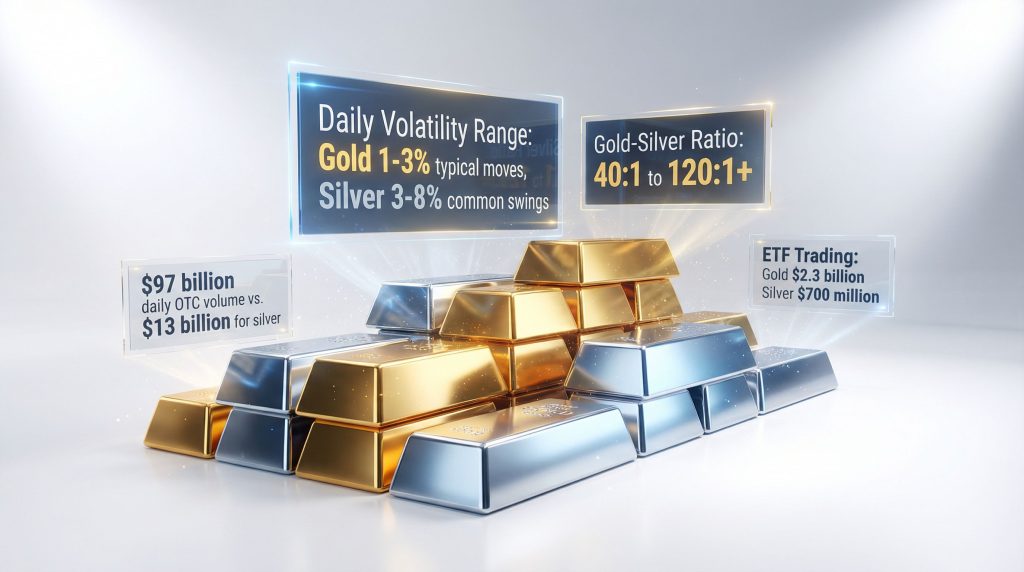
| Daily Volatility Range | 1-3% typical moves | 3-8% common swings |
| Crisis Correlation to Equities | -0.3 to -0.5 during drawdowns | +0.1 to +0.3 in severe stress |
| Institutional Holdings Base | $15 trillion global financial form | Significantly smaller institutional base |
| Central Bank Annual Demand | 1,000+ tonnes | Minimal accumulation |
The World Gold Council identifies key differences that gold benefits from balanced demand across consumers, investors, and central banks, while silver demand remains dominated by industrial applications. This demand composition difference creates distinct psychological comfort levels among investors regarding long-term stability and crisis performance.
Volatility Tolerance and Investment Horizons
Gold's lower volatility profile (typically 1-3% daily moves) appeals to strategic, long-term investors focused on wealth preservation. Silver's higher volatility (3-8% daily moves) attracts tactical investors seeking to capitalise on market momentum and amplified price movements.
Recent performance data illustrates these psychological preferences. Silver prices surged 147% during 2025, significantly outpacing gold's 60% increase. However, detailed gold-silver ratio analysis reveals important relationship dynamics between the metals.
Silver reached above $100/oz in early 2026 before settling in the $75-81/oz range. Meanwhile, gold averaged above $4,000/oz for six months and currently trades between $4,800-5,000/oz.
Market Liquidity's Impact on Investor Confidence
Trading Volume Analysis and Psychological Comfort
The liquidity differential between gold and silver markets fundamentally shapes investor behaviour during stress periods. Gold's deeper market structure creates psychological comfort for large institutional investors who require the ability to adjust positions without significant market impact.
Daily Trading Volume Comparison (5-Year Averages):
| Trading Venue | Gold Volume | Silver Volume | Ratio |
|---|---|---|---|
| ETF Trading | $2.3 billion | $700 million | 3.3x |
| Futures Markets | $55 billion | $11 billion | 5.0x |
| OTC Activity | $97 billion | $13 billion | 7.5x |
The World Gold Council characterises gold as possessing comparable liquidity to major bond and currency markets, with $97 billion daily OTC volume supporting institutional confidence. Silver's $13 billion daily OTC volume, while substantial, creates bottleneck conditions when institutions attempt large position adjustments during crisis periods.
Bid-Ask Spreads and Transaction Cost Psychology
A critical psychological factor in precious metal investment decisions involves transaction cost expectations. Gold maintains an average bid-ask spread of 2 basis points, providing institutional-grade liquidity. Silver's average spread of 9 basis points represents four times wider spreads than gold, creating psychological barriers to frequent position changes.
During crisis periods, silver spreads spike to extremely high levels, making position initiation or liquidation costly for investors. This spread expansion creates anxiety among investors who may need to adjust portfolios rapidly during market stress. In addition, the liquidity difference significantly impacts trading decisions during volatile periods.
Supply Chain Psychology and Scarcity Perceptions
Geographic Concentration and Security Concerns
Silver's concentrated Latin American production base versus gold's geographically diversified mining creates distinct supply disruption anxieties among investors. This concentration risk amplifies volatility during geopolitical tensions affecting key producing regions, as investors factor potential supply interruptions into their risk assessments.
Supply Source Composition Analysis:
| Supply Source | Gold Contribution | Silver Contribution |
|---|---|---|
| Primary Mining | ~67% of supply | ~81% of supply |
| Recycling Recovery | ~33% of supply | ~19% of supply |
| Production Flexibility | Independent mining decisions | By-product dependency |
Silver's 81% dependence on primary mining compared to gold's 67% creates supply rigidity concerns. Silver production primarily occurs as a by-product of copper, lead, and zinc mining, meaning silver supply cannot be independently increased when prices rise.
Recycling Infrastructure and Secondary Supply Confidence
Gold recycling contributes approximately one-third of global supply and remains profitable across various price ranges. This robust secondary supply provides psychological comfort regarding long-term availability. Silver recycling accounts for only 19% of supply, reflecting dispersion across electronics, solar panels, and industrial applications where recovery often proves uneconomical.
Furthermore, silver market squeeze insights reveal how supply constraints can dramatically impact market dynamics. The World Gold Council emphasises that gold benefits from more stable secondary supply, whereas silver faces structurally tighter physical market conditions.
Gold-Silver Ratio as Sentiment Indicator
What Does the Historical Ratio Tell Us About Risk Appetite?
The gold-silver ratio serves as a powerful indicator of collective investor risk appetite, typically ranging from 40:1 during risk-on periods to 120:1+ during maximum uncertainty phases. Current ratio levels, with silver at $75-81/oz and gold at $4,800-5,000/oz, reflect moderate risk appetite with defensive positioning still elevated from recent crisis periods.
Behavioural finance theory suggests that investor psychological anchoring to historical price relationships creates predictable patterns when ratios deviate significantly from long-term averages. These behavioural biases generate tactical opportunities for sophisticated investors who understand the psychological foundations driving ratio movements.
Crisis Period Volume Behavior and Investor Psychology
Volume Spike Analysis During Market Stress
February 2026 demonstrated dramatic volume expansion in silver markets across all trading venues:
- ETF volumes: Reached $11.4 billion daily (9x the 2025 average)
- Futures volumes: Jumped to $71 billion daily (4x the 2025 average)
- OTC activity: Increased to $59 billion daily (3x the 2025 average)
This multi-venue volume expansion reflects rapid sentiment shifts when industrial demand narratives change. The asymmetric volume expansion suggests retail investor participation drove much of the volatility, highlighting the different investor bases between gold and silver markets.
Consequently, investors seeking to understand these patterns should examine the historic gold surge explanation for context on recent precious metals performance.
The next major ASX story will hit our subscribers first
Investment Allocation Psychology and Portfolio Construction
How Do Risk-Adjusted Position Sizing Frameworks Work?
Due to silver's higher volatility profile, equal risk contribution strategies typically require materially smaller notional allocations to silver compared to gold. This mathematical reality shapes portfolio construction psychology and explains why gold maintains larger absolute investment flows despite silver's potentially higher returns.
Strategic Versus Tactical Positioning Psychology:
- Gold positioning: Strategic, long-term wealth preservation mindset
- Silver positioning: Tactical, opportunistic leverage-seeking behaviour
- Portfolio role: Gold as core hedge, silver as satellite amplifier
The World Gold Council notes that for portfolios seeking crisis diversification, gold's negative correlation to stock markets during drawdowns underpins its role as a hedge. Silver does not consistently provide the same protection, limiting its stabilising role during market stress periods.
However, implementing effective gold investment strategies requires understanding both metals' distinct characteristics within portfolio construction frameworks.
Industrial Demand Complex and Dual Identity Psychology
Competing Market Narratives
Silver's dual identity as both precious and industrial metal creates conflicting psychological signals for investors. During economic expansion phases, industrial demand psychology dominates, causing silver to trade with higher correlation to cyclical commodities. During recession fears, precious metal defensive positioning competes with industrial demand contraction.
The World Gold Council explicitly states that silver demand is dominated by industry demand, which increases exposure to pro-cyclical risk sentiment. Silver therefore trades closer to industrial metals and risky assets during periods of market stress and economic deceleration.
Technology Sector Influence on Investment Psychology
Silver's essential role in electronics, solar panels, and renewable energy technologies creates investment psychology influenced by technology sector trends. Investors must simultaneously evaluate precious metal dynamics and industrial demand forecasts, creating complexity absent from gold investment decisions.
Behavioural Finance Theory and Future Market Dynamics
Psychological Anchoring Effects
Investor psychological anchoring to historical precious metal performance relationships creates systematic behavioural patterns during market stress. Gold's historical role as the ultimate safe haven creates anchoring bias where investors automatically allocate to gold during uncertainty, regardless of relative valuation metrics.
Silver's historical volatility creates different anchoring effects, where investors expect amplified moves and position accordingly. This expectation often becomes self-fulfilling as volatility expectations influence trading behaviour and market structure.
Institutional Versus Retail Psychology Differences
Institutional investors prioritise liquidity, correlation stability, and regulatory treatment when selecting precious metal exposure. Gold's established institutional infrastructure and central bank acceptance creates psychological comfort unavailable with silver investments.
Retail investors often focus on potential percentage gains and momentum characteristics, making silver's volatility profile attractive rather than concerning. This investor base difference contributes to distinct market behaviour patterns during various market conditions.
Complementary Investment Psychology Framework
The behavioural analysis reveals that gold and silver market differences manifest because they serve fundamentally different psychological needs within investment portfolios. Gold satisfies defensive, wealth-preservation psychology through portfolio insurance mechanisms. Silver appeals to growth-oriented, leverage-seeking investor mindsets seeking amplified precious metal exposure.
Understanding these psychological foundations enables more effective precious metal allocation strategies aligned with specific investor risk profiles and market cycle positioning. Rather than viewing gold and silver as substitutable assets, the psychological evidence suggests they function as complementary components serving distinct behavioural investment needs.
The gold and silver market differences ultimately stem from investor psychology rather than fundamental similarities as precious metals. These behavioural distinctions create persistent market characteristics that sophisticated investors can leverage for enhanced portfolio construction and crisis preparation strategies.
Disclaimer: This analysis involves forecasts and market psychology assessments that are speculative in nature. Past performance does not guarantee future results. Investors should conduct their own research and consider their individual risk tolerance before making precious metal allocation decisions.
Ready to Capitalise on Precious Metal Market Opportunities?
Discovery Alert's proprietary Discovery IQ model delivers real-time notifications on significant ASX mineral discoveries, including precious metals opportunities that could benefit from the psychological market dynamics discussed above. Begin your 14-day free trial today at Discovery Alert to gain immediate access to actionable investment insights and position yourself ahead of market movements.