June 11, 2026
Global economic forces shape precious metal valuations through complex monetary mechanisms that extend far beyond simple supply and demand dynamics. Understanding the history of precious metal prices requires examining how central bank policies, currency debasement patterns, and structural economic shifts have created the modern investment landscape for gold, silver, platinum, and palladium.
Currency Debasement and Monetary Policy Evolution
The foundation of modern precious metal price behaviour stems from fundamental changes in global monetary systems over the past five decades. Following the abandonment of the Bretton Woods system in 1971, precious metals transitioned from fixed-price monetary anchors to free-floating investment assets, creating entirely new price discovery mechanisms.
Central bank balance sheet expansion has become a primary driver of precious metal appreciation since the global financial crisis. When major central banks implement quantitative easing programmes, they effectively increase the money supply while simultaneously reducing interest rates, creating conditions that historically favour precious metal ownership. This monetary expansion reduces the opportunity cost of holding non-yielding assets like gold and silver.
Real purchasing power analysis reveals how precious metals have served as hedges against currency depreciation over extended periods. While nominal prices may fluctuate dramatically in the short term, inflation-adjusted returns demonstrate precious metals' ability to preserve wealth across different economic cycles. During periods of aggressive monetary expansion, this preservation function becomes particularly pronounced.
Interest rate environments significantly impact precious metal valuations through opportunity cost calculations. When real interest rates turn negative, precious metals become more attractive relative to yield-bearing alternatives. Investors must weigh the cost of foregone interest income against the potential benefits of owning assets that may appreciate during periods of monetary instability.
When big ASX news breaks, our subscribers know first
Historical Economic Cycles and Price Formation
The transformation from the Bretton Woods era to modern floating exchange rate systems created distinct phases in precious metal price evolution. Each period brought unique economic pressures that shaped long-term valuation trends and established precedents for contemporary market behaviour.
Post-War Monetary Stability (1944-1971)
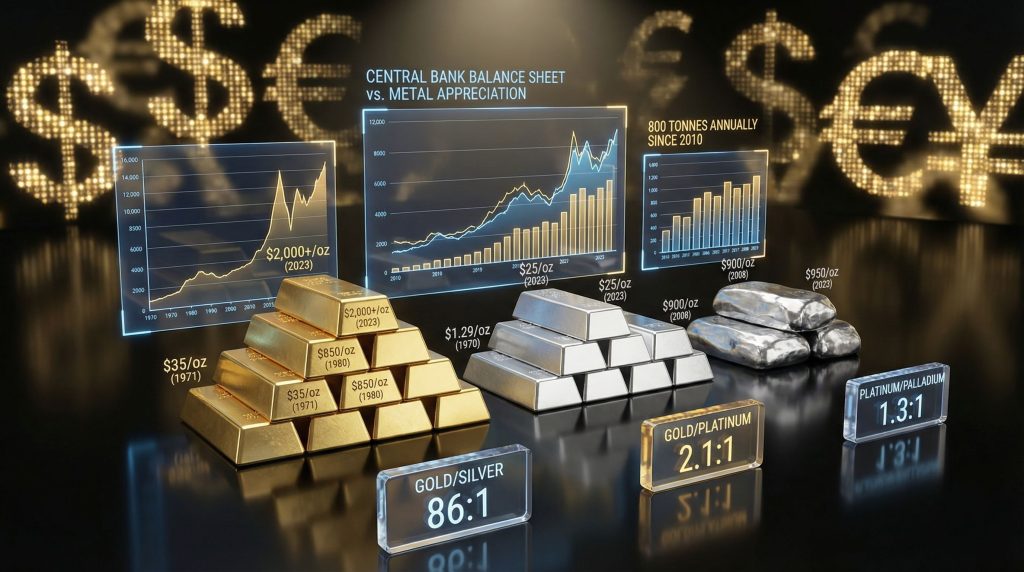
During the Bretton Woods period, gold maintained a fixed price of $35 per ounce, serving as the anchor for the international monetary system. This artificial price stability masked underlying economic pressures that would eventually force dramatic policy changes. Silver began its transition away from monetary use during this period, setting the stage for its evolution into an industrial commodity.
The collapse of this system in 1971 unleashed decades of pent-up price pressure. Historical data shows gold prices surged from $35 to over $800 per ounce by 1980, reflecting not only monetary policy changes but also broader economic challenges including energy crises and stagflation. This period established precious metals as alternative stores of value during times of currency instability.
Modern Crisis Response Era (1980-Present)
The subsequent decades witnessed several distinct cycles that shaped current precious metal market structure:
Disinflationary Period (1980-2000): Strong dollar policies and declining inflation expectations created headwinds for precious metals. Furthermore, gold fell from its 1980 highs to lows near $300 per ounce, while silver experienced similar pressure.
Technology Bubble Aftermath (2000-2008): Federal Reserve rate cuts following the dot-com crash initiated a new precious metals bull market. In addition, gold prices record highs began a steady climb from approximately $300 to over $1,000 per ounce.
Financial Crisis Response (2008-2012): Unprecedented monetary policy interventions, including multiple quantitative easing programmes, drove gold to record highs above $1,900 per ounce. Consequently, silver reached peaks near $50, demonstrating its tendency to amplify trends.
Normalisation Attempts (2013-2019): Federal Reserve efforts to normalise monetary policy created consolidation periods for precious metals, with prices trading in broad ranges as markets adjusted to changing policy expectations.
Pandemic Response (2020-Present): Massive fiscal and monetary stimulus measures drove renewed interest in precious metals as inflation hedges and currency alternatives.
Industrial Versus Monetary Demand Dynamics
Different precious metals exhibit varying sensitivities to industrial versus monetary demand factors, creating distinct price behaviour patterns that investors must understand when building portfolios or analysing market trends.
Gold's Monetary Premium
Gold maintains the strongest monetary characteristics among precious metals, with central bank demand representing a significant portion of annual consumption. However, emerging market central banks have increased their gold reserves substantially since 2010, reflecting concerns about currency diversification and monetary system stability.
Central bank gold purchases have averaged over 400 tonnes annually since 2010, representing the strongest institutional accumulation period in decades and highlighting gold's enduring monetary relevance.
Retail investment demand through exchange-traded funds and digital platforms has democratised gold ownership, creating new price transmission mechanisms. These investment vehicles allow smaller investors to participate in gold markets without the logistical challenges of physical ownership, potentially increasing price volatility during periods of heightened market stress.
Jewellery demand, particularly from emerging markets, provides a baseline level of consumption that supports prices during economic downturns. This demand tends to be price-sensitive, with higher gold prices reducing jewellery consumption and vice versa.
Silver's Industrial Transformation
Silver demonstrates unique price characteristics due to its dual role as both an investment asset and critical industrial input. Technology sector consumption, including solar panel production and electronics manufacturing, has grown significantly over the past two decades.
The industrial demand component creates different price dynamics compared to gold. For instance, economic growth expectations can drive silver prices higher even when monetary conditions might not favour precious metals generally. Conversely, industrial recession concerns can pressure silver prices despite supportive monetary conditions.
Supply constraints from silver's nature as primarily a mining by-product add complexity to price formation. Most silver comes from lead, zinc, and copper mining operations, meaning silver supply responds more to base metal economics than silver price levels themselves.
Furthermore, the silver market squeeze potential reflects these unique supply-demand dynamics that distinguish silver from other precious metals.
Platinum Group Metals and Automotive Cycles
Platinum and palladium exhibit strong correlations with automotive industry production cycles due to their critical role in catalytic converter manufacturing. Vehicle production levels, emission standard changes, and technological shifts toward electric vehicles all impact demand patterns.
The following table illustrates key ratio relationships that provide insight into relative value and economic conditions:
| Metal Ratio | Historical Average | Current Implications |
|---|---|---|
| Gold/Silver Ratio | 60:1 | Values above 80:1 suggest silver undervaluation |
| Gold/Platinum Ratio | 0.9:1 | Values above 1.5:1 indicate economic uncertainty |
| Platinum/Palladium Ratio | 2.5:1 | Current levels reflect automotive demand shifts |
Additionally, detailed gold/silver ratio analysis provides insights into market timing opportunities for precious metals investors.
Macroeconomic Indicators and Price Relationships
Precious metal prices respond to various macroeconomic indicators through different transmission mechanisms. Understanding these relationships helps investors position portfolios appropriately for different economic environments.
Real Interest Rate Environment
Real interest rates, calculated as nominal rates minus inflation expectations, represent perhaps the most important macroeconomic driver of precious metal prices. When real rates turn negative, precious metals become more attractive as they provide potential inflation protection without the erosion of purchasing power experienced by cash holdings.
Federal Reserve policy stance changes create ripple effects throughout global precious metal markets. However, policy signals regarding future rate paths often generate more price movement than actual rate changes themselves, as markets attempt to anticipate future conditions.
The relationship between gold bonds dynamics demonstrates how interest rate environments affect precious metal valuations across different economic cycles.
Currency Market Interactions
Dollar strength or weakness significantly influences precious metal pricing, as most metals trade in dollar-denominated markets. Currency market dynamics create complex feedback loops where precious metal strength can signal currency concerns, which in turn may drive additional precious metal demand.
Trade-weighted currency indices provide better insight into precious metal price movements than bilateral exchange rates. When the dollar weakens against a broad basket of currencies, precious metals typically benefit as they become cheaper for non-dollar investors.
Inflation Expectations Versus Reality
Market-based inflation expectations, measured through instruments like Treasury Inflation-Protected Securities (TIPS) breakeven rates, often influence precious metal prices more than realised inflation data. Forward-looking measures capture investor sentiment about future monetary policy effectiveness.
Different inflation measures can provide conflicting signals for precious metal investments. Core inflation measures exclude volatile food and energy prices, while alternative metrics attempt to capture asset price inflation or broader monetary phenomena.
Technological and Structural Market Evolution
Modern precious metal markets operate through significantly different mechanisms than historical markets, creating new price discovery processes and volatility patterns that affect both institutional and retail investors.
Electronic Trading and Price Discovery
Electronic trading platforms have increased market efficiency whilst potentially amplifying short-term volatility. Algorithm-driven trading systems can execute large volumes of transactions in milliseconds, creating price movements that may not reflect underlying supply and demand fundamentals.
Exchange-traded fund creation and redemption mechanisms have created new arbitrage opportunities whilst providing institutional investors with efficient precious metal exposure. These mechanisms help maintain pricing efficiency between physical metals and financial instruments representing metal ownership.
Supply Chain Modernisation
Mining technology improvements have shifted cost curves for precious metal production, affecting long-term price supports and resistance levels. Modern extraction techniques can make previously uneconomical deposits profitable, potentially increasing supply responsiveness to price changes.
Recycling technology advancement has created more efficient secondary supply sources, particularly for platinum group metals used in automotive applications. This secondary supply can respond more quickly to price changes than primary mining production.
Geopolitical supply concentrations continue to influence pricing, particularly for platinum and palladium, where South African and Russian production dominates global supply. Political instability or trade restrictions in these regions can create significant price premiums.
Investment Strategy Frameworks for Precious Metals
Portfolio allocation strategies for precious metals must account for their unique risk and return characteristics whilst considering correlation patterns with other asset classes during different market environments.
Modern Portfolio Theory Applications
Traditional mean variance optimisation often underweights precious metals due to their volatility relative to bonds and dividend-paying stocks. However, these models may not fully capture precious metals' defensive characteristics during periods of financial stress or currency instability.
Risk parity approaches that focus on risk contribution rather than dollar allocation may provide more appropriate frameworks for including precious metals in diversified portfolios. These strategies typically result in higher precious metal allocations than traditional optimisation methods.
Economic Cycle Positioning
Tactical allocation strategies can adjust precious metal exposure based on economic cycle analysis and monetary policy expectations. Different metals may perform better during various phases of economic expansion or contraction.
Early Cycle: Industrial metals like silver and platinum may outperform as economic growth accelerates.
Late Cycle: Gold often benefits as investors seek defensive assets amid peak economic conditions.
Recession: All precious metals may benefit from monetary policy responses and safe-haven demand.
Recovery: Metal performance depends on the nature of policy responses and currency stability.
Risk Management Considerations
Volatility clustering patterns in precious metal prices require careful position sizing to avoid excessive portfolio volatility during stressed market conditions. Historical correlation analysis shows these correlations can change dramatically during crisis periods.
Liquidity considerations vary significantly across different precious metal investment vehicles. Physical ownership provides ultimate security but may lack liquidity during market stress. ETFs and futures markets provide liquidity but introduce counterparty risks.
The next major ASX story will hit our subscribers first
Current Market Indicators and Future Implications
Contemporary precious metal price levels reflect numerous ongoing economic and geopolitical factors that may influence future price trajectories and investment opportunities.
Central Bank Policy Divergence
Different monetary policy paths among major central banks create currency volatility that often benefits precious metal prices. When policy divergence creates uncertainty about relative currency values, precious metals can serve as neutral alternatives.
Emerging market central bank policies increasingly influence global precious metal demand as these economies grow and seek to diversify reserve holdings away from traditional currencies.
Fiscal Sustainability Concerns
Growing government debt levels in developed economies raise questions about long-term currency stability and may support precious metal demand as alternative stores of value. Debt-to-GDP ratios in many countries have reached levels that historically preceded monetary system changes.
The gold price forecast considers these fiscal pressures when analysing future price potential for precious metals investments.
Digital Currency Competition
The emergence of cryptocurrencies and central bank digital currencies creates both competition and complementarity with precious metals as alternative monetary assets. Some investors view precious metals and digital assets as serving similar portfolio functions, while others see them as addressing different types of systemic risks.
Frequently Asked Questions About Precious Metal Price History
Why Do Precious Metal Prices Experience Such Dramatic Long-Term Cycles?
Precious metal price cycles reflect the interaction of monetary policy changes, economic growth patterns, and investor sentiment shifts that can take years or decades to fully play out. Unlike many commodities, precious metals serve both industrial and monetary functions, creating complex demand patterns that respond to different economic forces.
How Reliable Are Precious Metals as Long-Term Wealth Preservation Tools?
Historical evidence suggests precious metals have maintained purchasing power over very long periods, but with significant volatility during intermediate timeframes. Their effectiveness as wealth preservation tools depends largely on the time horizon and specific economic conditions during holding periods.
What Distinguishes Each Precious Metal in Terms of Investment Characteristics?
Gold exhibits the strongest monetary properties and tends to perform well during currency crises and geopolitical uncertainty. Silver amplifies trends due to its smaller market size and industrial demand components. Platinum and palladium correlate more closely with industrial economic cycles, particularly automotive production patterns.
Furthermore, live price tracking helps investors monitor these distinct characteristics across different market conditions.
Disclaimer: This analysis is for educational purposes only and should not be considered investment advice. Precious metal investments carry significant risks, including price volatility and potential for loss. Past performance does not guarantee future results. Investors should consult with qualified financial advisors before making investment decisions.
Ready to Discover the Next Major Precious Metal Investment Opportunity?
Discovery Alert provides instant notifications on significant ASX mineral discoveries, including precious metal finds, powered by its proprietary Discovery IQ model that transforms complex geological data into actionable investment insights. Start your 30-day free trial today to gain a competitive advantage in precious metal mining discoveries and position yourself ahead of market movements.