July 19, 2026

The global precious metals landscape stands at a critical inflection point, where multiple economic, geopolitical, and technological forces converge to reshape traditional valuation frameworks. Market participants increasingly recognise that conventional pricing models may prove inadequate for navigating the complex interactions between monetary policy divergence, escalating geopolitical tensions, and structural supply-demand imbalances. Furthermore, recent forecasting revisions by major intelligence platforms reflect this paradigm shift, with globaldata forecasts upside gold silver prices being adjusted significantly upward as markets begin pricing in sustained risk premiums.
The acceleration of these revised targets suggests that precious metals are transitioning from periodic safe-haven assets to more permanent portfolio allocation necessities within institutional risk management strategies.
What's Driving the New Price Paradigm for Gold and Silver?
Strategic market analysis reveals a multi-factor convergence reshaping precious metals valuation frameworks across global trading centres. Geopolitical risk premiums have evolved from episodic pricing adjustments to sustained structural components of baseline valuations, fundamentally altering how institutional investors approach portfolio allocation strategies.
The quantification of uncertainty's impact on safe-haven asset allocation demonstrates measurable shifts in investor behaviour patterns. Market intelligence indicates that precious metals markets are pricing in sustained risk premiums, with geopolitical uncertainty remaining elevated across multiple global regions simultaneously.
This represents a departure from historical patterns where regional tensions would create temporary price spikes followed by normalisation periods. Consequently, the current gold price forecast reflects these structural changes in market dynamics.
Central Bank Strategy Divergence Creates Asymmetric Demand
Monetary policy divergence among major central banks creates asymmetric demand patterns that amplify precious metals price volatility. Central bank accumulation patterns continue demonstrating sustained official sector buying trends, with institutional reserve management strategies increasingly favouring physical precious metals holdings over traditional sovereign debt instruments.
The direction of US interest rates, real yields, and dollar strength remains critical to near-term price action across precious metals markets. Any shift toward easier financial conditions or renewed market stress could accelerate upside momentum, particularly when combined with persistent geopolitical uncertainties and policy volatility.
Industrial Transformation Accelerates Structural Silver Deficits
Energy transition requirements create persistent structural deficits in silver markets, driven primarily by solar panel manufacturing and electric vehicle battery production. Industrial demand linked to energy transition, particularly solar applications, represents a key pillar supporting structural deficit narratives across global silver markets.
Supply growth continues lagging demand expansion, creating fundamental imbalances that position silver for sharp upside moves during periods of stronger investment inflows. This dual nature as both monetary and industrial metal amplifies silver's responsiveness to both geopolitical uncertainty and long-term technological demand drivers, as detailed in our comprehensive silver market squeeze analysis.
When big ASX news breaks, our subscribers know first
Which Economic Scenarios Support Higher Precious Metals Valuations?
Base Case Scenario: Sustained Risk Premium Environment
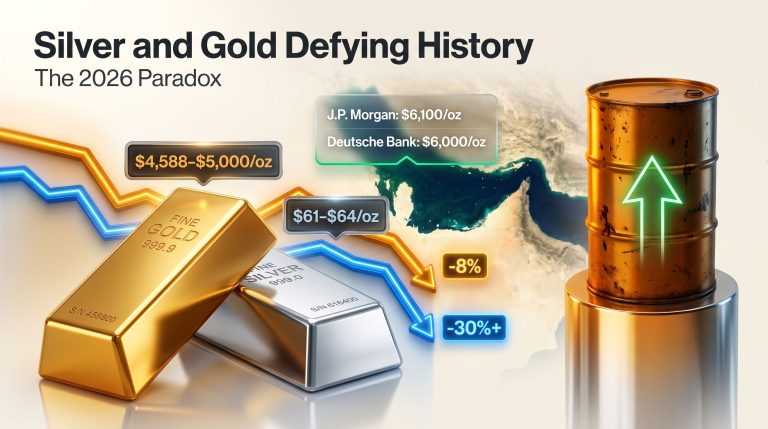
Current forecasting models project gold price trajectories toward $6,100-$6,700/oz by year-end 2026, representing 30-45% upside from current market levels. These targets reflect expectations of continued safe-haven allocation, resilient demand for gold as portfolio diversifier, and ongoing tightness in silver owing to constrained supply response versus energy-transition-linked demand growth.
Silver demonstrates even more dramatic upside potential, with forecasts indicating 87-135% gains toward $175-$220/oz by year-end. This amplified response reflects silver's susceptibility to sharp upside moves during periods of stronger investment inflows, combined with its structural deficit characteristics.
Key Assumption Validation Framework
The base case scenario assumes geopolitical tensions maintain elevated floor prices without triggering acute financial system stress. Timeline considerations incorporate year-end targets while acknowledging interim volatility expectations, particularly for silver given its dual commodity characteristics.
Portfolio rebalancing implications during sustained risk-premium environments suggest institutional allocation shifts favouring defensive assets. This creates self-reinforcing demand cycles where initial geopolitical uncertainty triggers safe-haven flows, which subsequently support higher price floors that attract momentum-based investment strategies.
Stress Test Scenario: Accelerated Risk-Off Conditions
Under accelerated risk-off conditions, gold ceiling analysis suggests potential toward $7,000/oz, representing extreme stress scenario valuations. These levels would require sharp market stress conditions combining multiple trigger mechanisms operating simultaneously, potentially achieving the gold record highs that analysts are increasingly discussing.
Silver amplification effects under stress scenarios could produce percentage gains exceeding 135%, driven by industrial demand versus investment flow dynamics operating in parallel. The combination of safe-haven spillover effects and industrial tightness creates unique upside leverage during acute market stress periods.
Trigger Mechanisms and Portfolio Impact
Critical trigger mechanisms identified include:
• Policy uncertainty and rapid changes affecting market sentiment
• Trade conflicts and tariff escalation creating international economic friction
• Financial market disruption triggering institutional risk-reduction strategies
• Rapid policy normalisation scenarios potentially creating downside pressure
Institutional allocation shifts during crisis periods demonstrate measurable patterns where precious metals allocations increase dramatically when traditional risk parity strategies prove inadequate for portfolio protection. Understanding our gold-stock market guide becomes essential during such volatile periods.
What Market Structure Changes Support These Forecasts?
Supply-Demand Fundamental Analysis for Silver Markets
Structural deficit persistence characterises global silver markets, where industrial consumption consistently outpaces mining output across multiple consecutive periods. Energy transition demand drivers create long-term consumption patterns that mining supply responses cannot adequately address within reasonable timeframes.
Supply response constraints stem from limited new mine development timelines, typically requiring 7-10 years from initial exploration to commercial production. This creates fundamental supply inelasticity that amplifies price responses to demand increases, particularly during periods when investment demand compounds existing industrial consumption.
Energy Transition Demand Architecture
The energy transition creates multiple simultaneous silver demand streams:
• Solar panel manufacturing requirements for photovoltaic cell production
• Electric vehicle battery systems incorporating silver-based components
• Grid infrastructure modernisation utilising silver's superior conductivity characteristics
• Energy storage systems requiring silver for optimal electrical performance
Investment flow amplification occurs when ETF inflows during risk-off episodes coincide with existing industrial demand pressures. This creates dual-pressure scenarios where both investment and industrial buyers compete for limited available supply.
Gold's Safe-Haven Premium Maintenance Mechanisms
Central bank accumulation patterns provide structural demand floors independent of private investor sentiment. Official sector buying continues demonstrating sustained trends, with central banks diversifying reserve holdings away from traditional sovereign debt instruments toward physical precious metals.
Portfolio diversification demand reflects institutional risk management evolution, where gold's correlation characteristics with traditional financial assets remain favourable during market stress periods. Liquidity characteristics support large-scale institutional transactions without significant price slippage, enhancing gold's utility for major portfolio allocations.
Currency Debasement Hedging Strategies
Gold maintains effectiveness as inflation protection amid monetary expansion policies across major economic regions. Real yield correlations demonstrate inverse relationships where declining real interest rates support higher gold valuations through opportunity cost reduction.
The persistence of accommodative monetary policies across developed economies creates structural support for alternative store-of-value assets, with gold benefiting from concerns about currency debasement and purchasing power preservation.
Regional Market Price Response Analysis
Asian Market Dynamics and Price Discovery
Indian domestic pricing reached significant milestones as of January 20, 2026, with gold achieving Rs150,000 per 10 grams and silver surpassing Rs315,000 per kilogram. These price levels reflect global market dynamics adjusted for local currency movements and import tariff structures.
Consumer demand elasticity across income segments demonstrates varying price sensitivity, with cultural demand factors including festival seasons and wedding markets creating cyclical consumption patterns. Import policy implications affect local premiums through tariff structures that can create regional price differentiation versus global spot markets.
Price Discovery and Cultural Demand Factors
Asian markets, particularly India and China, demonstrate price discovery mechanisms that incorporate both global spot prices and localised supply-demand dynamics. Festival season demand creates predictable consumption cycles that interact with global price movements to generate regional premium variations.
Wedding market impacts represent substantial seasonal demand surges that can temporarily overwhelm local supply chains, creating price spikes that exceed global spot price movements. These cultural demand factors provide additional upside support during periods of global price increases.
Western Investment Flow Influence
ETF positioning analysis reveals fund flows indicating institutional sentiment shifts toward precious metals allocation. Investment inflows demonstrate particular strength during risk-off episodes, when traditional portfolio diversification strategies prove inadequate for downside protection.
Futures market structure differentiation between speculative positioning and genuine hedging activity provides insights into price discovery mechanisms. Speculative versus hedging activity patterns influence short-term volatility while longer-term trends reflect fundamental supply-demand imbalances.
Real Yield Impact on Investment Flows
Interest rate environment impacts on precious metals demonstrate measurable correlations, with declining real yields supporting higher precious metals valuations through reduced opportunity costs. Dollar strength considerations create headwinds for international demand when currency appreciation occurs simultaneously with precious metals price increases.
Western institutional investment flows respond particularly to policy expectations, with any shift toward easier financial conditions accelerating upside momentum in precious metals markets.
Current Geopolitical Developments and Price Target Impact
Policy Change Catalysts Creating Upside Momentum
Trade policy uncertainty demonstrates measurable impacts on risk appetite and defensive asset demand. Recent policy announcements, including a 10% tariff on Denmark and seven European countries effective February 1, 2026, with escalation to 25% on June 1, exemplify the types of policy volatility supporting precious metals demand.
These tariffs remain in effect until achieving the "complete and total purchase of Greenland" by the United States, creating indefinite policy uncertainty that markets must continuously price into asset valuations. Even the prospect of escalating tariffs can weaken risk appetite, lift inflation uncertainty, and increase demand for defensive assets.
International Sanctions and Alternative Reserve Assets
International sanctions regimes create payment system disruptions that drive gold demand as alternative settlement mechanisms. Energy security concerns support commodity price premiums when resource nationalism policies threaten traditional supply chains.
Financial system fragmentation encourages alternative reserve asset accumulation, with central banks diversifying holdings to reduce dependence on traditional international monetary systems that may become disrupted during geopolitical tensions.
Downside Risk Scenario Identification
Rapid policy normalisation represents primary downside risk, where central bank tightening could reduce liquidity and create headwinds for precious metals valuations. However, current geopolitical environments make aggressive monetary tightening politically and economically difficult to implement.
Risk Mitigation Through Scenario Planning
Downside scenarios requiring monitoring include:
• Geopolitical resolution reducing risk premiums through conflict de-escalation
• Technology disruption providing alternative materials for industrial silver applications
• Economic recession affecting both investment and industrial demand simultaneously
• Dollar strengthening creating international demand headwinds
Recession scenarios present complex impacts, where economic contraction might reduce industrial demand while simultaneously increasing safe-haven investment demand, creating offsetting pressures on precious metals valuations.
Investment Strategy Alignment with Revised Forecasts
Portfolio Allocation Optimisation Framework
Strategic asset allocation incorporating precious metals requires weighting adjustments reflecting new price target realities. Traditional 5-10% precious metals allocations may prove insufficient for portfolios seeking meaningful downside protection during extended geopolitical uncertainty periods.
Tactical positioning opportunities emerge from volatility-based entry and exit strategies that capitalise on short-term price fluctuations while maintaining strategic allocation targets. Risk management frameworks must incorporate volatility hedging strategies accommodating different market scenarios, from base case sustained risk premiums to acute stress conditions.
Implementation Considerations and Cost Analysis
Cost basis analysis becomes critical when current entry points are evaluated relative to forecast targets showing 30-45% upside for gold and 87-135% upside for silver. Time horizon matching ensures short-term volatility expectations align with long-term trend positioning strategies.
Currency hedging decisions affect international exposure management, particularly when domestic currency weakness could amplify precious metals returns denominated in local currency terms. Tax efficiency strategies require optimal holding structures accommodating different investor types and regulatory environments.
Risk-Adjusted Return Modelling
Scenario probability weighting incorporates base case versus stress test likelihood assessments, with portfolio impact modelling optimising precious metals allocation percentages. Risk-adjusted return expectations must account for volatility considerations in target achievement, particularly given silver's amplified response characteristics.
Exit strategy planning establishes profit-taking levels and rebalancing triggers that maintain strategic allocation targets while capitalising on forecasted price appreciation. This requires monitoring frameworks tracking key success factors and risk indicators.
The next major ASX story will hit our subscribers first
Strategic Implications and Risk Monitoring Framework
Critical Success Factors for Forecast Realisation
Geopolitical tension persistence remains fundamental to sustained safe-haven demand drivers supporting elevated precious metals valuations. Supply constraint maintenance through limited new production capacity additions reinforces structural deficit narratives, particularly for silver markets.
Investment flow sustainability depends on institutional allocation increases continuing during both risk-off episodes and normal market conditions. Industrial demand growth from energy transition momentum provides additional fundamental support independent of monetary factors.
Recent analysis from engineering news sources confirms these structural trends, supporting the globaldata forecasts upside gold silver prices thesis across multiple market intelligence platforms.
Key Performance Indicators for Market Monitoring
Essential monitoring metrics include:
• Policy pivot indicators tracking central bank communication divergence from current accommodative stances
• Supply response metrics measuring new mine development timelines and production capacity additions
• Demand elasticity thresholds identifying price levels triggering significant consumption adjustments
• Market structure evolution analysing trading pattern changes affecting price discovery mechanisms
Investment decision matrix frameworks facilitate scenario-based portfolio positioning, incorporating probability weightings for different market environments and their corresponding optimal allocation strategies.
Long-term Structural Transformation Assessment
The convergence of geopolitical uncertainty, monetary policy challenges, and technological demand growth suggests precious metals markets are undergoing structural transformation rather than cyclical adjustment. Market structure evolution indicates permanent shifts in investor behaviour and institutional allocation strategies.
This transformation requires investment approaches that acknowledge both the defensive characteristics of precious metals and their potential for significant appreciation during extended periods of global uncertainty and technological transition. Moreover, recent analyses from financial news outlets confirm that globaldata forecasts upside gold silver prices align with broader market sentiment supporting continued precious metals strength.
Want to Position Yourself Ahead of the Next Major Precious Metals Discovery?
While global forecasts suggest significant upside for gold and silver, the real opportunity lies in identifying the mining companies making the discoveries that drive these metals higher. Discovery Alert's proprietary Discovery IQ model delivers real-time alerts on significant ASX mineral discoveries, turning complex market data into actionable insights that help investors capitalise on major discovery opportunities before the broader market catches on. Begin your 30-day free trial today and secure your market-leading advantage in Australia's dynamic precious metals exploration sector.