May 18, 2026
The precious metals drop on Kevin Warsh Fed appointment reflects broader market dynamics where Federal Reserve leadership transitions create ripple effects throughout global financial markets that extend far beyond traditional monetary policy channels. When analyzing how central bank decisions influence precious metals pricing, investors must examine the complex transmission mechanisms that connect institutional credibility, currency dynamics, and safe-haven demand patterns across interconnected global markets.
Understanding Central Bank Policy Transmission to Commodity Prices
The transmission from Fed appointments to commodity valuations operates through multiple pathways simultaneously. Currency strength adjustments create immediate inverse correlations with dollar-denominated precious metals, while institutional confidence shifts alter risk premium calculations embedded in safe-haven asset valuations. These mechanisms activated dramatically following Kevin Warsh's nomination announcement on January 31, 2026, when gold declined from $5,400.25/oz to $4,655.01/oz over four trading days.
Exchange-traded fund flows provide another critical transmission channel, as institutional investors rebalance portfolios based on revised monetary policy expectations. When political uncertainty premiums decrease following credible Fed appointments, ETF managers reduce precious metals allocations to optimize risk-adjusted returns. This rebalancing creates sustained selling pressure that amplifies initial price corrections beyond what fundamental supply-demand dynamics would suggest.
Key Transmission Mechanisms:
- Dollar strength inversions affecting international purchasing power
- Real interest rate recalculations changing opportunity costs
- Institutional portfolio rebalancing driving sustained flows
- Algorithmic trading responses amplifying volatility spikes
When big ASX news breaks, our subscribers know first
What Drives Precious Metals Volatility During Fed Transitions?
Market Psychology and Safe-Haven Demand Patterns
Precious metals volatility during Federal Reserve transitions stems from the intersection of technical trading mechanisms and psychological risk assessment adjustments. The precious metals drop on Kevin Warsh Fed appointment demonstrates how institutional confidence restoration can eliminate political uncertainty premiums that had supported elevated precious metals valuations, particularly when considering gold prices as inflation hedge.
Market psychology during Fed transitions operates through multiple layers of investor decision-making. Professional portfolio managers reassess allocation models based on revised central bank independence probability calculations, while algorithmic systems respond to volatility threshold breaches and correlation breakdown signals. Felipe Mendoza from IMB Capital Quants observed that Warsh's appointment specifically addressed investor concerns about central bank independence, directly reducing safe-haven asset appeal.
Volatility Amplification Factors:
| Factor | Gold Impact | Silver Impact | Duration |
|---|---|---|---|
| Political Uncertainty Premium | High negative | Moderate negative | 1-2 weeks |
| Margin Call Cascades | Amplified selling | Extreme selling | 3-5 days |
| ETF Rebalancing | Sustained pressure | Variable | 2-4 weeks |
| Currency Strength Shifts | Immediate inverse | Immediate inverse | Real-time |
Exchange Margin Requirements and Leveraged Position Unwinding
CME Group's margin requirement increases during the February 2026 precious metals correction created forced liquidation scenarios that amplified underlying price movements. When exchanges raise margin requirements to protect against counterparty risk during volatility spikes, leveraged funds face immediate capital calls that often trigger position liquidations regardless of fundamental market views.
The margin call cascade mechanism operates independently of precious metals supply-demand fundamentals. Funds maintaining leveraged long positions must either deposit additional collateral or reduce exposure when margin requirements increase. During the four-day correction period, heightened market volatility prompted CME Group to implement higher margin requirements, compelling both institutional leveraged funds and retail traders to liquidate positions.
Mining equity performance during this period demonstrated classic operational leverage amplification. Furthermore, the silver market squeeze dynamics contributed to additional volatility pressures across precious metals markets.
North American Mining Stock Performance:
- McEwen Mining: -19.3%
- Kinross Gold: -17.1%
- Newmont: -14.5%
- Agnico Eagle: -14.4%
Canadian-Listed Precious Metals Miners:
- Orla Mining: -23.2%
- Endeavour Silver: -21.5%
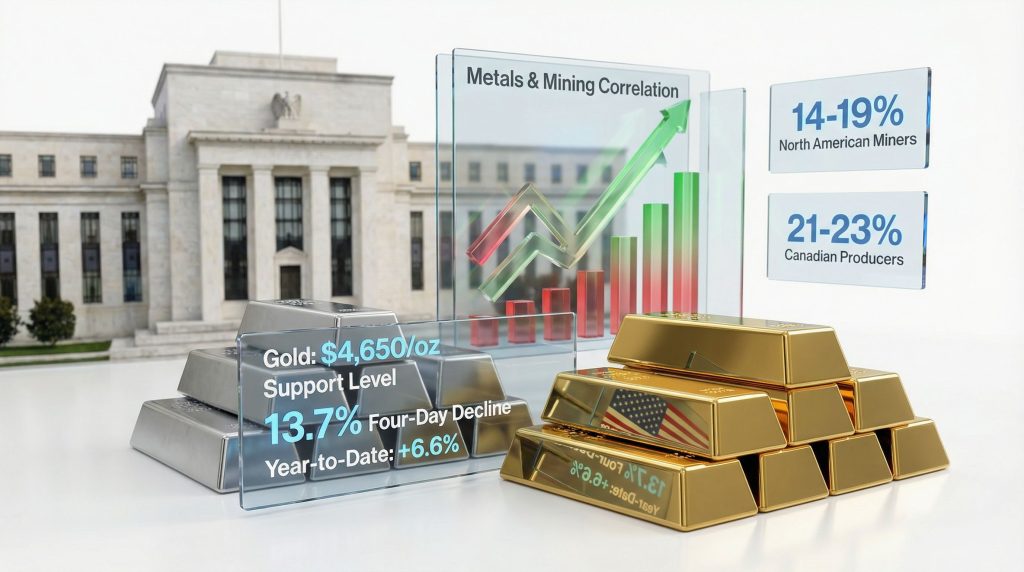
These equity declines demonstrate the 1.2-1.4x amplification factor typical during precious metals corrections, with Canadian miners showing higher volatility due to their concentrated precious metals exposure compared to diversified global mining operations.
Why Kevin Warsh's Fed Nomination Matters for Monetary Policy
Institutional Credibility and Market Confidence Restoration
Kevin Warsh's nomination as Federal Reserve Chair represents a strategic appointment prioritising institutional independence over political accommodation. His background as a former Fed Governor with experience navigating the 2008 financial crisis, combined with his academic and private sector investment experience, establishes credibility across multiple constituencies critical for central bank effectiveness.
Market participants had previously embedded political interference risk premiums in precious metals valuations due to concerns about alternative candidates. Derek Halpenny from MUFG noted that both Kevin Hassett and Rick Rieder were perceived as inexperienced and too close to President Trump, making them susceptible to political influence. Warsh's appointment eliminates these tail risks whilst maintaining support for accommodative monetary policy.
Warsh's Qualifying Experience:
- Former Federal Reserve Governor during 2008 financial crisis
- Background spanning public service, private investment, and academia
- Known policy position supporting lower interest rates
- Strong advocacy for maintaining Fed institutional independence
Comparing Alternative Fed Chair Scenarios
The market's positive response to Warsh's nomination becomes clearer when contrasted with alternative scenarios that had elevated precious metals uncertainty premiums. Political interference concerns had intensified following Trump's public criticism of Jerome Powell, including labelling him a stubborn mule and suggesting he could be removed from office.
Gabriela Siller from Banco Base emphasised that Warsh is viewed as relatively neutral despite his inclination toward rate cuts, distinguishing between policy direction preferences and institutional independence maintenance. This distinction proved crucial for market confidence, as investors had primarily concerned themselves with Federal Reserve institutional capture rather than specific rate policy outcomes.
The constitutional protections surrounding Federal Reserve Board appointments provide additional institutional stability. Trump's attempted removal of Fed member Lisa Cook over alleged mortgage fraud was blocked by courts whilst her legal challenge proceeds, demonstrating the legal framework that constrains executive influence regardless of Fed Chair selection.
How Interest Rate Expectations Shape Precious Metals Valuations
Real Interest Rate Calculations and Opportunity Cost Analysis
Precious metals compete directly with interest-bearing assets through real interest rate dynamics that determine the opportunity cost of holding non-yielding investments. The Federal Reserve's recent policy trajectory illustrates this competitive relationship: after raising rates sharply from near-zero levels to multi-decade highs during 2022-2023 to combat inflation, the Fed has cautiously reduced rates by 1% in late 2024 and another 0.75% from September 2025 onward.
Real interest rate calculations drive precious metals investment decisions through a straightforward framework: Nominal Rate minus Inflation Expectation equals Real Rate. When real rates rise, the opportunity cost of holding non-yielding precious metals increases, reducing investment demand. Conversely, negative real rates enhance precious metals attractiveness as wealth preservation vehicles.
Current Rate Environment Impact:
The Fed's most recent policy meeting left benchmark rates unchanged, reflecting ongoing caution amid economic uncertainty. This pause in rate reductions, combined with the precious metals drop on Kevin Warsh Fed appointment reducing political interference risks, creates a more predictable monetary policy environment that reduces the uncertainty premium previously supporting precious metals demand.
Federal Open Market Committee Decision-Making Structure
The FOMC's 12-member collective decision-making structure limits any single Fed Chair's influence over actual policy implementation. While the Chair traditionally plays a key role in shaping discussions and guiding consensus, the committee's dual mandate requires balancing inflation control and full employment support through collaborative analysis rather than unilateral decisions.
This institutional design explains why Warsh's appointment affects precious metals markets more through credibility restoration than through expected policy changes. The Fed's dual mandate creates inherent constraints on politically-motivated decisions, whilst the FOMC's collective structure ensures that rate decisions reflect economic analysis rather than individual preferences.
Jerome Powell's continued presence as a Federal Reserve Board member until 2028 provides additional policy continuity that limits potential disruption from leadership transitions. This overlap period ensures institutional knowledge retention whilst new leadership establishes credibility and working relationships with other FOMC members.
What Current Market Data Reveals About Precious Metals Trends
Gold Price Performance and Technical Analysis
Gold's recent correction from record highs demonstrates classic profit-taking behaviour following extraordinary January gains rather than fundamental demand destruction. The metal's decline from $5,400.25/oz on January 28 to $4,655.01/oz by February 2 represents a 13.7% correction that, whilst significant, maintains the commodity above key technical support levels whilst preserving year-to-date gains of 6.6%.
Moreover, gold technical analysis reveals that gold's four-day losing streak coincided with multiple resistance level breaches that triggered algorithmic selling programs. The $740 absolute decline eliminated most early-year gains but failed to breach longer-term uptrend support structures, suggesting the correction represents consolidation within an ongoing bull market rather than trend reversal.
Gold Performance Metrics:
| Timeframe | Price Level | Performance |
|---|---|---|
| January 28 Peak | $5,400.25/oz | Record high |
| February 2 Low | $4,655.01/oz | 13.7% decline |
| Year-to-Date | +6.6% | Despite correction |
| Four-Day Drop | $740 absolute | Technical breakdown |
Silver's Industrial vs. Investment Demand Dynamics
Silver's 31.85% decline from its late-January peak of $116.61/oz reflects the metal's unique position bridging precious metals and industrial commodities markets. Unlike gold's pure safe-haven characteristics, silver pricing incorporates industrial demand expectations that create additional volatility during economic uncertainty periods.
The magnitude of silver's correction exceeds gold's decline due to the metal's lower market liquidity and higher leverage effects in futures markets. Silver's January rally had approached Citigroup's $150/oz near-term target, creating substantial profit-taking pressure when Fed appointment news reduced safe-haven demand premiums.
Industrial demand considerations add complexity to silver's investment thesis. Whilst precious metals demand decreased following Warsh's nomination, silver's industrial applications in electronics, solar panels, and medical devices provide fundamental support that distinguishes the metal from pure investment commodities like gold.
How Mining Equity Performance Reflects Sector Sentiment
Global Mining Stock Correlation Analysis
Mining equity performance during precious metals corrections demonstrates operational leverage effects that amplify underlying commodity price movements. The February 2026 correction produced mining stock declines ranging from 14.4% to 23.2%, representing 1.0-1.7x amplification of spot gold's 13.7% decline.
Regional variations in mining stock performance reflect different market structures and company operational profiles. Canadian-listed precious metals miners experienced higher volatility than their Wall Street counterparts, with Orla Mining declining 23.2% and Endeavour Silver dropping 21.5% compared to more moderate declines among diversified U.S. miners.
Mining Stock Amplification Analysis:
| Company | Exchange | Decline | Amplification Factor |
|---|---|---|---|
| Orla Mining | Toronto | -23.2% | 1.7x |
| Endeavour Silver | Toronto | -21.5% | 1.6x |
| McEwen Mining | Wall Street | -19.3% | 1.4x |
| Kinross Gold | Wall Street | -17.1% | 1.2x |
Regional Mining Market Variations
South African mining operations demonstrated moderate correlation to precious metals prices during the correction, with AngloGold Ashanti declining 15.7% and Gold Fields dropping 14.4%. These more restrained declines reflect the companies' diversified geographical operations and multiple commodity exposures that provide natural hedging against single-metal price volatility.
The variation in mining stock performance highlights how operational leverage, geographical diversification, and production cost structures influence equity market responses to commodity price changes. Companies with higher-cost operations experience disproportionate margin compression during price declines, whilst diversified miners with multiple commodity exposures demonstrate greater resilience during single-sector corrections.
The next major ASX story will hit our subscribers first
Where Precious Metals Markets Head in 2026
Supply-Demand Fundamental Analysis
Despite recent corrections, precious metals fundamentals remain supportive through multiple demand channels that operate independently of short-term political developments. Central bank purchases continue at elevated levels globally, whilst geopolitical tensions maintain underlying safe-haven bid support that provides price floor protection during technical corrections.
Exchange-traded fund flows offer additional market stability during volatility periods. Whilst ETF outflows contributed to February's correction as institutional investors reduced precious metals allocations, the same ETF infrastructure provides rapid rebalancing mechanisms that can support prices when fundamental conditions improve.
2026 Price Projection Framework:
Professional analysts maintain constructive precious metals outlooks despite recent corrections. HSBC projects gold trading ranges of $3,950-$5,050/oz through 2026, whilst Citigroup forecasts silver reaching $150/oz within three months. These targets reflect fundamental supply-demand dynamics that transcend short-term monetary policy uncertainty, as outlined in comprehensive gold market outlook analyses.
Analyst Price Targets:
| Metal | Current Price | Target Range | Key Support Factors |
|---|---|---|---|
| Gold | $4,655/oz | $3,950-$5,200/oz | Central bank buying, ETF flows |
| Silver | $79.16/oz | $150/oz | Supply constraints, industrial demand |
Investment Strategy Implications
The precious metals drop on Kevin Warsh Fed appointment correction creates potential accumulation opportunities for investors with medium-term precious metals exposure objectives. Historical analysis suggests Fed chair appointment effects typically persist 2-4 weeks before markets refocus on underlying economic fundamentals and policy implementation rather than appointment speculation.
Successful precious metals investment during Fed transitions requires distinguishing between technical corrections and fundamental trend reversals. The combination of supportive monetary policy, ongoing geopolitical uncertainties, and structural supply constraints suggests current price levels may represent tactical entry points rather than sustained bearish reversals. Understanding gold & stock cycles provides additional context for positioning decisions.
"Investment Consideration: Professional investors should evaluate precious metals corrections within broader portfolio allocation frameworks rather than as isolated commodity plays. The metals' safe-haven characteristics provide portfolio diversification benefits that extend beyond absolute return expectations."
Long-Term Structural Demand Drivers
Precious metals markets enter 2026 supported by structural demand trends that operate independently of Federal Reserve leadership appointments. Central bank reserve diversification continues driving institutional gold purchases, whilst silver's industrial applications in renewable energy infrastructure create fundamental demand that differs from investment-driven volatility.
Silver's extraordinary January performance, surging nearly 50% over the month before its correction, demonstrates the metal's potential for rapid appreciation when supply-demand imbalances emerge. The gold-to-silver ratio's potential reversion toward historical norms provides additional upside catalysts that could drive silver toward Citigroup's $170/oz scenario targeting.
FAQ: Federal Reserve Changes and Precious Metals
How long do Fed chair appointment effects typically last in precious metals markets?
Initial market reactions generally persist 2-4 weeks, with longer-term impacts depending on actual policy implementation rather than appointment announcements. Historical analysis shows markets quickly refocus on economic fundamentals once initial uncertainty resolves.
Why do mining stocks decline more sharply than underlying metal prices during corrections?
Operational leverage creates amplification effects where fixed production costs generate disproportionate margin impacts during commodity price declines. Mining companies typically demonstrate 1.2-1.7x correlation to underlying metal price movements.
Should investors consider buying precious metals during Fed transition periods?
Fed transitions historically create temporary volatility opportunities, though individual investment decisions should incorporate comprehensive portfolio allocation strategies and risk tolerance assessments rather than focusing solely on tactical timing.
How do margin requirement increases affect precious metals pricing?
Exchange margin increases force leveraged position liquidations regardless of fundamental views, creating cascading sell-offs that amplify underlying price movements. These technical factors often overshadow supply-demand considerations during short-term correction periods.
Conclusion: Navigating Precious Metals During Monetary Policy Transitions
Federal Reserve leadership transitions create temporary market dislocations that frequently present strategic opportunities for informed precious metals investors. Kevin Warsh's nomination reduces political interference risks whilst maintaining support for accommodative monetary policy, addressing the institutional credibility concerns that had elevated uncertainty premiums in precious metals valuations.
The fundamental drivers supporting precious metals demand—including central bank purchases, geopolitical tensions, supply constraints, and portfolio diversification needs—remain intact despite short-term correction volatility. Successful navigation of these markets requires understanding both technical price dynamics and underlying macroeconomic forces that drive long-term precious metals investment returns.
Market participants should view the February 2026 correction within the context of broader precious metals market cycles rather than as isolated events. The combination of restored Fed credibility, continued monetary accommodation, and structural supply-demand imbalances suggests current price levels may represent accumulation opportunities for investors with appropriate risk tolerance and investment horizons.
This analysis is for educational purposes only and does not constitute investment advice. Precious metals investments carry inherent risks including price volatility, and past performance does not guarantee future results. Investors should consult qualified financial advisors before making investment decisions.
Looking to Capitalise on Precious Metals Market Volatility?
Discovery Alert's proprietary Discovery IQ model delivers real-time alerts on significant ASX mineral discoveries, helping investors identify actionable opportunities during market corrections like the recent precious metals volatility. Whilst precious metals experience Fed-related corrections, Australia's mining sector continues generating discovery opportunities that can provide portfolio diversification and growth potential—begin your 14-day free trial today to position yourself ahead of the market.