
June 15, 2026
Understanding the Precious Metals Investment Psychology Framework
The psychological complexity underlying precious metals investment decisions extends far beyond simple buy-and-sell mechanics. Investor behaviour in gold and silver markets reveals distinct patterns of risk tolerance, emotional decision-making, and cognitive biases that fundamentally shape market outcomes. Understanding gold vs silver performance requires examining these behavioural dynamics, which create measurably different experiences for investors depending on their metal selection and investment timeline.
When big ASX news breaks, our subscribers know first
Behavioural Finance Patterns in Gold vs Silver Markets
Market sentiment cycles demonstrate stark differences between gold and silver investor psychology. Gold attracts investors seeking stability and wealth preservation, creating more measured price movements and sustained trends. This investor base typically exhibits lower volatility tolerance but greater patience during extended holding periods.
Silver markets, conversely, attract momentum-driven speculation and retail investor enthusiasm. The metal's industrial applications create additional complexity, as investors must simultaneously evaluate monetary value and commodity demand fundamentals. This dual nature generates heightened emotional responses during both bull and bear market phases.
Recent market behaviour illustrates these patterns clearly. The silver market squeeze demonstrates silver's rapid ascent from $30 in April 2025 to $120 by January 2026, representing a 300% gain concentrated in just nine months. However, the subsequent 40% single-day correction to $73 demonstrates the emotional whiplash experienced by silver investors compared to gold's more moderate 11% decline from peak levels.
Volatility Tolerance and Investment Horizon Considerations
Investment timeline considerations create fundamentally different psychological experiences for gold vs silver performance. Short-term speculators gravitate toward silver's explosive potential, often overlooking the metal's historical tendency toward severe corrections. This creates recurring cycles of FOMO-driven purchasing followed by panic selling during downturns.
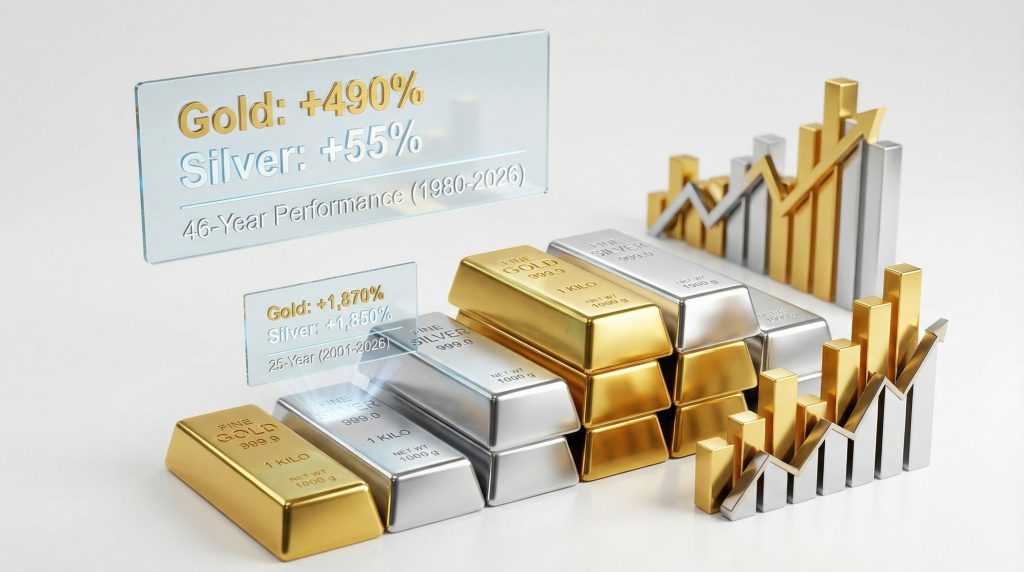
Long-term wealth preservation investors typically prefer gold's consistency over extended periods. Analysis of 46-year performance data reveals gold's 490% total return since 1980 compared to silver's 55% return over the same timeframe, validating patient investors' preference for steady accumulation over volatile speculation.
Furthermore, the psychological challenge emerges during silver's periodic outperformance spurts. Investors observing silver's recent 462% ten-year gain versus gold's 368% return may experience regret and consider switching strategies. However, this perspective ignores the reality that gold market performance consistently outperformed silver during the first nine years of that decade.
What Drives Different Risk-Return Profiles Between Gold and Silver?
The mathematical relationship between risk and return in precious metals markets reflects deeper psychological patterns that govern investor behaviour. Understanding these dynamics requires examining historical volatility patterns, correction severity, and recovery characteristics across multiple market cycles.
Historical Volatility Analysis and Investor Behaviour
Risk-Adjusted Returns Comparison Analysis
| Time Period | Gold Performance | Silver Performance | Volatility Differential | Psychological Impact |
|---|---|---|---|---|
| 10-Year (2016-2026) | +368% | +462% | Silver 2.3x more volatile | Momentum speculation dominance |
| 15-Year (2011-2026) | +162% | +60% | Silver severe underperformance | Loss aversion validation |
| 25-Year (2001-2026) | +1,870% | +1,850% | Near-equal outcomes | Time horizon crucial |
| 46-Year (1980-2026) | +490% | +55% | Gold consistency advantage | Patient investor rewards |
The 46-year analysis reveals the most psychologically significant differential. Gold's 490% total return compared to silver's 55% return represents a 435-percentage-point outperformance that validates conservative investor psychology. A $1,000 investment in gold during 1980 would reach $5,900 by 2026, while the equivalent silver investment would reach only $1,550.
Market Psychology During Peak Performance Periods
Euphoria cycles create distinctly different experiences for gold and silver investors. Silver's rapid price movements generate intense media attention and social media discussion, attracting newer investors unfamiliar with the metal's historical volatility patterns. Consequently, this creates feedback loops where rising prices attract speculative buying.
In addition, gold's inflation hedge characteristics attract less speculative attention but create more sustainable investor psychology. The metal's role as a central bank reserve asset and institutional holding provides psychological anchoring that reduces panic selling during market stress periods.
The recent silver collapse from $120 to $73 illustrates classic euphoria-to-panic transitions. However, according to historical gold-silver ratio analysis, these dramatic swings are characteristic of silver's behaviour pattern. Investors who purchased near the peak experienced immediate 40% losses, triggering loss aversion responses and emotional selling.
Downside Protection and Loss Aversion Analysis
Historical correction analysis reveals asymmetrical risk profiles that fundamentally alter investor psychology. Silver's 72% decline following its 2011 peak of $48.70 compared to gold's 44% decline from $1,895 demonstrates a 28-percentage-point differential in downside severity.
This asymmetry creates lasting psychological scarring among silver investors who experience major corrections. Furthermore, investors who purchased silver at the 2011 peak and held through 2026 achieved only a 60% total return despite enduring years of negative portfolio values. Conversely, gold-stock market cycles show gold investors from the same entry point achieved 162% returns with a less severe intermediate drawdown experience.
Loss aversion theory suggests that investors experience losses approximately 2.5 times more intensely than equivalent gains. Silver's tendency toward deeper corrections amplifies this psychological burden, creating lasting hesitation among investors who experience major downturns.
How Do Industrial Demand Dynamics Affect Investment Psychology?
The psychological complexity of silver investment stems largely from its dual role as both monetary metal and industrial commodity. This creates conflicting analytical frameworks that generate uncertainty and emotional volatility among investors attempting to evaluate the metal's intrinsic value.
Silver's Dual-Nature Investment Thesis
Industrial applications account for approximately 50% of silver demand, creating supply-demand dynamics that differ fundamentally from gold's primarily monetary role. Technology sector growth, renewable energy adoption, and electronics manufacturing directly influence silver prices through non-investment channels.
This industrial component generates both opportunity and anxiety among silver investors. For instance, positive industrial demand trends create compelling fundamental narratives that attract growth-oriented investors seeking exposure to technological advancement. However, economic downturns that reduce industrial demand can pressure silver prices independent of monetary policy or inflation concerns.
The psychological challenge emerges when industrial and monetary demand cycles diverge. In addition, investors purchasing silver for inflation protection may experience disappointing performance if technology sector weakness overwhelms monetary debasement trends.
Gold's Pure Store-of-Value Psychology
Gold's investment psychology benefits from conceptual clarity that silver lacks. Central bank accumulation patterns, sovereign wealth fund allocations, and institutional portfolio diversification create consistent demand sources that operate independently of industrial economic cycles.
This psychological advantage manifests during uncertain market conditions when investors seek assets with predictable demand characteristics. Furthermore, gold's 4,000-year history as a store of value provides emotional anchoring that reduces anxiety during economic volatility periods.
Inflation hedge psychology particularly favours gold due to its lack of industrial demand complications. Investors concerned about currency debasement can focus exclusively on monetary policy trends without analysing technology sector dynamics or supply chain disruptions that affect silver's industrial applications.
Which Metal Offers Superior Long-Term Wealth Preservation?
Mathematical analysis of multi-decade performance patterns reveals significant differences in wealth preservation characteristics that extend beyond simple return calculations. The consistency of returns, volatility of intermediate periods, and recovery characteristics following major corrections create distinctly different investor experiences.
Compound Returns Analysis Through Market Cycles
Based on 46-year historical data, gold has delivered 490% total returns since 1980 compared to silver's 55%, demonstrating superior wealth preservation despite silver's periodic outperformance spurts. Consequently, this performance differential reflects gold's ability to maintain purchasing power through multiple economic cycles while silver experiences extended periods of value erosion.
The compounding effect becomes particularly significant when analysing real-world investment scenarios. An investor following dollar-cost averaging strategies over multi-decade periods would experience dramatically different outcomes depending on metal selection. However, gold-silver ratio insights suggest gold's consistency reduces the psychological burden of timing decisions, while silver's volatility creates pressure to optimise entry and exit points.
Recovery patterns following major corrections also favour gold from a wealth preservation perspective. Silver required 15 years to exceed its 2011 peak, achieving $77.69 by January 2026 compared to its $48.70 peak. Meanwhile, gold surpassed its 2011 peak of $1,895 and continued advancing to $4,966, representing sustained wealth building rather than mere recovery.
Portfolio Diversification Psychology
Risk parity considerations between gold and silver allocations require understanding correlation patterns during various market stress scenarios. Gold typically maintains stronger inverse correlation with equity markets during financial crises, providing more reliable portfolio diversification benefits.
Silver's higher correlation with industrial commodity markets reduces its effectiveness as a portfolio diversifier during broad economic downturns. This characteristic creates psychological pressure among investors seeking true portfolio insurance, as silver may decline alongside other risk assets during precisely the periods when diversification benefits are most needed.
Rebalancing psychology during extreme price movements also differs significantly between the metals. Furthermore, gold's steadier price action facilitates systematic rebalancing strategies, while silver's volatility creates emotional barriers to mechanical portfolio adjustments.
Generational Wealth Transfer Considerations
Estate planning implications favour gold's stability for families seeking to preserve wealth across generations. Silver's volatility creates uncertainty regarding portfolio values during inheritance transitions, while gold provides more predictable wealth transfer outcomes.
Family office perspectives typically emphasise capital preservation over speculation, making gold's consistency more attractive than silver's explosive potential. In addition, multi-generational wealth requires surviving multiple economic cycles without catastrophic interim losses that could compromise long-term family financial security.
Long-term purchasing power protection analysis demonstrates gold's superior inflation hedge characteristics. Over 46-year periods, gold's 490% return significantly exceeds cumulative inflation rates, while silver's 55% return barely maintains purchasing power after accounting for monetary debasement.
What Are the Key Psychological Triggers for Metal Selection?
Investor personality characteristics create predictable patterns in precious metals selection that extend beyond rational financial analysis. Understanding these psychological triggers helps explain market behaviour and provides insight into appropriate metal allocation strategies for different investor types.
Investor Profile Matching Framework
"Investment Psychology Insight: Conservative wealth preservers typically gravitate toward gold's stability, while growth-oriented investors chase silver's explosive potential despite higher volatility risks."
Conservative investors prioritising capital preservation demonstrate clear preference for gold's steady appreciation patterns. This investor type typically exhibits low volatility tolerance and prefers predictable outcomes over maximum return potential. However, gold's 46-year track record provides psychological comfort that reduces anxiety during portfolio review periods.
Aggressive growth investors attracted to silver's explosive potential often underestimate the psychological burden of experiencing major corrections. For instance, the 72% decline following silver's 2011 peak created lasting emotional scarring among investors unprepared for such severe interim losses.
Balanced investors seeking exposure to both metals must develop psychological frameworks for managing different volatility characteristics within unified portfolio strategies. This requires understanding correlation patterns and developing systematic approaches to rebalancing between metals during extreme price movements.
Market Timing Psychology and Entry Points
Dollar-cost averaging strategies reduce psychological pressure for both metals but provide greater benefit for silver investors due to the metal's higher volatility. Furthermore, systematic purchasing approaches help smooth silver's price extremes while capturing long-term appreciation potential without requiring perfect market timing.
Contrarian investing opportunities emerge more frequently in silver markets due to the metal's tendency toward emotional extremes. However, successfully implementing contrarian strategies requires exceptional psychological discipline to purchase during periods of maximum pessimism and sell during euphoric conditions.
Momentum investing psychology tends to favour silver during bull market phases but creates dangerous emotional feedback loops. Consequently, investors attracted by rapid price appreciation often ignore fundamental analysis and risk management principles, leading to concentrated positions during peak valuations.
The next major ASX story will hit our subscribers first
How Should Investors Navigate the Gold vs Silver Decision?
Strategic precious metals allocation requires understanding personal risk tolerance, investment timeline, and psychological comfort zones. Successful navigation involves developing frameworks that account for emotional responses to volatility while maintaining focus on long-term wealth preservation objectives.
Risk Assessment Framework for Precious Metals
Personal risk tolerance evaluation begins with honest assessment of emotional responses to portfolio volatility. Investors who experience anxiety during 10-20% portfolio declines should emphasise gold allocation, while those comfortable with 40-50% interim corrections can consider higher silver weightings.
Investment timeline considerations fundamentally alter appropriate metal selection strategies. In addition, investors with 5-10 year horizons face significant timing risk in silver markets, while 20+ year timelines provide sufficient duration to capture silver's long-term appreciation potential despite interim volatility.
Portfolio percentage allocation strategies should account for correlation effects and diversification benefits. Most portfolio optimisation research suggests 5-10% total precious metals allocation, with gold representing 60-80% of that allocation for conservative investors and 40-60% for aggressive investors.
Switching Strategies and Rebalancing Psychology
Rotation between metals based on performance cycles requires overcoming emotional attachment to recent winners and losers. However, investors often exhibit psychological bias toward metals that have recently outperformed, exactly when switching strategies would provide greatest benefit.
Tax implications create additional psychological barriers to portfolio changes, as realising gains triggers immediate tax consequences while maintaining losing positions preserves future tax benefits. Furthermore, these considerations often prevent optimal portfolio adjustments during extreme valuation periods.
Systematic rebalancing approaches help overcome emotional decision-making biases by establishing predetermined adjustment triggers. However, implementing these strategies during extreme market conditions requires exceptional discipline to execute trades contrary to prevailing market sentiment.
Future Performance Expectations and Investor Sentiment
Market consensus psychology for 2026 and beyond suggests continued precious metals appreciation driven by monetary policy concerns and geopolitical uncertainty. According to detailed precious metals performance analysis, expectations for silver's relative outperformance may reflect recent performance bias rather than sustainable fundamental shifts.
Macroeconomic factors including inflation trends, currency debasement, and debt sustainability concerns create supportive environments for both metals. However, gold vs silver performance analysis shows gold's pure monetary characteristics provide more direct exposure to these themes compared to silver's mixed industrial-monetary dynamics.
Building realistic return expectations requires understanding historical performance ranges and volatility characteristics. Consequently, investors expecting sustained 300% annual returns in silver markets are likely to experience disappointment and make emotional decisions based on unrealistic assumptions.
Frequently Asked Questions About Gold vs Silver Investment Psychology
Why Do Investors Consistently Underestimate Silver's Volatility?
Recency bias causes investors to extrapolate recent performance trends indefinitely into the future. Silver's periodic explosive gains create psychological anchoring effects that overshadow historical correction severity. Furthermore, new investors entering during bull market phases lack experiential knowledge of silver's downside characteristics, leading to position sizing errors and inadequate risk management preparation.
How Do Emotional Biases Affect Precious Metals Investment Decisions?
Loss aversion creates asymmetrical responses to gains and losses, making silver's deeper corrections psychologically more damaging than its equivalent upside moves are beneficial. Confirmation bias leads investors to seek information supporting their metal selection while ignoring contrary evidence. In addition, herding behaviour amplifies both bull and bear market extremes, particularly in silver markets where retail investor participation creates feedback loops.
What Psychological Factors Make Gold More Suitable for Conservative Portfolios?
Gold's 4,000-year monetary history provides psychological anchoring that reduces anxiety during volatile periods. Lower volatility characteristics align with conservative investors' preferences for predictable outcomes over maximum returns. However, central bank accumulation patterns create institutional validation that supports conservative investors' confidence in long-term value preservation capabilities.
When Does Silver's Higher Risk Profile Justify Its Volatility Premium?
Silver's risk profile becomes justified for investors with 20+ year investment horizons who can withstand multiple volatility cycles. Growth-oriented portfolios seeking exposure to industrial technology trends may benefit from silver's dual monetary-commodity characteristics. Furthermore, tactical allocation strategies during extreme undervaluation periods can capture silver's explosive recovery potential for sophisticated investors with appropriate risk management frameworks.
Strategic Investment Framework for Precious Metals Success
Developing sustainable precious metals investment strategies requires integrating psychological insights with mathematical analysis to create approaches that survive emotional market extremes while capturing long-term wealth building opportunities.
Building a Psychologically Sustainable Precious Metals Strategy
Combined allocation strategies utilising both metals can optimise risk-adjusted returns while accommodating different psychological comfort zones. A 70-30 gold-silver allocation provides exposure to both metals' characteristics while emphasising gold's stability for portfolio confidence.
Setting realistic expectations based on historical performance patterns prevents emotional disappointment during normal market corrections. Understanding that 20-40% declines represent typical precious metals volatility helps investors maintain long-term perspective during temporary portfolio declines.
Developing discipline to withstand volatility cycles requires systematic approaches that remove emotional decision-making from investment processes. Consequently, dollar-cost averaging, automatic rebalancing, and predetermined allocation targets help maintain strategic focus during market extremes.
Long-Term Wealth Building Through Precious Metals Psychology
Understanding market cycles and investor sentiment patterns enables strategic positioning during optimal accumulation periods. Contrarian opportunities emerge when sentiment reaches extreme pessimism, providing enhanced long-term return potential for disciplined investors.
Creating systematic investment approaches that overcome emotional decision-making involves establishing predetermined rules for portfolio adjustments, rebalancing triggers, and allocation modifications. Furthermore, these frameworks help investors maintain strategic discipline during periods when emotions might otherwise drive suboptimal decisions.
Maximising compound returns through patient, disciplined investing requires understanding that wealth preservation often involves accepting lower volatility in exchange for more consistent long-term appreciation. Gold's 46-year outperformance demonstrates the mathematical advantage of steady appreciation over spectacular gains followed by severe corrections.
Disclaimer: This analysis is for educational purposes only and does not constitute investment advice. Precious metals investments involve significant risks including price volatility, liquidity constraints, and storage considerations. Past performance does not guarantee future results. Consult qualified financial advisors before making investment decisions.
Looking to Capitalise on Precious Metals Market Opportunities?
While gold and silver present distinct investment psychology profiles, Australian mining companies exploring and discovering these metals offer additional avenues for capitalised returns. Discovery Alert's proprietary Discovery IQ model delivers real-time notifications when ASX-listed companies announce significant precious metals discoveries, enabling subscribers to identify actionable opportunities before broader market recognition. Begin your 14-day free trial today to position yourself ahead of the market with instant alerts on gold, silver, and other commodity discoveries across Australia's resource sector.