August 6, 2026
The Anatomy of a Contrarian Opportunity in Precious Metals
Secular bull markets in commodities rarely move in straight lines. History shows that the most powerful advances in gold and silver are punctuated by sharp, disorienting corrections that feel, in the moment, like structural reversals. The sell-off gripping precious metals and their associated mining equities in mid-2025 fits this pattern with uncomfortable precision, and the precious metals market outlook for those willing to look beyond the noise remains compelling. Sentiment has collapsed, fund positioning has shifted dramatically, and technical indicators are flashing readings not seen since some of the most extreme market dislocations of the past two decades.
For investors willing to look past near-term noise, the convergence of technical extremes, historically cheap valuations, and record operating margins across the mining sector presents one of the more asymmetric setups in recent memory. Understanding why requires separating the genuine drivers of this correction from the fear-amplified narratives that typically accompany them.
When big ASX news breaks, our subscribers know first
Is This the Most Significant Precious Metals Correction in Nearly Two Decades?
Framing the Sell-Off as a Macro Dislocation, Not a Trend Reversal
The speed and depth of the current precious metals retreat has caught many participants off guard. Gold and silver miners have experienced declines of roughly 16 to 21 percent from recent peaks, a drawdown that mirrors the severity seen during the COVID-19 market flush of March 2020. More striking, the Gold Miners Bullish Percent Index has reached extreme oversold territory, comparable to lows last recorded in early 2020 and, in some measures, approaching conditions last observed during the 2008 financial crisis.
Tavi Costa, founder of Azura Capital and a widely followed macro analyst in the resource investment community, has observed that gold and silver have rarely if ever reached this level of oversold conditions since approximately 2008 when measured by the breadth of the sell-off and current fund positioning. He characterises the current environment as approaching capitulation from a fund-level perspective, a stage typically associated with the exhaustion of selling pressure rather than its continuation.
The 2008 parallel carries particular weight. At that historic low, precious metals and mining equities subsequently staged multi-year recoveries that rewarded contrarian positioning many times over. The critical distinction investors must make is whether the current episode reflects a deterioration in the underlying investment thesis or simply markets behaving as markets do during periods of acute macroeconomic anxiety.
The 2008 Parallel and What Historical Extremes Have Signalled
Individual company data reinforces the sector-wide picture. Newmont Corporation, the world's largest gold miner by production, reached its most oversold technical reading since 1987 during this correction, a statistic that underscores just how unusual the current episode is from a historical standpoint. Meanwhile, the silver miner-to-silver price ratio has compressed to approximately 30 percent, compared to a historical norm closer to 80 percent, indicating that silver mining equities are lagging the underlying metal by a historically extreme margin.
Furthermore, when this ratio has previously diverged this dramatically, the subsequent reversion has tended to benefit mining equities disproportionately. Understanding silver versus gold performance across historical cycles helps contextualise just how significant this divergence has become.
"When precious metals sentiment reaches levels comparable to the most extreme dislocations of the past two decades, the historical pattern has consistently rewarded contrarian positioning over capitulation selling. The question is not whether recovery occurs, but whether investors are positioned ahead of it."
What Is Actually Driving the Precious Metals Sell-Off Right Now?
Trigger One: Rate Hike Repricing and Why It Is Likely an Overreaction
Two distinct forces have combined to pressure precious metals in this cycle. The first is a repricing by markets of the probability that central banks, and specifically the US Federal Reserve, could embark on a new rate-hiking cycle. This shift surprised many seasoned analysts. Costa has noted publicly that this repricing is something he fundamentally disagrees with, arguing that the current fiscal and economic environment simply cannot tolerate sustained monetary tightening of the kind seen in 2021 and 2022.
The reasoning centres on a structural constraint that markets appear to be underweighting. Government fiscal budgets can be thought of as a fixed pie. As the share of that pie consumed by interest payments on existing debt expands, the portion available for growth-oriented spending on infrastructure, healthcare, education, and defence contracts accordingly. At current US debt levels, a sustained hiking cycle would accelerate this compression in a way that is politically and economically untenable. The ceiling on rate policy is therefore not a matter of central bank preference but of fiscal arithmetic.
Trigger Two: Dollar Strength and Its Likely Limits
The second driver is US dollar strength, which historically exerts downward pressure on commodity prices denominated in the currency. However, the dollar's current elevated positioning may itself be unsustainable for systemic reasons. For the dollar to function as the world's reserve currency, the United States must remain a net importer, providing dollars to the global economy. An excessively strong dollar undermines this function, creating friction for major trading partners and threatening the utility of the currency in global commerce.
From a technical standpoint, the dollar appears overbought against a range of major currency pairs including the yen, Canadian dollar, and euro. Long-term charts of these relationships suggest these currencies may be closer to the beginning of a meaningful upward move against the dollar than to further weakness, a development that would remove one of the primary headwinds facing precious metals.
Critically, neither of these two drivers reflects a genuine deterioration in the fundamental investment case for gold and silver. Both are cyclical market responses to macro anxieties rather than structural shifts in the commodity landscape. As noted by Mining.com, sentiment-driven selloffs of this nature have historically preceded meaningful recoveries rather than prolonged downturns.
How Oversold Are Gold and Silver Miners? The Data Behind the Thesis
Key Oversold Indicators Across the Sector
The technical picture across precious metals mining equities is striking in its uniformity. Multiple independent measures are flashing signals that have historically marked major cyclical lows rather than the onset of prolonged bear markets.
| Metric | Current Status | Historical Benchmark | Implication |
|---|---|---|---|
| GDX decline from peak | ~16 to 21% drawdown | Comparable to March 2020 COVID flush | Classic contrarian reset |
| Gold miner bullish percent index | Extreme oversold | Lowest since March 2020 | Peak pessimism signal |
| Newmont oversold reading | Most oversold since 1987 | Generational technical extreme | Potential mean-reversion setup |
| Silver miner-to-silver price ratio | ~30% vs. ~80% historical norm | Significant structural undervaluation | Silver miners severely lagging metal |
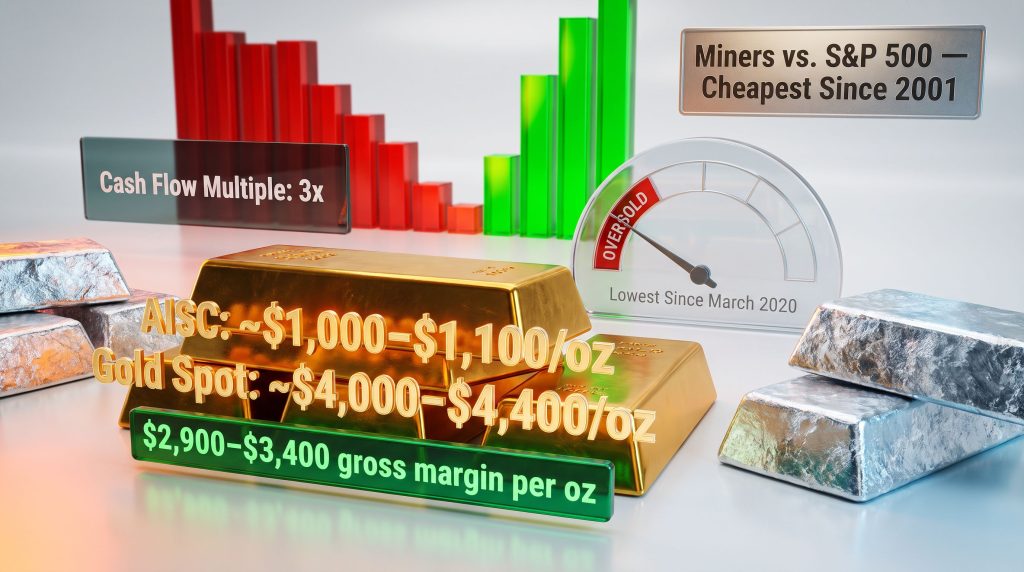
| Miners vs. S&P 500 relative valuation | Among cheapest since 2001 | Multi-decade low | Long-duration secular entry point |
What Sentiment Extremes at This Level Produce
At the fund level, positioning data suggests the sector is approaching or has reached a capitulation phase, a condition where forced or fear-driven selling by institutional holders has largely run its course. Historically, these conditions have preceded meaningful recoveries because they indicate that the marginal seller has already acted, leaving the market structurally light on supply from institutional sources.
"Unlike most asset classes where falling prices attract buyers, the resource sector has a documented behavioural tendency for investors to wait for price confirmation before committing capital. This anomaly is precisely what creates asymmetric entry opportunities at technically extreme levels."
Are Gold and Silver Miners Actually Cheap on Fundamentals?
Profit Margins That Rival, and in Some Cases Exceed, Major Technology Companies
The valuation case for gold and silver miners at current levels extends well beyond technical indicators. The fundamental picture is, arguably, even more compelling. Consider the operating economics of a typical gold miner in the current environment:
- Gold spot price: approximately $4,000 to $4,400 per ounce
- Average all-in sustaining cost (AISC) across the sector: approximately $1,000 to $1,100 per ounce
- Implied gross margin per ounce: $2,900 to $3,400
- Cash flow multiples across the sector: as low as 3x
These figures describe an industry operating at margins that structurally rival or exceed those of the most profitable technology businesses, yet trading at a fraction of the valuation multiples applied to tech. The disconnect is extraordinary by almost any financial analysis framework. Understanding gold's impact on mining equities helps explain why this margin expansion has not yet been fully reflected in share prices.
The Real-World Case: Sub-$20 Production Costs Against a $40+ Silver Price
Costa has direct operational experience that illustrates this dynamic. Through involvement with an acquisition of a Bolivian silver mining company that operates the fourth-largest silver-producing mine in the world, he has first-hand visibility into production economics. That operation produces silver at well below $20 per ounce all-in. Against a silver price of $40, $50, or $60 per ounce, the margin profile exceeds that of companies like Alphabet's Google division on comparable metrics. Yet the mining company trades at a cash flow multiple of approximately 3x.
"A silver producer operating at sub-$20 per ounce all-in production costs against a $40 to $60 per ounce silver price generates margins that structurally exceed many high-profile technology businesses, yet trades at a fraction of the valuation multiple. This disconnect is among the most significant mispricing opportunities visible in current markets."
Why Cash Flow Multiples of 3x Signal Structural Undervaluation
The historical context makes this valuation gap even more striking. Several senior mining companies, including those with long operational histories like Hecla Mining, are trading at price levels they have previously occupied at very different points in their free cash flow generation. Compare a historical stock price chart to a free cash flow panel for the same company over the past decade, and the divergence is dramatic.
Stock prices have returned to historical ranges while free cash flow sits at multiples of what it was during any prior period. The market is, in effect, discounting record earnings as if they were temporary aberrations rather than the new structural baseline. The relative valuation of miners against the S&P 500 reinforces this picture, with mining equities by several measures not this cheap relative to broad equities since 2001, which preceded a decade-long commodity super cycle.
Are Miners Beginning to Outperform the Metals Themselves?
Decoding the Signal When Miners Lead Gold
One of the most important and often overlooked signals in precious metals markets is the relative performance of mining equities versus the underlying metal. When miners outperform gold on a relative basis, it typically indicates that institutional capital is arriving in the sector. Sophisticated investors with longer time horizons tend to purchase mining equities ahead of retail flows, using the leverage to metal prices that miners provide.
This is precisely what has begun to emerge in the current environment. Despite gold's recent drawdown, miners have been holding up on a relative basis and in some cases outperforming the metal itself. Costa has highlighted this as a particularly encouraging signal given how weak the broader market backdrop for risk assets has been. Analysing gold stock market cycles over multiple decades consistently reveals that miners leading the metal is one of the most reliable precursors to sustained sector outperformance.
Explorer Outperformance and What It Signals About Capital Flows
Even more surprising has been the relative resilience of junior explorers. In a weak market environment, conventional wisdom suggests seniors would outperform juniors due to superior liquidity and lower risk profiles. Yet in this correction, some junior and mid-tier exploration companies have held up better than larger producers, a development that suggests speculative and growth-oriented capital is beginning to find its way into the sector at the earlier-stage end.
Separately, traditional hedge funds based in New York and other financial centres that have historically had little exposure to the mining sector are beginning to approach sector specialists for guidance. The mining investment universe is a relatively tight community, and the arrival of generalist hedge fund capital represents a meaningful potential source of incremental demand for mining equities.
The next major ASX story will hit our subscribers first
The Critical Minerals Distraction: Why Capital May Be Flowing to the Wrong Places
Institutional Enthusiasm for Rare Earths vs. the Business Case for Established Metals
One of the more counterproductive trends in current mining capital allocation is the concentration of institutional interest in rare earth and critical mineral projects at the expense of gold, silver, and copper. The geopolitical narrative around supply chain security has made rare earth deposits politically compelling, attracting capital from investors drawn by the thematic rather than the financial merits.
Evaluating these projects through a first-principles profitability lens often produces a different conclusion. Many rare earth and critical mineral projects carry extraction complexities, processing costs, and market structure challenges that make them marginal businesses at best. By contrast, a high-grade silver or gold deposit with established processing infrastructure and access to existing metal markets is a fundamentally different type of business proposition.
Costa's framework is instructive here: every project should be evaluated through the lens of whether it constitutes a genuinely profitable business. Applied to many critical mineral projects, this framework exposes significant gaps between political narrative and commercial viability.
Copper's Underappreciated Role
Copper sits in an awkward position in the current capital allocation environment. It is technically classified as a critical mineral given its indispensability to electrification and manufacturing, yet it is perceived as too conventional to attract the thematic enthusiasm directed at rarer materials. This perception gap may be creating an opportunity. Copper has shown remarkable resilience during the recent precious metals correction, defying expectations that it would lead commodity markets lower.
The fundamental demand case for copper tied to electrification, onshoring of manufacturing, and energy infrastructure build-out is arguably as strong as at any point in the modern era.
What Is the Long-Term Structural Case for a Commodity Super Cycle?
Onshoring and Electrification as a Demand Driver Larger Than AI Infrastructure
The political and economic trend toward manufacturing repatriation, driven by supply chain fragility concerns and geopolitical tensions, may represent a more significant long-term demand driver for commodities than the artificial intelligence infrastructure build-out that has dominated investment discourse. Costa has made this observation with reference to a particularly illuminating data set: electricity consumption charts comparing China to the rest of the world.
As China became the manufacturing centre of the global economy over recent decades, its electricity consumption grew dramatically while consumption in most other developed economies remained essentially flat. If the onshoring trend reverses even a fraction of that manufacturing concentration, the electricity consumption implications for North American, European, and other economies are enormous. The infrastructure required to support that consumption, including copper wiring, silver-based electrical components, and energy generation capacity, would represent a sustained multi-year demand surge for these metals.
The Exploration Deficit and Why It Creates a Supply Squeeze
On the supply side, the picture for precious metals is equally compelling over a medium to long-term horizon. Senior mining company exploration budgets remain below levels seen three to four years ago, a development that defies straightforward commercial logic given current metal prices and margins.
| Factor | Current Trend | 3 to 5 Year Implication |
|---|---|---|
| Senior exploration budgets | Down from 3 to 4 years ago | Declining organic reserve replacement |
| Junior discovery quality | Rising in select jurisdictions | Acquisition premium potential |
| Institutional capital allocation | Early-stage inflows beginning | Sector re-rating possible |
| M&A activity from majors | Below historical norms | Pent-up consolidation pressure |
Some senior producers have gone further, actually closing internal exploration programs and dissolving dedicated teams, at precisely the moment when metal prices and cash flows would justify the opposite. The consequence is a growing reserve replacement problem that will eventually force either a dramatic increase in exploration investment or a wave of acquisitions targeting junior companies with quality discoveries. The junior mining risks and rewards dynamic becomes particularly compelling in this environment, as acquisition premiums for quality junior assets could be substantial.
Could the Super Cycle Thesis Be Wrong? Honest Risk Assessment
Scenario One: Global Recession as a Delay Rather Than Derailment
A global recession represents the most straightforward risk to the commodity super cycle thesis. However, even a severe recession is more likely to delay the cycle than to permanently derail it. Recessions reduce demand temporarily, but they also tend to suppress investment in new supply, compressing available capacity and setting up the subsequent recovery for faster price appreciation. The 2008 financial crisis is instructive: the worst year for commodities was followed by one of the strongest recovery periods in modern commodity market history.
Scenario Two: AI-Driven Productivity and the Two-Phase Framework
The more intellectually interesting risk scenario involves artificial intelligence generating the kind of productivity surge that genuinely reduces inflationary pressures across the economy. This is not a dismissible scenario. If AI enables sufficient automation and efficiency gains to substantially increase economic output relative to debt levels, the macro environment underpinning hard asset demand could shift materially.
However, this scenario is itself time-dependent. Costa articulates a compelling two-phase framework. The current period, which he characterises as the infrastructure build-out phase of AI deployment, is inherently inflationary for physical commodities. Every data centre, every power grid upgrade, every automation system requires copper, silver, steel, and energy. This phase is likely to persist for ten to fifteen years. The genuinely deflationary phase of AI arrives only after this physical infrastructure is in place.
The implication is that the investment case for hard assets is robust over the medium term, even in a scenario where AI ultimately proves to be a structural deflationary force over the longer run.
Why Resource Businesses May Become the New Moat Assets
Costa raises a perspective that cuts against the prevailing investment zeitgeist. In an era where artificial intelligence can increasingly replicate or substitute for knowledge work and intellectual property, the businesses that retain genuine structural moats may be those built around irreplaceable physical resources. A high-quality ore body cannot be replicated by a language model. A mine producing silver at sub-$20 per ounce in a jurisdiction with reliable rule of law is a durable competitive advantage in a way that software increasingly is not.
Latin America: The Under-Explored Resource Frontier
Political Realignment and Its Investment Implications
A significant political shift is underway across Latin America. Countries including El Salvador, Argentina, Bolivia, Colombia, and Peru have moved, at varying speeds and in varying degrees, toward more market-oriented governance. This political realignment carries meaningful implications for resource investment. Regulatory risk, which has historically been among the primary concerns for mining investors considering Latin American jurisdictions, has in several cases moderated considerably.
Bolivia's shift was particularly notable for its internal character, driven by popular sentiment rather than external influence, suggesting a degree of durability that externally-imposed political changes do not always carry.
Energy Surplus Nations as Emerging Infrastructure Destinations
Several Latin American nations produce more energy than their domestic economies currently consume, creating a meaningful comparative advantage in an era when power availability is becoming a primary constraint on data centre deployment and advanced manufacturing. Major technology companies, including some of the largest in the world, are evaluating capital deployment in these regions specifically to capture this energy surplus.
This dynamic layers an additional source of capital inflows onto a region that is already benefiting from renewed resource investment interest, and does so in a way that reduces dependence on any single country or bloc.
Why Latin America Offers a Differentiated Investment Profile
Compared to African mining jurisdictions, which have seen substantial penetration of Chinese capital and strategic interests, Latin America offers a more differentiated ownership and capital structure. The region's mining projects are generally less concentrated in the hands of any single foreign capital source, which may appeal to investors seeking jurisdictional diversification. The geological endowment of the continent remains substantially underexplored relative to its potential, particularly in countries where decades of political instability suppressed systematic exploration investment.
How Should Investors Approach Oversold Miners Right Now?
Distinguishing Fundamental Deterioration from Market Dislocation
The critical analytical question for any investor evaluating the current precious metals correction is whether the sell-off reflects a genuine change in the fundamental investment thesis or a market dislocation driven by short-term sentiment and positioning. The evidence reviewed here points strongly toward the latter. Operating margins are at or near record levels. Metal prices, while volatile, remain well above average all-in sustaining costs for the industry. The structural demand drivers for gold, silver, and copper remain intact.
A useful framework for evaluating individual opportunities involves:
- Assessing free cash flow generation at current metal prices rather than relying solely on earnings-based metrics.
- Comparing current stock price levels to historical price ranges in the context of current vs. historical free cash flow to identify historical valuation dislocations.
- Evaluating AISC against current spot prices to determine margin resilience across a range of metal price scenarios.
- Distinguishing between liquid senior producers and early-stage explorers to calibrate risk-reward appropriately.
- Considering relative valuation versus the broader equity market rather than mining equities in isolation.
Liquid Names vs. Explorers: Where Risk-Reward Is Most Asymmetric
Both ends of the market capitalisation spectrum present opportunities, but for different reasons. Liquid senior producers offer access to record free cash flow at historically low multiples, with the added benefit of institutional-grade liquidity for funds that require it. Early-stage explorers, by contrast, offer leverage to discovery upside and potential acquisition premiums as senior producers face growing pressure to replace depleting reserves.
The unusual dynamic in the current correction, where some explorers have shown resilience comparable to or better than seniors, suggests that growth-oriented capital has already begun making its way into the sector at the earlier-stage end. Indeed, analysis from The Bubble Bubble suggests that miners are now positioned to outperform the metals themselves as this cycle matures.
FAQ: Gold and Silver Miners
What does oversold mean in the context of gold and silver miners?
Oversold refers to a condition where selling pressure has driven prices significantly below levels justified by underlying fundamentals. Technical measures such as the Relative Strength Index (RSI), the Gold Miners Bullish Percent Index, and fund-level positioning data all indicate when a sector has reached a statistical extreme that has historically preceded recoveries. Current readings in precious metals mining equities are at or near levels last observed during the 2020 COVID flush and, by some measures, approaching 2008-era extremes.
Are gold miners cheap relative to the price of gold right now?
By multiple measures, yes. Cash flow multiples across the sector sit as low as 3x despite all-in sustaining costs of approximately $1,000 to $1,100 per ounce against gold prices above $4,000. The relative valuation of miners versus the S&P 500 is near its lowest point since 2001. Individual company analysis shows stock prices at historical ranges while free cash flow is at multiples of any prior period.
What is the biggest risk to the gold and silver miner investment thesis?
The primary risks are a severe global recession that reduces demand materially, sustained US dollar strength that suppresses commodity prices, and the longer-term scenario where AI-driven productivity growth reduces structural inflationary pressures. Of these, the AI productivity scenario is the most intellectually substantive but also the most time-distant, potentially ten to fifteen years away from reaching the scale required to alter the macro environment for hard assets.
How do silver miners compare to gold miners in terms of valuation?
Silver miners appear, if anything, more undervalued than gold miners on a relative basis. The silver miner-to-silver price ratio has compressed to approximately 30 percent versus a historical norm of around 80 percent, indicating that silver mining equities are lagging the underlying metal by a structurally extreme margin. This gap has historically closed in favour of mining equities when sentiment stabilises.
What signals would confirm that institutional capital is entering the mining sector?
The primary signal is outperformance of mining equities relative to the metal prices themselves. Secondary signals include outperformance of junior explorers relative to seniors, increased attendance and engagement from generalist investors at industry conferences, and direct outreach to sector specialists from traditional hedge funds. Several of these signals are already visible in early form.
Is this a buying opportunity or a value trap?
The distinction between a buying opportunity and a value trap lies in whether the underlying business fundamentals support the investment thesis independent of sentiment recovery. In the current case, record operating margins, historically low cash flow multiples, and structural demand tailwinds all argue against the value trap characterisation. The correction appears to be driven by macro sentiment rather than deterioration in mining company fundamentals, which is the condition under which contrarian positioning has historically generated strong returns.
Synthesising the Evidence: A Rare Confluence of Signals
Corrections of the current depth and speed in precious metals markets are genuinely uncommon. When technical extremes, fundamental undervaluation, and early signs of institutional capital rotation converge simultaneously, the resulting asymmetry tends to be meaningful. The current environment displays all three conditions.
The gold and silver oversold miners cheap narrative is not merely a tactical trade idea. It sits within a larger structural context: a multi-year commodity cycle driven by manufacturing repatriation, energy infrastructure build-out, exploration deficits, and the physical demands of the AI infrastructure phase. Consequently, the gold and silver oversold miners cheap thesis carries particular weight at a moment when sentiment extremes are aligning with record fundamental value. Within that context, the current correction looks less like a reason for concern and more like the kind of entry point that secular bull markets occasionally offer to those willing to look past short-term discomfort.
This article is intended for informational and educational purposes only and does not constitute financial advice. Investing in mining equities involves significant risk, including the potential loss of capital. Past performance of any sector, instrument, or strategy is not indicative of future results. Readers should conduct their own due diligence and consult a qualified financial adviser before making any investment decisions.
Want to Know When the Next Major Mineral Discovery Hits the ASX?
Discovery Alert's proprietary Discovery IQ model scans ASX announcements in real time, delivering instant alerts on significant mineral discoveries so investors can act ahead of the broader market — explore historic discovery returns to understand the scale of opportunity, then begin a 14-day free trial at Discovery Alert to position yourself at the forefront of the next major find.