
August 24, 2026
What Drives Sudden Precious Metals Price Reversals?
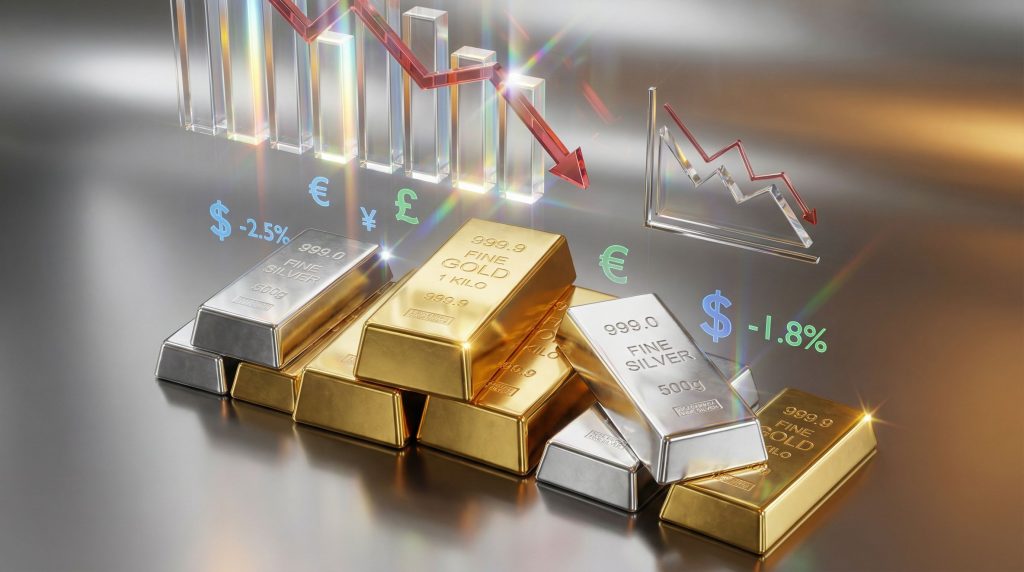
Market corrections in precious metals often emerge when seemingly stable uptrends encounter powerful opposing forces. These reversals demonstrate how rapidly sentiment can shift when multiple economic pressures converge simultaneously. Understanding these dynamics becomes crucial when gold and silver prices fall sharply, as witnessed during recent market volatility.
The mechanism behind price corrections operates through several interconnected channels. Profit-taking behaviour accelerates when investors who accumulated positions during extended rallies decide to lock in gains. This selling pressure typically intensifies when psychological price levels are reached, creating momentum that feeds on itself.
Key Market Mechanisms Behind Price Corrections:
- Profit-taking behaviour following sustained rallies
- Currency strength fluctuations affecting commodity pricing
- Monetary policy expectation shifts
- Technical resistance level breaches
- Leveraged position unwinding
Recent market events illustrate these dynamics in action. Gold declined from levels exceeding $5,500 per ounce to approximately $5,000, representing a 6-8% single-session correction. This movement occurred despite precious metals maintaining substantially elevated levels compared to earlier periods, demonstrating that corrections can be severe while overall trends remain higher.
The Role of Speculative Positioning in Price Volatility
Futures markets amplify price movements through leveraged positions that create outsized effects during corrections. When highly leveraged traders face margin calls during declining prices, forced liquidation accelerates downward momentum beyond what fundamental factors alone would suggest.
The concentration of speculative interest in precious metals during bull markets creates vulnerability to sharp reversals. Traders utilising significant leverage find themselves in precarious positions when prices move against them, triggering automatic selling mechanisms that compound downward pressure regardless of underlying value considerations.
When big ASX news breaks, our subscribers know first
How Do Currency Dynamics Impact Precious Metals Pricing?
The inverse relationship between the US dollar and precious metals creates significant pricing pressure during periods of currency strength. This relationship functions as one of the most reliable predictive mechanisms for precious metals volatility, particularly when combined with changing interest rate expectations.
Dollar Strength Impact Factors:
| Factor | Gold Impact | Silver Impact |
|---|---|---|
| Rising yields | High negative correlation | Higher volatility response |
| Economic data strength | Moderate pressure | Amplified industrial demand concerns |
| Fed policy shifts | Direct pricing influence | Secondary industrial effects |
Dollar appreciation pressures precious metals by making them more expensive for international investors holding non-dollar currencies. Furthermore, when the dollar strengthens while yields rise simultaneously, international investors face both absolute return headwinds from higher alternative yields and currency translation headwinds from dollar appreciation.
Recent market analysis indicates that expectations shifted toward somewhat less aggressive Federal Reserve rate cuts, enhancing dollar attractiveness relative to non-yielding precious metals. This macroeconomic shift created dual pressure mechanisms on precious metals prices through both direct yield competition and currency effects.
Interest Rate Expectations and Non-Yielding Assets
Precious metals face headwinds when interest rate environments become less accommodative. Higher opportunity costs reduce investment appeal for non-yielding assets, creating natural rotation toward yield-bearing alternatives.
The transmission mechanism operates through real interest rates, calculated as nominal rates minus inflation expectations. When real yields increase, precious metals lose comparative attractiveness since they provide no income stream to offset the rising opportunity cost of holding them versus bonds or bank deposits.
Why Does Silver Show Greater Volatility Than Gold During Corrections?
Silver's dual nature as both precious metal and industrial commodity creates amplified price swings compared to gold's more stable investment demand profile. This characteristic became evident when silver declined approximately 13% while gold fell 6-8% during the same trading session, demonstrating silver's roughly 1.6-2.2x greater price sensitivity.
Silver's High-Beta Characteristics:
- Industrial demand sensitivity to economic cycles
- Smaller market size enabling larger price swings
- Higher speculative interest during bull markets
- Greater leverage usage among traders
Silver's smaller absolute market size compared to gold enables larger percentage price swings from equivalent trading volumes. The speculative trader community concentrates more leverage and positioning in silver during bull markets, creating amplified forced liquidation pressure during reversals.
Four reinforcing mechanisms explain silver's enhanced volatility: sensitivity to industrial demand cycles, smaller liquidity pools, greater speculative interest during bull markets, and higher leverage usage among traders. However, each mechanism independently amplifies volatility; their convergence during corrections produces outsized price movements.
Industrial vs. Investment Demand Balance
Silver's industrial applications in electronics, solar panels, and medical devices create additional price pressure during economic uncertainty periods. When economic growth concerns emerge, both investment and industrial demand recalibrate simultaneously, creating amplified downward pressure.
The industrial component of silver demand responds to different economic signals than investment demand, creating complex cross-currents during market stress. Manufacturing demand may decline based on economic growth concerns while investment demand might increase due to safe-haven seeking, resulting in conflicting price pressures that enhance overall volatility.
What Technical Factors Trigger Precious Metals Selloffs?
Chart patterns and technical indicators often provide early warning signals for major price corrections in commodity markets. Understanding these technical elements helps explain why corrections can occur rapidly once key levels are breached, particularly when considering how the recent silver market squeeze impact has affected trading patterns.
Critical Technical Levels:
- Resistance breakthrough failures
- Moving average violations
- Volume surge confirmation
- Momentum indicator divergences
Technical analysis reveals that extreme optimism metrics had accumulated during rallying phases, creating vulnerability independent of fundamental catalysts. When resistance levels fail to contain selling pressure, momentum accelerates through algorithmic trading and high-frequency strategies that can amplify short-term volatility.
Gold's decline from above $5,500 to $5,000 per ounce represents a textbook resistance breakthrough failure scenario where prior support levels failed to contain selling pressure. Volume patterns during corrections typically provide confirmation of genuine selling pressure versus temporary profit-taking.
Support and Resistance Zone Analysis
Understanding key price levels helps investors navigate volatile periods and identify potential stabilisation points. Technical analysis combines price action, volume patterns, and momentum indicators to assess whether corrections represent temporary setbacks or more significant trend changes.
The breakdown through technical support levels often triggers algorithmic selling programs and stops-loss orders, creating cascading price effects that exceed what fundamental analysis alone would suggest. Modern precious metals markets incorporate algorithmic trading strategies that can amplify short-term volatility beyond traditional supply-demand dynamics.
How Do Central Bank Policies Influence Precious Metals Markets?
Monetary policy shifts create ripple effects across precious metals markets through multiple transmission channels that operate simultaneously. Central bank communications regarding policy stance influence not just direct rate expectations but also market sentiment regarding future policy trajectory.
Policy Impact Mechanisms:
- Real interest rate changes
- Currency valuation effects
- Inflation expectation adjustments
- Risk appetite modifications
The transmission mechanism operates through direct impact on real yields, currency effects where higher rates typically support stronger dollar, inflation expectations influenced by policy stance, and risk appetite where tighter policy reduces speculative positioning appetite.
Market participants repriced expectations for interest rate cuts toward less aggressive levels following Federal Reserve communications. This recalibration reflected changing central bank policy expectations that influenced precious metals valuations beyond direct rate effects, despite gold's record highs reached earlier in the cycle.
Quantitative Easing vs. Tightening Cycles
Different monetary policy phases create distinct precious metals market environments, affecting both institutional and retail investment flows. Accommodative policies generally support precious metals through lower real yields and currency effects, while tightening cycles create headwinds.
The shift from highly accommodative expectations toward more measured policy outlook reduced precious metals' attractiveness relative to yielding assets. Central bank policy uncertainty creates additional volatility as markets attempt to discount future policy paths with limited information.
What Role Do ETFs and Investment Flows Play in Price Corrections?
Exchange-traded funds significantly influence precious metals pricing through concentrated buying and selling pressure that can amplify underlying market movements. ETF flows create direct physical demand for metals while also influencing futures market positioning.
ETF Flow Impact Analysis:
- Inflow magnitude during bull markets
- Redemption pressure during corrections
- Market maker hedging activities
- Liquidity provision effects
ETF redemption pressure during corrections creates additional selling pressure as authorised participants must sell underlying metals to meet redemption requests. This mechanical selling adds to fundamental selling pressure and can accelerate price declines beyond what underlying demand would suggest.
Market maker hedging activities in ETF markets create additional derivatives exposure that must be managed during volatile periods. These hedging flows can amplify price movements in both directions as market makers adjust their exposure to maintain neutral risk profiles, particularly relevant for those considering an ETF investment guide strategy.
Institutional vs. Retail Investment Behaviour
Different investor categories exhibit varying response patterns during market volatility, creating complex flow dynamics that influence price formation. Institutional investors may have different risk management triggers compared to retail investors, leading to varied timing of buying and selling decisions.
Professional investors often employ sophisticated risk management systems that trigger automatic position adjustments during volatile periods. These systematic responses can create predictable flow patterns that amplify price movements beyond what discretionary trading alone would produce.
The next major ASX story will hit our subscribers first
How Do Geopolitical Events Affect Precious Metals Volatility?
Safe-haven demand fluctuates based on global risk perception changes, creating both upward and downward price pressures depending on the nature and severity of geopolitical developments. These events create complex interactions with other market factors.
Geopolitical Risk Factors:
- Regional conflict developments
- Trade policy uncertainties
- Currency war implications
- Sovereign debt concerns
Market sentiment shifts between risk appetite and safety seeking create predictable precious metals flow patterns. During risk-off periods, safe-haven demand typically supports precious metals prices, while risk-on environments can create selling pressure as investors rotate toward growth-oriented assets.
The relationship between geopolitical events and precious metals prices depends significantly on the broader market context. The same geopolitical development may have different precious metals implications depending on interest rate environments, currency dynamics, and investor positioning.
Risk-On vs. Risk-Off Market Sentiment
Understanding sentiment cycles helps predict precious metals behaviour during different market regimes. Risk-off periods typically benefit precious metals through safe-haven flows, while risk-on environments can create headwinds as investors seek higher returns elsewhere.
Global risk perception changes create complex interactions with other market factors, sometimes reinforcing and sometimes offsetting fundamental price drivers. Successful precious metals analysis requires understanding how geopolitical factors interact with monetary policy, currency dynamics, and technical factors.
What Are the Long-Term Implications of Sharp Price Corrections?
Understanding whether corrections represent trend reversals or temporary setbacks requires comprehensive analysis of multiple market factors operating simultaneously. Historical precedent provides guidance but market structure evolution creates new dynamics, particularly when evaluating how gold-silver ratio analysis can inform investment decisions.
Correction vs. Reversal Indicators:
- Fundamental support level maintenance
- Volume pattern analysis
- Breadth of selling pressure
- Recovery speed assessment
Sharp corrections can serve healthy functions by reducing speculative excess and creating more sustainable price levels. Markets that experience periodic corrections often demonstrate greater long-term stability than those that advance without interruption.
The current correction occurred while precious metals remain substantially elevated compared to earlier levels, suggesting the decline may represent profit-taking rather than fundamental deterioration. However, recovery patterns and volume characteristics will provide important clues about underlying market health.
Market Structure Evolution and Price Discovery
Modern precious metals markets incorporate algorithmic trading and high-frequency strategies that can amplify short-term volatility while potentially improving long-term price discovery. These structural changes affect how corrections unfold and resolve.
Price discovery mechanisms have evolved to incorporate more diverse information sources and participant types, creating both opportunities and challenges for traditional analysis methods. Understanding these structural changes becomes crucial for interpreting correction patterns and their implications.
How Should Investors Navigate Precious Metals Volatility?
Strategic approaches to precious metals investing require understanding both short-term volatility and long-term value drivers. Successful navigation involves balancing risk management with opportunity recognition during volatile periods, particularly when considering gold strategic investment approaches.
Risk Management Strategies:
- Position sizing considerations
- Diversification across metals
- Time horizon alignment
- Volatility expectation setting
Position sizing becomes particularly important during volatile periods when drawdowns can exceed historical norms. Investors should size positions based on their ability to withstand temporary declines without compromising their overall investment strategy.
Diversification across different precious metals can help reduce portfolio volatility while maintaining exposure to the sector. Gold and silver respond differently to various market conditions, creating natural hedging opportunities within precious metals allocations.
Dollar-Cost Averaging vs. Tactical Allocation
Different investment approaches suit various investor profiles and market outlook scenarios. Dollar-cost averaging during volatility often proves more effective than attempting to time exact market bottoms or tops.
Tactical allocation strategies require greater market timing skill but can potentially enhance returns for sophisticated investors. The choice between systematic and tactical approaches should reflect individual risk tolerance, time availability, and investment expertise.
What Economic Indicators Predict Precious Metals Price Movements?
Leading economic indicators provide insights into potential precious metals market direction changes by revealing underlying economic and monetary conditions. Understanding these relationships helps investors anticipate market movements when gold and silver prices fall sharply due to macroeconomic shifts.
Key Predictive Metrics:
- Real interest rate trends
- Currency volatility measures
- Inflation breakeven spreads
- Credit market conditions
Real interest rate trends represent one of the most reliable precious metals indicators since they directly affect the opportunity cost of holding non-yielding assets. Monitoring Treasury Inflation-Protected Securities (TIPS) yields provides real-time insight into real rate changes.
Currency volatility measures help predict periods of precious metals volatility since currency instability often drives safe-haven demand. The US Dollar Index and its volatility provide important context for precious metals price formation.
Correlation Analysis with Other Asset Classes
Understanding precious metals relationships with stocks, bonds, and commodities helps predict price behaviour during different market regimes. These correlations change over time based on underlying economic conditions and market structure evolution.
During periods of financial stress, precious metals often demonstrate negative correlation with risk assets while showing positive correlation with safe-haven assets like Treasury bonds. However, these relationships can break down during extreme market conditions or structural changes, as evidenced in recent market analysis.
Frequently Asked Questions About Precious Metals Price Corrections
How long do precious metals corrections typically last?
Corrections can range from days to several months, depending on underlying fundamental drivers and technical damage extent. Historical analysis suggests most corrections resolve within 2-8 weeks, though structural bear markets can persist much longer.
Should investors buy during sharp price declines?
Dollar-cost averaging during volatility often proves more effective than attempting to time exact bottoms. Sharp declines can create attractive entry opportunities but require careful risk management and position sizing.
What differentiates temporary corrections from major trend reversals?
Fundamental analysis of supply-demand dynamics, monetary policy direction, and global economic conditions provides crucial context. Volume patterns, recovery speed, and breadth of selling pressure offer additional clues about correction nature.
How do mining stocks perform during precious metals corrections?
Mining equities typically experience amplified volatility compared to underlying metals due to operational leverage effects. They often decline more during corrections but can rebound more strongly during recoveries, particularly when gold and silver prices fall sharply across the sector.
Disclaimer: This analysis is for educational purposes only and does not constitute investment advice. Precious metals investing involves significant risk, including potential loss of principal. Market predictions and forecasts are speculative and may not materialise. Investors should conduct their own research and consult with qualified financial advisors before making investment decisions. Past performance does not guarantee future results.
Looking for Market-Leading Precious Metals Investment Opportunities?
Whilst precious metals corrections create volatility, they also present significant opportunities for investors who can identify and act on emerging discoveries quickly. Discovery Alert's proprietary Discovery IQ model provides instant notifications on significant ASX mineral discoveries, turning complex market data into actionable insights that help investors position themselves ahead of broader market movements during both volatile and stable periods.