August 6, 2026
The Mineralogical Complexity Rewriting the Rules of DRC Ore Processing
The history of copper and cobalt extraction across the Central African Copperbelt is, at its core, a story of escalating geological difficulty. What began as relatively straightforward oxide ore processing has evolved into one of the most mineralogically intricate challenges in global base metals mining. As shallow, high-grade ore zones are progressively exhausted, operations are pushing into deeper, more variable geological formations where the old toolkit simply does not perform.
This shift is not incremental. It represents a structural change in the nature of the ore itself, and it demands an equally structural change in how metallurgists think about reagent chemistry, leaching selectivity, and processing circuit design.
Understanding why conventional approaches are reaching their limits requires a close look at what makes precision chemistry for complex DRC ores so fundamentally different from standard hydrometallurgical practice elsewhere in the world.
When big ASX news breaks, our subscribers know first
Why Conventional Leaching Falls Short in the DRC's Most Complex Orebodies
The Mineralogical Challenge Driving Demand for Precision Chemistry
DRC copper-cobalt orebodies are rarely composed of a single mineral phase. A typical ore matrix from the Lualaba or Kolwezi regions may contain heterogenite, malachite, azurite, chrysocolla, carrollite, and various copper-cobalt sulphides in intimate association. Each phase carries a different solubility profile, a different response to acid concentration, and a different tendency to release penalty elements such as iron, manganese, and arsenic into solution.
Conventional bulk-acid sulphuric acid leaching was designed for simpler ore systems. It applies indiscriminate dissolution across all mineral phases, which is effective when the ore is predominantly composed of a single oxide species. When applied to multi-phase DRC ores, the result is excessive iron co-dissolution, elevated impurity loads in the pregnant leach solution, and cascading inefficiencies through the solvent extraction and electrowinning circuits downstream.
How Ore Complexity Has Escalated Across the Central African Copperbelt
Several converging factors are driving the complexity increase across DRC operations:
- Mining depths are increasing as shallow ore bodies are depleted, exposing more heterogeneous geological formations
- Feed grade variability is widening, with ore types changing across short spatial intervals within the same orebody
- Impurity profiles are worsening as operations encounter zones with elevated manganese, arsenic, and calcium content
- Finer liberation sizes are required to recover valuable minerals from increasingly fine-grained ore textures
Each of these factors compounds the others. Finer grinding generates more surface area for unwanted mineral dissolution. Wider grade variability makes fixed reagent dosing strategies obsolete. Deeper mining introduces new mineral associations that were never encountered in earlier, shallower campaigns.
Oxide-Sulphide Transition Zones: The Processing Frontier That's Redefining Metallurgical Strategy
Among the most technically demanding zones in the DRC's mineralogical landscape are the oxide-sulphide transition horizons. These intermediate geological formations sit between the near-surface oxide cap, which is relatively amenable to acid leaching, and the deeper primary sulphide zones, which typically require flotation-based concentration followed by pressure or bacterial oxidation.
Transition zone ores contain both oxide and sulphide minerals simultaneously, creating a processing paradox. Acid leaching conditions optimised for oxide minerals tend to be insufficient for sulphide recovery. Conditions suited to sulphide treatment risk dissolving penalty elements from the oxide fraction. Impurity management, acid consumption control, and recovery optimisation all become disproportionately important in these mixed assemblages.
What Is Precision Chemistry for Complex DRC Ores and Why Does It Matter Now?
Defining Selective Leaching in a Critical Minerals Context
Selective leaching, at its simplest, means dissolving the minerals you want while leaving the minerals you do not want largely undisturbed. In a single-phase ore, this is straightforward. In a multi-phase DRC ore, achieving meaningful selectivity requires reagent systems that can distinguish between chemically similar mineral species at the molecular level.
This is the core proposition of precision chemistry for complex DRC ores. Rather than applying a blanket acid solution and managing the consequences downstream, precision chemistry involves designing the leachant itself to preferentially interact with target mineral phases while minimising co-dissolution of iron and other penalty elements.
How Precision Chemistry Differs from Conventional Bulk-Acid Processing
The distinction between these two approaches runs deeper than reagent choice. It reflects a fundamentally different philosophy of metallurgical design.
Conventional bulk-acid processing accepts impurity loading as an operational constant and compensates through downstream purification. Precision chemistry attempts to prevent impurity loading from occurring in the first place, reducing the burden on solvent extraction circuits and improving the overall economics of the hydrometallurgical flowsheet.
The practical implication is significant. Every percentage point of iron that enters the pregnant leach solution creates additional reagent consumption, reduced extraction efficiency, and greater risk of crud formation in organic solvent phases. Precision reagent design addresses this at the source.
The Role of the DRC in Global Copper and Cobalt Supply Chains
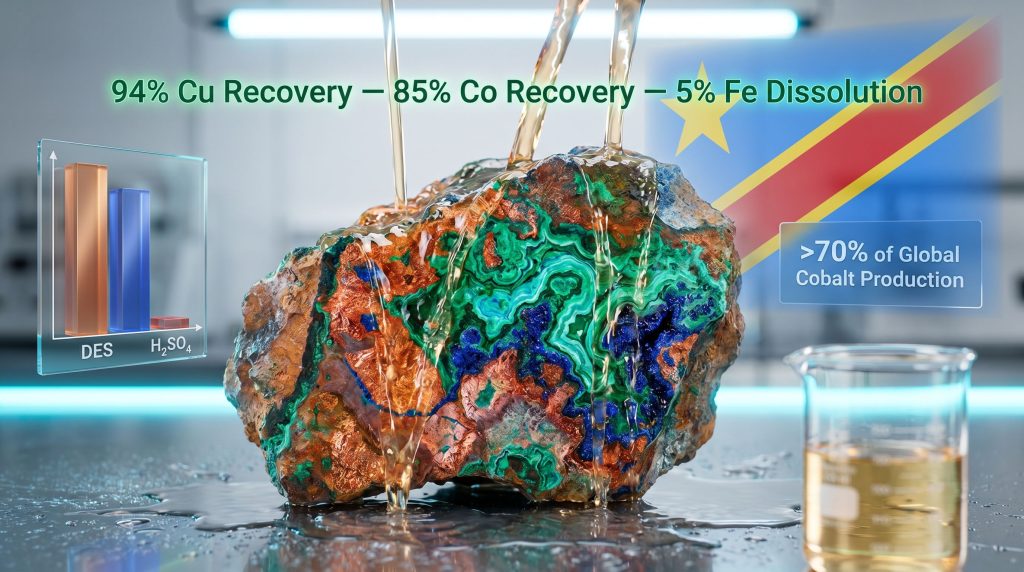
The DRC accounts for more than 70% of global cobalt production and holds its position as Africa's foremost copper-producing nation. As global demand for lithium-ion batteries, electric vehicle drive systems, and grid storage infrastructure continues to expand, the strategic weight of DRC output grows correspondingly. Battery cathode chemistries that rely on cobalt, including NMC variants widely used in automotive applications, are directly dependent on the DRC's ability to maintain and grow production volumes.
Furthermore, DRC mineral resources span far beyond cobalt and copper, reinforcing the country's central role in the global critical minerals supply chain. This dependency means that processing inefficiency in the DRC is not merely a local cost problem. It has implications for global battery supply chain resilience, downstream manufacturing schedules, and the pace of energy transition deployment.
The Science Behind Selective Reagent Systems for DRC Copper-Cobalt Ores
How Deep Eutectic Solvents Are Redefining Leach Selectivity
One of the most technically significant developments in selective leaching research is the emergence of deep eutectic solvents (DESs) as viable alternatives to mineral acid systems for specific ore types. DESs are formed by combining a hydrogen bond acceptor with a hydrogen bond donor in specific molar ratios, producing a mixture with a melting point substantially below that of either individual component.
What makes DESs particularly interesting for DRC copper-cobalt ores is their tunable chemistry. By adjusting the donor-acceptor pair and the molar ratio, researchers can create leachant systems with highly specific dissolution affinity for particular mineral phases while suppressing the dissolution of others. Novel approaches for processing complex carbonate-rich copper-cobalt mixed ores have further demonstrated the value of phase-targeted strategies in these challenging ore environments.
Choline Chloride-Lactic Acid: The High-Selectivity Benchmark
The choline chloride-lactic acid (ChCl:LA) system has emerged as a benchmark for high-selectivity copper and cobalt leaching from complex oxide ores. Research into this system has demonstrated approximately 94% copper recovery and approximately 85% cobalt recovery over a 90-hour leach period at ambient temperature of around 20 degrees Celsius, while dissolving only approximately 5% of the iron present in the ore matrix.
This selectivity profile is exceptional by the standards of conventional hydrometallurgy. Suppressing iron dissolution to 5% while achieving near-complete copper recovery represents a qualitative improvement over standard sulphuric acid systems, which typically co-dissolve iron at much higher rates in multi-phase DRC ores.
The mechanism behind this selectivity relates to the lactic acid component's preferential coordination chemistry with copper and cobalt mineral phases, particularly those associated with arsenic and iron-bearing gangue minerals. The organic acid ligand forms stable complexes with target metals while being less reactive toward iron oxide and hydroxide phases under the same conditions.
Choline Chloride-Oxalic Acid: Speed Versus Selectivity Trade-Offs
The choline chloride-oxalic acid (ChCl:OA) system offers a different performance profile. It demonstrates faster dissolution kinetics than ChCl:LA, making it potentially attractive where processing time is a constraint. However, its selectivity profile differs meaningfully.
ChCl:OA shows stronger dissolution affinity for cobalt, manganese, and nickel-bearing mineral phases, while generating higher iron dissolution rates than ChCl:LA. In ores where cobalt is the primary target and iron contamination is manageable, this trade-off may be acceptable. In ores where copper is the priority and iron management is critical, ChCl:LA retains its advantage.
Comparative Performance: DES Systems vs. Conventional Sulphuric Acid Leaching
| Leachant System | Cu Recovery | Co Recovery | Fe Dissolution | Key Advantage |
|---|---|---|---|---|
| ChCl:Lactic Acid (ChCl:LA) | ~94% | ~85% | ~5% | Highest Cu/Co selectivity, minimal Fe co-dissolution |
| ChCl:Oxalic Acid (ChCl:OA) | Lower than ChCl:LA | High | Higher than ChCl:LA | Fastest dissolution kinetics, strong Co/Mn/Ni action |
| Conventional H₂SO₄ | Variable | Variable | High | Established infrastructure, low reagent cost |
| Ferrous H₂SO₄ | Variable | Variable | Very High | Reductive leaching of cobalt oxides |
Why Phase-Specific Targeting Is Critical in Multi-Mineral DRC Ore Matrices
The mineralogical diversity of DRC ores means that no single reagent system will be universally optimal across all ore types within a single operation. Phase-specific targeting — the practice of matching leachant chemistry to the dominant mineral assemblage in a given ore feed — represents a more sophisticated approach to flowsheet design.
A framework for matching chemistry to target phases looks like this:
- ChCl:LA equilibrates preferentially with copper, arsenic, and iron-bearing mineral phases, making it suitable for high-copper oxide ores with iron penalty concerns
- ChCl:OA demonstrates stronger dissolution affinity for cobalt, manganese, and nickel-bearing phases, making it more effective where cobalt recovery is the primary metallurgical objective
- Phase-targeted chemistry reduces downstream impurity loads and improves the efficiency of solvent extraction circuits by delivering cleaner pregnant leach solutions
How Flotation Reagent Optimisation Is Transforming Plant Performance
Advanced Collectors, Depressants, and Modifiers in Complex Ore Environments
Hydrometallurgical leaching is not the only processing route affected by ore complexity. Flotation-based circuits, used either as a primary concentration step or as a complementary processing stage, face equally significant challenges when ore mineralogy becomes variable and fine-grained.
Advanced collectors, depressants, and froth modifiers each play distinct roles in flotation performance. Collectors selectively render target mineral surfaces hydrophobic, allowing them to attach to air bubbles and float to the surface. Depressants suppress the flotation of unwanted gangue minerals. Modifiers adjust pulp chemistry to optimise the conditions under which these interactions occur.
In complex DRC ore environments, the challenge is that variable mineralogy means that a reagent combination optimised for one ore blend may perform poorly when the feed changes. This drives the need for more sophisticated, adaptive reagent strategies rather than fixed-suite approaches. Moreover, the DRC cobalt market risk posed by regulatory shifts adds further urgency to processing efficiency improvements across the Copperbelt.
Frother Consumption Reduction: Achieving Up to 50% Savings
One of the more practically significant outcomes of targeted flotation reagent optimisation programmes in DRC operations has been meaningful reductions in frother consumption. Through systematic optimisation work, some operations have achieved frother consumption reductions of up to 50% while maintaining or improving overall recovery performance.
The significance of this extends beyond the direct cost saving. In remote DRC operations where reagent logistics represent a major operational vulnerability, reducing the volume of consumables required has compounding benefits for supply chain resilience and working capital management.
Step-by-Step: How a Reagent Optimisation Programme Is Structured
A rigorous flotation reagent optimisation programme follows a structured sequence:
- Ore characterisation and mineralogical mapping to establish the full variability envelope across the mine plan
- Bench-scale flotation test work to screen collector, modifier, and depressant combinations against representative ore samples
- Pilot-scale validation to confirm selectivity gains under conditions that more closely approximate plant operation
- Reagent dosing optimisation to balance recovery performance against chemical cost across the expected ore variability range
- Continuous monitoring and real-time adjustment to respond to feed variability as it occurs in production
Hydrometallurgical Circuit Efficiency: Solvent Extraction and Electrowinning Under the Microscope
Why SX-EW Operations Are Particularly Sensitive to Impurity Management
Solvent extraction-electrowinning (SX-EW) circuits are the dominant copper and cobalt refining pathway across the Copperbelt, and they are also among the most sensitive to upstream impurity loading. Impurities that pass through the leaching stage accumulate in the organic solvent phase, progressively degrading extraction efficiency and increasing the risk of crud formation, which can seriously disrupt phase separation.
Iron is the primary culprit in most DRC circuits, but manganese, calcium, and arsenic also contribute to organic phase contamination and extractant degradation over time. In addition, the Congo cobalt price impacts resulting from supply disruptions place even greater pressure on operations to extract maximum value from existing ore feeds.
Plant Throughput Gains of Up to 20% Through Better Impurity Control
More effective impurity management in hydrometallurgical circuits has demonstrated measurable throughput benefits. Reagent technology advances targeting impurity suppression across Copperbelt operations have been associated with plant throughput improvements of up to 20%, a substantial operational lever given the capital intensity of SX-EW infrastructure.
The relationship between impurity control and throughput is not always intuitive. Reduced impurity loading decreases the frequency of organic phase cleanouts, minimises extractant losses, improves phase separation rates, and allows circuits to operate closer to their design capacity over sustained periods.
Acid Efficiency and Extraction Stability: The Two Variables That Determine SX-EW Profitability
Beyond throughput, two variables dominate the profitability equation in SX-EW operations: acid efficiency and extraction stability. Acid efficiency reflects how effectively each unit of sulphuric acid is consumed in productive dissolution rather than in dissolving gangue or regenerating depleted extractant. Extraction stability reflects the consistency of the organic phase's metal-loading performance over time.
Both variables deteriorate when impurity management is inadequate. Precision chemistry approaches that reduce upstream impurity generation protect both metrics simultaneously, creating a compound economic benefit across the processing chain.
The next major ASX story will hit our subscribers first
Water Management and Tailings: The ESG Pressure Points Reshaping DRC Processing Strategy
Why Water Recovery Has Become a Strategic Operational Priority
As processing capacity expands across major DRC mining regions including Kolwezi and Lualaba, water infrastructure is under increasing strain. These are not water-abundant environments, and freshwater availability is constrained by both hydrological factors and competition from growing local populations.
Improving water recovery, reducing freshwater consumption, and strengthening tailings management have moved from optional sustainability initiatives to operational requirements. These are driven by the expectations of international investors and the standards demanded by downstream supply chain partners in the battery and automotive sectors. Consequently, the copper supply trends emerging from these pressures are reshaping how producers across the Copperbelt approach capital allocation.
Advanced Thickening Technologies and Their Role in Water Recycling
Polyacrylamide flocculants and synergistic coagulant systems are among the most effective tools available for improving water recovery from tailings streams. These chemistries improve settling rates and overflow clarity, enabling more efficient water recycling back into the processing circuit.
Water and Tailings Management: Key Technology Levers
| Challenge | Technology Approach | Operational Outcome |
|---|---|---|
| High freshwater consumption | Polyacrylamide flocculant systems | Improved water recycling rates |
| Poor tailings settling performance | Synergistic coagulant combinations | Enhanced settling rates and overflow clarity |
| Tailings storage risk | Slurry rheology optimisation | Reduced dewatering volumes, lower storage risk |
| Downstream ESG compliance | Reagent dosing optimisation | Demonstrable environmental footprint reduction |
The Growing Scrutiny of Tailings Failures and What It Means for DRC Operators
High-profile tailings storage facility failures in other mining regions have placed global scrutiny firmly on tailings management practices. For DRC operators supplying international battery and automotive markets, this scrutiny translates into concrete due diligence requirements from downstream buyers and institutional investors.
Optimising reagent dosing, improving slurry rheology, and deploying more effective dewatering strategies are not only environmental best practices in this context. They are increasingly prerequisites for maintaining international market access.
Cleaner Processing Chemistry: Biodegradable Reagents, Emission Controls, and Circular Recovery
The Shift Toward Lower-Toxicity and Biodegradable Reagent Portfolios
Global demand for responsibly sourced battery minerals is reshaping the reagent portfolios that DRC producers can viably use. Downstream buyers in Europe, North America, and East Asia are conducting increasingly thorough supply chain assessments that extend to the specific chemical inputs used in ore processing.
This is driving accelerating adoption of biodegradable and lower-toxicity reagent alternatives across the Copperbelt. The transition is not purely ideological. Operations that can demonstrate cleaner processing chemistry face lower regulatory risk, reduced remediation liability, and stronger positioning in supply chain certification programmes.
Acid Mist Suppressants and Cyanide Detoxification Technologies
Within copper electrowinning operations, acid mist generation is both an occupational health hazard and an emissions management challenge. Purpose-designed acid mist suppressants reduce the aerosol generation associated with the electrowinning process, protecting workers and reducing the atmospheric emissions load at processing facilities.
Cyanide detoxification technologies represent another dimension of cleaner processing chemistry, particularly relevant where cyanide-based processes are used in associated gold or silver recovery circuits. Meeting international supply chain requirements increasingly means being able to demonstrate certified cyanide management and destruction practices. Recent research on fluid evolution and ore-forming processes in the Central African Copperbelt further underlines how geological complexity at depth shapes the chemical challenges faced at surface processing facilities.
Membrane-Based Reagent Recovery: The Circular Chemistry Model
Early-stage test work on membrane-based reagent recovery systems has indicated potential recovery rates of up to 70% for chemicals including sulphuric acid and caustic soda. At the ore grades increasingly encountered across the DRC's maturing deposits, this level of chemical reuse has the potential to materially shift the economics of processing mineralisation that would otherwise sit below the viability threshold.
Membrane-based recovery works by separating dissolved chemical species from process water streams through selective permeability, allowing concentrated reagent fractions to be recaptured and reintroduced into the leaching circuit rather than being neutralised and discarded. The technology is still in the transition from laboratory to commercial scale in most DRC applications, but the economic case for lower-grade deposit processing is compelling.
Supply Chain Resilience: Reagent Logistics in Remote DRC Operations
Why Reagent Supply Continuity Is a Tier-One Operational Risk
The remoteness of many DRC mining operations introduces a supply chain vulnerability that has no direct analogue in more accessible mining jurisdictions. Border delays, seasonal road deterioration, and regional security fluctuations can all disrupt the timely delivery of chemical reagents, and even short supply interruptions can cascade into significant production losses.
Strategic stocking of critical reagents, combined with diversified sourcing strategies and investment in regional distribution infrastructure, represents the standard multi-layer mitigation approach for responsible operators. The ability to maintain minimum buffer inventories across key reagent categories is effectively a production continuity insurance mechanism in the DRC operating context.
What Does the Future of DRC Ore Processing Chemistry Look Like?
The Trajectory of DES Adoption: From Laboratory to Commercial Scale
Deep eutectic solvents remain primarily a laboratory and pilot-scale technology in most DRC applications as of mid-2026. However, the performance data emerging from test work programmes is sufficiently compelling to drive growing investment in scale-up studies. The primary barriers to faster commercial adoption involve reagent cost at scale, handling logistics in remote environments, and the need to develop commercially proven circuit designs for DES-based leaching at production volumes.
As these barriers are progressively addressed, the expectation within the metallurgical community is that DES and hybrid leaching systems will gain meaningful commercial traction across the Copperbelt over the remainder of the decade.
Forward-Looking Scenario: DRC Processing Chemistry by 2030
| Dimension | Current State | Projected Direction |
|---|---|---|
| Leach selectivity | H₂SO₄ dominant, DES emerging | DES and hybrid systems gaining commercial traction |
| Reagent sustainability | Conventional reagent portfolios | Biodegradable and low-toxicity alternatives expanding |
| Water management | Improving but under pressure | Closed-loop water systems becoming standard |
| Reagent recovery | Early-stage test work | Membrane-based recovery at commercial scale |
| ESG compliance pressure | Growing from downstream buyers | Mandatory for international market access |
ESG-Driven Chemistry: The Convergence of Environmental Performance and Metallurgical Efficiency
Perhaps the most significant structural shift underway in DRC processing chemistry is the convergence of environmental performance objectives with metallurgical efficiency objectives. For much of the industry's history, these were treated as competing priorities, with environmental improvements assumed to come at a cost to recovery or throughput.
Precision chemistry for complex DRC ores is demonstrating that this trade-off is not inherent. Selectivity improvements that suppress iron co-dissolution simultaneously reduce the impurity burden on SX-EW circuits, improve extraction efficiency, and produce cleaner effluent streams. Water recycling improvements reduce freshwater consumption while also reducing the volume of reagent-bearing water requiring treatment. Membrane-based reagent recovery reduces chemical costs while simultaneously reducing the volume of neutralisation waste generated.
The convergence is not accidental. It reflects a maturing understanding that sustainable processing and economically optimised processing are, in the best-designed systems, the same thing.
Key Statistics Summary: Precision Chemistry Performance Benchmarks in DRC Operations
| Metric | Reported Performance |
|---|---|
| DRC share of global cobalt production | >70% |
| Cu recovery via ChCl:LA DES system | ~94% |
| Co recovery via ChCl:LA DES system | ~85% |
| Fe dissolution via ChCl:LA DES system | ~5% |
| Frother consumption reduction potential | Up to 50% |
| SX-EW plant throughput improvement | Up to 20% |
| Membrane-based reagent recovery potential | Up to 70% |
Frequently Asked Questions: Precision Chemistry for DRC Copper-Cobalt Ores
What makes DRC ores more difficult to process than ores from other regions?
DRC ores are characterised by high mineralogical complexity, including mixed oxide-sulphide assemblages, variable grade distribution across short spatial intervals, and elevated concentrations of penalty elements such as iron, manganese, and arsenic. As mining depths increase, these challenges intensify, requiring more sophisticated and targeted reagent strategies than standard sulphuric acid systems can reliably deliver.
What is a deep eutectic solvent and how does it work in metal leaching?
A deep eutectic solvent is a mixture of two or more components that, when combined in specific molar ratios, produces a liquid with a melting point far below that of either individual component. In metal leaching applications, DESs are designed so that their hydrogen bonding chemistry interacts preferentially with specific mineral phases, enabling selective dissolution of target metals while suppressing the dissolution of unwanted species such as iron.
How does precision chemistry reduce environmental impact in DRC mining operations?
By suppressing co-dissolution of penalty elements such as iron, precision chemistry reduces the volume and toxicity of process effluents, lowers neutralisation reagent requirements, and decreases the impurity load entering tailings storage. Reduced frother consumption and advances in reagent recovery further diminish the chemical footprint of processing operations.
What is the difference between flotation reagent optimisation and hydrometallurgical reagent systems?
Flotation reagent optimisation involves customising the collectors, depressants, and modifiers used in physical separation circuits to improve the selective concentration of valuable minerals before any chemical leaching occurs. Hydrometallurgical reagent systems, by contrast, govern the chemical dissolution and recovery of metals from the ore or concentrate, including leachants, extractants, and stripping agents used in SX-EW circuits.
Why is iron selectivity such a critical parameter in DRC copper-cobalt leaching?
Iron is present in abundance across most DRC ore matrices, and it dissolves readily under the acidic conditions required for copper and cobalt recovery. Elevated iron in the pregnant leach solution degrades solvent extraction performance, increases extractant consumption, promotes crud formation in organic phases, and ultimately reduces plant throughput and product quality.
How do membrane-based reagent recovery systems work in mining applications?
Membrane-based systems use selective permeability to separate dissolved reagent molecules from process water streams. Specific membrane types, including nanofiltration and reverse osmosis membranes, can concentrate sulphuric acid, caustic soda, or other chemicals from dilute waste streams, allowing them to be recycled back into the processing circuit rather than being neutralised and discharged.
What ESG standards are DRC copper and cobalt producers expected to meet for international markets?
International battery and automotive supply chains increasingly require producers to demonstrate compliance with frameworks including the Responsible Minerals Initiative, the Copper Mark, and various national responsible sourcing regulations. These frameworks address chemical management, water stewardship, tailings governance, emissions control, and community impact alongside the traditional occupational health and safety requirements.
Disclaimer: Performance figures and technology projections cited in this article reflect published research findings and operational benchmarks from the DRC mining industry. Forward-looking statements regarding technology adoption timelines, reagent recovery rates, and throughput improvements involve inherent uncertainty and should not be interpreted as guarantees of future operational outcomes. Investors and operators should conduct independent technical due diligence before making decisions based on emerging technology claims.
Want to Stay Ahead of the Next Major Mineral Discovery on the ASX?
Discovery Alert's proprietary Discovery IQ model delivers real-time alerts on significant ASX mineral discoveries across copper, cobalt, and beyond — instantly transforming complex mineral data into actionable investment insights for traders and long-term investors alike. Explore historic examples of exceptional discovery returns and begin your 14-day free trial today to position yourself ahead of the broader market.