
July 8, 2026
When Benchmark Transparency Becomes a Market Signal
In seaborne commodity markets, the difference between a price and its rationale is often misunderstood by those outside the industry. A published price index represents a single numerical output. The rationale, however, is the documented audit trail that explains how that number was reached: which bids were observed, which offers were circulated, and what trades were concluded. When a rationale is incomplete, market participants lose part of the evidentiary foundation they rely on for procurement decisions, risk management, and contract disputes.
This distinction sits at the heart of a correction issued on Wednesday, July 8, 2026, relating to the MB-COA-0003 premium hard coking coal, FOB eastern Australian ports index. The correction restored a missing data point to the published rationale from the prior session without altering the final price itself. While procedurally routine, the underlying market data that was restored carries meaningful signals about where physical buyers are positioning ahead of Q3 2026 deliveries.
When big ASX news breaks, our subscribers know first
What the MB-COA-0003 Index Measures and Why It Matters
The MB-COA-0003 index tracks the spot value of premium hard coking coal delivered free on board at eastern Australian export terminals, denominated in US dollars per wet metric tonne (WMT). It functions as the foundational reference price for one of the most strategically important raw materials in global steelmaking. Reviewing the latest metallurgical coal price update provides useful context for understanding current benchmark movements.
How the Index Is Constructed
Fastmarkets assembles this assessment by collecting transactional evidence from the physical spot market during a defined assessment window. This includes:
- Bids placed on electronic trading platforms such as GlobalCOAL
- Offers circulated through brokers and direct counterparty negotiations
- Concluded spot trades at nominated Australian export terminals
- Contextual information including laycan dates, tonnage, and coal specification
The index is part of Fastmarkets' broader steel raw materials pricing suite, which is relied upon by more than 14,000 commodity market participants globally to benchmark physical trade and manage procurement risk. Steelmakers, traders, miners, and financial institutions use MB-COA-0003 as a reference point for spot contracts, quarterly settlement discussions, and derivative hedging.
The Role of Price Reporting Agencies in Benchmark Credibility
Price reporting agencies (PRAs) operating in commodity markets are expected to follow governance frameworks that ensure consistency, transparency, and reproducibility. The International Organization of Securities Commissions (IOSCO) published its Principles for Oil Price Reporting Agencies, which have since been broadly adopted across commodity sectors including coal and metals. These principles require PRAs to maintain documented error correction procedures, preserve audit trails, and ensure that any correction restores the original intent of the assessment without distorting the published price.
When a rationale is amended, it does not reflect a failure in pricing methodology. It reflects precisely the kind of procedural discipline that underpins market confidence in independently assessed benchmarks.
What Was Missing and What the Correction Restored
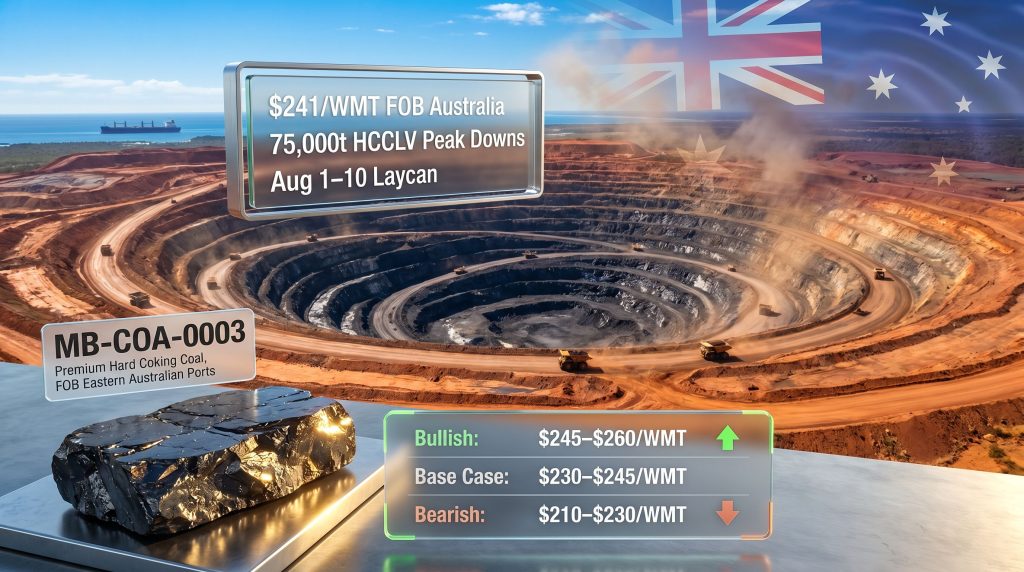
The original rationale published on Tuesday, July 7, 2026, inadvertently excluded a specific bid entry from the GlobalCOAL electronic trading platform. The omitted information described a bid for 75,000 tonnes of HCCLV Peak Downs premium low-volatile matter hard coking coal, placed at $241 per WMT FOB Australia with a laycan of August 1 to 10.
The correction, published the following day, restored this bid to the rationale. Critically, the final published price for the MB-COA-0003 index was not affected by the omission or the subsequent correction. The Fastmarkets premium hard coking coal FOB eastern Australian ports index page provides full historical data for those wishing to contextualise this correction within broader price trends.
| Correction Detail | Information |
|---|---|
| Index Affected | MB-COA-0003 Premium Hard Coking Coal, FOB Eastern Australian Ports |
| Error Type | Typographical omission in published rationale |
| Original Publication Date | Tuesday, July 7, 2026 |
| Correction Published | Wednesday, July 8, 2026 |
| Price Impact | None – published price remains unchanged |
| Omitted Data Point | GlobalCOAL bid: 75,000t HCCLV Peak Downs at $241/WMT FOB Australia, laycan Aug 1-10 |
Price vs. Rationale: Understanding the Distinction
The price and rationale are two distinct outputs within a commodity price assessment. The price is the index value that feeds into contracts and settlement mechanisms. The rationale is the explanatory record that documents the market evidence underpinning that value. In physical commodity markets, sophisticated participants routinely read both, using the rationale to verify whether the assessed price is consistent with the market activity they themselves observed during the session.
When a rationale omits a material piece of market data, it creates an information asymmetry: some participants who were active on the GlobalCOAL platform during the session knew about the bid, while those relying solely on the published rationale did not. Restoring this information maintains the evidentiary completeness that market confidence depends upon.
The Significance of the $241/WMT Bid: What Physical Market Positioning Reveals
The bid that was restored to the rationale is worth examining on its own terms. A 75,000-tonne volume is a commercially meaningful lot size in the seaborne coking coal spot market, where individual cargo transactions typically range from 50,000 to 100,000 tonnes depending on vessel class. A Panamax vessel at full utilisation typically carries around 75,000 to 80,000 tonnes, making this bid consistent with a single-vessel spot cargo.
Recent Price Context: Where $241/WMT Sits Relative to Market History
To understand what this bid level signals, it helps to position it within recent price history. Furthermore, the broader global crude steel outlook shapes the demand environment underpinning these spot bids.
| Market Milestone | Price Level | Timeframe |
|---|---|---|
| Australian PLV Hard Coking Coal 17-Month High | ~$227.38/t FOB Australia | January 2026 |
| Broader Coking Coal Benchmark Settlement | ~$234/t USD | July 7, 2026 |
| GlobalCOAL Bid (Correction Context) | $241/WMT FOB Australia | August 1-10 Laycan |
The bid at $241/WMT sits above both the January 2026 multi-month high and the contemporaneous benchmark settlement level, suggesting the buyer placing this bid was willing to pay a premium for near-term August delivery. This positioning is consistent with procurement behaviour driven by either logistics urgency or an expectation that prices will move higher through the quarter.
Physical market bids placed above the prevailing benchmark are rarely coincidental. They typically reflect either supply anxiety, shipment timing constraints, or a directional view on near-term price movement held by the buying counterparty.
Queensland's Geographic Vulnerability and Its Repeated Influence on FOB Supply
Understanding why buyers might bid above benchmark levels requires understanding the structural fragility of Australian coking coal supply logistics.
The Bowen Basin's Export Dependency
Queensland's Bowen Basin is the geographic source of the majority of Australia's premium hard coking coal exports. The basin contains some of the world's most coveted metallurgical coal assets, including the Peak Downs and Goonyella mining operations. Coal extracted from these mines travels by rail to export terminals at Dalrymple Bay and Hay Point, two of the largest dedicated coal export facilities in the world by volume.
The challenge is that the Bowen Basin sits within a monsoonal rainfall zone. Seasonal flooding events between November and April can:
- Interrupt rail haulage between mine sites and port facilities
- Reduce port stockpile levels and constrain vessel loading rates
- Trigger force majeure declarations by mining and logistics companies
- Compress the volume of premium product available for spot sale during affected periods
These disruptions have historically generated rapid price spikes. Because Australian PLV hard coking coal has no close substitute in global steelmaking, supply compression at the source translates almost directly into spot price volatility. The impact of tariffs on bulk commodities adds a further layer of complexity to supply chain calculations for importing steelmakers.
Coal Grade Architecture: Why Not All Hard Coking Coal Is Priced Equally
One layer of complexity that buyers and analysts must navigate is the quality spectrum within what is broadly called hard coking coal. The MB-COA-0003 index specifically tracks premium hard coking coal, which represents the highest quality tier of metallurgical coal used in blast furnace steelmaking.
Understanding the Grading Framework
| Coal Grade | Volatile Matter Range | Typical Price Premium | Key Producing Mines |
|---|---|---|---|
| Premium Low-Volatile (PLV) | ~18-22% VM | Highest benchmark | Peak Downs, Saraji |
| Premium Mid-Volatile (PMV) | ~23-28% VM | Slight discount to PLV | Goonyella, Moranbah North |
| Semi-Hard Coking Coal | ~28-35% VM | Significant discount | Various Bowen Basin operations |
The Peak Downs product referenced in the corrected rationale is classified as HCCLV, meaning high-quality coking coal with low volatile matter content. This classification places it at the top of the quality hierarchy. Low-volatile coking coals are particularly valued by integrated steelmakers because their coke produces a dense, strong coke structure that supports the reduction chemistry inside blast furnaces more effectively than higher-volatile alternatives.
Steel mills in Japan, South Korea, and increasingly India use blending strategies that incorporate PLV coals as the backbone of their coke oven charge, supplementing with mid-volatile and semi-hard grades to optimise cost and coke quality outcomes. The price differentials between these grades can vary substantially through the market cycle. In addition, green steel pricing trends are beginning to influence how steelmakers weigh their long-term coal procurement strategies.
The next major ASX story will hit our subscribers first
FOB Pricing Mechanics: What Eastern Australian Ports Terms Mean for Importers
The FOB eastern Australian ports pricing structure defines the seller's obligations precisely. Under FOB terms, the seller is responsible for all costs and risks up to the point at which coal is loaded onto the vessel at the nominated Australian terminal. Once loading is complete, all subsequent freight, insurance, and risk transfers to the buyer.
For major importing nations, this structure means the MB-COA-0003 benchmark serves as the baseline cost before freight differentials are added. Voyage freight rates from eastern Australia to:
- Japan and South Korea: approximately $15-20/t at current Panamax rates
- India (east coast): approximately $20-28/t depending on port and vessel size
- China (north): approximately $18-25/t under normal market conditions
These freight additions mean that a movement of $10/t in the FOB benchmark translates to a proportionally significant shift in the total landed cost for steel mills, particularly those operating in markets where blast furnace productivity is already under margin pressure. Consequently, China steel market trends remain a key variable in determining how aggressively Asian buyers pursue spot FOB cargoes.
How GlobalCOAL Bids Feed Into Price Discovery
The GlobalCOAL platform operates as an electronic trading and price discovery venue for seaborne coal. Bids and offers submitted through the platform during the assessment window become primary inputs to rationale documentation because they represent firm market commitments at specified prices, volumes, and delivery terms.
A bid on GlobalCOAL is not merely indicative. It carries commercial weight as a standing offer to purchase at the stated terms. When a bid of 75,000 tonnes at $241/WMT is placed with a specific August laycan, it tells the market that at least one buyer considered this price level fair value for near-term delivery. The fact that this bid was initially omitted from the rationale does not diminish its informational value; the correction ensures it is now part of the permanent record. The IEA's coal mid-year price update provides broader context for understanding where seaborne coking coal sits within the global energy and industrial commodity landscape.
Scenario Projections for Premium Hard Coking Coal Through Q3-Q4 2026
Analysts and procurement teams tracking the premium hard coking coal FOB eastern Australian ports correction context can frame near-term price pathways around three broad scenarios.
| Scenario | Key Driver | Implied Price Range (FOB Australia) |
|---|---|---|
| Bullish – Supply Disruption Continues | Prolonged Queensland weather events | $245-$260/WMT |
| Base Case – Gradual Stabilisation | Normal export logistics resume | $230-$245/WMT |
| Bearish – Demand Softening | Weak steel margins in Asia | $210-$230/WMT |
The August bid at $241/WMT, if representative of broader buyer sentiment, suggests the physical market is currently pricing closer to the upper end of the base case range. Whether this level is sustained depends primarily on whether Queensland export logistics normalise through July and whether Asian steel production schedules remain intact through the traditional maintenance season.
Disclaimer: Scenario projections are analytical estimates based on current market conditions and historical precedent. They do not constitute financial advice or guaranteed price forecasts. Commodity prices are subject to significant uncertainty and may move outside projected ranges due to unforeseen supply, demand, or geopolitical developments.
What Transparent Correction Processes Signal About Benchmark Integrity
For market participants who use MB-COA-0003 as a reference in physical contracts or risk management frameworks, the handling of this correction offers a useful signal about how the benchmark is governed. The correction was:
- Identified and disclosed within one business day of the original publication
- Clearly attributed to a specific typographical omission rather than a methodology failure
- Documented with sufficient detail for any market participant to verify the change
- Accompanied by confirmation that the published price remained unaffected
This procedural discipline is consistent with IOSCO principles that require PRAs to maintain transparent and auditable correction mechanisms. For a benchmark used by thousands of market participants across multiple time zones and contract types, the speed and specificity of the correction matters as much as the correction itself. The Argus Media report on Australian premium coking coal hitting a 17-month high further underscores why rationale accuracy at elevated price levels carries heightened commercial significance.
Rationale transparency is not administrative housekeeping. It is the mechanism through which market participants can verify that an independently assessed price reflects the actual balance of commercial activity on a given day.
Key Takeaways for Buyers, Sellers, and Analysts Tracking This Benchmark
The premium hard coking coal FOB eastern Australian ports correction issued on July 8, 2026 is procedurally straightforward, but its implications extend across several dimensions worth monitoring:
- The published price for MB-COA-0003 is unchanged, so no contract adjustments or settlement recalculations are required
- The restored bid at $241/WMT for August delivery provides useful evidence of physical buyer appetite above the contemporaneous benchmark settlement level
- The Peak Downs HCCLV specification referenced in the bid represents the premium end of the quality spectrum, suggesting this was not an opportunistic bid for discounted product
- Market participants should track Queensland logistics conditions and Asian steel margin data as the two primary variables likely to determine whether August prices sustain or retreat from current levels
- Those wishing to participate in the price discovery process for this index can do so by contacting Fastmarkets directly through the channels outlined in the correction notice, with methodology documentation available at Fastmarkets' methodology page
The correction itself is a transparency measure, not a market event. However, the data it restores is a genuine window into where sophisticated physical market participants see value in premium hard coking coal as the second half of 2026 unfolds.
Want to Track the Next Major ASX Mineral Discovery Before the Market Moves?
Discovery Alert's proprietary Discovery IQ model delivers real-time alerts on significant ASX mineral discoveries, transforming complex commodity data into actionable investment insights — explore the historic returns major discoveries have generated or visit Discovery Alert to begin your 14-day free trial and position yourself ahead of the broader market.