August 20, 2026
The Hidden Fragility of the World's Most Concentrated Energy Corridor
Every energy security model built on Gulf supply chains contains a structural assumption that rarely gets examined openly: that roughly 33 kilometres of navigable water will remain accessible. The Strait of Hormuz is not merely a geographic feature. It is the single most consequential maritime chokepoint in the global energy system, and events on July 8, 2026 exposed just how quickly three commercial ships attacked near Hormuz can translate into a full-scale market shock.
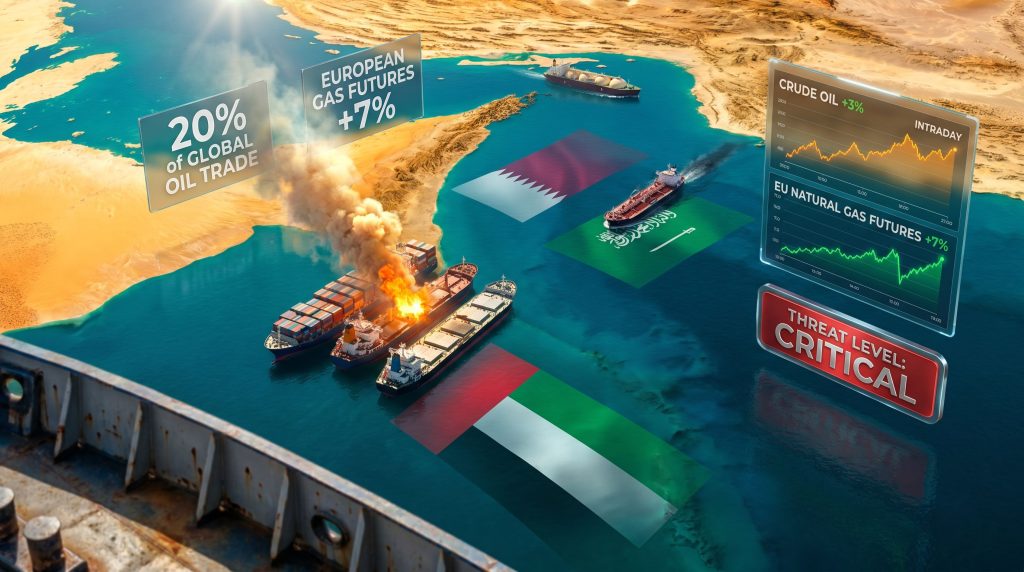
On that date, the attacks occurred in a coordinated sequence that sent crude oil price trends surging more than 3% intraday and pushed European natural gas futures up by approximately 7%. The magnitude of those market reactions, relative to the number of vessels involved, reveals something important about how global energy markets price concentrated geographic risk.
When big ASX news breaks, our subscribers know first
Why Hormuz Cannot Be Replaced by Alternative Infrastructure
Approximately 20% of the world's daily oil trade transits the Strait of Hormuz, along with a substantial share of global LNG shipments. At its narrowest navigable point, the strait spans roughly 33 kilometres, separating the UAE and Oman whilst functioning as the sole maritime exit for energy producers including Saudi Arabia, Qatar, Kuwait, and Iraq.
When policymakers and analysts discuss Hormuz alternatives, two routes are typically cited. Understanding their actual limitations is essential to grasping why any sustained disruption here is structurally irreplaceable.
| Alternative Route | Capacity Limitation | Key Dependency |
|---|---|---|
| Saudi Arabia's East-West Pipeline | Throughput falls well short of full export volume | Requires stability at Red Sea terminal endpoints |
| UAE's Habshan-Fujairah Pipeline | Bypasses Hormuz for crude oil only | Cannot accommodate LNG shipments |
| Overland routes | Commercially unviable at meaningful scale | Severe infrastructure constraints |
The critical point is not that these alternatives are useless. It is that none can absorb the full volume of energy that transits Hormuz on a single day. LNG, in particular, has no viable bypass. Qatar's LNG exports, which account for a commanding share of global supply, have no overland or pipeline alternative to maritime transit.
Furthermore, the LNG supply outlook means disruptions near Hormuz carry a disproportionate price signal for European and Asian gas buyers. Unlike crude oil, which can be rerouted through pipelines or alternative tanker corridors, LNG requires specialised vessels and purpose-built receiving terminals. Buyers already managing tight inventories have virtually no short-term substitution mechanism.
Breaking Down the July 8 Attack Sequence
What Actually Happened on the Water?
The three commercial ships attacked near Hormuz on July 8 were struck by what maritime operators described as unknown explosive projectiles, according to Reuters. The targeted vessels represented a deliberately broad cross-section of global maritime trade:
- One container ship
- One cargo ship
- One bulk carrier
A fire broke out aboard the cargo vessel following the strike. Critically, all crew members across all three ships were evacuated safely, with no fatalities reported. The attacks occurred in close succession near Ras Al Khaimah, positioned at the mouth of the strait within the corridor between UAE and Omani territorial waters.
In separate but related incidents within the broader Hormuz corridor, a Qatari LNG carrier and a Saudi crude oil tanker were also damaged. The Qatari vessel, the Al Rekayyat, operated by state-owned Nakilat, became the first confirmed Qatari LNG tanker to be struck since hostilities began in late February 2026. Its crew abandoned ship, and the vessel was subsequently anchored off Limah, Oman.
The AIS Blackout Problem
Shipping data confirmed that both the Saudi tanker and the Qatari LNG carrier were sailing with their Automatic Identification System (AIS) transponders switched off at the time of the attacks. This practice has become increasingly prevalent among vessels transiting the Gulf, adopted as a precaution to reduce targeting risk. The unintended consequence is a significant reduction in maritime situational awareness, complicating both rescue coordination and threat attribution.
The AIS blackout pattern introduces a less-discussed systemic problem. As more vessels disable transponders, the real-time picture of Gulf maritime traffic becomes increasingly opaque, making it harder for naval forces, insurers, and port operators to model risk across the corridor as a whole.
Sixteen Vessels and a Pattern That Demands Attention
July 8 did not occur in isolation. At least 16 vessels have been affected in the Hormuz region since hostilities between Iranian forces and US-Israeli interests intensified in late February 2026. The pattern has shifted decisively from isolated incidents to what maritime security professionals now classify as a sustained threat environment.
The July 8 attacks represented the most significant single-day maritime escalation since a US-Iran interim peace agreement was reached the prior month. Following these incidents, the Joint Maritime Information Center (JMIC) formally elevated the regional threat classification from "substantial" to "severe", with broader maritime monitoring bodies characterising conditions as "critical" — the highest designation in use.
| Threat Level | Definition | Operational Impact |
|---|---|---|
| Substantial | Elevated but manageable risk | Increased vigilance recommended |
| Severe | High probability of attack | Precautionary rerouting advised |
| Critical | Imminent or active threat environment | Active avoidance protocols engaged |
The JMIC specifically noted that Iran's Revolutionary Guard Corps (IRGC) had continued to exert pressure on commercial vessels over transit route authorisation. This pressure is not new, however the frequency and severity of incidents under the shadow of an active peace agreement represents a qualitative escalation. These broader oil market disruptions are compounding an already fragile supply environment.
Iran's Legal Gambit and the Freedom of Navigation Conflict
Tehran's position on Hormuz transit rights sits at the core of the ongoing crisis. Iran has maintained that commercial vessels require Iranian approval before transiting the strait, a claim that directly contradicts international maritime law under the United Nations Convention on the Law of the Sea (UNCLOS), which guarantees transit passage rights through international straits.
On the same day as the July 8 attacks, Iran formally communicated its claimed authority over parts of the strait to the International Maritime Organization (IMO). This legal filing, timed to coincide with the attacks, signals a deliberate strategy. Tehran appears to be constructing a parallel legal framework to justify operational pressure on commercial shipping while simultaneously pursuing diplomatic engagement.
This dual-track approach places commercial operators in an impossible position. Complying with Iranian transit demands would undermine internationally recognised navigational rights. Ignoring them carries demonstrated physical risk.
Qatar's Contradictory Position: Mediator and Target
Few dimensions of the July 8 attacks carry more diplomatic significance than the targeting of a Qatari LNG carrier. Qatar has served as one of the most active intermediary states in ongoing US-Iran negotiations, leveraging its unique relationships with both Washington and Tehran to facilitate dialogue. The Al Rekayyat attack placed Doha in the position of being simultaneously a peace broker and a victim of the conflict it is trying to resolve.
Qatar formally condemned the attack and called on Iran to halt actions that destabilise regional maritime security. The language was measured, but the diplomatic signal was unmistakable. If Iran is willing to strike vessels belonging to a neutral mediating state, the practical constraints on its use of maritime pressure appear to be narrowing.
The incident also underscores Qatar's particular vulnerability. As one of the world's top three LNG exporters, with European and Asian buyers heavily dependent on Qatari supply, any sustained campaign against Qatari LNG carriers would create immediate disruption for buyers operating with limited spot market alternatives. Consequently, the effect on European gas prices could be severe and enduring.
The next major ASX story will hit our subscribers first
How Shipping Operators Are Responding
The operational response across commercial shipping has shifted meaningfully following the JMIC threat level upgrade:
- Crew evacuation protocols are being pre-positioned on vessels entering the strait, reducing response time in the event of an attack.
- War-risk insurance premiums for Gulf-transiting vessels are expected to rise sharply, adding a structural cost layer to Gulf energy flows.
- Temporary transit suspensions are being evaluated by several operators pending security reassessment.
- AIS blackout practices are becoming near-universal among Gulf-transiting commercial vessels, despite the situational awareness trade-offs involved.
The insurance dimension deserves particular attention. War-risk premiums in the Gulf surged during the 2019–2020 period of Hormuz tensions and are now entering another significant repricing cycle. These costs do not evaporate when tensions ease. They become embedded in freight rate structures and, ultimately, in the landed cost of energy for importing nations.
Energy Market Reactions and What They Reveal
The 3% intraday crude oil price surge following the July 8 attacks was notable, but the 7% jump in European natural gas futures was the more structurally revealing response. Gas markets reacted nearly twice as sharply as oil markets because buyers understand the structural asymmetry in supply flexibility.
European gas storage levels heading into the second half of 2026 remain a point of sensitivity for buyers who have spent three years restructuring supply chains away from Russian pipeline gas. Qatari LNG represents a critical pillar of that diversified supply strategy. Any signal that Qatari LNG flows could be interrupted does not merely affect spot prices — it forces buyers to reassess the reliability assumptions embedded in their entire supply architecture.
Three Scenarios for the Near-Term Maritime Environment
The trajectory of Hormuz security over the coming months will be shaped by how the following competing forces resolve:
| Scenario | Trigger Condition | Energy Market Impact |
|---|---|---|
| De-escalation | US-Iran diplomatic breakthrough reinforces interim deal | Risk premiums recede; shipping normalises within weeks |
| Sustained Low-Intensity Conflict | IRGC continues targeted strikes without full escalation | Persistent 5–10% oil price premium; structural rise in insurance costs |
| Full Strait Closure | Major escalation triggers Iranian blockade declaration | Acute global energy shock; potential 20–30% crude price spike |
Disclaimer: The scenario projections above represent analytical frameworks for understanding potential market outcomes and should not be interpreted as investment advice or price forecasts. Energy markets are subject to a wide range of geopolitical, meteorological, and macroeconomic variables that make precise prediction unreliable.
The Long-Term Structural Consequence: Accelerating Supply Diversification
Beyond the immediate market disruption, the sustained vulnerability of the Hormuz corridor is producing a durable shift in how energy-importing nations think about supply concentration. In addition to short-term price volatility, several structural trends are already accelerating:
- Investment interest in alternative pipeline infrastructure and floating storage solutions is increasing among Gulf producers seeking to reduce Hormuz dependency.
- European and Asian energy buyers are reassessing the concentration risk embedded in Gulf-dependent supply chains, with procurement strategies shifting toward diversification.
- The geopolitical premium on non-Gulf LNG assets — including US LNG exports, Australian LNG, and emerging East African gas projects — is rising as buyers seek supply pathways that do not transit Hormuz.
- Saudi Arabia's long-term calculus on the East-West Pipeline capacity expansion may shift if the tanker threat to strait-transiting crude exports becomes structurally embedded rather than episodic.
The deeper implication is that even if the current crisis de-escalates, the credibility of Hormuz as a reliably open corridor has been structurally damaged. Furthermore, the broader geopolitical risk landscape suggests that buyers and producers who design supply infrastructure around the assumption of uninterrupted Hormuz access are now pricing in a risk that was previously treated as theoretical.
Frequently Asked Questions: Three Commercial Ships Attacked Near Hormuz
What types of ships were attacked near the Strait of Hormuz on July 8, 2026?
The three vessels struck by explosive projectiles included one container ship, one cargo ship, and one bulk carrier. Separate incidents in the same corridor also damaged a Qatari LNG carrier and a Saudi crude oil tanker.
Were any crew members killed in the Hormuz attacks?
No fatalities were reported. Crews aboard all affected vessels were evacuated safely, though a fire broke out aboard the cargo ship following the strike.
Who is believed to be responsible for the attacks?
No group formally claimed responsibility. According to AP News, maritime authorities noted continued operational pressure from Iran's Revolutionary Guard Corps on commercial vessels transiting the strait. The use of unidentified explosive projectiles preserves a degree of attribution ambiguity consistent with previous IRGC maritime operations.
How did energy prices react to the July 8 Hormuz attacks?
Crude oil prices rose more than 3% intraday, whilst European natural gas futures climbed approximately 7%, with the sharper gas market reaction reflecting LNG supply vulnerability.
What is the current maritime threat level near the Strait of Hormuz?
Following the July 8 incidents, the JMIC elevated the threat classification to "severe", with broader maritime monitors citing "critical" conditions as of the same date.
Why does the attack on the Qatari LNG carrier carry particular diplomatic significance?
Qatar is serving as an active mediating party in US-Iran negotiations, making the targeting of a Qatari vessel a direct signal about the limits of that neutrality. Doha condemned the attack whilst simultaneously continuing its intermediary role, placing it in an unprecedented diplomatic position.
Want to Stay Ahead of the Market Shifts Driving ASX Mineral Opportunities?
Geopolitical disruptions like the Hormuz attacks are reshaping global energy supply chains and accelerating investment interest in non-Gulf commodities — and Discovery Alert's proprietary Discovery IQ model delivers real-time alerts the moment significant ASX mineral discoveries are announced, turning complex market shifts into actionable investment opportunities. Begin your 14-day free trial at Discovery Alert today and position yourself ahead of the market before the next major discovery moves.