June 19, 2026
Understanding Primary Recovery Fundamentals in Unconventional Reservoirs
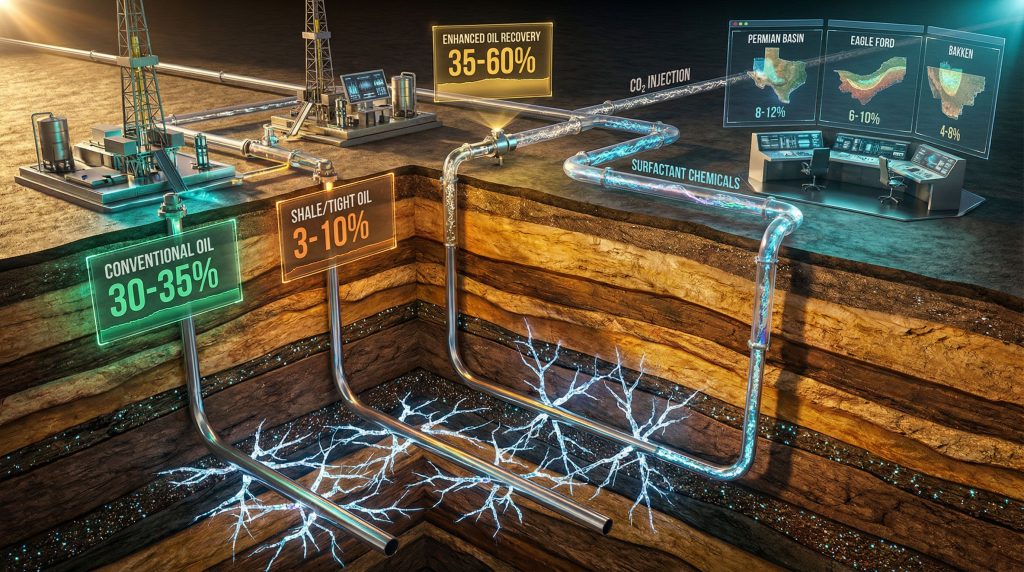
The stark disparity between conventional and unconventional recovery performance reflects fundamental differences in reservoir engineering principles. Conventional oil reservoirs typically achieve 30-35% recovery rates through natural drive mechanisms, while shale formations struggle to exceed 3-10% recovery rates under current completion methodologies.
Recovery rates in shale oil production face significant constraints that stem from the unique geological characteristics of unconventional reservoirs. These limitations have prompted the industry to explore advanced oil price rally insights as market dynamics continue evolving.
Recovery Rate Comparison Across Reservoir Types
| Reservoir Type | Typical Recovery Rate | Primary Extraction Method | Key Limiting Factors |
|---|---|---|---|
| Conventional Oil | 30-35% | Natural drive mechanisms | Reservoir pressure, permeability |
| Shale/Tight Oil | 3-10% | Hydraulic fracturing + horizontal drilling | Ultra-low permeability, rapid decline |
| Enhanced Oil Recovery | 35-60% | Secondary/tertiary methods | Economic viability, technical complexity |
This performance differential becomes particularly significant when considering that U.S. oil production reached 13.6 million barrels per day in 2025, with shale formations contributing the majority of this output. Furthermore, the US oil production decline in certain basins highlights the critical importance of improving extraction efficiency.
The Physics Behind Low Shale Recovery Rates
Shale formations present unique extraction challenges due to their geological characteristics that fundamentally differ from conventional reservoirs. The ultra-low permeability measured in nanodarcies creates an environment where oil molecules remain trapped within rock matrix structures that resist conventional extraction techniques.
Key Physical Constraints:
-
Permeability differential: Shale formations measure in nanodarcies (10^-9 darcies) compared to conventional formations measuring in millidarcies to darcies (10^-3 to 10^0 darcies)
-
Heterogeneous rock matrix: Creates uneven flow patterns and non-uniform depletion
-
Rapid pressure depletion: Results in steep production decline curves that limit long-term recovery
Critical Insight: The 3-10% recovery rate represents only the oil that can flow naturally to wellbores under current completion techniques, leaving 90-97% of oil in place untapped and requiring technological innovation to access.
The heterogeneous nature of shale formations compounds these challenges. Unlike conventional reservoirs where relatively uniform rock properties enable predictable fluid flow, shale contains multiple mineral phases including quartz, clay, and organic matter with varying pore structures. This geological complexity means that fracture networks created through hydraulic fracturing cannot uniformly contact all productive intervals within target formations.
When big ASX news breaks, our subscribers know first
How Current Extraction Technologies Limit Recovery Efficiency
Current completion methodologies face inherent limitations that prevent optimal resource extraction from unconventional reservoirs. Industry analysis reveals that drilling productivity has declined across major producing basins, with the Midland Basin experiencing an 8% decline and the Eagle Ford showing a 27% decline in drilling productivity during 2025.
The industry has increasingly recognised that oil price movements trade war dynamics affect investment decisions in recovery enhancement technologies. Consequently, operators must balance technological advancement with economic viability.
Hydraulic Fracturing Constraints
Standard completion methods encounter several technical limitations that restrict overall recovery efficiency:
Fracture Network Geometry Limitations:
-
Limited reservoir contact: Induced fractures typically create 2-5 primary fractures per stage in many formations
-
Uneven flow distribution: High-permeability fracture zones receive disproportionate fluid flow
-
Matrix isolation: Low-permeability zones receive minimal stimulation benefit
Proppant Distribution Challenges:
-
Settling patterns: Heavier proppants concentrate in lower-elevation fracture regions
-
Conductivity degradation: Long-term performance suffers from proppant crushing and fine particle migration
-
Coverage gaps: Incomplete proppant placement reduces fracture network effectiveness
Well Decline Behavior Analysis
Unconventional wells exhibit characteristic decline patterns that reflect the fundamental physics of ultra-low permeability formations:
Typical Shale Well Performance Profile:
-
Year 1: 65-80% production decline from peak rates due to rapid pressure depletion near fractures
-
Years 2-3: Additional 70-90% cumulative decline as remaining accessible oil depletes
-
Long-term: Minimal production requiring artificial lift with marginal economic returns
This steep decline pattern creates what industry analysts term a "drilling treadmill" effect. Moreover, operators must continuously drill new wells to maintain field-level production, while current oil price stagnation analysis suggests challenging market conditions ahead.
What Advanced Technologies Are Emerging to Boost Recovery Rates?
The industry response to recovery rate limitations has spawned multiple technological approaches designed to extract additional value from existing infrastructure. Major operators have committed significant resources to developing enhanced completion techniques that address fundamental constraints of current methodologies.
Artificial Intelligence and Machine Learning Applications
Exxon Mobil has implemented comprehensive AI-driven optimization strategies that demonstrate the potential for data analytics to improve recovery rates in shale oil production:
AI-Driven Optimization Components:
-
Development planning algorithms: Optimise well spacing and completion design based on geological data analysis
-
Real-time drilling adjustments: Adapt drilling and completion parameters based on continuous geological feedback
-
Production forecasting models: Predict optimal intervention timing for enhanced recovery techniques
Enhanced Completion Techniques
Next-generation completion technologies address specific limitations of conventional fracturing approaches through improved proppant systems and wellbore design optimisation.
Advanced Proppant Technologies:
-
Lightweight ceramic proppants: Improve fracture conductivity retention and contribute to sustained production performance
-
Resin-coated proppants: Reduce flowback losses and maintain permeability over extended periods
-
Micro-proppants: Access smaller fracture networks and improve matrix contact
Extended Lateral Development:
-
Ultra-long horizontals: Increase reservoir contact per wellbore, reducing per-barrel development costs
-
Multi-zone targeting: Access multiple productive intervals within single wellbore systems
-
Geometric optimisation: Maximise drainage efficiency through advanced completion design
Which Enhanced Oil Recovery Methods Show Promise for Shale Applications?
Traditional enhanced oil recovery techniques require significant adaptation for unconventional reservoir applications. Laboratory studies demonstrate potential for substantial recovery improvements, though field-scale implementation faces unique technical and economic challenges.
Gas Injection Techniques
Carbon Dioxide Enhanced Oil Recovery (CO2-EOR):
CO2 injection represents one of the most technically viable enhanced recovery approaches for shale applications. The mechanism operates through oil viscosity reduction and pressure support, with laboratory studies indicating potential for 15-30% additional recovery beyond primary production.
Implementation Requirements:
-
CO2 supply infrastructure development
-
Injection well drilling and completion
-
Surface facility modifications for gas handling
-
Economic justification against current oil price environments
Nitrogen and Natural Gas Injection:
Alternative gas injection approaches focus on pressure maintenance rather than miscible displacement. These techniques show particular promise in formations where CO2 supply presents logistical challenges.
Chemical Enhanced Oil Recovery (CEOR)
Surfactant Flooding Applications:
Laboratory testing of surfactant flooding in shale core samples has achieved recovery rates up to 75% under controlled conditions. However, field-scale implementation requires extensive water treatment infrastructure and chemical handling systems that significantly impact project economics.
According to recent studies on US shale recovery efficiency, the transition from volume-focused to efficiency-optimised strategies represents a fundamental shift in industry approach.
Operational Challenges:
-
Chemical procurement and logistics costs
-
Formation compatibility and retention issues
-
Environmental compliance requirements
-
Integration with existing production systems
How Are Major Operators Implementing Recovery Enhancement Strategies?
Industry leaders have adopted integrated approaches to recovery rate improvement that combine multiple technologies and methodologies. These comprehensive strategies reflect the understanding that no single technique provides sufficient enhancement to achieve recovery rate doubling targets.
Integrated Technology Approaches
Exxon's Multi-Technology Strategy:
Exxon has operationalised a comprehensive approach combining artificial intelligence for development planning, extra-long laterals for increased reservoir contact, and lightweight proppant technology. This integrated methodology contributed to the company's expectation of higher overall output in 2025 despite industry-wide productivity challenges.
Chevron's Strategic Position:
Chevron CEO Mike Wirth has articulated the fundamental opportunity in recovery rate improvement, emphasising that the primary value creation opportunity involves recovering more molecules from existing resources rather than expanding drilling operations.
Field Development Strategy Evolution
The industry has fundamentally shifted from volume-focused growth strategies to efficiency-optimised approaches that prioritise return on invested capital over production expansion.
Strategic Transformation Elements:
-
Capital discipline focus: Prioritising returns over production growth rates
-
Technology investment reallocation: Directing resources toward recovery enhancement rather than new drilling
-
Long-term value creation: Building sustainable production profiles that extend asset life
Strategic Insight: The industry transition from "drill faster" to "recover more" represents a fundamental shift in value creation methodology that could determine long-term competitiveness of unconventional oil production.
What Economic Factors Drive Recovery Rate Improvement Initiatives?
The economic imperative for recovery rate improvement extends beyond operational optimisation to encompass strategic positioning for long-term market competitiveness. Current market conditions with WTI trading below $58 per barrel create pressure for enhanced efficiency across all operational aspects.
Cost-Benefit Analysis Framework
Recovery rates in shale oil production improvement initiatives require comprehensive economic evaluation that considers both incremental costs and long-term value creation potential.
Economic Evaluation Components:
-
Incremental recovery value: Additional barrels multiplied by net present value calculations
-
Technology implementation costs: Equipment, chemicals, and operational expenses
-
Risk-adjusted returns: Accounting for technical and commercial uncertainties
-
Infrastructure utilisation: Maximising value from existing facilities and surface systems
Investment Prioritisation Metrics
Analysts warn that shale oil production could face a 700,000 barrels-per-day drop by end of 2026 if WTI falls to $50 per barrel and remains at that level. This potential scenario underscores the economic necessity of recovery rate improvements as a defensive strategy against price volatility.
Return on Investment Calculations:
-
Technology deployment must demonstrate positive returns across various price scenarios
-
Recovery enhancement competes with new drilling for capital allocation
-
Long-term sustainability requires economic viability at $50-60 oil prices
The next major ASX story will hit our subscribers first
How Do Basin-Specific Characteristics Affect Recovery Potential?
Geological variations among major shale basins create distinct opportunities and challenges for recovery rate improvement initiatives. Understanding these differences enables targeted technology application and optimised development strategies.
Research on enhanced oil recovery for shale formations demonstrates how formation-specific approaches can significantly impact extraction efficiency across different geological environments.
Basin-by-Basin Recovery Analysis
Permian Basin Characteristics:
-
Current recovery rates: 8-12% average across productive intervals
-
Enhancement potential: High due to thick pay zones and favourable geology
-
Technology focus: Extended laterals and optimised completion designs show particular promise
Eagle Ford Formation:
-
Current recovery rates: 6-10% average with significant variation by area
-
Enhancement potential: Moderate, with limitations imposed by formation characteristics
-
Technology focus: Chemical EOR pilots and AI optimisation programmes
Bakken Formation:
-
Current recovery rates: 4-8% average representing substantial untapped potential
-
Enhancement potential: Significant upside from gas injection techniques
-
Technology focus: CO2-EOR and pressure maintenance programmes
The 27% drilling productivity decline experienced in the Eagle Ford demonstrates how geological constraints can limit traditional completion effectiveness, making recovery enhancement technologies particularly valuable in challenging formations.
What Are the Technical Challenges in Scaling Recovery Enhancement?
Transitioning from pilot projects to field-wide implementation presents significant technical and logistical challenges that require systematic solutions. The complexity of integrating enhanced recovery techniques with existing infrastructure creates operational hurdles that must be addressed for successful scaling.
Engineering Limitations
Infrastructure Requirements:
-
Injection well systems: Additional drilling and completion for EOR methods
-
Fluid handling capacity: Managing increased water and chemical volumes
-
Surface facility modifications: Adapting processing equipment for enhanced recovery fluids
-
Monitoring systems: Real-time tracking of enhancement effectiveness across field areas
Technology Integration Challenges
System Compatibility Issues:
-
Existing well constraints: Retrofitting older completions for enhancement techniques
-
Operational coordination: Integrating enhanced recovery with ongoing production activities
-
Regulatory compliance: Meeting environmental standards for injection operations and chemical usage
Economic Scaling Factors:
-
Technology deployment costs: Capital requirements for field-wide implementation
-
Operational complexity: Managing multiple recovery techniques simultaneously
-
Performance monitoring: Validating enhancement effectiveness across diverse geological conditions
What Does the Future Hold for Shale Recovery Rate Innovation?
The trajectory toward improved recovery rates in shale oil production represents more than technological advancement; it constitutes a fundamental transformation in how the industry approaches resource extraction and value creation. Government support through the new Hydrocarbons and Geothermal Energy Office indicates institutional recognition of recovery enhancement as a national energy priority.
Emerging Technology Horizons
Next-Generation Enhancement Methods:
-
Nanotechnology applications: Engineered particles designed for targeted reservoir modification and enhanced oil mobility
-
Biotechnology solutions: Microbial enhanced oil recovery systems adapted specifically for shale formation characteristics
-
Advanced materials development: Smart proppants with responsive characteristics that adapt to changing reservoir conditions
Industry Transformation Outlook
The strategic importance of recovery rate improvement extends beyond operational optimisation to encompass long-term industry sustainability. Government analysis suggests that doubling recovery rates in shale oil production could effectively repeat the shale revolution using existing infrastructure and characterised resources.
Long-Term Strategic Implications:
-
Production sustainability: Maintaining output levels without continuous drilling expansion requirements
-
Economic resilience: Improving project returns across various commodity price cycles
-
Environmental benefits: Reducing surface footprint through enhanced performance of existing wells
Future Perspective: Recovery rate doubling represents the potential to access equivalent resources to the original shale revolution without additional land disturbance or new infrastructure development.
Implementation Timeline and Adoption Strategy
Phased Development Approach:
-
2025-2027: Pilot project expansion and technology validation across representative geological conditions
-
2028-2030: Commercial-scale deployment of proven enhancement methods with documented economic returns
-
2030 and beyond: Industry-wide adoption and optimisation of recovery enhancement as standard practice
The transition toward improved recovery rates in shale oil production represents a fundamental evolution in unconventional resource development. Success in implementing these technologies will determine whether the industry can maintain production levels and economic competitiveness in an environment of maturing assets and increased capital discipline.
Strategic Necessity Recognition:
Industry analysis indicates that recovery rate improvement has transitioned from optional performance enhancement to operational necessity. As traditional drilling opportunities diminish and capital efficiency requirements intensify, enhanced recovery techniques provide the primary pathway for sustained value creation in unconventional oil development.
The convergence of technological capability, economic necessity, and government support creates unprecedented opportunity for systematic implementation of recovery enhancement across North American shale basins. The outcome of this technological transition will fundamentally shape the long-term competitiveness and sustainability of unconventional oil production in the global energy landscape.
Seeking Opportunities in Energy Sector Innovations?
Discovery Alert's proprietary Discovery IQ model delivers real-time alerts on significant ASX mineral discoveries, instantly empowering subscribers to identify actionable opportunities ahead of the broader market. Begin your 30-day free trial today and secure your market-leading advantage with immediate access to Discovery Alert.