May 19, 2026
Process Engineering Fundamentals in Sustainable Magnet Manufacturing
The industrial production of high-performance permanent magnets represents one of the most complex metallurgical challenges in modern manufacturing. Environmental performance and circular strategies in rare earth magnet production require precision control over crystal structure formation, grain boundary optimization, and magnetic domain alignment. These technical demands create inherent environmental pressures that drive innovation in process engineering and circular material flows.
Traditional magnet manufacturing follows a linear pathway from geological extraction through chemical separation to final sintering operations. Each processing stage introduces specific environmental challenges related to chemical intensity, thermal energy requirements, and waste stream management. Understanding these fundamental mechanisms provides the foundation for implementing circular strategies that minimise ecological impact whilst maintaining magnetic performance specifications.
Chemical Complexity in Lanthanide Processing Systems
Rare earth element separation represents the most chemically intensive aspect of magnet production due to the fundamental properties of lanthanide chemistry. The lanthanide contraction phenomenon creates nearly identical ionic radii across the series, requiring sophisticated separation techniques that operate through minimal differences in coordination chemistry and electronic configurations.
Industrial separation systems employ cascading solvent extraction processes that may require hundreds or thousands of individual stages to achieve the purity levels necessary for magnetic applications. These systems utilise organic extractants such as di(2-ethylhexyl)phosphoric acid (D2EHPA) or tributyl phosphate (TBP) in hydrocarbon diluents, creating complex three-phase equilibrium systems that demand precise pH control, temperature management, and phase transfer optimisation.
Key Environmental Impact Factors:
- Solvent consumption rates reaching 10-15 cubic metres per tonne of separated oxides
- Aqueous waste streams containing residual organic compounds and mineral acids
- Energy requirements for solvent recovery and recycling operations
- Chemical storage and handling infrastructure for hazardous materials
The thermal processing stages introduce additional environmental considerations through high-temperature operations. Reduction metallurgy converts rare earth oxides to metallic forms using molten salt electrolysis or calcium reduction processes operating at temperatures exceeding 900°C. Subsequent sintering operations align crystalline structures under controlled atmospheres at temperatures approaching 1,100°C, requiring significant energy input and specialised furnace systems.
Furthermore, the integration of rare earth reserves importance considerations becomes critical when evaluating the long-term sustainability of these processing operations. Additionally, industry innovation trends are driving developments in more efficient separation technologies.
Water Resource Management and Closed-Loop Systems
Water consumption in rare earth processing extends beyond direct usage in chemical operations to include cooling systems, dust suppression, and equipment cleaning protocols. Modern processing facilities implement multi-stage water treatment systems incorporating membrane filtration, ion exchange, and chemical precipitation to achieve water recycling rates exceeding 85% in optimised operations.
Advanced treatment technologies enable recovery of process chemicals alongside water recycling. Reverse osmosis and ultrafiltration systems separate dissolved salts and organic compounds, whilst electrowinning processes recover metals from concentrated waste streams. These integrated approaches transform traditional waste streams into secondary resource inputs, reducing both freshwater consumption and effluent discharge volumes.
Quantitative Performance Metrics:
| Water Management Parameter | Conventional Processing | Closed-Loop Systems | Improvement Factor |
|---|---|---|---|
| Freshwater Consumption (m³/tonne REO) | 120-150 | 20-35 | 4-6x reduction |
| Wastewater Discharge (m³/tonne REO) | 75-95 | 5-15 | 8-12x reduction |
| Chemical Recovery Rate (%) | 15-25 | 65-80 | 3-4x improvement |
| Treatment Energy (kWh/m³) | 2-4 | 8-12 | Increased complexity |
When big ASX news breaks, our subscribers know first
Advanced Separation Technologies and Process Innovation
Biological processing systems offer transformative approaches to rare earth extraction that operate through fundamentally different mechanisms compared to conventional hydrometallurgy. Microbial leaching employs acidophilic bacteria such as Acidithiobacillus ferrooxidans and Leptospirillum ferrooxidans to generate ferric iron oxidants that dissolve rare earth minerals through indirect oxidation mechanisms.
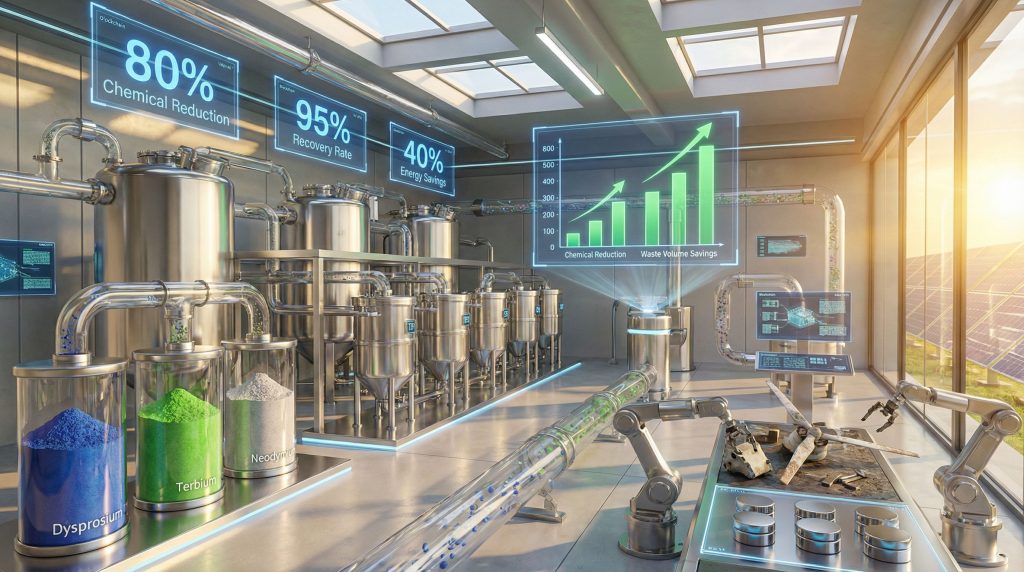
These biological systems operate at ambient temperatures and atmospheric pressure, dramatically reducing energy requirements compared to thermal processing methods. Bacterial leaching achieves selective dissolution of target minerals whilst leaving gangue materials largely unaffected, reducing overall chemical consumption and waste generation. Research demonstrates potential reductions in chemical reagent usage of 70-85% compared to conventional acid leaching processes.
Moreover, the development of environmental benefits in leaching processes has shown promising results for environmental performance and circular strategies in rare earth magnet production.
Ionic Liquid Applications in Selective Separation
Ionic liquid technology represents a paradigm shift in rare earth separation chemistry through the use of designer solvents with tunable properties. These molten salt systems remain liquid at operational temperatures whilst providing exceptional selectivity for specific lanthanide elements through carefully engineered coordination environments.
Phosphonium-based ionic liquids demonstrate particular effectiveness for heavy rare earth separation, achieving separation factors exceeding 100:1 for dysprosium-holmium pairs. These systems operate through outer-sphere coordination mechanisms that exploit subtle differences in lanthanide hydration energies, enabling highly efficient separations with minimal energy input.
Technical Performance Characteristics:
- Operating temperatures: 25-65°C (versus 80-120°C for conventional solvent extraction)
- Vapour pressure: Negligible (eliminating solvent loss concerns)
- Thermal stability: Stable to 300-400°C (enabling process intensification)
- Selectivity coefficients: 50-500 (versus 2-10 for conventional extractants)
The integration of ionic liquid separations with conventional processing requires modified equipment designs that accommodate different flow characteristics and phase behaviour. Viscosity management becomes critical, as ionic liquids typically exhibit 10-100 times higher viscosity than conventional organic solvents, affecting mass transfer rates and pumping requirements.
Membrane-Based Separation Technologies
Emerging membrane technologies provide additional pathways for sustainable rare earth processing through selective permeation and rejection mechanisms. Liquid membrane systems incorporate rare earth-selective carriers within supported polymer matrices, enabling continuous separation operations without the phase mixing requirements of solvent extraction.
Polymer inclusion membranes (PIMs) utilise extractant molecules immobilised within polymer films to achieve selective rare earth transport. These systems demonstrate excellent stability over extended operating periods whilst eliminating the organic solvent inventories required for conventional processing. Research indicates potential energy savings of 40-60% compared to conventional separation cascades through elimination of mixing and settling operations.
Material Recovery and Urban Mining Infrastructure
The development of comprehensive material recovery systems requires understanding the diverse pathways through which rare earth magnets enter end-of-life streams. Electric vehicle drive motors typically contain 1-3 kilograms of rare earth magnets, whilst large wind turbine generators may incorporate 200-600 kilograms of magnetic material depending on design specifications and power ratings.
Collection infrastructure must accommodate the distributed nature of these resources across multiple application sectors. Electric vehicle batteries reach end-of-life after 8-15 years of service, creating predictable material flows for recovery planning. Wind turbine magnets have longer service lives of 20-25 years but represent larger quantities concentrated at specific installation sites.
In addition, mine reclamation innovations are playing an increasingly important role in sustainable material recovery strategies.
Short-Loop Processing Pathways
Direct mechanical processing of end-of-life magnets enables rapid reintroduction into manufacturing systems without chemical reprocessing. This approach requires careful demagnetisation procedures to enable safe handling and processing of magnetic materials. Thermal demagnetisation at temperatures above the Curie point (310-380°C for Nd-Fe-B magnets) provides complete demagnetisation whilst preserving chemical composition.
Mechanical size reduction through controlled atmosphere grinding produces powder suitable for direct reuse in magnet manufacturing. Hydrogen decrepitation represents a particularly effective approach, using hydrogen absorption to induce micro-cracking that facilitates subsequent grinding operations whilst preventing oxidation of reactive rare earth elements.
Process Flow Sequence:
- Initial sorting and contamination removal
- Thermal or electromagnetic demagnetisation
- Hydrogen decrepitation treatment (600-800°C in H₂ atmosphere)
- Mechanical grinding and size classification
- Chemical analysis and quality verification
- Powder conditioning for downstream processing
Chemical Recovery and Purification Systems
Long-loop recycling pathways enable recovery of individual rare earth elements through dissolution and separation processes. Acid leaching systems dissolve magnetic alloys using mineral acids, producing mixed rare earth solutions suitable for conventional separation processing. This approach enables recovery of high-purity rare earth compounds equivalent to virgin materials.
Selective leaching protocols minimise dissolution of iron components whilst maximising rare earth recovery. Organic acid systems using citric acid or oxalic acid provide environmentally benign alternatives to mineral acids whilst achieving comparable dissolution rates. Research demonstrates rare earth recovery rates exceeding 95% through optimised leaching conditions and pH control.
Consequently, these advances in circular economy approaches are transforming traditional linear production models into sustainable closed-loop systems.
Traceability Systems and Governance Architecture
Digital tracking systems provide essential infrastructure for circular economy implementation through comprehensive material flow documentation. Blockchain-based platforms enable immutable recording of material origins, processing history, and environmental performance metrics throughout complex supply chains.
These systems must accommodate the multi-stage nature of rare earth processing, where materials may pass through 5-10 different facilities before final magnet production. Each transfer point requires documentation of material quantities, compositions, and processing conditions to maintain traceability integrity.
Certification and Compliance Frameworks
International standards development focuses on establishing measurable criteria for sustainable rare earth production. The Initiative for Responsible Mining Assurance (IRMA) provides comprehensive standards covering environmental management, social responsibility, and governance practices across mining and processing operations.
Environmental performance indicators include quantitative metrics for water usage efficiency, energy intensity, and waste generation rates. Carbon footprint calculations incorporate both direct emissions from processing operations and indirect emissions from electricity consumption, enabling comprehensive lifecycle impact assessment.
Key Performance Indicators:
| Sustainability Metric | Target Range | Measurement Protocol |
|—|—|—|—|
| Water Recycling Efficiency | >85% | ISO 14046 Water Footprint Standard |
| Renewable Energy Integration | >50% | Scope 2 emissions reporting |
| Material Recovery Rate | >90% | Mass balance accounting |
| Biodiversity Impact Score | <0.1 PDF·m²/tonne | ReCiPe impact assessment |
Regulatory Landscape and Policy Drivers
The European Union's Critical Raw Materials Act establishes mandatory recycling targets for rare earth materials, requiring 15% recycled content by 2030 and 25% by 2035. These regulations create economic incentives for circular economy adoption whilst establishing minimum performance standards for market access.
Carbon border adjustment mechanisms introduce additional compliance requirements for imported rare earth materials based on production methods and energy sources. These policies favour domestic recycling operations and renewable-powered production facilities, reshaping global supply chain economics.
However, the development of comprehensive techno-economic assessments remains crucial for evaluating the viability of different circular economy approaches.
Economic Analysis and Market Development
Cost structures for circular rare earth magnet production depend critically on scale economies and technological maturity. Current recycling operations achieve processing costs of $8-15 per kilogram of rare earth oxide recovered, compared to $12-25 per kilogram for virgin material production in regions with environmental compliance requirements.
Market development requires addressing several economic challenges including collection infrastructure investment, technology development costs, and quality assurance systems. Initial capital requirements for comprehensive recycling facilities range from $50-150 million depending on processing capacity and technology selection.
Supply Security and Geopolitical Considerations
Rare earth supply chains exhibit extreme geographical concentration, with China controlling approximately 60% of global mining capacity and 85% of processing infrastructure. This concentration creates supply security vulnerabilities for consuming nations and industries dependent on rare earth magnets for critical applications.
Domestic recycling capabilities provide strategic alternatives to import dependence whilst supporting industrial competitiveness. Analysis indicates that recycling could potentially supply 25-35% of rare earth demand by 2035, significantly reducing import requirements for developed economies.
Furthermore, green transition in mining initiatives are driving policy changes that support circular economy development.
"The development of comprehensive rare earth recycling infrastructure represents not only environmental necessity but strategic imperative for supply chain resilience in clean technology sectors."
Investment Patterns and Technology Commercialisation
Venture capital investment in rare earth recycling technologies reached $340 million in 2024, indicating growing investor confidence in circular economy business models. Technology development focuses on process automation, energy efficiency improvements, and integrated facility designs that combine multiple processing pathways.
Public sector support includes research grants, demonstration project funding, and loan guarantees for commercial facility development. The U.S. Department of Energy's Critical Materials Innovation Hub allocated $120 million for rare earth recycling research, whilst the European Union's Horizon Europe programme provides €200 million for critical materials circularity projects.
Technology Integration and Future Development Pathways
Artificial intelligence applications in rare earth processing focus on process optimisation, predictive maintenance, and quality control enhancement. Machine learning algorithms analyse spectroscopic data to optimise separation parameters in real-time, potentially improving recovery rates by 5-15% whilst reducing chemical consumption.
Automated sorting systems utilise advanced sensor technologies including laser-induced breakdown spectroscopy (LIBS) and X-ray fluorescence (XRF) to identify and separate different magnet compositions in mixed waste streams. These systems achieve sorting accuracies exceeding 95% whilst processing 1-3 tonnes of material per hour.
Modular Processing System Design
Distributed processing approaches utilise smaller-scale, modular equipment that can be deployed closer to end-of-life material sources. These systems reduce transportation costs and enable more efficient collection from dispersed sources such as consumer electronics and small wind installations.
Modular designs incorporate standardised processing units for demagnetisation, size reduction, and chemical treatment that can be combined in different configurations based on local material flows and market requirements. Capital costs for modular systems range from $5-20 million compared to $50-150 million for traditional integrated facilities.
Next-Generation Magnet Technologies
Research into alternative magnet compositions aims to reduce rare earth requirements whilst maintaining performance characteristics. Grain boundary engineering using elements such as gallium and copper improves magnetic properties without additional rare earth content, potentially reducing material requirements by 10-30%.
Nanostructured magnet designs utilise controlled crystal morphologies to enhance magnetic performance through optimised domain structures. These approaches may enable equivalent performance with reduced rare earth content, supporting circular economy objectives through demand reduction strategies.
The next major ASX story will hit our subscribers first
Implementation Strategies and Scaling Pathways
Successful circular economy implementation requires coordinated development across multiple sectors including manufacturing, logistics, policy, and finance. Regional approaches that leverage existing industrial capabilities and infrastructure provide more practical pathways than attempting comprehensive system transformation simultaneously.
Pilot project development enables technology validation and economic optimisation before full-scale deployment. Current demonstration projects processing 100-1,000 tonnes annually provide essential operational experience and performance data for commercial facility design.
Stakeholder Coordination and Partnership Development
Industry partnerships between magnet producers, equipment manufacturers, and recycling companies create integrated value chains that optimise material flows and economic returns. These partnerships enable shared investment in infrastructure development whilst distributing commercial risks across multiple participants.
Academic research institutions provide essential technology development capabilities and workforce training programmes. University partnerships with industry enable fundamental research into separation chemistry, materials science, and process engineering whilst training the technical workforce required for scaled operations.
Critical Success Factors:
- Consistent material supply agreements with end-of-life product sources
- Technology licensing arrangements enabling rapid deployment
- Regulatory frameworks supporting circular economy business models
- Financial instruments enabling infrastructure investment
- International standards enabling global market development
The transformation toward environmental performance and circular strategies in rare earth magnet production represents both environmental necessity and economic opportunity. Success requires integrated approaches that combine technological innovation, policy support, and market development to create sustainable material flows that support continued growth in clean technology sectors whilst minimising environmental impact.
This analysis is based on current technological capabilities and market conditions. Future developments in materials science, processing technology, and policy frameworks may significantly alter the economic and technical landscape for environmental performance and circular strategies in rare earth magnet production.
Ready to Stay Ahead of Critical Materials Discoveries?
Discovery Alert's proprietary Discovery IQ model delivers instant notifications on significant ASX mineral discoveries, including critical materials essential for sustainable magnet manufacturing and green technology transitions. Explore how major mineral discoveries generate substantial returns and begin your 30-day free trial today to position yourself ahead of emerging opportunities in the critical materials sector.