July 25, 2026
When Industrial Supply Chains Become a National Security Problem
For most of the twentieth century, commodity stockpiling was understood through a single lens: oil. The Strategic Petroleum Reserve, created in the wake of the 1973 Arab oil embargo, became the defining template for how governments buffer against supply shocks. However, the industrial economy of the twenty-first century runs on something far more complex than crude oil. It runs on neodymium, dysprosium, germanium, antimony, and dozens of other minerals whose names rarely appear in mainstream financial coverage but whose absence can halt production lines across entire industries.
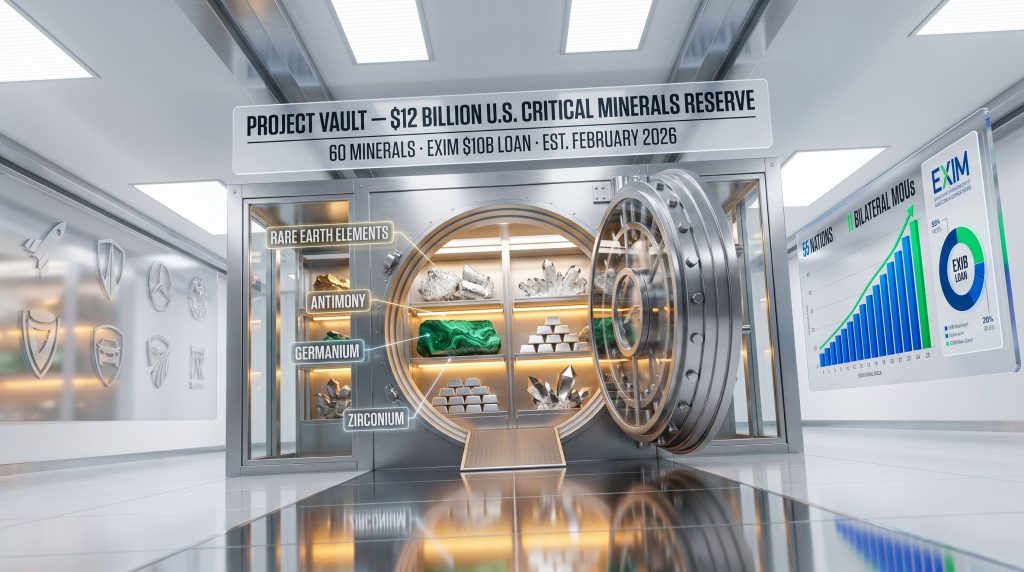
This is the structural reality that gave rise to the Project Vault critical minerals reserve, a $12 billion initiative authorised by presidential executive order in February 2026 that represents the most significant rethinking of U.S. industrial stockpiling strategy in decades. Understanding what Project Vault is, how it works, and what it signals about the future of American industrial policy requires moving beyond the headlines and examining the architecture beneath the announcement.
When big ASX news breaks, our subscribers know first
The Dependency Problem That Made Project Vault Inevitable
Decades of Concentration Create a Single Point of Failure
The vulnerability that Project Vault is designed to address did not emerge overnight. Over several decades, global mineral processing capacity concentrated heavily in China, driven by lower labour costs, less stringent environmental regulations, and deliberate state industrial policy. The result is a situation where approximately 90% of global rare earth element processing flows through Chinese facilities, even when the raw ore originates elsewhere.
This processing bottleneck is often underappreciated by investors and policymakers who focus on mining rather than the full value chain. A country can possess significant rare earth deposits yet remain entirely dependent on Chinese processing infrastructure to convert those deposits into the refined materials that manufacturers actually require. This distinction between mining capacity and processing capacity is one of the least understood dynamics in the critical minerals demand surge conversation.
The consequences of this dependency moved from theoretical to tangible in 2025, when documented rare earth shortages contributed to production disruptions affecting Ford's Explorer vehicle line. This case illustrated a broader pattern: concentrated supply chains do not merely create cost volatility — they create operational fragility that can halt physical production of goods generating billions in revenue.
The U.S. Geological Survey's 2025 Critical Minerals List identifies 60 minerals considered essential to both economic competitiveness and national security, many of which have no domestic production or processing pathway operating at meaningful commercial scale.
Furthermore, prior to Project Vault, no equivalent of the Strategic Petroleum Reserve existed for this category of industrial inputs. The defence establishment maintained separate mineral stockpiles for military applications, but civilian manufacturers operating across aerospace, automotive, energy, and high-technology sectors had no equivalent buffer. Each company sourced independently, competed on spot markets, and absorbed geopolitical disruption individually.
What the Project Vault Critical Minerals Reserve Actually Is
A Structured Definition for Investors and Industry Participants
Project Vault is a $12 billion U.S. strategic stockpile initiative launched under a presidential executive order signed in February 2026. Its purpose is to accumulate and manage reserves of critical minerals and metals that American manufacturers across multiple industrial sectors require, consequently reducing the operational exposure those companies face from foreign-controlled supply chains.
The financial architecture of the programme rests on a $10 billion loan from the Export-Import Bank of the United States (EXIM), which the agency itself has designated its Deal of the Year. This loan represents the largest single transaction in EXIM's 92-year institutional history, a distinction that underlines both the programme's scale and the degree to which it pushes the boundaries of what federal credit institutions have historically done. An additional approximately $2 billion in private-sector capital completes the funding stack.
The comparison most frequently used to explain Project Vault's cooperative structure is that of a "Costco for critical minerals" — member companies pool their purchasing power through a centralised reserve rather than sourcing independently, reducing per-unit costs, improving access to grade-specific materials, and eliminating the operational overhead of individual corporate stockpiling programmes.
How Project Vault Differs From the Strategic Petroleum Reserve
The SPR comparison is instructive precisely because the differences are as significant as the similarities.
| Feature | Strategic Petroleum Reserve | Project Vault |
|---|---|---|
| Governance model | Federal government-controlled | Public-private partnership |
| Commodity scope | Single commodity (crude oil) | 60+ critical minerals |
| Demand signal | Centralised government forecasting | OEM-driven, demand-led commitments |
| Release mechanism | Open market or emergency allocation | Direct return to specific member companies |
| Funding source | Taxpayer-appropriated | EXIM loan plus private capital |
| Financial return | Cost centre | Expected positive taxpayer return |
The most consequential difference is the demand signal mechanism. Traditional government stockpiles rely on bureaucratic forecasting to determine what gets purchased and in what volumes. Project Vault inverts this logic entirely: participating industrial companies specify what they need before procurement begins, creating a commercially disciplined reserve where every stockpile decision is anchored to verified downstream demand.
How the Operational Architecture Functions
Step-by-Step: The Five-Stage Procurement and Release Model
Understanding how Project Vault actually functions requires tracing the process from demand identification through to material release.
-
Demand Identification: Participating Original Equipment Manufacturers specify which minerals they require, at what purity or grade specifications, and in what volumes over their planning horizon.
-
Financial Commitment: Member companies make binding, long-term purchase commitments at fixed future prices before any procurement activity begins. This front-loads demand certainty into the system.
-
Procurement Execution: Three specialist commodity trading firms act as procurement agents on behalf of the reserve: Hartree Partners LP, Traxys North America LLC, and Mercuria Energy Group Ltd. These firms bring existing supply chain relationships, market intelligence, and procurement infrastructure to the programme.
-
Secure Storage: Acquired materials are held in secure storage facilities distributed across the United States, providing geographic resilience within the domestic supply chain.
-
Controlled Release: When a member company activates its allocation, stockpiled materials are sold directly back to that specific company rather than released to open markets. This prevents the reserve from distorting commodity prices during activation events.
This demand-pull architecture fundamentally changes what a government-backed stockpile can achieve. By anchoring procurement to verified industrial commitments rather than centralised forecasting, Project Vault creates a reserve where every tonne of material stored has a pre-identified buyer and a contractually fixed price.
The Cost-Sharing Model and Member Obligations
Participation in Project Vault is not a passive arrangement. Member companies pay upfront fees that cover their proportional share of storage operational costs and their allocation of the interest accruing on the $10 billion EXIM loan. This cost-sharing structure transforms the reserve from a government subsidy into a commercially structured service.
The fixed-price forward commitment model offers member companies a meaningful competitive advantage: price certainty on critical raw material inputs across their planning horizon. In industries where raw material cost volatility directly compresses margins, this certainty has measurable financial value. However, the same mechanism introduces a structural risk: if commodity prices decline significantly after commitments are locked, the reserve may hold materials at above-market cost, creating potential mark-to-market exposure.
The Minerals Covered and Their Strategic Significance
From Rare Earths to Industrial Metals: Mapping the Commodity Scope
Project Vault's mineral coverage spans all 60 materials identified on the USGS 2025 Critical Minerals List, with initial procurement emphasis expected to concentrate on rare earth elements given the severity of Chinese processing concentration in that commodity class. Indeed, the complexity of rare earth supply chains makes this prioritisation particularly critical.
| Mineral | Primary Industrial Application | Primary Supply Risk |
|---|---|---|
| Rare Earth Elements | EV motors, wind turbine generators, defence magnets | Approximately 90% of global processing in China |
| Copper | Electrical infrastructure, electric vehicles | Production concentrated in Chile and Peru |
| Antimony | Flame retardants, military munitions | Chinese export restrictions currently active |
| Germanium | Semiconductors, fibre optic systems | Chinese export controls currently in force |
| Aluminium | Aerospace structures, automotive manufacturing | Energy-intensive production, significant import dependency |
| Silver | Solar panel manufacturing, electronics | Multi-sector demand growth compressing supply margins |
| Zirconium | Nuclear fuel assemblies, advanced ceramics | Limited Western processing infrastructure |
Several nuances within this list are worth examining from an analytical standpoint. Germanium and antimony are particularly notable because Chinese export controls on both materials are already active, meaning the supply risk is not hypothetical but operationally present. The growing antimony shortage risks extend beyond Project Vault's scope, affecting defence and industrial sectors simultaneously. Zirconium, meanwhile, is rarely discussed in mainstream coverage despite its critical role in nuclear fuel and advanced ceramics manufacturing.
The EXIM Bank's Transformation Into a Strategic Industrial Instrument
Breaking Down the $12 Billion Capital Structure
EXIM's participation in Project Vault represents something qualitatively different from its historical mandate as a trade finance institution. Established 92 years ago to support U.S. export competitiveness, EXIM's core function has been to provide financing for foreign buyers of American goods. Project Vault repurposes this institutional capacity toward a domestic industrial security objective.
EXIM President and Chairman John Jovanovic framed the transaction at the agency's 2026 annual conference as a demonstration that securing access to critical raw materials is now being treated as a genuine strategic imperative rather than a logistics management problem, as reported by Metal Tech News on 5 May 2026.
The financial structure is designed with taxpayer returns in mind. Interest payments on the $10 billion loan are structured to generate net positive returns for U.S. taxpayers over the programme's operational life, which repositions the reserve as a revenue-generating national asset rather than a fiscal liability. This distinguishes Project Vault from conventional government spending programmes and from the SPR, which operates as a cost centre without revenue generation expectations.
The EXIM board of directors approved the $10 billion transaction through formal institutional governance channels in February 2026 before the presidential executive order formalised the programme. This two-stage authorisation process reflects the scale and precedent-setting nature of the commitment.
The next major ASX story will hit our subscribers first
The Corporate Coalition and What Membership Signals
Confirmed Participants as of May 2026
The initial membership base of the Project Vault critical minerals reserve spans four major industrial sectors, reflecting the breadth of industries whose manufacturing competitiveness depends on reliable critical mineral access.
- Aerospace: Boeing
- Automotive: General Motors, Stellantis
- Energy Technology: GE Vernova, Clarios
- Technology: Google, Western Digital, Corning
The composition of this coalition is analytically significant. The presence of Google and Western Digital alongside traditional industrial manufacturers like Boeing and General Motors reflects the degree to which digital technology hardware has become as mineral-dependent as physical manufacturing. Rare earth elements are essential to hard disk drive manufacturing, data centre cooling systems, and the permanent magnets used throughout the technology hardware supply chain.
Membership requires formal commitment to purchase specified materials at fixed future prices, upfront payment allocations for storage and financing costs, and long-term participation obligations. This is not a spot-market access arrangement or an option structure: it is a binding commercial commitment that reflects genuine strategic prioritisation by participating companies.
The Geopolitical Architecture Surrounding Project Vault
A Dual-Track Strategy: Domestic Stockpiling and International Diversification
Project Vault did not launch in isolation. Its domestic announcement was coordinated with a Critical Minerals Ministerial hosted by the U.S. State Department, at which foreign ministers from 55 countries participated. Simultaneously, the U.S. administration signed bilateral critical minerals Memoranda of Understanding with 11 nations, establishing formalised supply chain cooperation agreements that complement the domestic stockpiling initiative.
This dual-track structure is important for understanding the programme's strategic logic. Domestic stockpiling addresses near-term supply disruption risk, but it does not resolve the underlying structural concentration of mineral processing in adversarial supply chains. The international dimension, formalised through the companion FORGE (Forum on Resource Geostrategic Engagement) framework, is designed to progressively diversify the allied-nation supply base. In addition, the broader implications of critical minerals and energy security mean this diversification effort extends well beyond traditional defence considerations.
Furthermore, Project Vault is explicitly designed to stimulate domestic mineral production and processing by creating the stable, predictable demand environment that has historically been absent from the U.S. market. When OEM members commit to purchasing specific materials at fixed prices over extended horizons, those commitments provide the demand certainty that domestic mining and processing project developers require to justify large capital investments. This creates a market-pull mechanism for domestic supply chain development without requiring direct government production subsidies. The parallel push for wartime critical mineral production authorities further reinforces the strategic intent behind this approach.
Risks and Unresolved Questions
Critical Analysis: What Remains Open as of May 2026
Investors and industry participants examining Project Vault should weigh the following unresolved dimensions against the programme's structural advantages.
-
Sourcing geography remains undefined: Whether minerals must be sourced from allied nations or can be procured from any international supplier remains under policy deliberation. This determination will significantly affect procurement costs and availability timelines.
-
Operational parameters still being finalised: As of May 2026, specific mineral prioritisation within the $12 billion budget and detailed procurement rules have not been publicly confirmed.
-
Fixed-price commitment risk: Forward price commitments protect member companies from cost escalation but expose the reserve to potential mark-to-market losses if commodity prices fall materially after contracts are established.
-
Counterparty concentration: Routing procurement through three trading firms creates meaningful operational dependency on those entities. If any firm encounters financial difficulty or operational disruption, procurement continuity could be affected.
-
Political durability: As a presidentially authorised programme, Project Vault's continuity across future administrations is not structurally guaranteed. Legislative codification would significantly improve long-term institutional stability.
The CSIS analysis of Project Vault as a pillar of economic security further contextualises these risks within a broader geopolitical framework, noting that the programme's success ultimately depends on consistent implementation across administrations.
Key Programme Statistics at a Glance
| Metric | Detail |
|---|---|
| Total programme value | $12 billion |
| EXIM loan commitment | $10 billion (largest in EXIM's 92-year history) |
| Private capital component | Approximately $2 billion |
| Minerals covered | 60 (USGS 2025 Critical Minerals List) |
| Programme authorisation date | February 2026 |
| Countries at State Dept. Ministerial | 55 |
| Bilateral MOUs signed | 11 nations |
| Procurement trading firms | 3 (Hartree Partners, Traxys, Mercuria) |
| Confirmed member companies | 8 (as of May 2026) |
Frequently Asked Questions: Project Vault Critical Minerals Reserve
What is the Project Vault critical minerals reserve?
Project Vault is a $12 billion U.S. strategic stockpile initiative authorised by presidential executive order in February 2026, designed to accumulate critical minerals and metals for American manufacturers through a public-private partnership anchored by a $10 billion EXIM loan.
How is Project Vault funded?
The programme combines a $10 billion loan from the Export-Import Bank of the United States with approximately $2 billion in committed private-sector capital from participating member companies and investors.
Which minerals does Project Vault cover?
All 60 minerals on the USGS 2025 Critical Minerals List are within scope, with initial emphasis on rare earth elements and other strategically exposed commodities including copper, antimony, germanium, silver, and zirconium.
Who can participate in Project Vault?
U.S. manufacturers across aerospace, automotive, energy, and technology sectors. Participation requires binding long-term purchase commitments at fixed prices and upfront fee contributions covering storage and financing costs.
Is Project Vault operational in 2026?
The programme received EXIM board approval and presidential executive authorisation in February 2026. Final operational parameters including sourcing rules and mineral prioritisation were still being determined as of May 2026.
Disclaimer: This article is for informational purposes only and does not constitute financial or investment advice. Forward-looking statements regarding Project Vault, including expected taxpayer returns and programme outcomes, involve assumptions and uncertainties. Readers should conduct independent research before making investment or business decisions based on any information contained herein.
Want to Know Which ASX Critical Minerals Discoveries Could Benefit From This Shift?
Project Vault's $12 billion commitment signals a structural re-rating of critical minerals as strategic assets — and Discovery Alert's proprietary Discovery IQ model scans ASX announcements in real time to identify significant mineral discoveries the moment they are made public, from rare earths to antimony and germanium. Explore how historic discoveries have translated into substantial market returns on Discovery Alert's dedicated discoveries page, and begin a 14-day free trial to position yourself ahead of the broader market.