
July 28, 2026
The Psychology of Hard Assets in Uncertain Times
Global economic uncertainty has fundamentally altered how investors approach wealth preservation, moving beyond traditional diversification strategies toward tangible assets that offer both psychological security and potential appreciation. This shift becomes particularly pronounced during periods of geopolitical instability, where institutional confidence erodes and individuals seek financial instruments that maintain value independent of government policies or currency fluctuations.
The phenomenon extends far beyond simple investment allocation decisions. Cultural traditions, social signalling mechanisms, and deep-seated behavioural patterns converge to create demand dynamics that transcend conventional market analysis. When examining these forces, certain geographic regions demonstrate particularly compelling patterns where traditional wealth preservation methods intersect with modern investment vehicles.
Furthermore, this intersection creates unique market dynamics where seasonal consumption patterns, geopolitical risk assessment, and cultural gift-giving traditions generate demand surges that can influence global pricing mechanisms. Understanding these patterns provides crucial insights into how emerging market economies increasingly drive commodity demand cycles and reshape international price discovery processes.
When big ASX news breaks, our subscribers know first
Understanding China's Cultural Gold Economy During Lunar New Year
The Economics of Festive Gold Consumption
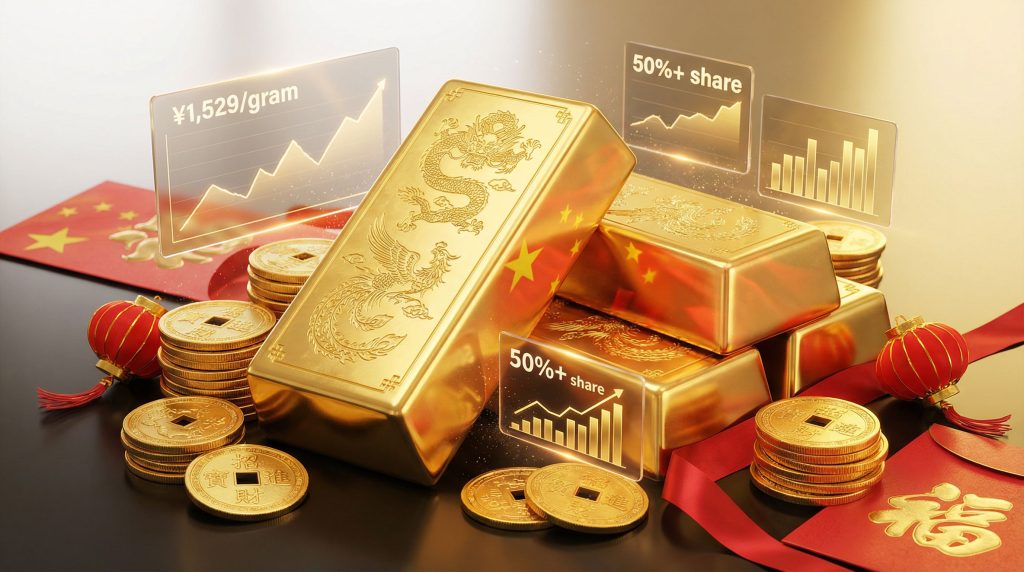
Chinese consumers gobbling up gold in run-up to Lunar New Year represents more than seasonal shopping patterns. During the 2026 Lunar New Year period, Chinese retailers reported gold jewellery selling at ¥1,529 (approximately $221) per gram, representing a dramatic 71.7% price increase from the ¥890 per gram average during the corresponding 2025 period. This price appreciation occurred alongside sustained volume growth, indicating highly inelastic demand during cultural celebration periods.
The economic data reveals fascinating consumption patterns across urban hierarchies. Tier-1 cities (Beijing, Shanghai, Guangzhou) experienced inventory depletion at premium jewellery retailers, whilst tier-2 and tier-3 cities showed increased participation in smaller-denomination purchases. This geographic distribution suggests that gold consumption during Lunar New Year functions as both wealth signalling among urban professionals and practical value storage for rural families receiving remittances.
Key consumption metrics include:
- Average jewellery price: ¥1,529 per gram (71.7% year-over-year increase)
- Primary purchase locations: Premium jewellery chains in tier-1 cities
- Alternative products: 1-gram gold "beans" as affordable gifting options
- Price comparison: Gold gifts valued 2.4x to 12x higher than traditional cash red envelopes
The price elasticity analysis reveals that cultural significance supersedes traditional consumer price sensitivity. Despite the substantial premium pricing, purchase volumes remained robust, indicating that Lunar New Year gold buying follows ceremonial demand patterns rather than investment return optimisation.
Migrant Worker Remittance Patterns Through Precious Metals
The emergence of 1-gram gold "beans" as preferred holiday gifts represents a significant evolution in wealth transfer mechanisms within Chinese society. These standardised, small-denomination gold products serve multiple economic functions simultaneously: they provide accessible entry points for precious metals ownership, facilitate value transfer across geographic regions, and satisfy cultural gifting requirements.
Migrant workers returning from urban employment centres to rural communities increasingly choose gold gifts over traditional cash transfers. This preference shift reflects several economic considerations: gold maintains purchasing power across regions, provides tangible wealth signalling within rural communities, and offers recipients flexible timing for potential liquidation.
Economic impact analysis shows:
- Value concentration: Single 1-gram gold unit worth approximately ¥1,529 versus traditional ¥1,000-5,000 cash gifts
- Geographic arbitrage: Urban gold purchases transferred to rural areas with limited precious metals retail infrastructure
- Liquidity benefits: Recipients can convert to cash through local dealers when needed
- Social signalling: Gold gifts demonstrate urban employment success to rural family networks
The cost-benefit analysis favours gold over cash transfers when considering purchasing power preservation, social status enhancement, and long-term value retention. Consequently, traditional red envelope distributions, whilst culturally significant, do not provide the same wealth preservation characteristics during inflationary periods.
How Geopolitical Uncertainty Reshapes Chinese Investment Behaviour
Safe Haven Asset Allocation in Chinese Portfolios
Middle-class Chinese investors demonstrate increasingly sophisticated risk management approaches, reallocating portfolios from traditional assets toward precious metals during periods of international tension. The behavioural pattern became particularly evident in early January 2026, when Venezuela and Middle East situations deteriorated, prompting immediate gold investment decisions among urban professionals.
Yang Ling, a Beijing-based translator, exemplified this reactive investment behaviour by increasing gold positions within days of geopolitical developments. This rapid decision-making cycle suggests that Chinese consumers gobbling up gold represents strategic portfolio rebalancing rather than speculative positioning. The timeline correlation between international events and investment actions indicates real-time risk assessment capabilities among retail investors.
Investment vehicle evolution patterns include:
- Traditional allocation: Real estate concentration (historical Chinese wealth building)
- Current diversification: Precious metals, gold ETFs, physical bullion
- Risk triggers: Geopolitical instability, currency uncertainty, domestic policy changes
- Decision timeline: Sub-week portfolio adjustments following international developments
Chinese funds increased gold holdings by 133 tonnes in 2025, representing substantial institutional and retail participation through investment vehicles. This growth occurred alongside government regulatory attention, suggesting authorities recognise the systemic implications of rapid precious metals investment expansion.
Central Bank Policy Impact on Retail Precious Metal Demand
Chinese government implementation of tightened risk-management policies in January 2026 directly addressed the surge in gold-related financial product purchases. The new requirements mandate that banks enforce more stringent risk assessments before allowing investors to purchase gold-related financial products, indicating regulatory concern about retail investor concentration without adequate risk understanding.
The policy timing, occurring one month before Lunar New Year peak demand, suggests government awareness of seasonal consumption patterns and their potential impact on financial system stability. These regulations specifically target ETF accessibility whilst maintaining physical gold purchase freedom, creating a two-tier regulatory approach between derivative and tangible asset markets.
Regulatory framework components:
- Risk assessment requirements: Enhanced financial capacity evaluation for ETF purchases
- Investment sophistication testing: Verification of derivative product understanding
- Exposure limits: Implicit constraints on individual precious metals concentration
- Physical versus derivative distinction: Different regulatory treatment based on product type
However, the regulatory response acknowledges that ETF growth may have outpaced retail investor sophistication. Gold ETFs create counterparty risk through trust structures, storage dependencies, and administrative vulnerabilities that differ fundamentally from physical precious metals ownership.
What Do Record Chinese Gold Purchases Mean for Global Markets?
Supply Chain Implications of Asian Demand Concentration
China and India's combined control of more than 50% of global bar and coin consumption creates unprecedented geographic demand concentration in precious metals markets. With global bar and coin demand reaching 1,374.1 tonnes in 2025 (a 12-year high valued at a record-breaking $154 billion), Asian markets now drive global supply allocation and pricing dynamics.
This concentration generates several structural market implications. Mining production, refining capacity, and logistics networks become increasingly dependent on Asian absorption rates. For instance, supply disruptions affecting Chinese or Indian markets can create global inventory imbalances, whilst demand surges in these regions can exhaust available supply faster than production can respond.
| Market Concentration Analysis | Volume | Percentage | Value (2025) |
|---|---|---|---|
| Global bar and coin demand | 1,374.1 tonnes | 100% | $154 billion |
| China + India estimated share | 687+ tonnes | 50%+ | $77+ billion |
| Remaining global demand | 687- tonnes | 50%- | $77- billion |
Supply chain vulnerabilities include:
- Refinery allocation pressure: Swiss, Chinese, and Australian refineries prioritising Asian demand
- Logistics concentration: Hong Kong, Dubai, Singapore becoming critical redistribution hubs
- Inventory redistribution: Western market stocks potentially declining relative to Eastern accumulation
- Price discovery conflicts: Eastern physical demand competing with Western futures-based pricing
Investment Vehicle Evolution in Chinese Gold Markets
The diversification of Chinese precious metals investment reflects market maturation and increasing financial sophistication. Traditional jewellery purchases now compete with ETFs, bullion coins, gold-plated silver products, and specialised small-denomination items designed for gifting and entry-level investment.
| Investment Type | 2025 Growth | Risk Profile | Accessibility |
|---|---|---|---|
| Gold ETFs | +133 tonnes | Medium | Restricted |
| Physical Jewellery | +72% price growth | Low | High |
| Gold-plated Silver | Emerging trend | Low-Medium | High |
| Bullion Bars/Coins | Record volumes | Low | Medium |
This product ecosystem serves different investor segments and economic functions. ETFs provide convenient exposure for urban professionals with investment accounts, whilst physical products serve gift-giving, wealth display, and direct ownership preferences. Gold-plated silver emergence reflects price sensitivity among consumers seeking precious metals exposure with lower capital requirements.
Shanghai Gold Exchange withdrawal patterns serve as key market signals for genuine underlying demand versus speculative trading activity. Physical gold removals from exchange vaults indicate investor preference for direct possession over trading positions, providing insights into long-term accumulation versus short-term speculation patterns.
How Cultural Traditions Drive Modern Investment Strategies
The Psychology of Prosperity Symbols in Economic Uncertainty
Gold functions as both social respectability marker and practical wealth preservation tool within Chinese society, creating dual motivations that transcend traditional investment analysis. During uncertain economic periods, these cultural associations become particularly important as investors seek assets that provide psychological security alongside potential financial returns.
The behavioural economics of gold ownership reveal that Chinese consumers gobbling up gold represents more than commodity speculation. Gold serves as visible prosperity signalling within social networks, generational wealth transfer medium, and hedge against economic instability. These multiple functions create demand patterns that persist regardless of short-term price movements or return calculations.
Cultural risk perception factors:
- Social status preservation: Gold ownership demonstrates financial success
- Intergenerational wealth transfer: Physical assets passed between family generations
- Crisis preparation: Tangible value storage independent of financial system stability
- Cultural continuity: Traditional Chinese association between gold and prosperity
One investor's perspective illustrates this psychology: expectations that gold investment will remain robust even with slower price appreciation, because it provides essential security. This sentiment suggests that behavioural motivation prioritises risk mitigation over return optimisation, creating persistent demand floors during market volatility.
Seasonal Demand Forecasting Models
Lunar New Year represents the most significant seasonal demand driver in Chinese gold markets, creating predictable consumption cycles that impact global pricing and inventory management. The February 17, 2026 holiday generated months of advance purchasing, inventory accumulation, and supply chain preparation throughout the precious metals industry.
Seasonal consumption cycle analysis:
- Pre-holiday accumulation: October-January inventory building by retailers
- Peak consumption period: Two weeks surrounding Lunar New Year date
- Post-holiday normalisation: February-March demand reduction and inventory replenishment
- Mid-year stability: April-September baseline consumption patterns
These predictable patterns create opportunities for supply chain optimisation, price hedging strategies, and inventory management. However, the 2026 season demonstrated that cultural demand can override traditional price sensitivity, as consumption remained strong despite 71.7% price increases year-over-year.
Festival-driven price volatility requires specialised forecasting models that incorporate cultural calendar events, demographic trends, and economic conditions. Traditional commodity analysis must account for non-economic demand drivers that generate consumption independent of investment return expectations.
What Are the Long-Term Implications for Global Gold Pricing?
Structural Demand Shifts in Emerging Market Economies
Chinese urbanisation trends fundamentally reshape global gold consumption patterns as rural populations migrate to cities with higher disposable income and greater access to precious metals products. This demographic transition creates expanding consumer bases for both jewellery and investment-grade products, supporting long-term demand growth regardless of short-term economic cycles.
Income elasticity analysis suggests that gold consumption increases disproportionately with rising household wealth in Chinese markets. As urban wages continue growing and financial sophistication increases, precious metals allocation within household portfolios likely expands beyond current levels, creating structural demand support for global markets.
Demographic transition impact:
- Urban population growth: Continued rural-to-urban migration increasing gold market access
- Middle class expansion: Growing household income supporting discretionary precious metals purchases
- Financial product sophistication: Increasing ETF and investment vehicle utilisation
- Cultural preservation: Traditional gold associations maintained despite modernisation
The long-term implications suggest that Chinese demand evolution from seasonal consumption toward year-round investment allocation could fundamentally alter global gold market dynamics, shifting from cyclical demand patterns toward structural consumption growth.
Currency Diversification Strategies in Uncertain Times
Chinese consumers gobbling up gold reflects broader currency diversification strategies as individuals and institutions seek alternatives to traditional monetary assets. This behavioural pattern extends beyond China to other emerging market economies experiencing similar economic transitions and geopolitical uncertainties.
Furthermore, US-China trade tensions create additional pressure for portfolio diversification, whilst record gold prices reflect the culmination of these diverse demand pressures.
Key Economic Insight: Chinese consumers' gold purchasing behaviour represents a fundamental shift from speculative trading to strategic asset diversification, with implications extending far beyond seasonal demand patterns.
The diversification motivation creates persistent demand that differs from traditional commodity cycles. Rather than responding primarily to price signals, this demand stems from portfolio allocation decisions based on risk management, currency hedging, and wealth preservation objectives that maintain strength across various economic scenarios.
Strategic allocation considerations:
- Currency hedge function: Gold provides yuan-independent value storage
- Inflation protection: Real asset characteristics preserve purchasing power
- Political risk mitigation: Asset type with international recognition and liquidity
- Portfolio diversification: Non-correlated returns relative to equity and bond markets
The next major ASX story will hit our subscribers first
Strategic Investment Implications for Global Portfolios
Portfolio Allocation Models Incorporating Asian Demand Dynamics
Global investment strategies must account for Asian consumption patterns that increasingly drive precious metals pricing and availability. Traditional Western-centric analysis becomes insufficient when Eastern markets control majority consumption and demonstrate different behavioural patterns regarding price sensitivity and investment motivation.
Risk-adjusted return calculations require incorporating Chinese economic indicators, festival calendar timing, and cultural consumption patterns. These factors create demand predictability in some periods whilst generating unexpected volatility during geopolitical or economic disruption periods.
Correlation analysis factors:
- Chinese GDP growth: Economic expansion supporting discretionary gold consumption
- Geopolitical tension indicators: International conflict driving safe haven demand
- Currency stability metrics: Yuan volatility encouraging precious metals diversification
- Regulatory policy changes: Government restrictions affecting market access and investment vehicles
Future Market Structure Evolution
The precious metals market structure continues evolving as Eastern demand patterns compete with Western price discovery mechanisms. Shanghai Gold Exchange physical delivery requirements increasingly challenge COMEX futures-based pricing, creating arbitrage opportunities and regional price divergences.
| Trend | Timeline | Market Impact | Investment Consideration |
|---|---|---|---|
| Continued urbanisation | 2026-2030 | Sustained demand growth | Long-term bullish |
| Regulatory evolution | 2026-2027 | Market access changes | Monitor policy shifts |
| Alternative investments | 2026-2028 | Competitive pressures | Diversification needs |
Market structure implications include:
- Dual price discovery: Eastern physical markets versus Western futures pricing
- Supply chain rebalancing: Refinery output increasingly directed toward Asian consumption
- Investment product evolution: New vehicles serving cultural and investment preferences simultaneously
- Regulatory coordination: International policy alignment required for stable market function
In addition, gold market surge patterns suggest sustained momentum, whilst investors increasingly recognise gold as inflation hedge during uncertain times.
From Traditional Store of Value to Strategic Asset Class
The evolution of gold from traditional store of value toward strategic asset class reflects changing global economic conditions, geopolitical uncertainty, and cultural wealth preservation practices. Chinese consumers gobbling up gold represents one manifestation of broader trends affecting how individuals and institutions approach portfolio construction in uncertain times.
Integration of cultural, economic, and geopolitical factors in investment decisions creates demand patterns that transcend traditional commodity analysis. These patterns require understanding behavioural economics, cultural traditions, and risk psychology alongside conventional supply-demand fundamentals.
The multipolar economic system development means precious metals markets must accommodate different cultural approaches to wealth preservation, investment timing, and risk management. Western speculation-driven markets increasingly interact with Eastern consumption-based demand, creating new price discovery mechanisms and market efficiency considerations.
Moreover, the gold price forecast must account for these evolving cultural and economic dynamics, whilst Chinese consumers' growing appetite for precious metals continues reshaping global market fundamentals.
Long-term implications for global financial stability include reduced reliance on single currency systems, increased importance of tangible asset allocation, and greater integration between cultural traditions and modern investment vehicles. Additionally, the growing recognition of how Chinese New Year affects global gold markets suggests that precious metals markets will continue evolving toward greater complexity and cultural integration rather than simple commodity trading patterns.
Disclaimers: This analysis involves forecasting and speculation about future market conditions, cultural trends, and investment patterns. Past performance does not guarantee future results. Economic and geopolitical factors affecting precious metals markets remain subject to rapid change and unpredictable developments. Investment decisions should be made after consultation with qualified financial advisors and consideration of individual circumstances, risk tolerance, and investment objectives.
Want to Capitalise on the Next Major Discovery?
Discovery Alert's proprietary Discovery IQ model delivers instant notifications when significant ASX mineral discoveries are announced, turning complex geological data into actionable investment insights before the broader market reacts. With Chinese consumers driving record global gold demand and precious metals markets reaching new heights, understanding historic discovery returns demonstrates why timing matters – begin your 14-day free trial today to position yourself ahead of market movements.