
August 6, 2026
Indonesia's Nickel Expansion Model Is Breaking Under Its Own Weight
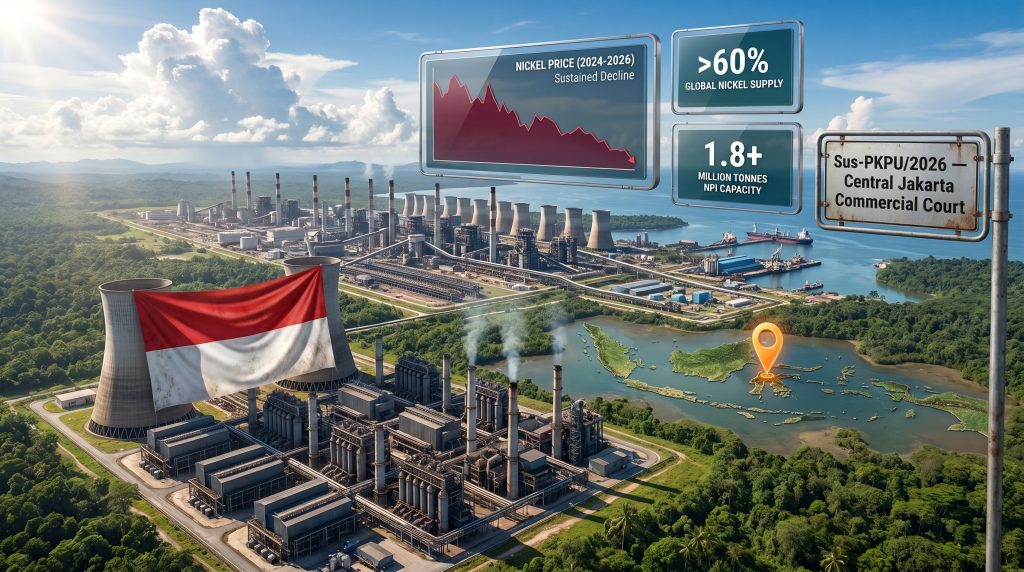
The industrial logic that powered Indonesia's rise to global nickel dominance was straightforward: Chinese capital, Chinese technology, and abundant domestic ore reserves would combine to create a vertically integrated processing powerhouse. For a time, it worked. Indonesia now accounts for more than 60% of global nickel supply, a staggering share that reshaped pricing dynamics across the entire battery metals and stainless steel supply chain. However, the conditions that made rapid expansion possible, namely cheap financing, accessible ore, and rising nickel prices, have all deteriorated simultaneously. The result is a structural reckoning, and the PT Gunbuster Nickel debt halt is its most visible symptom.
When big ASX news breaks, our subscribers know first
What the PKPU Process Actually Means for PT Gunbuster Nickel
When the Central Jakarta Commercial Court issued its PKPU ruling on June 19, 2026 (case number Sus-PKPU/2026), it triggered a legal mechanism that is frequently misunderstood outside Indonesian commercial law circles. PKPU, which stands for Penundaan Kewajiban Pembayaran Utang, translates literally as a suspension of debt payment obligations. Critically, this is not a bankruptcy declaration.
PKPU functions as a court-supervised breathing space. The debtor retains control of operations while creditor claims are temporarily frozen, allowing both sides to negotiate a restructuring agreement without the threat of immediate asset seizure.
The process operates in two phases. The first is a temporary suspension, which provides immediate creditor protection and buys time for negotiation. The second phase either produces a binding restructuring agreement or, if creditors reject any proposed settlement, results in the debtor being declared bankrupt and subjected to court-supervised liquidation. The stakes at each phase are therefore materially different.
What makes the GNI filing particularly significant is that it was creditor-initiated, not debtor-initiated. The application was lodged by two logistics and shipping companies: PT Pancaran Karya Shipping and PT Pancaran Maritim Transportindo. This distinction matters considerably. When suppliers rather than the debtor itself trigger PKPU proceedings, it signals that payment failures have already cascaded far enough down the supply chain to compel external legal action. Furthermore, the identity of the petitioners, both operating in maritime logistics, reveals that GNI's payment defaults had penetrated its transportation and raw material delivery infrastructure well before the court filing became public. For additional context on the scale of this development, reporting on the major Indonesian nickel smelter's court-ordered debt halt provides further detail on the timeline of events.
The Operational Reality Behind the Corporate Communications
GNI's official position maintained that production was proceeding with routine line adjustments. Industry intelligence, however, painted a substantially different picture. Of the facility's 24 production lines, which at full capacity can output more than 1.8 million tonnes per year of nickel pig iron (NPI), the clear majority appear to have been suspended, with only a small number remaining active at the time of the court ruling.
The divergence between official corporate communications and third-party operational data is a pattern that repeats throughout industrial distress cycles. Supply chain counterparties and commodity market participants typically receive earlier and more accurate signals than the public record reflects.
The facility itself represents a landmark in Indonesian industrial history. Inaugurated in 2021 under then-President Joko Widodo as a centrepiece of the country's downstream processing ambitions, GNI was conceived as proof that Indonesia could move beyond raw ore exports and capture value at the processing stage. That ambition was real and the facility's scale was genuinely impressive. The problem was that GNI was not built in isolation. It was one of multiple large-scale smelters commissioned within a compressed timeframe, all drawing on the same domestic ore supply and all competing in the same global NPI market.
Three Structural Pressures That Converged on GNI
The PT Gunbuster Nickel debt halt cannot be attributed to a single operational failure. It reflects the convergence of three distinct structural pressures, each serious in isolation, and collectively overwhelming in combination. These pressures also illustrate the broader Indonesian nickel industry challenges that extend well beyond any single facility.
| Pressure Factor | Core Dynamic | Consequence for GNI |
|---|---|---|
| Nickel Ore Availability | Domestic Indonesian ore supply constrained relative to processing capacity | Raw material shortfalls, deferred supplier payments |
| Global NPI Price Weakness | Sustained price decline driven by oversupply | Revenue compression across all active production lines |
| Parent Company Distress | Jiangsu Delong Nickel Industry undergoing debt restructuring in China | Capital flow disruption, loss of affiliate financial support |
The Ore Supply Constraint: A Structural Deficit Hidden in Plain Sight
One of the least-discussed dynamics behind Indonesia's nickel processing boom is the paradox of ore scarcity within a resource-rich nation. Indonesia sits atop some of the world's most extensive nickel laterite deposits, yet the pace of smelter commissioning has significantly outrun the rate at which new mining areas can be permitted, developed, and brought into consistent production.
Nickel laterite deposits, which dominate Indonesian geology, are classified primarily as either saprolite (higher nickel grade, suitable for NPI production) or limonite (lower grade, more suited to hydrometallurgical processing for battery-grade nickel sulphate). NPI smelters like GNI require saprolite feed, and competition for quality saprolite ore among the growing number of smelters has intensified meaningfully. When ore procurement becomes unreliable, furnace utilisation rates drop, unit costs rise, and cash flow positions deteriorate in a compounding sequence.
The NPI Price Collapse and Its Feedback Loop
NPI is a lower-purity ferronickel product used predominantly by stainless steel producers in China. Its price is closely correlated with London Metal Exchange nickel benchmarks but trades at a discount reflecting its lower nickel content, typically ranging from 10% to 15% nickel by weight. Consequently, when LME nickel prices collapsed from their 2022 highs, NPI prices followed, and Indonesian producers operating at high fixed costs found their margins compressed to levels that rendered many operations economically marginal.
The self-reinforcing nature of this dynamic deserves emphasis. Indonesian smelters collectively produce so much NPI that their own output exerts downward pressure on the prices they receive. Understanding the current nickel price market trends is therefore essential for anyone assessing the viability of Indonesian NPI operations. By expanding aggressively, the sector effectively undermined its own revenue base.
The Jiangsu Delong Contagion: Cross-Border Corporate Risk
GNI's corporate relationship with Jiangsu Delong Nickel Industry, one of China's major nickel conglomerates, introduced a cross-border vulnerability that is easy to overlook when assessing a facility's standalone operational metrics. Jiangsu Delong itself entered debt restructuring proceedings in China, creating a situation where the parent entity could no longer serve as a reliable source of liquidity or credit support for its Indonesian subsidiary.
This is a pattern that carries broader implications for Chinese investment in Indonesia nickel processing ventures across Southeast Asia. When a Chinese parent company faces financial stress, its ability to support offshore operating subsidiaries is constrained by its own restructuring obligations, capital controls, and creditor restrictions. The operating subsidiary then faces a dual challenge: managing its own commercial difficulties while simultaneously losing access to the capital buffer that parent company support had historically provided.
Danantara and the Sovereign Rescue Scenario
Indonesia's sovereign wealth fund, Danantara, has emerged as a prospective acquirer of GNI's assets. Reported figures suggest that the fund has considered an acquisition framework potentially reaching $20 billion, alongside a $60 million syndicated loan designed to maintain operational liquidity through any ownership transition period. Indonesia's Ministry of Industry reportedly indicated that financing structures could be finalised by mid-August 2025, though the acquisition process remained incomplete and its timeline uncertain as of the PKPU filing date.
It is important to note that until any acquisition is formally concluded, GNI remains a subsidiary of Jiangsu Delong. The Danantara scenario represents a potential pathway, not a confirmed resolution. Investors and counterparties should therefore treat the acquisition narrative as one of several possible outcomes rather than a base case.
The three scenarios facing GNI can be summarised as follows:
- Successful PKPU restructuring – creditors accept a negotiated settlement, liquidity is restored, and production lines are progressively restarted.
- Danantara acquisition and sovereign continuity – Indonesia's sovereign wealth fund completes a purchase, injecting the capital needed to stabilise operations and honour supply chain obligations.
- Operational wind-down and liquidation – no restructuring agreement or acquisition is reached within the PKPU timeframe, triggering court-supervised bankruptcy and raising significant environmental reclamation liability concerns.
An unmanaged closure at GNI's scale would represent one of the most consequential industrial wind-downs in Indonesian mining history, with environmental, employment, and sovereign investment credibility implications that extend well beyond the facility itself.
What the GNI Debt Halt Signals for Global Nickel Markets
From a market perspective, a sustained curtailment of GNI's production capacity removes a meaningful volume of NPI from the global supply picture. Given Indonesia's greater than 60% share of global nickel supply, any significant reduction in output from a facility of GNI's scale has the potential to provide at least temporary price support for NPI and, by extension, for LME nickel benchmarks. In addition, the role of Indonesian nickel in the energy transition means that disruptions at this scale carry implications far beyond stainless steel markets.
Steel mills in China that rely on Indonesian NPI for stainless steel production will be reassessing procurement strategies. Diversification of NPI supply sources, alternative ferronickel suppliers, or acceleration of battery-grade nickel sulphate adoption could all feature in procurement team responses over the medium term. Analysis from The Oregon Group on the shutdown risks at one of Indonesia's largest nickel smelters underscores just how consequential any sustained production halt could be for global supply chains.
The longer-term structural implication is arguably more important. The PT Gunbuster Nickel debt halt tests the thesis that Indonesia's downstream processing mandate is commercially sustainable at current price levels and ore availability. If the Danantara acquisition proceeds, it signals a shift toward greater state involvement in managing distressed critical minerals assets. If it does not, the resulting precedent could materially affect foreign investor appetite for future Indonesian smelter projects. Furthermore, the nickel market recovery outlook will hinge significantly on how swiftly these structural imbalances are addressed.
The concentration of Chinese capital across Indonesian nickel processing infrastructure is now clearly a vulnerability rather than just a strength. GNI's difficulties demonstrate that parent company instability in China can propagate to Indonesian subsidiaries with limited warning and limited ability for local management to intercept the financial deterioration before it reaches a legal threshold.
The next major ASX story will hit our subscribers first
Key Takeaways for Investors and Market Participants
- The PT Gunbuster Nickel debt halt is a systemic indicator, not an isolated corporate event, reflecting overcapacity, ore scarcity, and cross-border capital dependency risks embedded throughout Indonesia's nickel sector.
- PKPU protection does not guarantee survival. The outcome hinges on whether creditors, the parent company, and potential acquirers can align on a restructuring framework within the court's timeframe.
- The NPI price environment remains structurally challenged by Indonesia's own production expansion, creating a negative feedback loop for producers operating at high fixed costs.
- Saprolite ore quality and availability is a critical but underappreciated variable in assessing the viability of individual Indonesian NPI operations.
- The Danantara acquisition pathway, if realised, would represent a significant shift in how Indonesia approaches distressed assets in its critical minerals sector, with implications for sovereign risk assessment and future foreign investment structures.
- Environmental reclamation obligations at large-scale laterite nickel processing facilities represent a material contingent liability in any wind-down scenario, one that regulators and civil society will scrutinise closely given the industrial footprint involved.
This article is intended for informational purposes only and does not constitute financial or investment advice. Forward-looking statements, scenario projections, and market assessments involve inherent uncertainty and should not be relied upon as predictions of future outcomes. Readers are encouraged to conduct independent research and consult qualified advisors before making investment decisions. For additional context on Indonesia's nickel industry and global battery metals market dynamics, readers may find value in reviewing reporting available through Mining Weekly at miningweekly.com.
Want to Stay Ahead of the Next Major Mineral Discovery Before the Market Moves?
Discovery Alert's proprietary Discovery IQ model delivers real-time alerts on significant ASX mineral discoveries, instantly translating complex mineral data into actionable opportunities for both short-term traders and long-term investors — explore Discovery Alert's discoveries page to see the historic returns major discoveries have generated, and begin your 14-day free trial to position yourself ahead of the broader market.