May 9, 2026
Syria's public revenue surge represents a remarkable economic transformation as Mediterranean exploration unlocks massive untapped hydrocarbon reserves across the Levant. Complex geological formations beneath territorial waters contain an estimated 1,200 billion cubic meters of natural gas, fundamentally reshaping supply dynamics that have constrained Middle Eastern economies for decades. This offshore potential represents a paradigm shift from traditional onshore extraction models, requiring sophisticated deepwater technologies and international partnerships to monetize reserves previously considered economically unviable.
The convergence of post-conflict reconstruction financing, institutional capacity building, and hydrocarbon revenue optimization creates unique market conditions rarely observed in emerging economies. Unlike conventional recovery models that rely heavily on external assistance, this transformation demonstrates how resource-rich nations can achieve fiscal independence through strategic sector diversification and administrative modernisation.
Understanding Syria's Fiscal Revolution: From Deficit to Surplus
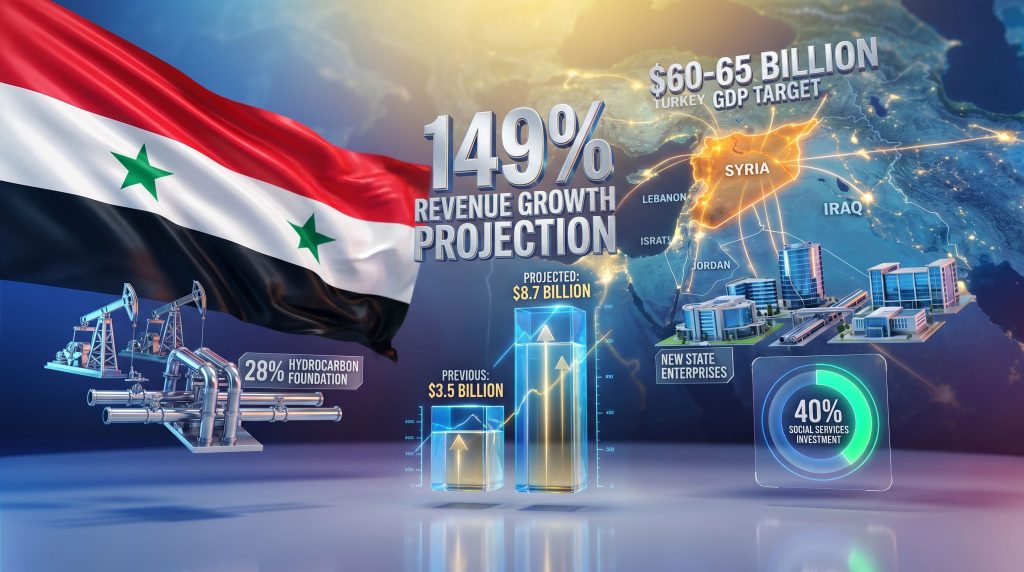
Economic recovery patterns in the Middle East reveal extraordinary fiscal momentum as Syria's public revenue surge 2026 reaches unprecedented levels. The government projects public revenues of $8.7 billion in 2026, representing a remarkable 149 percent increase from the $3.5 billion recorded in 2025. This expansion follows an already impressive annual growth rate of 120.2 percent achieved in 2025 compared to 2024 baseline figures.
The achievement of fiscal discipline during reconstruction represents a fundamental departure from typical post-conflict spending patterns. Syria recorded its first budget surplus since 1990, calculating at 0.15 percent of GDP in 2025, whilst simultaneously expanding public spending from $3.45 billion in 2025 to a projected $10.5 billion in 2026. This represents an annual spending increase of approximately 205 percent, demonstrating sophisticated revenue-to-expenditure management.
Analysing the Revenue Growth Trajectory
The mathematical progression of Syria's fiscal expansion reveals structural transformation beyond simple commodity price appreciation. Starting from a $32 billion GDP in 2024, the economy expanded to $45 billion in 2025, representing 40.6 percent growth. The projected 2026 GDP range of $60-65 billion implies continued robust expansion of 33.3 to 44.4 percent from the 2025 baseline.
| Economic Indicator | 2024 | 2025 | 2026 Projection |
|---|---|---|---|
| GDP (USD Billion) | $32 | $45 | $60-65 |
| Public Revenue | – | $3.5B | $8.7B |
| Budget Size | – | $3.45B | $10.5B |
| Revenue Growth Rate | – | 120.2% | 149% |
| Budget Surplus/GDP | – | 0.15% | Projected Positive |
Finance Minister Mohammed Yasser Barnieh's attribution of revenue increases to improvements in oil and gas earnings reflects broader sector revitalisation. However, the achievement of budget surplus concurrent with massive spending expansion indicates comprehensive administrative efficiency improvements across customs collection, border security, and public enterprise management.
The First Budget Surplus Since 1990: Structural Reform Impact
The 0.15 percent GDP surplus achievement during 2025 represents more than accounting precision; it demonstrates institutional capacity for fiscal restraint during reconstruction pressures. This surplus occurred whilst expanding government spending significantly, indicating revenue collection improvements outpaced expenditure growth through administrative modernisation rather than austerity measures.
International Monetary Fund verification in February 2026 confirmed Syrian economic recovery indicators, noting clear signs of progress with notable inflation slowdown and small public budget surplus. The IMF described these developments as reflecting improved management of fiscal and monetary policies, providing external validation of domestic financial management capabilities.
"The fiscal transformation from decades of deficit spending to surplus generation whilst expanding reconstruction expenditure demonstrates sophisticated economic management during transition periods."
When big ASX news breaks, our subscribers know first
What Economic Sectors Are Fuelling Syria's Revenue Surge?
Revenue diversification beyond traditional hydrocarbon dependency characterises Syria's economic recovery model. Oil and gas constitute approximately 28 percent of projected 2026 revenues, totalling roughly $2.44 billion in hydrocarbon income. This structure means 72 percent of revenues derive from non-hydrocarbon sources, representing approximately $6.26 billion generated through customs, trade, mining industry evolution, utilities, and services sectors.
Oil and Gas: The Strategic Foundation
Mediterranean offshore exploration represents the cornerstone of Syria's energy sector revival. Energy Minister Mohammed Al-Bashir's assessment indicates 1,200 billion cubic meters of offshore gas reserves, with substantial unexplored areas remaining across Syrian territorial waters. Syrian Petroleum Company CEO Youssef Qablawi emphasised that less than one-third of Syrian territory has undergone exploration, with extensive areas lacking any exploration wells.
Current production constraints reflect exploration gaps rather than resource limitations. The government's strategic approach involves attracting international energy companies through licensing agreements, joint ventures, and production-sharing contracts. Recent partnerships with Saudi Arabia's ADES Holding target 25-50 percent increases in gas production within the first operational year through existing well maintenance and new drilling programmes.
Key International Energy Partnerships:
• ADES Holding (Saudi Arabia): Well maintenance and new exploration drilling
• Chevron and Qatar Power International: Territorial waters exploration agreements
• ConocoPhillips and Novatera: Gas sector development and production expansion
• Dana Gas (UAE): Strategic field redevelopment and expansion projects
• Ongoing negotiations with Eni, BP, plus Russian and Chinese companies
Revenue Diversification Beyond Hydrocarbons
The 72 percent non-hydrocarbon revenue contribution demonstrates Syria's economic base extends far beyond energy extraction. This diversification includes restored customs collection through improved border security, anti-smuggling enforcement, regional trade corridor reopening, and commercialisation of previously subsidised utilities.
Border control improvements enable enhanced customs revenue collection as regional trade networks normalise. The restoration of Levantine commerce routes connecting Syria with neighbouring markets generates transaction fees, import duties, and transit revenues that contribute substantially to the $6.26 billion non-hydrocarbon income.
Electricity and water sector commercialisation transforms previously subsidised services into revenue-generating enterprises. Rather than draining government budgets through operational subsidies, these sectors now contribute positive cash flows through customer billing, infrastructure usage fees, and operational efficiency improvements.
How Do Syria's New State-Owned Enterprises Reshape Market Dynamics?
Institutional restructuring through specialised state-owned enterprises represents a fundamental shift from direct government management toward corporatised operational models. President Ahmed Al-Sharaa issued three presidential decrees establishing the Syrian Mining Company, Syrian Electricity Company, and General Establishment for Drinking Water and Sanitation as independent entities with separate financial and administrative structures.
Mining Sector Institutionalisation
The Syrian Mining Company operates as a financially and administratively independent entity, enabling commercial operations separate from government budget constraints. This structure permits mineral exploration trends licensing, international joint ventures, and revenue generation through concession agreements whilst maintaining state ownership and strategic control.
Syria's critical minerals energy transition potential remains largely untapped due to conflict-related exploration disruptions. The institutionalisation of mining operations through dedicated enterprise management enables systematic resource assessment, licensing framework development, and international partnership cultivation for extraction technology and capital investment.
Mining Company Operational Advantages:
• Independent procurement and contracting capabilities
• Separate profit-and-loss accounting systems
• Licensing authority for mineral exploration agreements
• Revenue retention for operational reinvestment
• International partnership development autonomy
Electricity and Water Infrastructure Commercialisation
The Syrian Electricity Company functions as a public holding company of economic nature, fully owned by the state but operating with commercial management principles. This hybrid structure enables utility billing, infrastructure investment, maintenance planning, and service expansion without direct government budget dependency.
Similarly, the General Establishment for Drinking Water and Sanitation transforms water services from subsidised government provision into sustainable utility operations. Commercial utility management enables infrastructure maintenance financing, service quality improvements, and system expansion through customer revenue rather than government appropriations.
These entities report to the Minister of Energy with headquarters in Damascus, maintaining governmental oversight whilst operating with commercial flexibility. This governance model balances state strategic control with operational efficiency requirements for sustainable service delivery.
What Does Syria's $10.5 Billion Budget Allocation Reveal About Priorities?
Budgetary allocation patterns demonstrate government prioritisation of human capital development and infrastructure reconstruction as dual foundations for economic recovery. The $10.5 billion 2026 budget represents a 205 percent increase from the $3.45 billion 2025 allocation, indicating massive public investment scaling during the reconstruction phase.
Social Services and Human Capital Investment
Healthcare and education infrastructure reconstruction receives substantial budgetary emphasis, with social services commanding significant allocation percentages. Public sector salary increases of 50 percent baseline with premium adjustments signal government commitment to retaining professional administrative capacity and attracting qualified personnel during institutional rebuilding.
The integration of salary improvements with expanded service delivery creates multiplier effects throughout the domestic economy. Government employees with increased purchasing power stimulate local consumption whilst expanded healthcare and education services improve human capital quality for long-term productivity gains.
Social Services Investment Framework:
• Healthcare facility reconstruction and equipment modernisation
• Educational infrastructure rehabilitation and capacity expansion
• Public sector compensation restructuring for talent retention
• Social assistance programmes for vulnerable populations
• Professional development and training initiatives
Infrastructure Reconstruction Strategy
The $3 billion infrastructure support fund represents 28.6 percent of the total budget, targeting war-damaged regions including Deir al-Zor, Hasaka, and Raqqa provinces. This geographic prioritisation indicates data-driven assessment of reconstruction needs rather than equal national distribution, suggesting government analysis identified these areas as requiring concentrated investment for economic normalisation.
Transportation network rehabilitation, utility system restoration, and communication infrastructure rebuilding create foundations for private sector economic activity. Rather than direct economic production, infrastructure investment enables commerce, manufacturing, and service sector development through improved connectivity and reliable utilities.
The provincial targeting approach recognises differential war damage impacts across Syrian territory. By concentrating reconstruction resources in the most affected areas, the government maximises economic restoration efficiency whilst addressing regional inequality concerns that could undermine national cohesion.
How Does Syria's GDP Recovery Compare to Regional Benchmarks?
Syria's projected GDP expansion from $32 billion (2024) to $60-65 billion (2026) represents cumulative growth of 87.5 to 103 percent over two years. This trajectory, if sustained, would restore pre-conflict economic output levels significantly faster than typical post-war recovery patterns observed in comparable regional contexts.
Economic Growth Velocity Analysis
The 40.6 percent growth achieved between 2024 and 2025 followed by projected 33.3 to 44.4 percent growth in 2026 demonstrates sustained momentum rather than one-time recovery effects. This velocity suggests fundamental economic restructuring beyond simple reconstruction activity.
Historical comparison with Iraq's post-2003 recovery and Libya's post-2011 economic patterns reveals Syria's trajectory as exceptionally rapid. Whilst both Iraq and Libya experienced initial GDP rebounds following conflict resolution, neither sustained growth rates above 30 percent annually for consecutive years whilst achieving fiscal surplus simultaneously.
Regional Recovery Comparison:
| Country | Peak Annual Growth | Surplus Achievement | Timeline to Pre-War GDP |
|---|---|---|---|
| Syria (2024-26) | 40.6% (2025) | Year 2 (2025) | Projected 3-4 years |
| Iraq (2003-07) | 35% (2004) | Year 7 (2010) | 6-8 years |
| Libya (2011-15) | 104% (2012) | Year 5 (2016) | 4-5 years |
Pre-2010 Economic Baseline Restoration
Syria's pre-conflict GDP peaked at approximately $64 billion in 2010 before declining dramatically during 2011-2021. The projected 2026 range of $60-65 billion suggests restoration to pre-war economic output within 15 years of conflict initiation, comparable to successful post-conflict recoveries but achieved through different mechanisms.
Unlike reconstruction models dependent on external assistance, Syria's recovery relies primarily on hydrocarbon revenue optimisation and institutional efficiency improvements. This domestic resource mobilisation reduces external dependency whilst enabling more rapid scaling of government services and infrastructure investment.
The 10 percent projected growth rate for 2026 indicates stabilisation toward sustainable expansion patterns following the initial rapid recovery phase. This moderation suggests realistic expectations for maintaining growth momentum without unsustainable acceleration that could trigger inflationary pressures or resource misallocation.
What International Energy Partnerships Drive Syria's Oil Sector Revival?
Strategic partnerships with global energy corporations provide essential technology, capital, and operational expertise for Syria's hydrocarbon sector modernisation. The diversity of international partnerships spanning Saudi, American, Qatari, European, Russian, and Chinese companies reflects Syria's non-aligned approach to energy development during reconstruction.
Strategic Alliances with Regional and Global Players
ADES Holding's partnership with Syrian Petroleum Company targets immediate production improvements through existing well maintenance and new exploration drilling. The projected 25-50 percent production increases within 12 months demonstrate achievable short-term gains from infrastructure rehabilitation rather than long-term field development.
Chevron and Qatar Power International's territorial waters exploration agreement scheduled to commence within two months represents significant deepwater expertise application to Syria's offshore potential. This partnership combines American drilling technology with Qatari financing capabilities for complex Mediterranean exploration projects.
International Partnership Portfolio:
• ADES Holding (Saudi): Immediate production optimisation and drilling expansion
• Chevron-Qatar Power: Offshore territorial waters exploration and development
• ConocoPhillips-Novatera: Gas sector development and field expansion
• Dana Gas (UAE): Strategic field redevelopment and production enhancement
• Eni (Italy): Ongoing technology transfer and exploration discussions
• BP (UK): London-based negotiations for potential involvement
• Russian/Chinese Companies: Investment discussions amid Western sanctions
Geopolitical Energy Positioning
Syria's openness to Russian and Chinese investment reflects pragmatic resource development strategy despite Western sanctions constraints. This approach enables technology access and capital investment from multiple sources whilst avoiding exclusive dependence on any single geopolitical bloc.
The Mediterranean positioning provides potential export access to European markets through Turkish pipeline infrastructure, creating strategic value for natural gas production beyond domestic consumption. This export potential enhances project economics for international partners whilst generating foreign currency revenues for Syria's economic reconstruction.
Regional energy security implications extend beyond Syria's domestic needs. Natural gas production from Syrian fields could reduce regional import dependency on distant suppliers, strengthening Levantine energy security whilst generating transit revenues through pipeline infrastructure development.
The next major ASX story will hit our subscribers first
Can Syria Sustain This Growth Trajectory Through 2027?
Sustainability analysis reveals both substantial opportunities and significant risks facing Syria's economic recovery momentum. The fiscal achievements of 2025-2026 provide strong foundations, but maintaining 149 percent revenue growth rates requires continued institutional strengthening and international partnership expansion.
Risk Factors and Economic Vulnerabilities
Informal Economy Integration Challenges: Substantial portions of Syrian economic activity remain outside formal measurement and taxation systems. Integrating informal commerce, services, and remittances into official statistics and revenue collection presents both opportunities and administrative complexities.
International Sanctions Impact: Banking sector constraints and investment flow limitations from Western sanctions affect capital access for large-scale infrastructure projects. Alternative financing mechanisms through regional partners partially offset these constraints but may increase dependency risks.
Security Situation Dependencies: Economic growth sustainability requires continued stability for infrastructure operation, international partnership implementation, and normal commercial activities across Syrian territory.
"Economic vulnerability assessment indicates that Syria's rapid growth depends critically on maintaining institutional capacity whilst scaling operations across previously conflict-affected regions."
Fiscal Sustainability Mechanisms
Revenue diversification beyond hydrocarbons provides crucial stability for government finances during commodity price volatility. The 72 percent non-hydrocarbon revenue base reduces exposure to oil price dynamics whilst creating multiple revenue streams from customs, utilities, mining, and services sectors.
External financing requirements for major infrastructure reconstruction may necessitate international lending arrangements or development partnerships. IMF engagement prospects could provide technical assistance and conditional reform programmes supporting long-term fiscal sustainability.
The planned 2027 budget preparation beginning in May 2026 with parliamentary discussion in the final quarter demonstrates institutional development toward democratic budget processes and multi-year fiscal planning capabilities.
What Does Syria's Recovery Mean for Middle East Energy Markets?
Syria's economic transformation carries significant implications for regional energy supply chains, trade networks, and investment flows across the Middle East. The combination of hydrocarbon production revival, infrastructure modernisation, and institutional capacity building creates new economic relationships within Levantine markets.
Regional Supply Chain Integration
Natural gas export potential through Turkish pipeline infrastructure could reshape Mediterranean energy markets by providing alternative supply sources to European consumers. Syria's offshore reserves offer proximity advantages compared to distant suppliers whilst generating substantial foreign currency revenues.
Cross-border electricity grid connections with neighbouring countries enable energy trading relationships that optimise regional power generation efficiency. Syria's electricity sector reconstruction creates opportunities for both importing power during peak demand and exporting surplus capacity during favourable production periods.
Regional Integration Opportunities:
• Natural gas pipeline development for European export markets
• Refined petroleum product distribution networks across Levantine markets
• Cross-border electricity grid integration with Turkey, Lebanon, Jordan
• Transit corridor restoration for regional trade facilitation
• Joint infrastructure projects with neighbouring economies
Investment Climate Transformation
Regulatory framework modernisation attracts international companies seeking stable operational environments with transparent licensing procedures. Property rights protection, contract enforcement mechanisms, and dispute resolution improvements create foundations for sustained foreign direct investment beyond energy sectors.
Currency stability measures and exchange rate management become increasingly important as economic integration deepens with regional and global markets. The achievement of fiscal surplus provides government capacity for maintaining monetary stability during reconstruction spending.
Banking sector development enables international financial transactions, project financing, and trade settlement mechanisms necessary for expanded economic relationships. Improved financial infrastructure supports both domestic economic growth and regional commercial integration.
Syria's Economic Renaissance: Long-Term Structural Transformation
The convergence of fiscal discipline, institutional modernisation, and international partnership development positions Syria for sustained economic transformation beyond immediate reconstruction needs. The achievement of budget surplus whilst expanding public services demonstrates governance capabilities necessary for long-term development planning.
Economic Diversification Strategy
Moving beyond hydrocarbon dependency requires continued expansion of manufacturing, services, agriculture, and technology sectors. The 72 percent non-hydrocarbon revenue base provides foundations for further diversification through targeted investment in emerging industries and export-oriented production.
Regional economic integration through restored trade relationships, transportation connectivity, and financial linkages creates market access opportunities for Syrian businesses whilst attracting foreign investment in productive sectors beyond energy extraction.
Structural Transformation Indicators:
• Institutional capacity building through specialised state-owned enterprises
• Regulatory framework modernisation for international business operations
• Infrastructure investment enabling private sector development
• Human capital development through education and healthcare expansion
• Financial sector strengthening for domestic and international transactions
Forward Planning and Democratic Governance
The implementation of multi-year fiscal planning beginning with 2027 budget preparations demonstrates institutional sophistication beyond immediate crisis management. Parliamentary oversight and democratic budget approval processes strengthen governance legitimacy whilst ensuring public accountability for resource allocation decisions.
Economic policy coordination with reconstruction priorities requires balancing immediate infrastructure needs against long-term development investments. The government's ability to maintain fiscal surplus whilst expanding services indicates sophisticated understanding of sustainable development principles.
Furthermore, the Syria public revenue surge 2026 represents a unique model of post-conflict development that emphasises domestic resource mobilisation, institutional efficiency, and diversified international partnerships. The sustainability of this trajectory depends on continued governance improvements, regional stability maintenance, and successful integration of informal economic activities into formal institutional frameworks.
Additionally, the government has attracted significant attention from exploration licenses impact assessments as regional powers monitor Syria's success in converting resource potential into sustainable economic growth. International observers note that Syria's fiscal transformation has implications for Syria's 2026 economic outlook in terms of budget management and development priorities.
Disclaimer: This analysis is based on government projections and economic data that are subject to change based on regional developments, international relations, and implementation challenges. Economic forecasts involve uncertainties and should be evaluated in conjunction with ongoing political and security conditions.
As regional energy markets evolve, Syria's contribution to Mediterranean supply security and Levantine economic integration could significantly influence Middle Eastern economic relationships through 2027 and beyond. The remarkable achievement of the Syria public revenue surge 2026 demonstrates that post-conflict economies can achieve rapid fiscal transformation through strategic resource management and institutional reform.
Exploring Opportunities in Energy and Mining Discovery?
Discovery Alert's proprietary Discovery IQ model delivers real-time alerts on significant ASX mineral and energy discoveries, instantly empowering subscribers to identify actionable opportunities ahead of the broader market. Understand why historic discoveries can generate substantial returns by visiting Discovery Alert's dedicated discoveries page, showcasing exceptional market outcomes from major resource finds.