June 3, 2026
The Architecture of Russia's LNG Retreat: What Happens When Western Capital Leaves the Arctic
Global LNG markets are not simply shaped by supply and demand curves. They are shaped by the legal frameworks, geopolitical relationships, and ownership architectures that determine who controls the infrastructure, who can access the finance, and who is permitted to sell to whom. Few case studies illustrate this more starkly than the ongoing transformation of Russia's Arctic LNG 2 project, where Putin approves TotalEnergies exit from Arctic LNG 2 project through a presidential decree that reveals far more about Russia's strategic trajectory than any single production statistic.
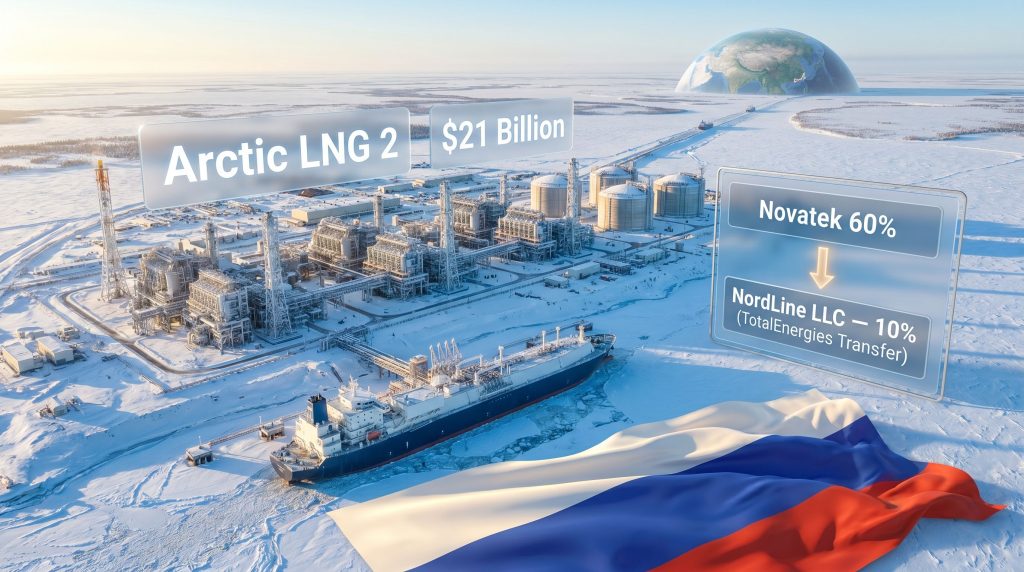
The decision to authorise the transfer of TotalEnergies' interest to NordLine LLC, a subsidiary newly established under Novatek's corporate umbrella, is not a commercial headline. It is a structural signal: Russia is consolidating domestic ownership over its flagship LNG export infrastructure at precisely the moment when Western capital has been rendered inoperable by sanctions, and when European demand is scheduled to disappear entirely by 2027. Understanding the broader LNG supply outlook helps contextualise why this matters so deeply for global energy markets.
When big ASX news breaks, our subscribers know first
Arctic LNG 2: Scale, Ownership, and Original Strategic Logic
To understand the significance of this ownership transfer, it is necessary to first understand what Arctic LNG 2 was originally designed to be. The project was conceived as a three-train liquefaction facility with a total nameplate capacity of approximately 19.8 million tonnes per annum (mtpa), divided into three trains of roughly 6.6 mtpa each. At full operational capacity, this would place Arctic LNG 2 among the largest single LNG export projects in the world, comparable in scale to major Australian facilities.
Capital expenditure estimates have ranged between $21 billion and $25 billion, making it one of the most expensive energy infrastructure projects ever undertaken in Russia. According to TotalEnergies' own project documentation, Novatek reached final investment decision in 2019, with plateau production originally targeted for the mid-2020s.
The ownership structure that underpinned this investment was deliberately designed to distribute geopolitical and financial risk across multiple jurisdictions:
| Shareholder | Stake | Country/Region |
|---|---|---|
| Novatek | 60% | Russia |
| TotalEnergies | 10% | France / Western Europe |
| CNPC (China National Petroleum Corp) | 10% | China |
| CNOOC (China National Offshore Oil Corp) | 10% | China |
| Mitsui / JOGMEC Consortium | 10% | Japan |
This multilateral structure was not accidental. By securing Chinese and Japanese equity participation alongside a major European energy company, Novatek was able to underwrite the project's financing, establish offtake commitments across multiple Asian markets, and gain access to Western liquefaction technology. The design reflected a period when Russian energy projects could still credibly attract international capital on commercial terms.
How Was Arctic LNG 2 Engineered?
One technically distinctive aspect of Arctic LNG 2 worth understanding is its use of gravity-based structures (GBS) for the liquefaction modules. Unlike conventional land-based LNG facilities, Arctic LNG 2 was engineered to mount its liquefaction trains on large concrete platforms floated into position, reducing the need for permanent onshore infrastructure in permafrost conditions. This construction methodology, while innovative, also introduced significant complexity and required access to specialised engineering capabilities that Western sanctions have since curtailed.
What Putin Approved and Why the Kremlin Mechanism Matters
On 3 June 2026, a presidential decree formally authorised TotalEnergies to transfer its 10% equity stake in Arctic LNG 2 to NordLine LLC. No financial terms were disclosed, raising legitimate questions about the valuation basis of the transfer, particularly given that TotalEnergies had already written down the asset to zero and suspended all revenue recognition from the project.
The financial impairment had already occurred long before the legal transfer. For TotalEnergies, this decree closes an administrative chapter on an asset that had already been treated as economically stranded. The strategic significance lies entirely on Russia's side of the ledger.
The regulatory mechanism itself deserves scrutiny. Under Russian law, the transfer of significant equity stakes in strategic energy assets requires presidential authorisation, a requirement that has created a structural bottleneck for foreign investors seeking clean exits since 2022. Furthermore, Kremlin approvals for major asset transfers have been notably infrequent over the past three years, which makes this decree structurally unusual.
The rarity of such approvals means that TotalEnergies' case could function as a policy precedent, potentially indicating Moscow's willingness to facilitate further foreign exits under specific conditions, particularly where the remaining domestic ownership concentration serves Russia's strategic objectives.
Sanctions Architecture and the Shadow Fleet Reality
The U.S. Treasury's designation of Arctic LNG 2 in late 2023 was designed as a precision instrument: restrict Russia's access to the Western technology, insurance, financing, and shipping infrastructure required to scale LNG exports, without triggering a broader commodity market disruption. The practical effect has been meaningful but incomplete. The broader sanctions on Russian energy have similarly produced mixed results across the sector.
Arctic LNG 2 began delivering cargoes in 2024, but through mechanisms that deliberately circumvent Western sanctions:
- Shipments are transported via non-Western flagged and insured vessels, commonly referred to as the shadow fleet, which operate outside the reach of Western P&I club insurance and flag state oversight
- To date, deliveries have been directed exclusively to a single port in Southern China, reflecting both the limited sanctions-resistant buyer base available to Russia and China's willingness to absorb discounted Arctic LNG
- Production volumes remain well below the 6.6 mtpa capacity of the first train, let alone the 19.8 mtpa total nameplate capacity of the full facility
- Access to Western liquefaction technology and specialised engineering components has been severely constrained, slowing the ramp-up of subsequent trains
The gap between Arctic LNG 2's designed capacity and its actual throughput represents one of the clearest quantifiable demonstrations of how targeted Western sanctions have materially degraded Russia's LNG expansion ambitions. Before sanctions, Novatek had envisioned a combined Yamal LNG and Arctic LNG 2 output approaching 40 mtpa, which would have elevated Russia's share of global LNG trade to near or above 10%.
Comparison: Key Russian LNG Assets Under Current Conditions
| Asset | Sanctions Status | TotalEnergies Position | Primary Market Access |
|---|---|---|---|
| Arctic LNG 2 | U.S.-sanctioned (late 2023) | 10% being transferred to NordLine LLC | China only (shadow fleet) |
| Yamal LNG (~17.4 mtpa capacity) | Not directly sanctioned | Stake retained | Europe and Asia |
| Novatek (equity) | Not directly sanctioned | Equity position retained | Diversified |
TotalEnergies' Residual Russian Exposure: A Portfolio That Cannot Be Cleanly Severed
A critical nuance often lost in reporting on this transfer is that TotalEnergies has not exited Russia. The company retains a stake in Yamal LNG, the predecessor Arctic liquefaction project with a nameplate capacity of approximately 17.4 mtpa that does not carry direct U.S. sanctions. It also holds an equity position in Novatek itself, Russia's dominant independent gas producer and the controlling shareholder of both major Arctic LNG facilities.
This residual exposure places TotalEnergies in a structurally uncomfortable position:
- ESG investor pressure continues to mount, with European institutional investors and sovereign wealth funds applying increasing scrutiny to any retained Russian energy holdings
- EU regulatory trajectory is moving toward comprehensive restrictions on Russian energy, and Yamal LNG's current non-sanctioned status cannot be assumed to be permanent
- Reputational asymmetry means that TotalEnergies' continued involvement in Novatek's equity structure will attract ongoing scrutiny regardless of the Arctic LNG 2 exit
- Kremlin consent requirements mean that further exits from retained Russian positions will require the same presidential approval mechanism that made the Arctic LNG 2 transfer so slow and administratively complex
The financial timeline of this exit also warrants clarity. TotalEnergies recorded impairment charges against its Arctic LNG 2 interest and suspended proved reserve bookings attributable to the project well before the June 2026 presidential decree. Consequently, the formal transfer to NordLine LLC carries minimal immediate balance sheet impact, as the economic loss was absorbed in prior reporting periods.
Russia's Asia Pivot: The Strategic Logic Behind Domestic Consolidation
The ownership transfer cannot be understood in isolation from Russia's broader energy export recalibration. The EU's commitment to ending all Russian gas purchases by 2027 eliminates what was historically Russia's most lucrative and geographically accessible market for both pipeline gas and LNG. This structural demand cliff is forcing a fundamental redesign of Russia's energy export architecture, further compounded by US-China trade war impacts reshaping global energy trade flows.
Moscow's strategic response has two components: consolidate domestic control over flagship export infrastructure, and accelerate offtake agreements with Asian buyers, primarily China, India, and other markets that have demonstrated willingness to absorb Russian energy outside the Western sanctions framework.
By absorbing TotalEnergies' 10% stake into NordLine LLC, Novatek eliminates several friction points that a Western co-investor's continued presence would create:
- Governance constraints: A sanctioned Western co-investor creates legal and operational complications around project decisions, technology procurement, and financial flows
- Reputational exposure for counterparties: Chinese and Japanese offtakers and financiers operating adjacent to a project with active Western co-investors face secondary sanctions risks
- Technology and procurement pathways: Removing the formal Western equity presence may simplify, at the margins, Russia's ability to source alternative technology through non-Western channels
China's role in this equation is both commercially essential and geopolitically deliberate. Beijing's absorption of Arctic LNG 2 cargoes at a single Southern Chinese port reflects a calculated posture: secure access to discounted Russian energy whilst avoiding the reputational exposure of publicly advertising the arrangement. This dynamic is contributing to what analysts increasingly describe as a bifurcated global LNG market, with a sanctions-compliant Western-aligned supply chain operating in parallel with a sanctions-tolerant Russia-China corridor.
The next major ASX story will hit our subscribers first
Global LNG Market Implications: What This Means Beyond Russia
The constraints imposed on Arctic LNG 2 have direct implications for global LNG supply balances. A project designed to contribute nearly 20 mtpa to global LNG supply is instead contributing a fraction of that volume, and exclusively to a single buyer in a single port. In addition, the geopolitical resource risks associated with Arctic energy projects have only intensified as sanctions regimes evolve.
- Alternative LNG suppliers benefit from reduced Russian competition, particularly U.S. Gulf Coast exporters, Qatari mega-trains, and Australian producers who have been expanding capacity to serve European demand
- The EU's accelerated effort to pre-contract alternative LNG supply from the U.S., Qatar, and East Africa reflects a deliberate strategy to ensure the 2027 Russian gas ban does not cause a supply crisis, but the pace of new LNG terminal construction in Europe will determine whether the transition is orderly
- For spot LNG price formation, the persistent under-delivery of Arctic LNG 2 relative to its nameplate capacity provides a subtle but real floor effect, reducing the volume of LNG competing for Asian spot buyers
The geopolitical bifurcation of LNG markets is not a theoretical scenario. It is already observable in Arctic LNG 2's delivery pattern: one project, one buyer country, one port. This is what sanctions-constrained LNG trade looks like in practice.
The Investor Lesson: Exit Risk in Authoritarian Resource Environments
For international energy investors, the multi-year journey from TotalEnergies' 2018 stake acquisition through to the 2026 presidential transfer decree encapsulates a due diligence failure that the industry should treat as a reference case study. The risk that materialised was not simply geopolitical disruption; it was specifically the inability to exit a stranded asset without the consent of a sovereign counterparty whose interests had fundamentally diverged from those of the foreign investor.
However, several structural lessons emerge from this episode that extend well beyond a single transaction, particularly given the broader supply chain disruption risks now confronting international energy companies operating across contested geographies.
- Sovereign exit risk is asymmetric: In Russian law, entering a strategic energy project as a foreign investor is commercially straightforward; exiting requires the Kremlin's permission, and that permission may take years, may come at an unfavourable valuation, or may not come at all
- Impairment does not equal exit: TotalEnergies wrote down Arctic LNG 2 years before it was legally permitted to transfer the asset, meaning the company carried an impaired position on its books without the ability to legally divest
- Shadow fleet exposure creates secondary liability risk: Projects that pivot to sanctions-circumvention mechanisms expose associated parties to secondary sanctions risks, even where those parties have formally suspended participation
- ESG frameworks have not caught up: The retained stakes in Yamal LNG and Novatek equity demonstrate that clean exits from complex multi-asset Russian exposure are structurally difficult, and ESG scoring models have not yet developed adequate frameworks for valuing these residual risks
The headline that Putin approves TotalEnergies exit from Arctic LNG 2 project may read as a resolution, but for the broader class of Western energy companies with residual Russian holdings, it reads as a partial data point in an unresolved story. The Kremlin has shown it can authorise exits when doing so serves Russian consolidation objectives. Whether that authorisation extends to other stranded Western positions remains an open question with material implications for multiple balance sheets across the European energy sector. A comprehensive Oxford Energy analysis of the project underscores just how much uncertainty remains embedded in Arctic LNG 2's long-term commercial trajectory.
Disclaimer: This article contains forward-looking analysis, market projections, and geopolitical assessments that are inherently speculative. Production capacity figures, sanction impacts, and market dynamics are subject to change. Nothing in this article constitutes financial or investment advice. Readers should conduct independent research before making investment decisions.
Want to Identify the Next Major Mineral Discovery Before the Broader Market?
While geopolitical forces reshape global energy infrastructure, Discovery Alert's proprietary Discovery IQ model scans ASX announcements in real time, instantly alerting subscribers to significant mineral discoveries across more than 30 commodities — explore historic discovery returns that demonstrate why early positioning matters, and begin a 14-day free trial at Discovery Alert to secure a market-leading edge.