August 14, 2026
The Eurasian Energy Chessboard: Why Russia Needs This Deal More Than China Does
Global energy markets are undergoing a structural transformation that has been building for decades but accelerated sharply after 2022. The traditional architecture of energy trade, in which Russian gas flowed west into European homes and factories while Middle Eastern crude dominated Asian import portfolios, is fracturing along geopolitical fault lines. What is emerging in its place is a contested Eurasian energy corridor where two very different national interests are negotiating the terms of an interdependence neither country entered into by choice.
The dynamics driving Putin China energy deals are not simply diplomatic theatre. They reflect deep structural forces: a sanctioned Russian economy that has lost its most lucrative export markets, a Chinese industrial complex hungry for energy security, and a Middle Eastern supply chain disrupted by conflict. Understanding who holds leverage in this relationship, and why the pricing deadlock on major infrastructure projects persists, requires looking beyond the summit communiques and into the economic fundamentals beneath them.
When big ASX news breaks, our subscribers know first
Three Forces Accelerating the Moscow–Beijing Energy Axis
The convergence of Russia and China around energy trade did not emerge from shared ideology alone. Three distinct pressures have been compressing the two nations into closer alignment, each reinforcing the other.
First, Western sanctions following Russia's full-scale invasion of Ukraine in 2022 effectively severed Moscow from its most profitable export relationships. European gas revenues, which had historically underwritten a significant portion of Russian state expenditure, collapsed. Russia needed new buyers urgently, and China was the logical destination.
Second, the closure of the Strait of Hormuz has disrupted approximately 20% of global seaborne oil supply, injecting acute energy insecurity into Beijing's planning calculations. Furthermore, China imports heavily from Middle Eastern producers, and any prolonged disruption to Hormuz transit raises the strategic premium on overland supply alternatives that bypass maritime chokepoints entirely. These oil price movements have consequently added urgency to Beijing's search for diversified supply routes.
Third, China's own long-term energy strategy has been moving toward diversification for years. Reducing exposure to any single supply corridor, whether Middle Eastern crude or spot LNG markets, has been a consistent policy priority. Russian pipeline gas, delivered overland through Central Asia, fits theoretically into that diversification framework, even if the commercial terms remain unresolved.
These three forces do not point toward the same conclusion. Russia's urgency is acute and immediate. China's interest is strategic and patient. That asymmetry defines everything about how these negotiations unfold.
What the Power of Siberia Pipeline Sequence Actually Means
Media coverage of Putin China energy deals tends to collapse multiple distinct infrastructure projects into a single narrative, obscuring important differences in status, capacity, and commercial viability. The reality is a three-stage pipeline sequence, each at a different point of development.
| Pipeline | Capacity | Status | Key Date |
|---|---|---|---|
| Power of Siberia 1 | ~38 bcm/year | Operational, at capacity | Reached full capacity 2024–2025 |
| Far East Pipeline | 12 bcm/year | Under development | Operations expected from 2027 |
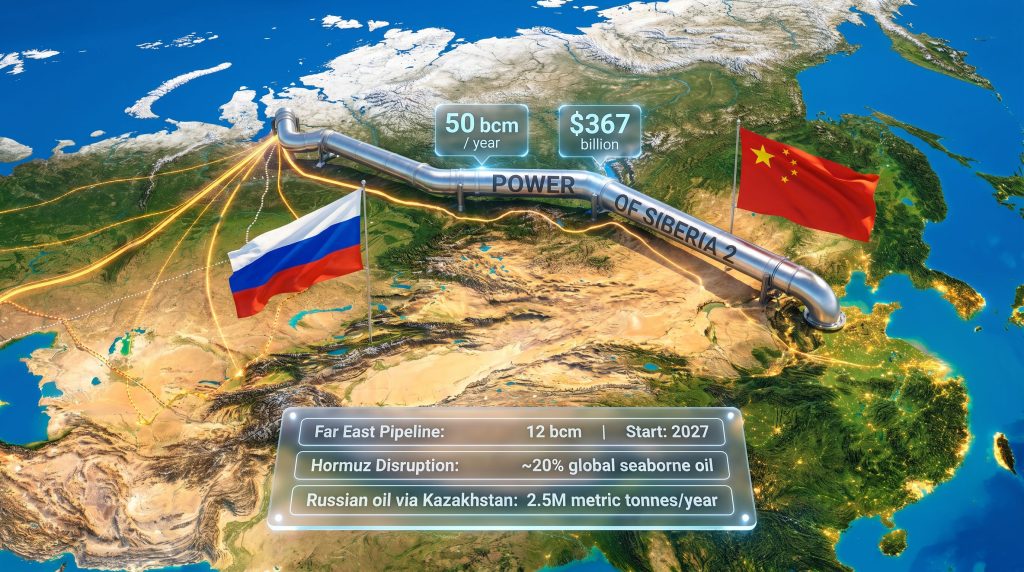
| Power of Siberia 2 | Up to 50 bcm/year | MOU signed; pricing unresolved | No confirmed construction start |
Power of Siberia 1 reached its operational ceiling during 2024–2025, meaning no additional volume can flow through that route without new infrastructure. The Far East pipeline, which would add 12 billion cubic metres of annual capacity, is scheduled to begin operations in 2027 but will ramp up volumes progressively rather than delivering full capacity immediately.
Power of Siberia 2 is the prize that Russia is most eager to secure. The proposed 2,600-kilometre route would carry gas from the Yamal Peninsula in Russia's Arctic north, transit through eastern Mongolia, and terminate in China's northern provinces. At up to 50 bcm per year, it would represent the largest single expansion of Russian gas export capacity eastward. However, a memorandum of understanding is not a contract. Pricing, construction financing, builder selection, and operational timelines all remain unresolved as of mid-2026.
Anne-Sophie Corbeau of Columbia University's Center on Global Energy Policy has noted that the immediate pipeline gas outlook offers limited upside for Russia, with Power of Siberia 1 already full and the Far East pipeline not operational until 2027 at the earliest. This assessment underscores the multi-year gap between Russian ambitions and physical delivery reality. For context, WTI and Brent futures continue to reflect this supply uncertainty across global benchmarks.
Why the Pricing Deadlock Persists
The commercial stalemate over Power of Siberia 2 comes down to a fundamental conflict of interest that neither side can easily resolve:
- Russia requires export pricing that justifies the enormous capital expenditure of building a 2,600-kilometre pipeline through challenging terrain
- China is pushing for pricing structures closer to what Russian consumers pay domestically, a level that would generate minimal margin for Moscow
- No agreement on who finances construction has been publicly confirmed, adding another unresolved layer to negotiations
- Previous memoranda between the two countries have repeatedly failed to progress to binding commercial agreements, establishing a pattern of diplomatic momentum without contractual follow-through
Researchers at institutions including CSIS and the Brookings Institution have consistently observed that signed intent documents between Russia and China on gas trade have historically struggled to translate into enforceable deals, particularly when pricing structures remain contested.
China's Diversification Arsenal: Why Beijing Can Afford to Wait
The most underappreciated dimension of Putin China energy deals is the degree to which China has deliberately constructed a portfolio of alternatives that removes any urgency from its side of the negotiating table. Beijing does not need Power of Siberia 2 to survive an energy crisis. Russia needs Beijing to need it.
China's energy diversification strategy spans five distinct supply categories:
- Pipeline gas from Central Asia: Active supply discussions with Turkmenistan are running in parallel to Russian negotiations, creating direct competitive pressure on Moscow's pricing expectations
- LNG flexibility: China's position as one of the world's largest swing buyers in global LNG markets gives it price optionality that no single pipeline deal can replicate
- Domestic gas production: Continued capital investment in domestic gas output provides a baseline supply buffer independent of any foreign supplier
- Renewable energy scaling: China's rapid expansion of solar, wind, and nuclear capacity is progressively reducing its long-run fossil fuel dependency, shrinking the long-term market that Russia is competing to serve
- Coal bridging capacity: Short-term increases in coal burn have historically absorbed supply gaps during transition periods, buying time without forcing unfavourable import agreements
This multi-vector approach gives Chinese negotiators the luxury of patience. As Michael Kimmage, Director of the Kennan Institute, has pointed out, Russia may be the answer to China's energy security challenge, but it is a slow answer, and potentially too slow if the Middle Eastern conflict resolves within months rather than years. In addition, the broader US-China trade war dynamics further complicate how Beijing prioritises its energy relationships with Moscow.
The Numbers Behind the Partnership: Quantifying Russian Energy Trade
The scale of China–Russia energy trade since the escalation of Western sanctions is substantial enough to reshape global commodity flows, even without Power of Siberia 2 coming online.
| Metric | Figure |
|---|---|
| Chinese fossil fuel purchases from Russia (since Iran war onset) | Over $367 billion |
| Additional Russian oil via Kazakhstan (agreed 2025) | 2.5 million metric tonnes/year |
| Global oil supply disrupted by Hormuz closure | Approximately 20% |
| Power of Siberia 2 annual delivery potential | Up to 50 bcm |
| Far East pipeline annual capacity | 12 bcm |
| Power of Siberia 2 route length | ~2,600 kilometres |
Data from the Centre for Research on Energy and Clean Air places Chinese fossil fuel purchases from Russia at over $367 billion since the onset of the Iran war. This figure captures oil, gas, and coal purchases combined and reflects the systematic deepening of energy trade flows as European buyers withdrew under sanctions pressure.
Russia's agreement in 2025 to supply an additional 2.5 million metric tonnes of oil annually via Kazakhstan represents a parallel effort to diversify transit pathways while expanding overall export volume. The use of Kazakhstan as a routing corridor is strategically significant: it provides Moscow with an alternative to direct border crossings and integrates Kazakhstan more deeply into the Russia-China supply architecture.
The Asymmetry Problem: Russia's Growing Dependence on Beijing
One of the least discussed but most consequential features of the evolving Russia–China relationship is the structural imbalance that has developed since 2022. Pre-invasion, Russia maintained diversified export relationships across European and Asian markets. Post-invasion, European gas revenues collapsed and China became Russia's dominant commercial partner.
Timothy Ash, Associate Fellow at Chatham House, has argued that the Ukraine war has fundamentally altered Russia's strategic positioning relative to China. Moscow has consequently become progressively more dependent on Beijing for trade volumes, investment capital, and diplomatic cover — a dynamic that shifts pricing leverage further toward China with each passing year.
The dual-use trade dimension adds a further layer of complexity. China has emerged as a critical supplier of goods that serve both civilian and military industrial purposes, goods that Western sanctions have made otherwise difficult for Russia to obtain. Western governments have repeatedly raised concerns about Beijing's role in sustaining Russian economic resilience. China maintains it strictly controls dual-use exports and categorically denies supplying lethal military equipment to combatants in Ukraine.
Scenario Modelling: What the Future Holds for Russia–China Energy
| Scenario | Key Driver | Probable Outcome for Russia |
|---|---|---|
| US–China trade normalisation | Tariff reduction; diplomatic thaw | Russia's strategic value to Beijing diminishes; pricing leverage shifts further to China |
| Hormuz crisis resolves quickly | Ceasefire or diplomatic deal | Middle Eastern supply returns; urgency for Power of Siberia 2 drops sharply |
| Ukraine conflict ends within 12 months | Peace negotiations succeed | Western sanctions potentially ease; Russia partially regains European market access |
| Power of Siberia 2 construction begins | Sustained Hormuz closure; pricing compromise | Russia locks in long-term Asian revenue but likely on commercially unfavourable terms |
The scenario most favourable to Russia — prolonged Middle Eastern instability combined with a stagnant US–China relationship — is also the scenario least within Moscow's control. The scenario most damaging to Russia's negotiating position, simultaneous US–China normalisation and a Hormuz resolution, is the one Beijing can credibly threaten to facilitate simply by maintaining its existing diplomatic posture.
The next major ASX story will hit our subscribers first
Global Market Consequences: Three Sectors Watching Closely
LNG Markets and the Swing Buyer Premium
A functioning Power of Siberia 2 would fundamentally alter China's role in global LNG markets. Currently, China's willingness to absorb spot LNG cargoes at various price points provides a price floor that benefits producers in Australia, Qatar, and the United States. If pipeline commitments replace spot LNG purchases, that swing-buyer premium disappears. Australian LNG exporters in particular, already navigating industrial action risks and ageing infrastructure, would face a structural reduction in their largest growth market.
European Energy Strategy
A completed Eurasian overland gas corridor carries a clear geopolitical signal for European energy planners: Russian supply has permanently redirected eastward, and the leverage that European buyers once held over Moscow through purchase volumes no longer exists. This signal, even without physical pipeline completion, strengthens the case for accelerating LNG import terminal capacity across European coastal nations and deepening domestic renewable generation.
Central Asian Transit Geopolitics
Mongolia's role as the designated transit corridor for Power of Siberia 2 introduces a new geopolitical actor into an already complex energy equation. Kazakhstan's expanded oil transit role adds another layer. Furthermore, Turkmenistan's parallel gas negotiations with China create competitive pressure that further erodes Russia's pricing power. The broader picture is a Central Asian energy landscape being actively reshaped, with multiple producers competing for Chinese contract volumes that China is deliberately distributing to maintain leverage over all of them simultaneously. This mirrors the wider geopolitical mining landscape where resource competition is increasingly driven by strategic rather than purely commercial logic.
This is the rarely acknowledged strategic logic behind Beijing's multi-source energy approach: it is not simply about supply security. It is about ensuring that no single supplier, including Russia, ever accumulates enough market share to negotiate from a position of strength.
The 25th Summit and What Diplomatic Symbolism Actually Tells Us
Putin's May 2026 visit to Beijing, his 25th trip to China since first assuming power, coincides with the 25th anniversary of the Sino-Russian Treaty of Friendship signed in 2001. The layering of these symbolic milestones onto substantive energy negotiations is not accidental. Both governments understand the value of demonstrating institutional depth and historical continuity to domestic audiences and international observers alike.
What is analytically interesting is the sequencing. Xi Jinping hosted US President Donald Trump in Beijing the week before receiving Putin. This back-to-back scheduling, far from being logistically coincidental, communicates something precise about China's strategic posture: Beijing is simultaneously managing its most important economic relationship (the United States) and its most important energy-geopolitical relationship (Russia) without subordinating either to the other.
Michael Kimmage of the Kennan Institute has characterised this as a deliberate balancing exercise — a demonstration that Beijing regards itself as occupying a position of sufficient centrality in global affairs to engage both Washington and Moscow on its own terms. Al Jazeera's reporting on the latest Russia-China gas pipeline similarly highlights how these agreements deepen energy ties that extend well beyond any single summit. Consequently, concerns about global recession risks add further pressure on both nations to stabilise their energy revenues amid deteriorating global demand conditions.
Frequently Asked Questions: Putin China Energy Deals
What is the current status of Power of Siberia 2?
As of mid-2026, Russia and China have advanced to a memorandum of understanding stage for the proposed 2,600-kilometre pipeline, which would carry up to 50 bcm of gas annually from the Yamal Peninsula through Mongolia into China. No binding commercial agreement covering pricing, financing, or construction timelines has been confirmed.
Why hasn't China committed to the deal?
China operates without supply urgency. Its diversified energy portfolio spanning domestic production, Central Asian pipeline gas, global LNG markets, coal reserves, and rapidly expanding renewables gives Beijing the negotiating patience to hold out for pricing terms that Russia has so far resisted.
When will Russian gas volumes to China next increase?
The 12 bcm Far East pipeline is scheduled to begin operations in 2027, representing the next incremental capacity increase before any Power of Siberia 2 infrastructure could theoretically come online.
How much Russian energy has China purchased since Western sanctions began?
According to data from the Centre for Research on Energy and Clean Air, China has purchased more than $367 billion worth of Russian fossil fuels since the onset of the Iran war and escalation of Western sanctions.
Is Russia becoming dangerously dependent on China?
Analysts at Chatham House and other institutions have argued that Russia's post-2022 economic trajectory has created a structurally asymmetric relationship — one in which Moscow depends on Beijing for trade, investment, and diplomatic standing to a degree that China does not reciprocate.
Key Takeaways for Investors and Market Watchers
The Russia–China energy relationship is analytically rich but operationally slow-moving. For those tracking its commercial and market implications, the following points warrant close attention:
- The structural asymmetry is the central fact: Russia needs Chinese energy revenues more than China needs Russian supply, and this imbalance shapes every negotiation
- Power of Siberia 2 completion is not inevitable: Multiple signed memoranda have preceded the current one without producing binding agreements, and the pricing gap remains substantial
- LNG market participants should monitor Chinese pipeline commitments closely: Any progression toward construction on Power of Siberia 2 would signal a reduction in China's spot LNG demand with direct consequences for global benchmark pricing
- Central Asian suppliers, particularly Turkmenistan, are the hidden variable: Their parallel negotiations with Beijing create competitive pressure that benefits China and constrains Russia
- The Hormuz crisis timeline matters enormously: A rapid resolution of Middle Eastern conflict would substantially reduce the urgency driving China toward Russian overland alternatives
- European energy planners should treat the permanent eastward redirection of Russian gas as a baseline assumption, regardless of whether Power of Siberia 2 is ever completed
Disclaimer: This article is intended for informational and educational purposes only and does not constitute financial, investment, or trading advice. Forward-looking statements, scenario projections, and market assessments involve inherent uncertainty and should not be relied upon as predictions of future outcomes. Readers should conduct their own independent research before making any investment decisions.
Want to Stay Ahead of the Resource and Energy Shifts Reshaping Global Markets?
Discovery Alert's proprietary Discovery IQ model delivers real-time alerts on significant ASX mineral discoveries, transforming complex commodity and resource data into actionable investment insights — explore historic discoveries and their returns to see what early positioning can mean, then begin your 14-day free trial at Discovery Alert to ensure you never miss a market-moving opportunity.